Loading page, please wait…
Vaidra Logo
Vaidra

Top 4 items + smart groups

UPSC GPT
New
Current Affairs
Daily Solutions
Daily Puzzle
Mains Evaluator

Version 2.0.0 • Built with ❤️ for UPSC aspirants

Loading...
Loading...
Loading...
Loading...
Loading...
Loading...
Loading...
Loading...
Loading...
Loading...
Loading...
Loading...
Loading...
Back
All Subjects

Topics

0 topics • 0 completed

Loading topics...
Loading...
Loading...
Loading...
Loading...
Loading...
Overall Progress0%

Types of landslides - UPSC Geography

What is Types of landslides in UPSC Geography?

Types of landslides is a key topic under Geography for UPSC Civil Services Examination. Key points include: Landslides are classified into Flows, Spreads, Topples, and Falls based on material and movement.. Flows involve fluid-like movement (e.g., debris flows); Spreads are lateral extensions often due to liquefaction.. Topples are forward rotations and free-falls; Falls are detachments from steep slopes.. Understanding this topic is essential for both UPSC Prelims and Mains preparation.

Why is Types of landslides important for UPSC exam?

Types of landslides is a Medium-level topic in UPSC Geography. It is tested in both Prelims (factual MCQs) and Mains (analytical answer writing). Previous year UPSC questions have frequently covered aspects of Types of landslides, making it essential for comprehensive IAS preparation.

How to prepare Types of landslides for UPSC?

To prepare Types of landslides for UPSC: (1) Study the comprehensive notes covering all key concepts on Vaidra. (2) Practice previous year questions on this topic. (3) Connect it with current affairs using daily updates. (4) Revise using key takeaways and mind maps available for Geography. (5) Write practice answers linking Types of landslides to related GS Paper topics.

Key takeaways of Types of landslides for UPSC

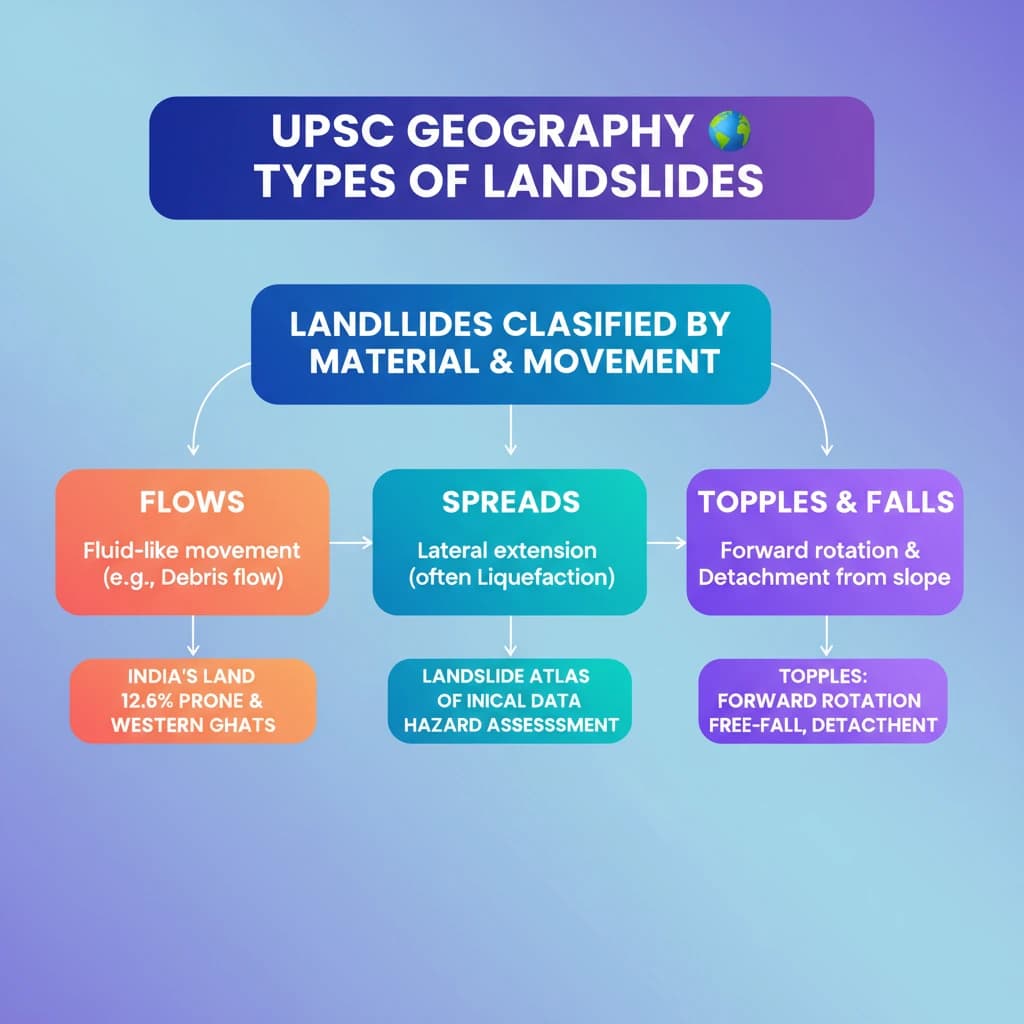
  • Landslides are classified into Flows, Spreads, Topples, and Falls based on material and movement.
  • Flows involve fluid-like movement (e.g., debris flows); Spreads are lateral extensions often due to liquefaction.
  • Topples are forward rotations and free-falls; Falls are detachments from steep slopes.
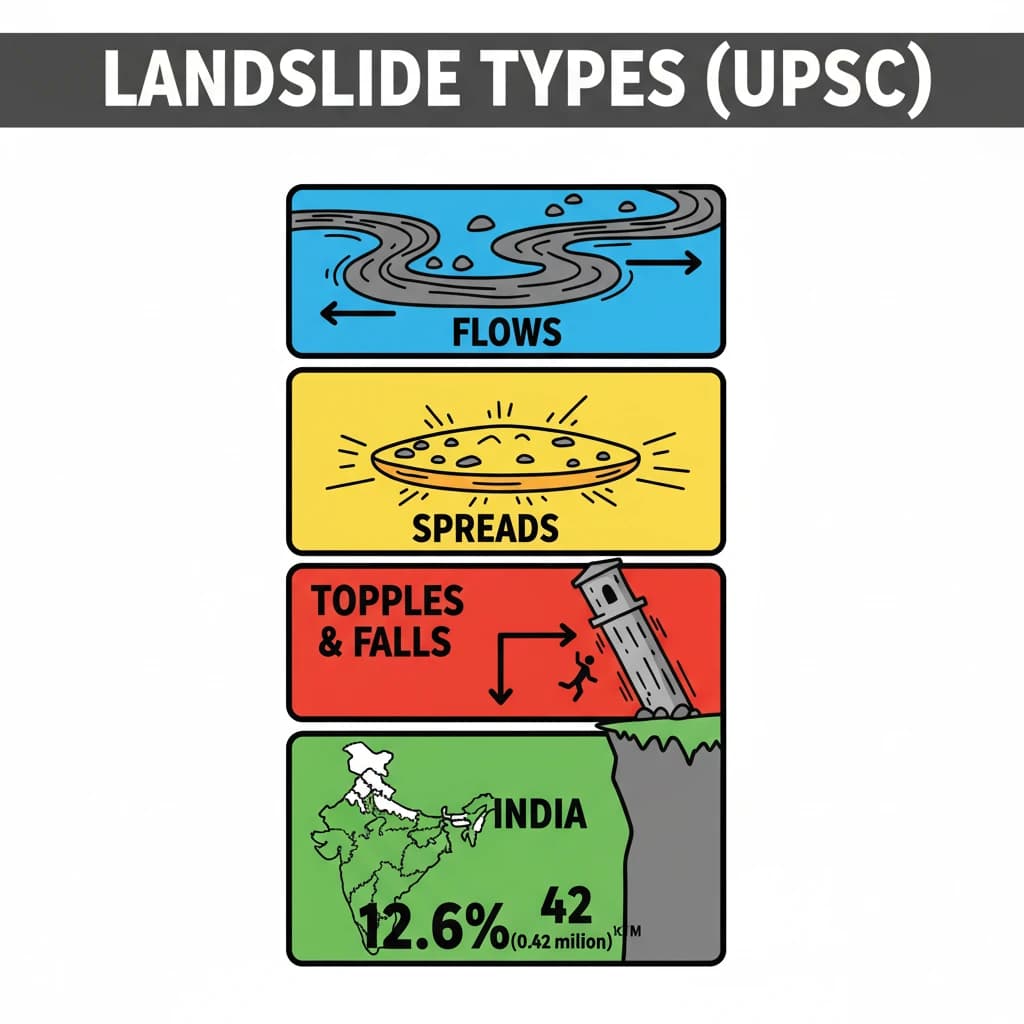
  • Approximately 12.6% (0.42 million sq. km) of India's land area is landslide-prone, concentrated in the Himalayas and Western Ghats.
  • The Landslide Atlas of India provides critical data for hazard assessment.
  • Understanding landslide types is crucial for effective disaster management and mitigation strategies.
Types of landslides

Types of landslides

Medium⏱️ 8 min read✓ 95% Verified
geography

📖 Introduction

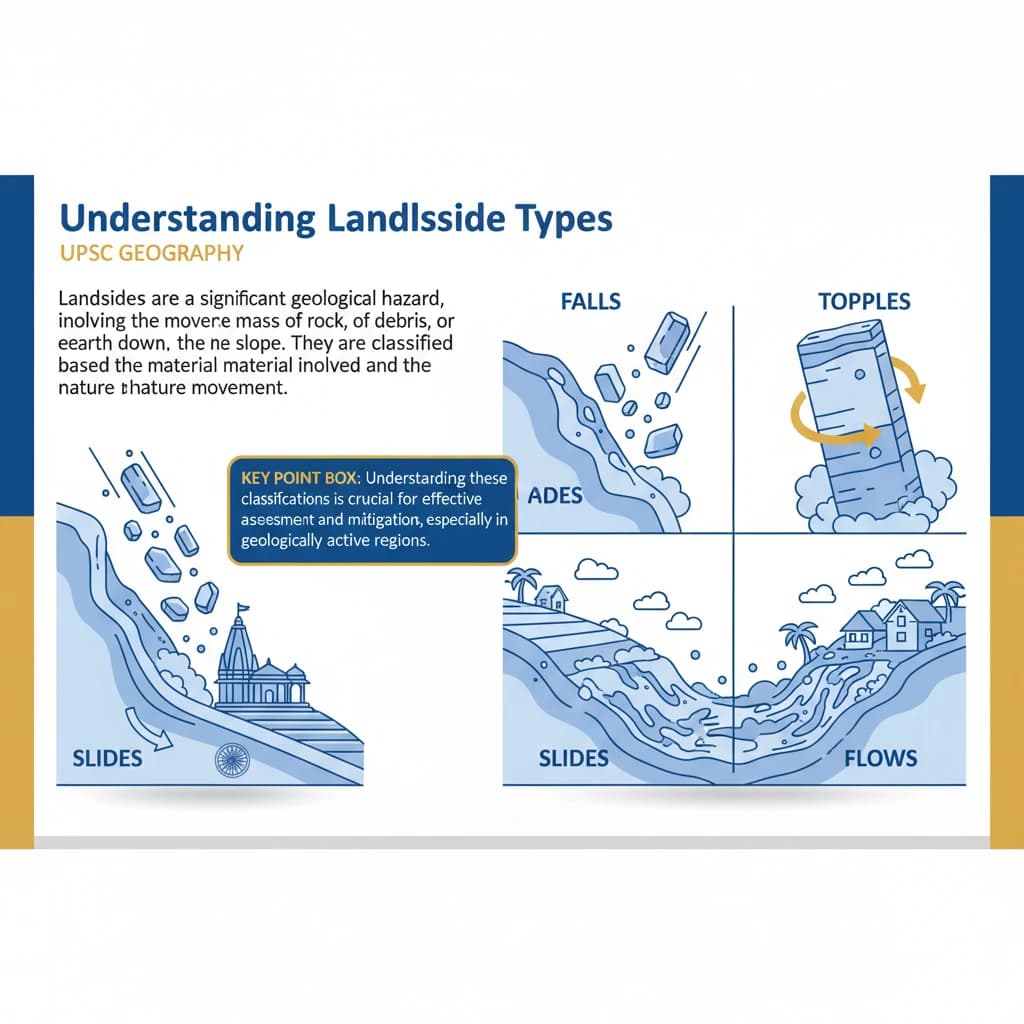
<h4>Understanding Landslide Types</h4><p><strong>Landslides</strong> are a significant geological hazard, involving the movement of a mass of rock, debris, or earth down a slope. They are broadly classified based on the type of material involved and the nature of movement.</p><div class='key-point-box'><p>Understanding these classifications is crucial for effective <strong>hazard assessment</strong> and <strong>mitigation strategies</strong>, especially in geologically active regions.</p></div><h4>Flows</h4><p><strong>Flows</strong> describe landslides where soil or rock material mixes with water, moving downslope like a viscous fluid. This category encompasses several distinct phenomena.</p><ul><li><strong>Earth Flows:</strong> Slow to rapid movement of fine-grained soil.</li><li><strong>Debris Flows:</strong> Rapid movement of a mixture of water, soil, and rock fragments.</li><li><strong>Mudflows:</strong> Very rapid flow of water-saturated fine-grained material.</li><li><strong>Creep:</strong> Extremely slow, imperceptible downslope movement of soil and rock, often influenced by freeze-thaw cycles.</li></ul><h4>Spreads</h4><p><strong>Spreads</strong> involve the lateral extension and cracking of a ground mass. This type of movement often occurs on gentle slopes or flat terrain due to the <strong>liquefaction</strong> of underlying saturated granular materials like sand.</p><div class='info-box'><p><strong>Liquefaction</strong> is a phenomenon where saturated, loose granular soil temporarily loses strength and stiffness, behaving like a liquid due to applied stress, typically from an earthquake or rapid loading.</p></div><h4>Topples</h4><p><strong>Topples</strong> are characterized by the forward rotation and free-fall of a mass of rock or earth from a vertical or near-vertical slope. This typically happens when the center of gravity of a block of material moves beyond its base of support.</p><div class='key-point-box'><p><strong>Toppling failures</strong> are common in areas with steeply dipping rock strata or heavily jointed rock masses, leading to sudden and dangerous collapses.</p></div><h4>Falls</h4><p><strong>Falls</strong> involve the detachment of rock or earth material from a steep slope or cliff face. The detached material then descends primarily by <strong>free-fall</strong>, but can also involve bouncing or rolling down the slope.</p><div class='info-box'><p><strong>Rockfalls</strong> are a common example of falls, frequently triggered by weathering, earthquakes, or heavy rainfall, especially in mountainous regions.</p></div><h4>Landslide Prone Areas in India</h4><p>India, with its diverse geological and topographical features, has significant areas vulnerable to landslides. The <strong>Landslide Atlas of India</strong> provides crucial data on these susceptible regions.</p><div class='info-box'><p>According to the <strong>Landslide Atlas of India</strong>, approximately <strong>0.42 million sq. km</strong>, which constitutes about <strong>12.6%</strong> of the country's total land area, is prone to landslides.</p></div><p>The distribution of these prone areas highlights specific geological and climatic vulnerabilities across different regions:</p><ul><li><strong>North East Himalaya:</strong> Approximately <strong>0.18 million sq. km</strong>.</li><li><strong>North West Himalaya:</strong> Approximately <strong>0.14 million sq. km</strong>.</li><li><strong>Western Ghats and Konkan Hills:</strong> Approximately <strong>0.09 million sq. km</strong>.</li><li><strong>Eastern Ghats of Andhra Pradesh:</strong> Approximately <strong>0.01 million sq. km</strong>.</li></ul><div class='exam-tip-box'><p>Knowledge of these <strong>landslide-prone regions</strong> is vital for UPSC Mains answers, particularly in <strong>Geography (GS Paper I)</strong> and <strong>Disaster Management (GS Paper III)</strong>. Be prepared to discuss their causes and mitigation strategies.</p></div>
Concept Diagram

💡 Key Takeaways

  • •Landslides are classified into Flows, Spreads, Topples, and Falls based on material and movement.
  • •Flows involve fluid-like movement (e.g., debris flows); Spreads are lateral extensions often due to liquefaction.
  • •Topples are forward rotations and free-falls; Falls are detachments from steep slopes.
  • •Approximately 12.6% (0.42 million sq. km) of India's land area is landslide-prone, concentrated in the Himalayas and Western Ghats.
  • •The Landslide Atlas of India provides critical data for hazard assessment.
  • •Understanding landslide types is crucial for effective disaster management and mitigation strategies.

🧠 Memory Techniques
Memory Aid
95% Verified Content

📚 Reference Sources

•Geological Survey of India (GSI) reports on landslides
•National Disaster Management Authority (NDMA) guidelines
•ISRO's Landslide Atlas of India

Related Topics

Loading related topics...
Explore:Geography Topics·All Subjects·Daily Current Affairs·Editorial Analysis·Previous Year Questions·UPSC GPT
Types of landslides - UPSC Geography