Loading page, please wait…
Vaidra Logo
Vaidra

Top 4 items + smart groups

UPSC GPT
New
Current Affairs
Daily Solutions
Daily Puzzle
Mains Evaluator

Version 2.0.0 • Built with ❤️ for UPSC aspirants

Loading...
Loading...
Loading...
Loading...
Loading...
Loading...
Loading...
Loading...
Loading...
Loading...
Loading...
Loading...
Loading...
Magnetic Fossils in Bay of Bengal - UPSC Geography
Back
All Subjects

Topics

0 topics • 0 completed

Loading topics...
Loading...
Loading...
Loading...
Loading...
Loading...
Overall Progress0%

Magnetic Fossils in Bay of Bengal - UPSC Geography

What is Magnetic Fossils in Bay of Bengal in UPSC Geography?

Magnetic Fossils in Bay of Bengal is a key topic under Geography for UPSC Civil Services Examination. Key points include: A 50,000-year-old massive magnetofossil was discovered in the Bay of Bengal.. This discovery, made by CSIR-National Institute of Oceanography, is one of the youngest of its kind.. It challenges the previous assumption that giant magnetofossils form only during periods of extreme global warming (e.g., Paleocene-Eocene Thermal Maximum, Middle Eocene Climatic Optimum).. Understanding this topic is essential for both UPSC Prelims and Mains preparation.

Why is Magnetic Fossils in Bay of Bengal important for UPSC exam?

Magnetic Fossils in Bay of Bengal is a Medium-level topic in UPSC Geography. It is tested in both Prelims (factual MCQs) and Mains (analytical answer writing). Previous year UPSC questions have frequently covered aspects of Magnetic Fossils in Bay of Bengal, making it essential for comprehensive IAS preparation.

How to prepare Magnetic Fossils in Bay of Bengal for UPSC?

To prepare Magnetic Fossils in Bay of Bengal for UPSC: (1) Study the comprehensive notes covering all key concepts on Vaidra. (2) Practice previous year questions on this topic. (3) Connect it with current affairs using daily updates. (4) Revise using key takeaways and mind maps available for Geography. (5) Write practice answers linking Magnetic Fossils in Bay of Bengal to related GS Paper topics.

Key takeaways of Magnetic Fossils in Bay of Bengal for UPSC

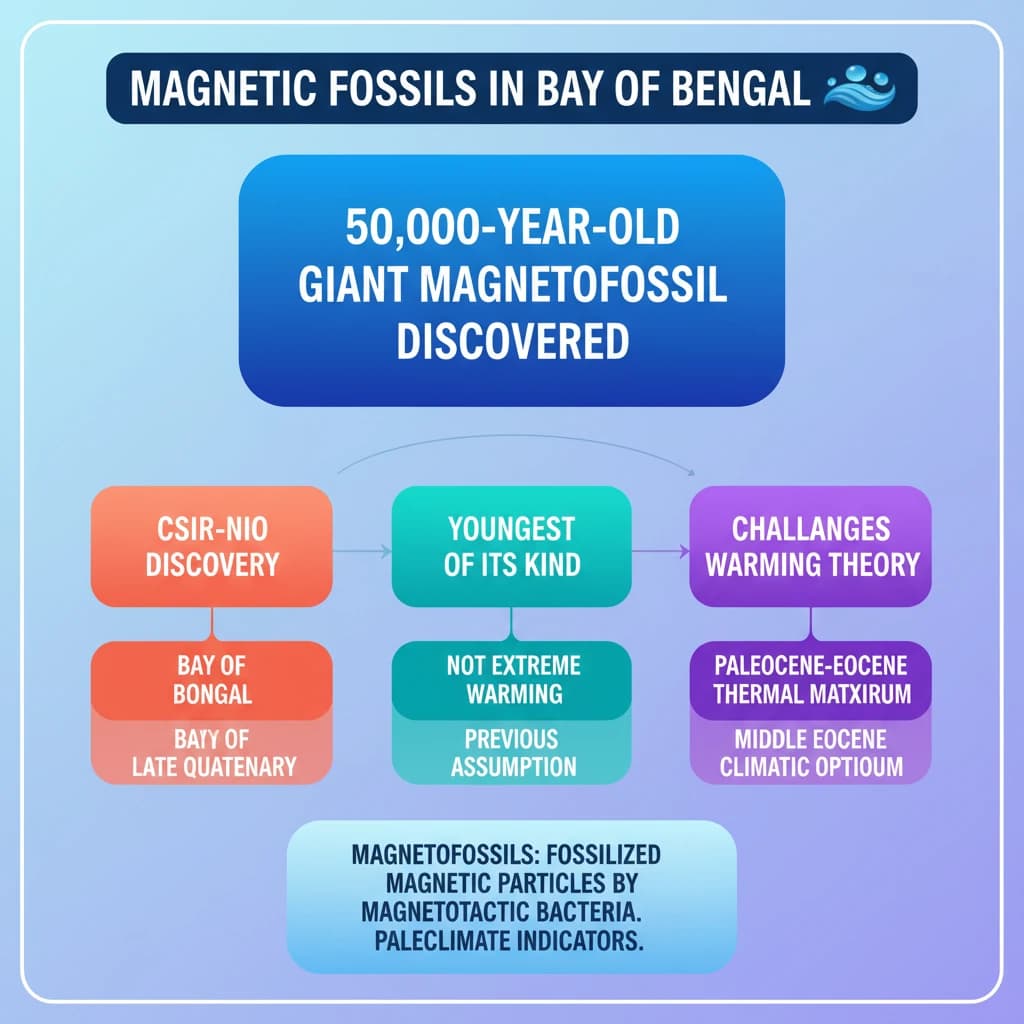
  • A 50,000-year-old massive magnetofossil was discovered in the Bay of Bengal.
  • This discovery, made by CSIR-National Institute of Oceanography, is one of the youngest of its kind.
  • It challenges the previous assumption that giant magnetofossils form only during periods of extreme global warming (e.g., Paleocene-Eocene Thermal Maximum, Middle Eocene Climatic Optimum).
  • The Bay of Bengal magnetofossil dates to the late Quaternary period, which was not an extreme warming event.
  • Magnetofossils are fossilized magnetic particles produced by magnetotactic bacteria, serving as valuable paleomagnetic and paleoclimate indicators.
Magnetic Fossils in Bay of Bengal

Magnetic Fossils in Bay of Bengal

Medium⏱️ 8 min read✓ 95% Verified
geography

📖 Introduction

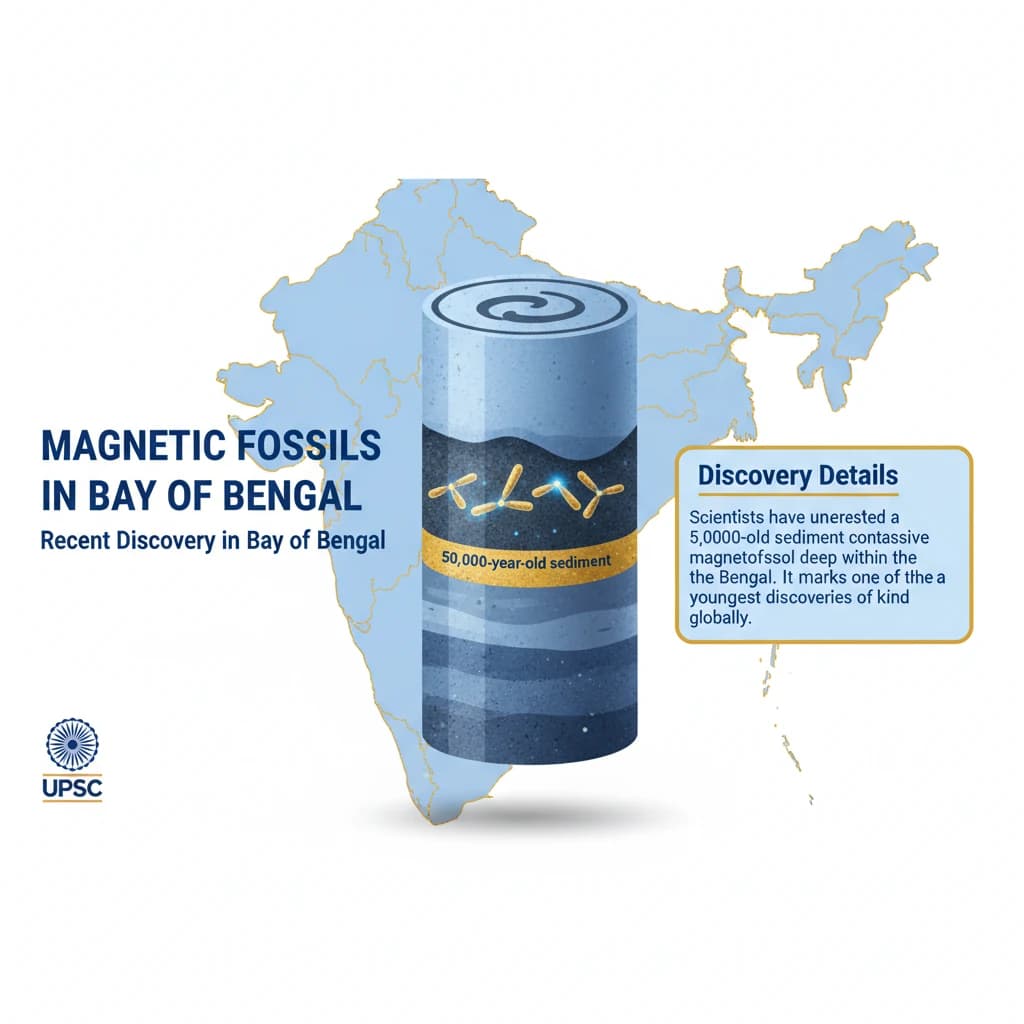
<h4>Recent Discovery in Bay of Bengal</h4><p>Scientists have recently unearthed a significant geological find: a <strong>50,000-year-old sediment</strong> containing a massive <strong>magnetofossil</strong>. This discovery was made deep within the <strong>Bay of Bengal</strong>.</p><p>It marks one of the <strong>youngest discoveries</strong> of its kind globally, providing new insights into the formation of these unique geological structures.</p><div class='info-box'><p><strong>Discovery Details:</strong></p><ul><li><strong>Age:</strong> Approximately <strong>50,000 years old</strong></li><li><strong>Type:</strong> Massive <strong>magnetofossil</strong> within sediment</li><li><strong>Location:</strong> Deep in the <strong>Bay of Bengal</strong> (specifically, southwestern Bay of Bengal)</li><li><strong>Significance:</strong> One of the <strong>youngest discoveries</strong> of giant magnetofossils</li></ul></div><h4>Scientific Investigation</h4><p>The research was conducted by scientists at <strong>CSIR-National Institute of Oceanography</strong>. They employed advanced analytical techniques to study the sediment sample.</p><p>Their methodology involved detailed <strong>magnetic analyses</strong> and high-resolution <strong>electron microscopy</strong> to characterize the magnetofossil.</p><h4>Understanding Magnetofossil Origin</h4><p>Historically, most giant magnetofossils have been found in sediments from two specific geological time periods known for significant global warming events.</p><div class='info-box'><p><strong>Previous Major Discovery Periods:</strong></p><ul><li><strong>Paleocene-Eocene Thermal Maximum:</strong> Approximately <strong>56 million years ago</strong></li><li><strong>Middle Eocene Climatic Optimum:</strong> About <strong>40 million years ago</strong></li></ul></div><p>These periods were characterized by a notable <strong>rise in global temperature</strong>, leading to the assumption that magnetofossils formed exclusively during times of <strong>extreme warming</strong>.</p><h4>Challenging Previous Assumptions</h4><p>The recent discovery of giant magnetofossils from the <strong>Bay of Bengal</strong> has been dated to the <strong>late Quaternary period</strong>, approximately <strong>50,000 years ago</strong>.</p><p>This makes them the <strong>youngest giant magnetofossils discovered to date</strong>. Crucially, this finding directly challenges the long-held assumption that these fossils form <em>only</em> during periods of extreme global warming.</p><div class='key-point-box'><p>The discovery from the <strong>Bay of Bengal</strong> suggests that the formation of giant magnetofossils might occur under a wider range of climatic conditions than previously understood, not solely during periods of <strong>extreme warming</strong>.</p></div><div class='exam-tip-box'><p>For UPSC, understand the <strong>scientific method</strong> used (magnetic analyses, electron microscopy) and the <strong>implications</strong> of the discovery (challenging existing theories on climate and fossil formation). Connect it to <strong>paleoclimate studies</strong> and <strong>geological time scales</strong>.</p></div>
Concept Diagram

💡 Key Takeaways

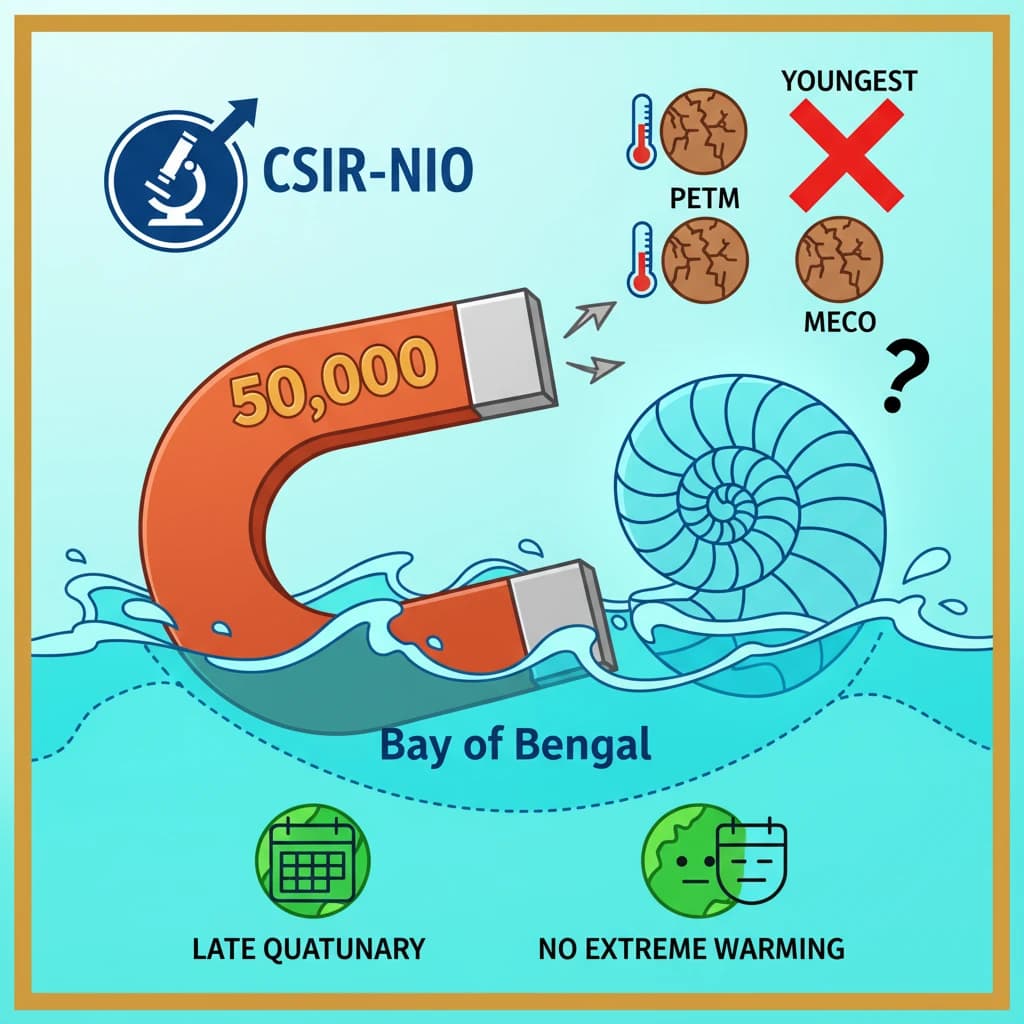
  • •A 50,000-year-old massive magnetofossil was discovered in the Bay of Bengal.
  • •This discovery, made by CSIR-National Institute of Oceanography, is one of the youngest of its kind.
  • •It challenges the previous assumption that giant magnetofossils form only during periods of extreme global warming (e.g., Paleocene-Eocene Thermal Maximum, Middle Eocene Climatic Optimum).
  • •The Bay of Bengal magnetofossil dates to the late Quaternary period, which was not an extreme warming event.
  • •Magnetofossils are fossilized magnetic particles produced by magnetotactic bacteria, serving as valuable paleomagnetic and paleoclimate indicators.

🧠 Memory Techniques
Memory Aid
95% Verified Content

📚 Reference Sources

•CSIR-National Institute of Oceanography (implied primary research source)

Related Topics

Loading related topics...
Explore:Geography Topics·All Subjects·Daily Current Affairs·Editorial Analysis·Previous Year Questions·UPSC GPT