Loading page, please wait…
Vaidra Logo
Vaidra

Top 4 items + smart groups

UPSC GPT
New
Current Affairs
Daily Solutions
Daily Puzzle
Mains Evaluator

Version 2.0.0 • Built with ❤️ for UPSC aspirants

Loading...
Loading...
Loading...
Loading...
Loading...
Loading...
Loading...
Loading...
Loading...
Loading...
Loading...
Loading...
Loading...
Back
All Subjects

Topics

0 topics • 0 completed

Loading topics...
Loading...
Loading...
Loading...
Loading...
Loading...
Overall Progress0%

UNCCD’s Drought Atlas - UPSC Geography

What is UNCCD’s Drought Atlas in UPSC Geography?

UNCCD’s Drought Atlas is a key topic under Geography for UPSC Civil Services Examination. Key points include: The World Drought Atlas, launched at UNCCD COP16, is a global publication on drought risks and solutions.. UNCCD (1994) is the only legally binding international treaty focused on sustainable land management in drylands.. Droughts are extended periods of water scarcity, caused by climate factors and human activities, intensified by climate change.. Understanding this topic is essential for both UPSC Prelims and Mains preparation.

Why is UNCCD’s Drought Atlas important for UPSC exam?

UNCCD’s Drought Atlas is a Medium-level topic in UPSC Geography. It is tested in both Prelims (factual MCQs) and Mains (analytical answer writing). Previous year UPSC questions have frequently covered aspects of UNCCD’s Drought Atlas, making it essential for comprehensive IAS preparation.

How to prepare UNCCD’s Drought Atlas for UPSC?

To prepare UNCCD’s Drought Atlas for UPSC: (1) Study the comprehensive notes covering all key concepts on Vaidra. (2) Practice previous year questions on this topic. (3) Connect it with current affairs using daily updates. (4) Revise using key takeaways and mind maps available for Geography. (5) Write practice answers linking UNCCD’s Drought Atlas to related GS Paper topics.

Key takeaways of UNCCD’s Drought Atlas for UPSC

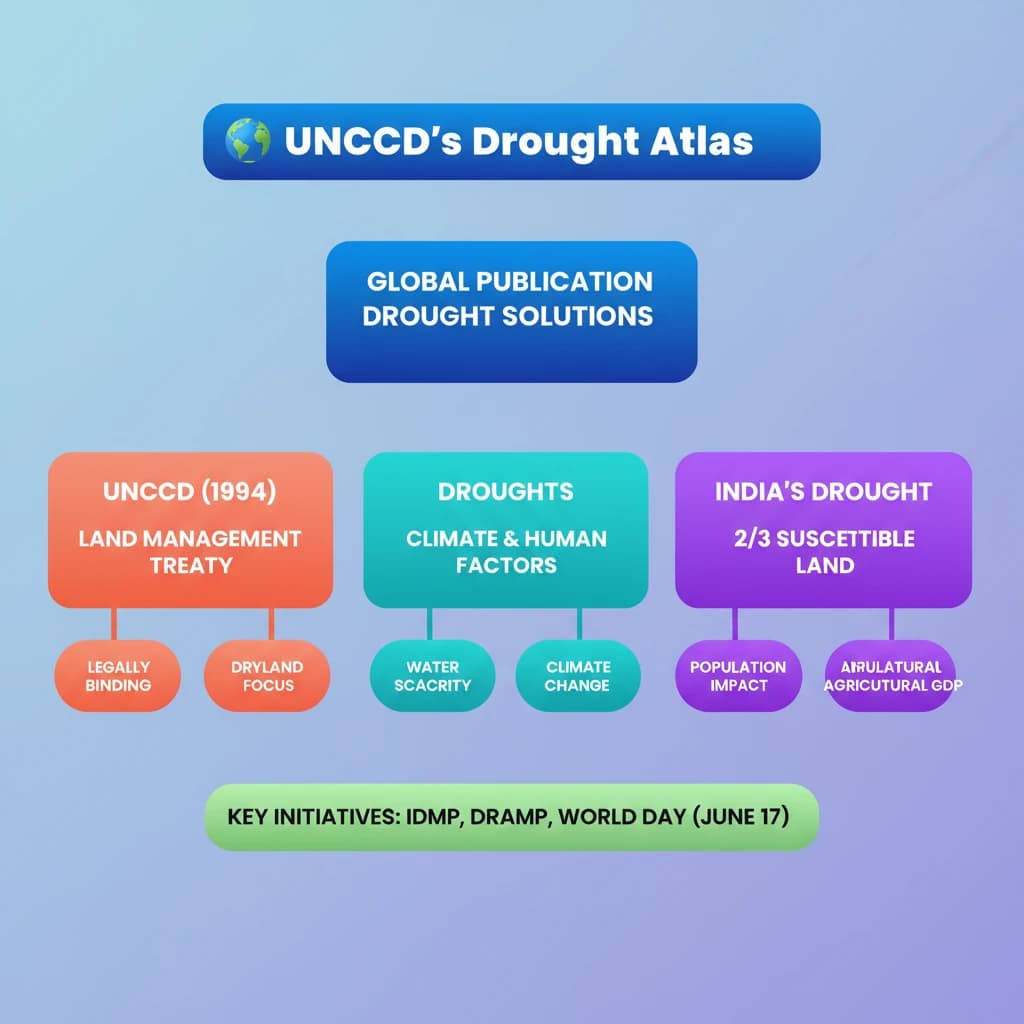
  • The World Drought Atlas, launched at UNCCD COP16, is a global publication on drought risks and solutions.
  • UNCCD (1994) is the only legally binding international treaty focused on sustainable land management in drylands.
  • Droughts are extended periods of water scarcity, caused by climate factors and human activities, intensified by climate change.
  • Two-thirds of India is drought-susceptible, with significant historical impacts on population, cattle, and agricultural GDP.
  • Key initiatives include IDMP, UNCCD's Drought Initiative, World Day to Combat Desertification and Drought (June 17), and the DRAMP framework.
  • UNCCD collaborates with CBD and UNFCCC, highlighting the interconnectedness of land, climate, and biodiversity.
UNCCD’s Drought Atlas

UNCCD’s Drought Atlas

Medium⏱️ 8 min read✓ 95% Verified
geography

📖 Introduction

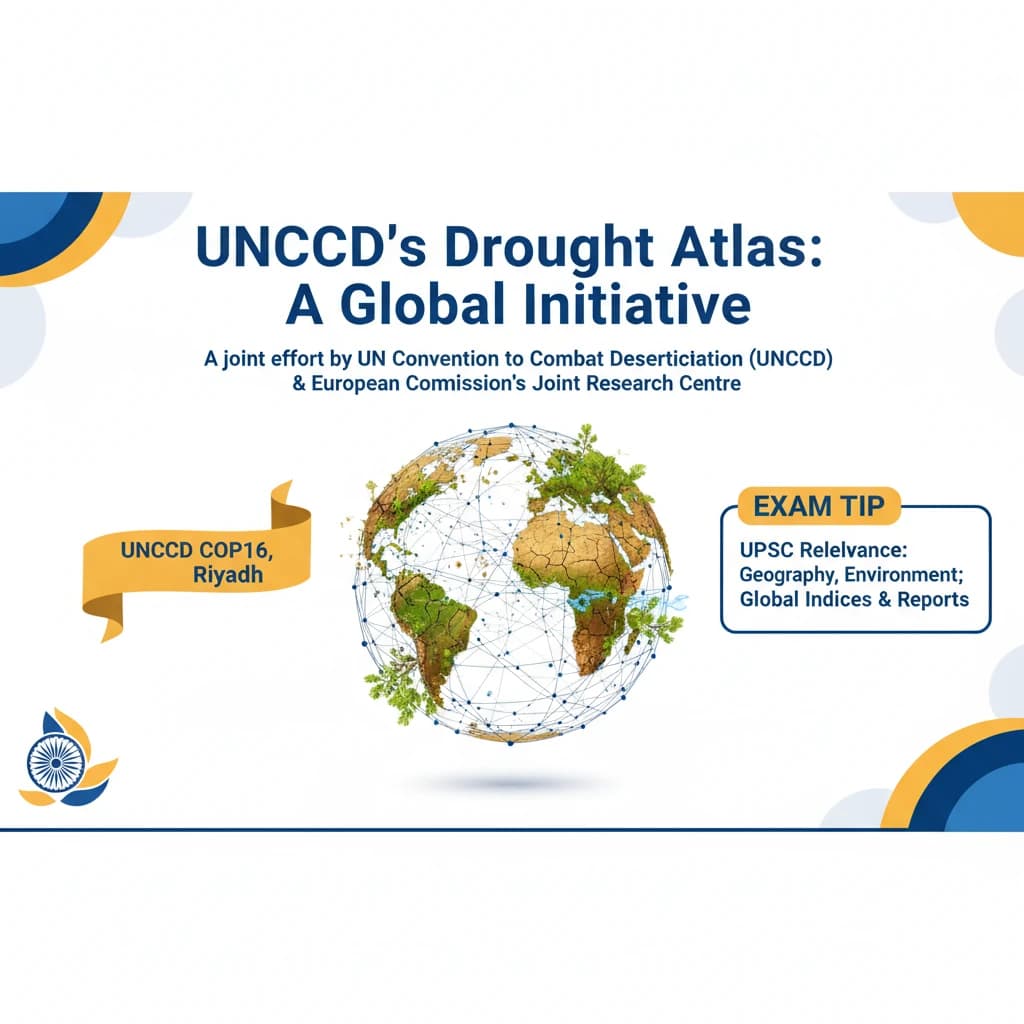
<h4>UNCCD's Drought Atlas: A Global Initiative</h4><p>At the recent <strong>UNCCD COP16</strong> in <strong>Riyadh</strong>, a significant global publication was launched. The <strong>World Drought Atlas</strong>, a joint effort by the <strong>UN Convention to Combat Desertification (UNCCD)</strong> and the <strong>European Commission’s Joint Research Centre</strong>, provides comprehensive insights into drought risks and potential solutions.</p><div class='exam-tip-box'><p><strong>UPSC Relevance:</strong> This topic is crucial for <strong>GS Paper 1 (Geography)</strong>, <strong>GS Paper 3 (Environment & Disaster Management)</strong>. Questions may focus on international conventions, drought management strategies, and climate change impacts.</p></div><h4>Understanding the UN Convention to Combat Desertification (UNCCD)</h4><p>The <strong>UNCCD</strong> was established in <strong>1994</strong> as a pivotal international treaty. It is the <strong>only legally binding international agreement</strong> that integrates environmental and developmental goals with sustainable land management practices.</p><div class='info-box'><p><strong>Key Focus Areas:</strong> The Convention primarily targets <strong>arid, semi-arid, and dry sub-humid regions</strong>, collectively known as <strong>drylands</strong>. These areas are home to some of the world's most vulnerable ecosystems and communities.</p></div><p>With <strong>197 member countries</strong>, the UNCCD fosters global collaboration. Its objectives include improving living conditions in drylands, restoring land and soil productivity, and mitigating the adverse impacts of drought.</p><div class='key-point-box'><p><strong>Interconnected Rio Conventions:</strong> The UNCCD works in synergy with two other critical Rio Conventions to address the intertwined challenges of land, climate, and biodiversity:</p><ul><li><strong>Convention on Biological Diversity (CBD)</strong></li><li><strong>United Nations Framework Convention on Climate Change (UNFCCC)</strong></li></ul></div><h4>Defining Droughts</h4><p><strong>Droughts</strong> are characterized by extended periods of significantly reduced water availability. This reduction leads to imbalances in water supply, quality, and demand, impacting various sectors.</p><p>These periods can vary in duration, from brief spells to several years. Their effects include hindering plant growth and causing a substantial lowering of water tables.</p><div class='info-box'><p><strong>Causes of Droughts:</strong> Droughts originate from a combination of factors:</p><ul><li><strong>Climate Factors:</strong> Primarily low precipitation.</li><li><strong>Human Activities:</strong> Excessive water extraction, unsustainable water usage, and poor land management practices.</li></ul></div><p>While droughts can occur naturally due to weather patterns, <strong>climate change</strong> is increasingly recognized as a factor. It contributes to both the rising frequency and enhanced severity of drought events globally.</p><h4>Drought Scenario in India</h4><p>India faces a significant challenge from droughts, as highlighted by the <strong>Drought Atlas of India (1901–2020)</strong>. This report indicates that approximately <strong>two-thirds of the nation is susceptible to drought conditions</strong>.</p><p>Given India's agrarian economy and large population of <strong>1.4 billion people</strong>, droughts have profound impacts on agricultural productivity and food security.</p><div class='info-box'><p><strong>Historical Impact (1901-2020):</strong></p><ul><li>Around <strong>56% of India’s total area</strong> experienced moderate to exceptional drought conditions.</li><li>This affected an estimated <strong>300 million people</strong> and <strong>150 million cattle</strong>.</li><li>Crop damage during this period led to an approximate economic loss of <strong>USD 4.7 billion</strong>, resulting in a <strong>3.1% reduction in agricultural GDP</strong>.</li></ul></div><h4>Global and National Initiatives to Combat Drought</h4><p>Several initiatives have been launched to address the growing threat of droughts and enhance resilience.</p><div class='key-point-box'><p><strong>Integrated Drought Management Programme (IDMP):</strong> This is a joint initiative by the <strong>Global Water Partnership (GWP)</strong> and the <strong>World Meteorological Organization (WMO)</strong>. It provides policy, technical, and management guidance to governments and stakeholders for effective drought management.</p></div><p>The <strong>UNCCD’s Drought Initiative</strong> specifically focuses on establishing robust drought preparedness systems worldwide. This proactive approach aims to minimize the impacts of future drought events.</p><div class='info-box'><p><strong>World Day to Combat Desertification and Drought (WDCDD):</strong> Celebrated annually on <strong>June 17th</strong>, this day raises global awareness about the urgency of addressing desertification and drought.</p></div><p>The <strong>UNCCD’s Drought Resilience, Adaptation and Management Policy (DRAMP) framework</strong> promotes continuous collaboration between science and policy. It emphasizes understanding drought risks, collecting vital data, and designing equitable solutions to build resilience for economies, societies, and ecosystems.</p>
Concept Diagram

💡 Key Takeaways

  • •The World Drought Atlas, launched at UNCCD COP16, is a global publication on drought risks and solutions.
  • •UNCCD (1994) is the only legally binding international treaty focused on sustainable land management in drylands.
  • •Droughts are extended periods of water scarcity, caused by climate factors and human activities, intensified by climate change.
  • •Two-thirds of India is drought-susceptible, with significant historical impacts on population, cattle, and agricultural GDP.
  • •Key initiatives include IDMP, UNCCD's Drought Initiative, World Day to Combat Desertification and Drought (June 17), and the DRAMP framework.
  • •UNCCD collaborates with CBD and UNFCCC, highlighting the interconnectedness of land, climate, and biodiversity.

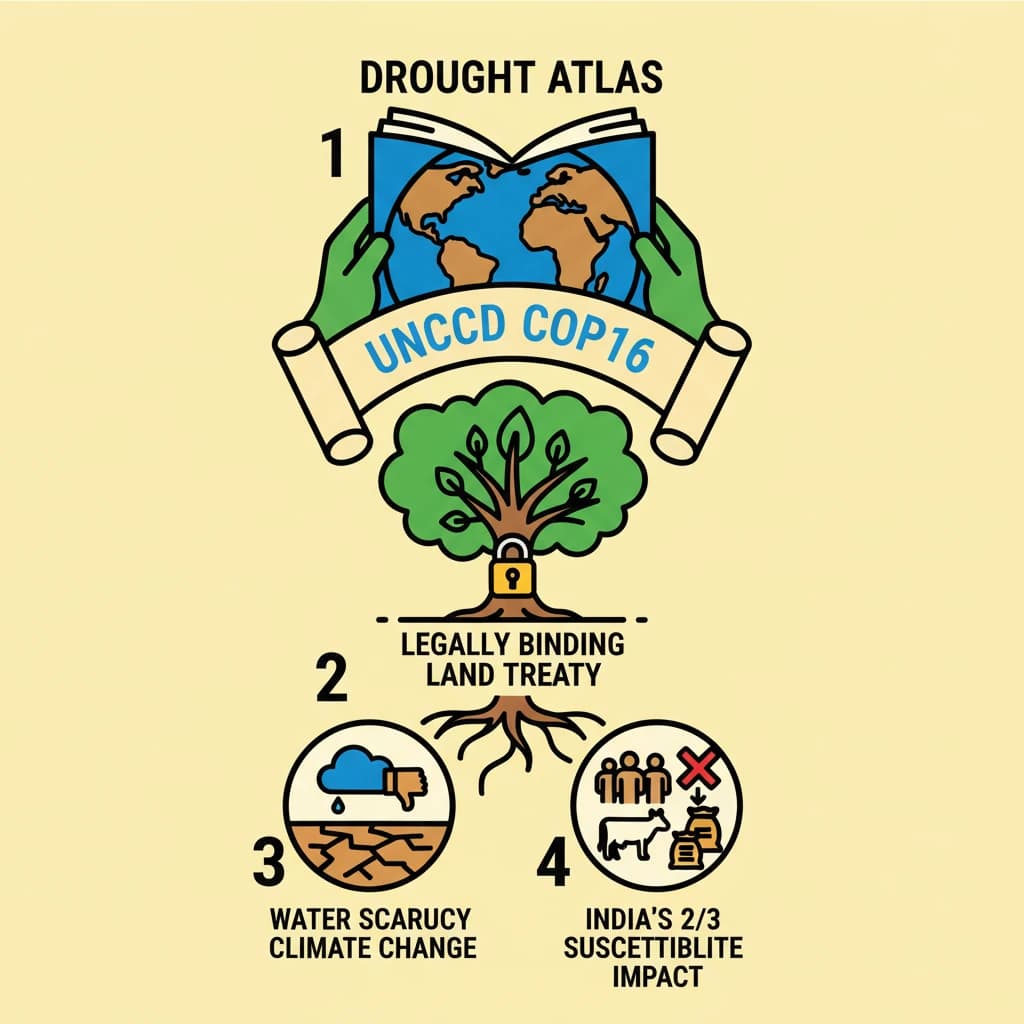
🧠 Memory Techniques
Memory Aid
95% Verified Content

📚 Reference Sources

•Official website of the UN Convention to Combat Desertification (UNCCD)
•European Commission’s Joint Research Centre (JRC) publications on drought
•World Meteorological Organization (WMO) resources on drought management

Related Topics

Loading related topics...
Explore:Geography Topics·All Subjects·Daily Current Affairs·Editorial Analysis·Previous Year Questions·UPSC GPT
UNCCD’s Drought Atlas - UPSC Geography