Loading page, please wait…
Eruptions in Kilauea Volcano - UPSC Geography
What is Eruptions in Kilauea Volcano in UPSC Geography?
Eruptions in Kilauea Volcano is a key topic under Geography for UPSC Civil Services Examination. Key points include: Magmatism is the formation and movement of magma, contributing to heat release, mountain building, and tectonic crack filling.. The Erta Ale volcano in the East African Rift Valley provides clues to tectonic transitions, mimicking mid-ocean ridge characteristics.. Ongoing rift expansion in the East African Rift Valley could lead to a new ocean, the "Aivor-Teide Atlantic Rift.". Understanding this topic is essential for both UPSC Prelims and Mains preparation.
Why is Eruptions in Kilauea Volcano important for UPSC exam?
Eruptions in Kilauea Volcano is a Medium-level topic in UPSC Geography. It is tested in both Prelims (factual MCQs) and Mains (analytical answer writing). Previous year UPSC questions have frequently covered aspects of Eruptions in Kilauea Volcano, making it essential for comprehensive IAS preparation.
How to prepare Eruptions in Kilauea Volcano for UPSC?
To prepare Eruptions in Kilauea Volcano for UPSC: (1) Study the comprehensive notes covering all key concepts on Vaidra. (2) Practice previous year questions on this topic. (3) Connect it with current affairs using daily updates. (4) Revise using key takeaways and mind maps available for Geography. (5) Write practice answers linking Eruptions in Kilauea Volcano to related GS Paper topics.
Key takeaways of Eruptions in Kilauea Volcano for UPSC
- Magmatism is the formation and movement of magma, contributing to heat release, mountain building, and tectonic crack filling.
- The Erta Ale volcano in the East African Rift Valley provides clues to tectonic transitions, mimicking mid-ocean ridge characteristics.
- Ongoing rift expansion in the East African Rift Valley could lead to a new ocean, the "Aivor-Teide Atlantic Rift."
- Tectonic movement involves the large-scale motion of Earth's lithosphere, forming divergent, convergent, and transform boundaries.
- Rifting is the stretching and thinning of the lithosphere, creating rift valleys or basins.
- Mid-oceanic ridges are underwater mountain ranges at divergent boundaries, characterized by volcanic activity and new oceanic crust formation (seafloor spreading).
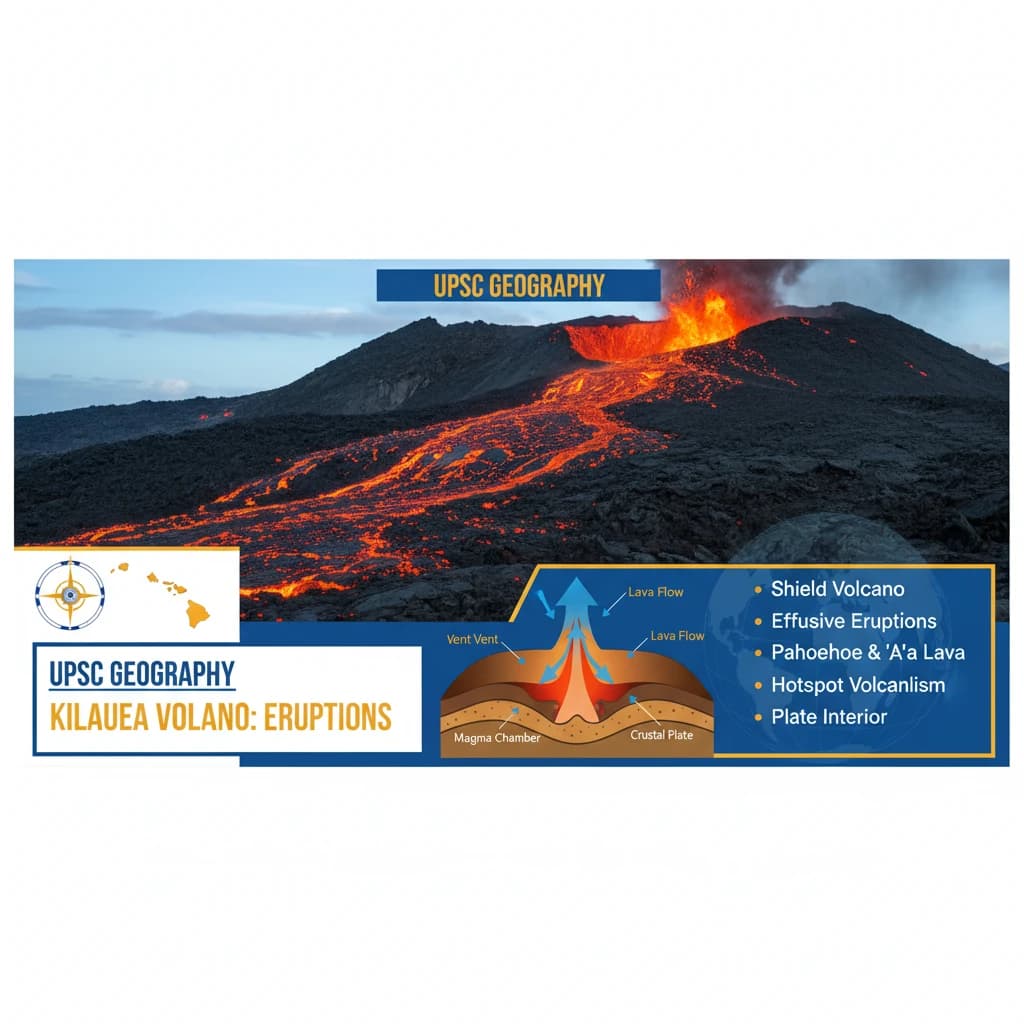
Eruptions in Kilauea Volcano
Medium⏱️ 8 min read
geography
📖 Introduction
Understanding Magmatism and Tectonic Transitions
The study of volcanic activity, particularly at the Erta Ale volcano, provides crucial insights into tectonic transitions. This region exhibits characteristics that closely mimic those of a mid-ocean ridge, offering a natural laboratory for geological processes.
The magmatism observed at Erta Ale is a key indicator of ongoing geological shifts, reflecting processes typically associated with the formation of new oceanic crust.
What is Magmatism?
Magmatism refers to the complex process involving the formation and subsequent movement of magma beneath the Earth's surface. This fundamental geological phenomenon plays a vital role in shaping our planet.
Magmatism's Contributions:
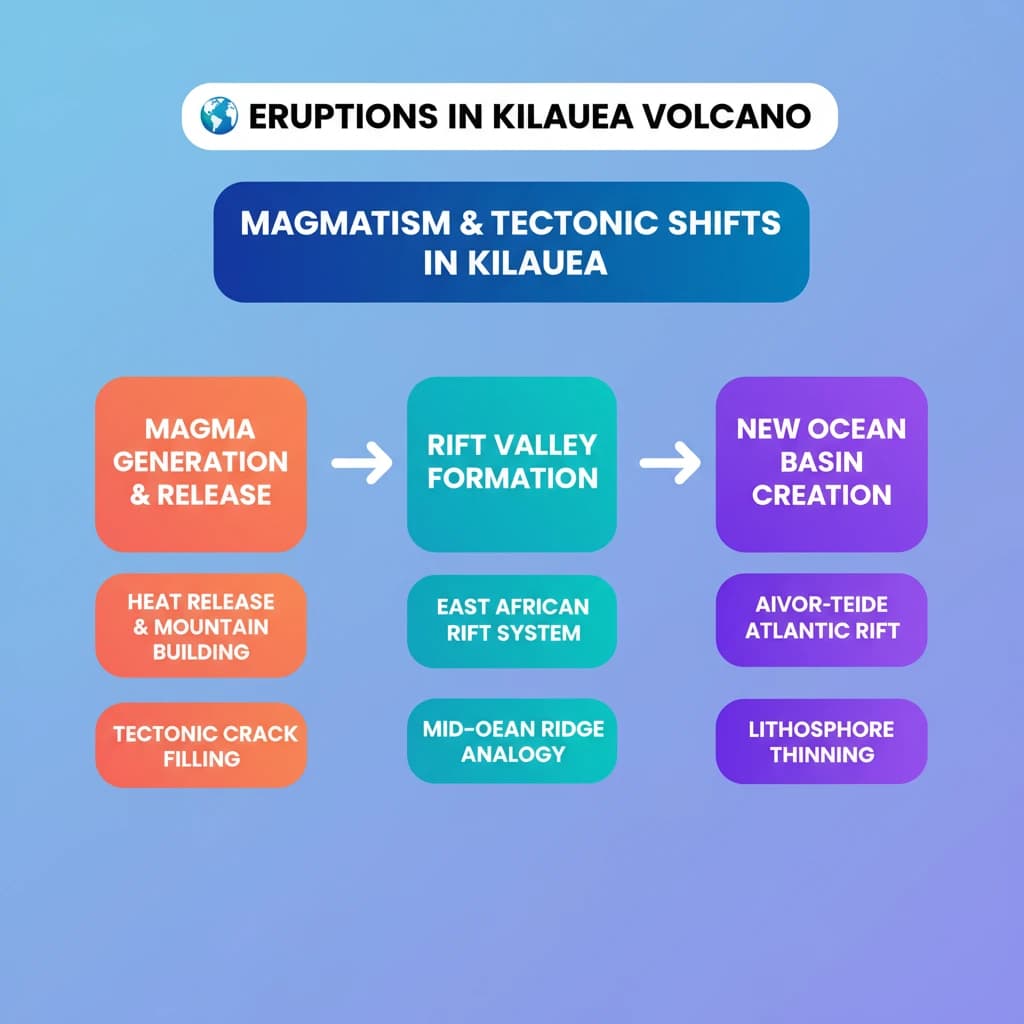
- Fills tectonic cracks within the Earth's crust.
- Contributes to the formation of mountains.
- Aids in the efficient release of internal heat from the Earth’s core.
Potential Formation of a New Ocean
The ongoing rift expansion in the East African Rift Valley region holds significant implications for future global geography. Scientists hypothesize that this process could eventually lead to the formation of an entirely new ocean basin.
This nascent ocean has been tentatively named the “Aivor-Teide Atlantic Rift”. Its formation would involve the eventual flooding of the Afar region and the East African Rift Valley by waters from the Red Sea and the Gulf of Aden.
Understanding the concept of rift expansion and its potential to form new oceans is crucial for UPSC Geography, especially for topics related to Plate Tectonics and Geomorphology.
Key Tectonic Concepts Explained
Tectonic Movement:
This describes the large-scale motion of the Earth’s lithosphere, driven by the dynamic interactions of various tectonic plates. These movements are responsible for most major geological features.
- Divergent Boundaries: Plates move apart.
- Convergent Boundaries: Plates move towards each other.
- Transform Boundaries: Plates slide past each other horizontally.
Rifting:
Rifting is a geological process where the Earth's lithosphere, its outermost rigid layer, undergoes stretching and thinning. This process ultimately leads to the creation of characteristic rift valleys or basins.
As tectonic plates move apart, powerful tensional forces cause the lithosphere to fracture and break, defining these active rift zones.
Mid-Oceanic Ridge:
A mid-oceanic ridge is an extensive underwater mountain range that develops along divergent boundaries between tectonic plates, specifically within the oceanic crust. These are some of the most prominent features on Earth's surface.
These ridges are distinguished by intense volcanic activity and the continuous upwelling of magma from the Earth's mantle. This magma solidifies upon reaching the surface, forming new oceanic crust.
Mid-oceanic ridges are central to the concept of seafloor spreading, a process where new crust is perpetually generated as tectonic plates diverge.
💡 Key Takeaways
- •Magmatism is the formation and movement of magma, contributing to heat release, mountain building, and tectonic crack filling.
- •The Erta Ale volcano in the East African Rift Valley provides clues to tectonic transitions, mimicking mid-ocean ridge characteristics.
- •Ongoing rift expansion in the East African Rift Valley could lead to a new ocean, the "Aivor-Teide Atlantic Rift."
- •Tectonic movement involves the large-scale motion of Earth's lithosphere, forming divergent, convergent, and transform boundaries.
- •Rifting is the stretching and thinning of the lithosphere, creating rift valleys or basins.
- •Mid-oceanic ridges are underwater mountain ranges at divergent boundaries, characterized by volcanic activity and new oceanic crust formation (seafloor spreading).
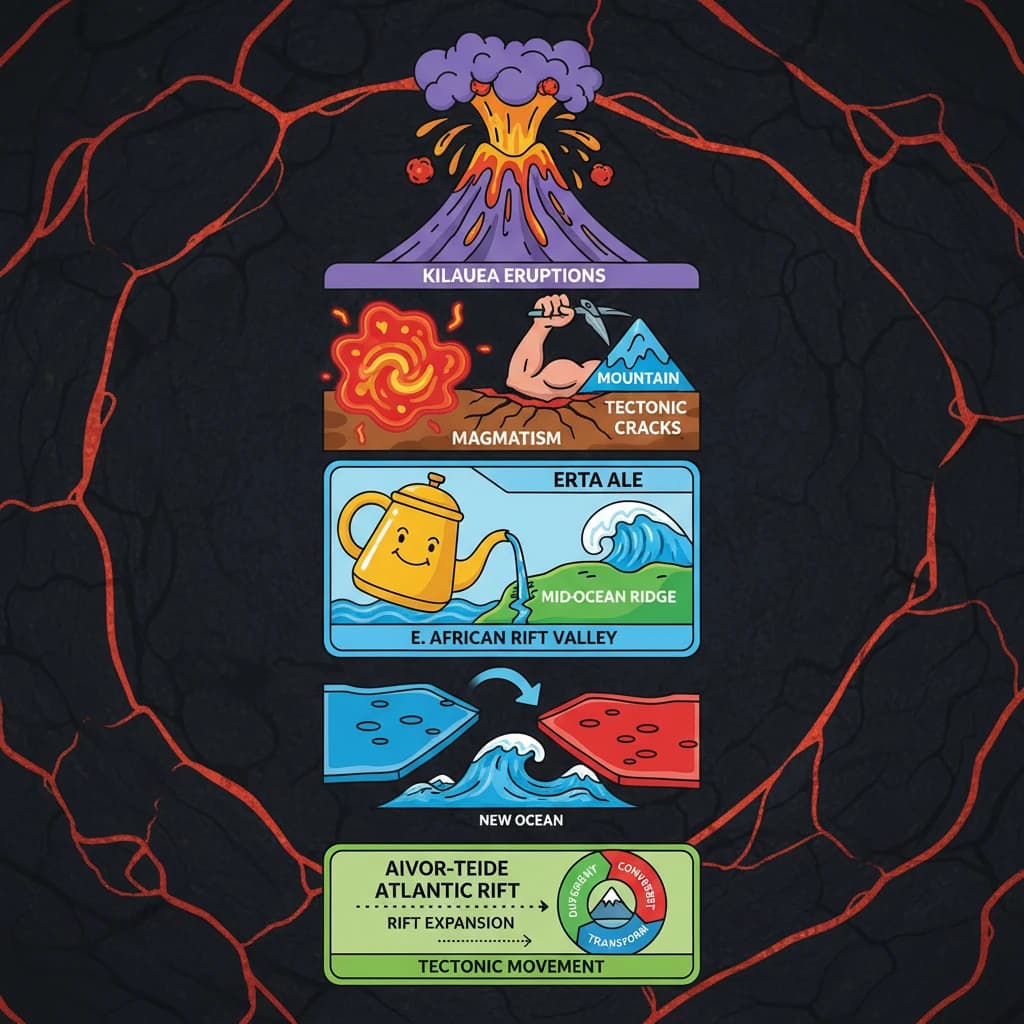
🧠 Memory Techniques
90% Verified Content