Loading page, please wait…
Vaidra Logo
Vaidra

Top 4 items + smart groups

UPSC GPT
New
Current Affairs
Daily Solutions
Daily Puzzle
Mains Evaluator

Version 2.0.0 • Built with ❤️ for UPSC aspirants

Loading...
Loading...
Loading...
Loading...
Loading...
Loading...
Loading...
Loading...
Loading...
Loading...
Loading...
Loading...
Loading...
Back
All Subjects

Topics

0 topics • 0 completed

Loading topics...
Loading...
Loading...
Loading...
Loading...
Loading...
Overall Progress0%

Jamuna (called Brahmaputra in India) - UPSC Geography

What is Jamuna (called Brahmaputra in India) in UPSC Geography?

Jamuna (called Brahmaputra in India) is a key topic under Geography for UPSC Civil Services Examination. Key points include: Jamuna is a Brahmaputra distributary in Bangladesh, meeting Padma (Ganga) at Goalundo Ghat.. India-China share two major trans-border river systems: Brahmaputra (eastern) and Indus (western).. Brahmaputra is known as Yaluzangbu/Tsangpo in China and Siang in Arunachal Pradesh.. Understanding this topic is essential for both UPSC Prelims and Mains preparation.

Why is Jamuna (called Brahmaputra in India) important for UPSC exam?

Jamuna (called Brahmaputra in India) is a Medium-level topic in UPSC Geography. It is tested in both Prelims (factual MCQs) and Mains (analytical answer writing). Previous year UPSC questions have frequently covered aspects of Jamuna (called Brahmaputra in India), making it essential for comprehensive IAS preparation.

How to prepare Jamuna (called Brahmaputra in India) for UPSC?

To prepare Jamuna (called Brahmaputra in India) for UPSC: (1) Study the comprehensive notes covering all key concepts on Vaidra. (2) Practice previous year questions on this topic. (3) Connect it with current affairs using daily updates. (4) Revise using key takeaways and mind maps available for Geography. (5) Write practice answers linking Jamuna (called Brahmaputra in India) to related GS Paper topics.

Key takeaways of Jamuna (called Brahmaputra in India) for UPSC

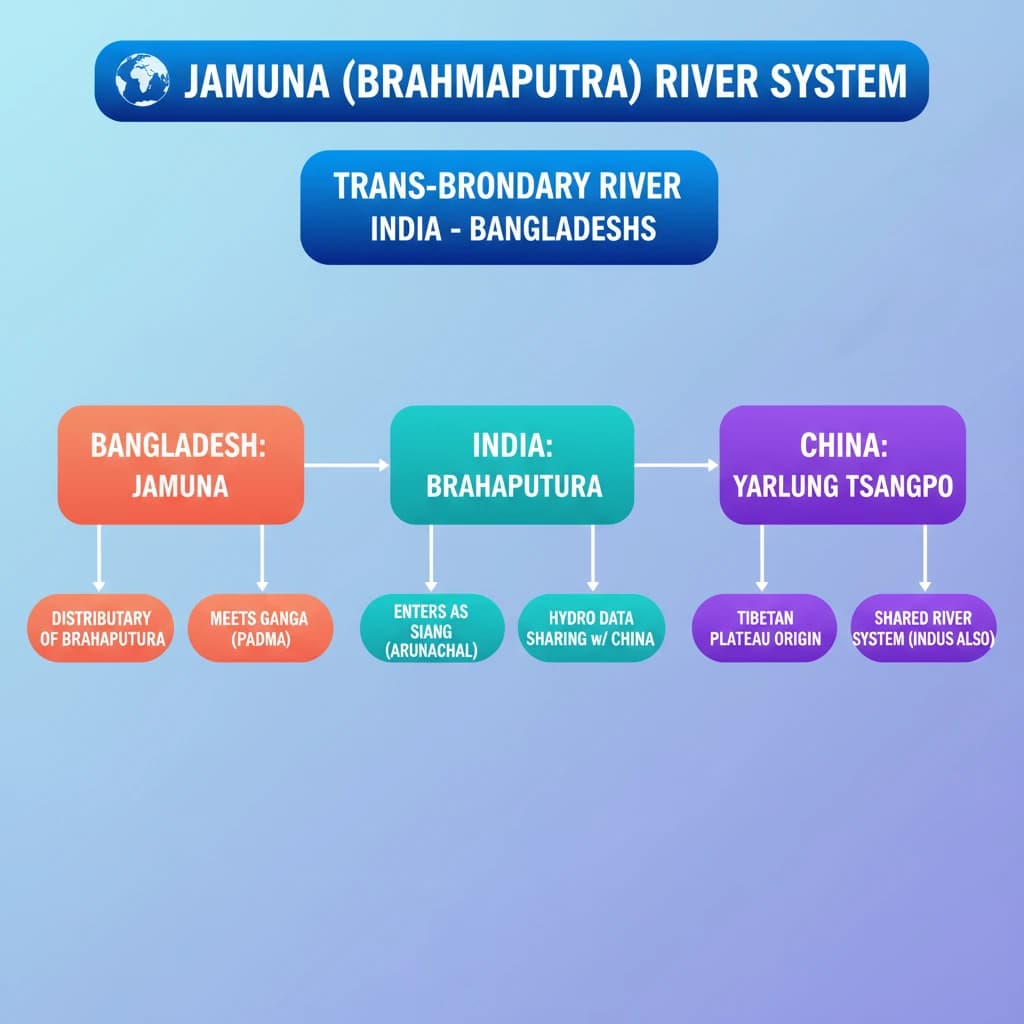
  • Jamuna is a Brahmaputra distributary in Bangladesh, meeting Padma (Ganga) at Goalundo Ghat.
  • India-China share two major trans-border river systems: Brahmaputra (eastern) and Indus (western).
  • Brahmaputra is known as Yaluzangbu/Tsangpo in China and Siang in Arunachal Pradesh.
  • India and China have MoUs for hydrological data sharing on Brahmaputra and Sutlej.
  • Transboundary river management is crucial for regional water security and geopolitical stability.
Jamuna (called Brahmaputra in India)

Jamuna (called Brahmaputra in India)

Medium⏱️ 7 min read✓ 95% Verified
geography

📖 Introduction

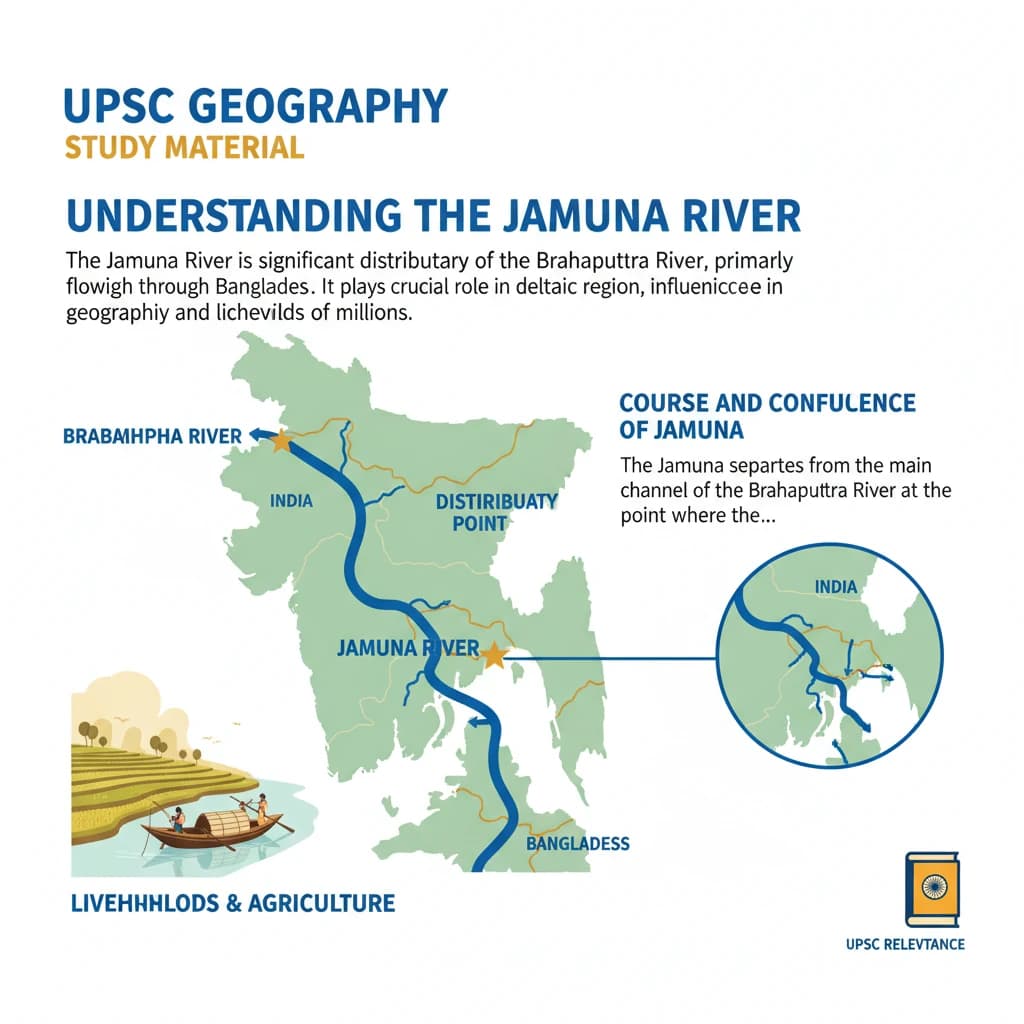
<h4>Understanding the Jamuna River</h4><p>The <strong>Jamuna River</strong> is a significant <strong>distributary</strong> of the <strong>Brahmaputra River</strong>, primarily flowing through <strong>Bangladesh</strong>.</p><p>It plays a crucial role in the deltaic region, influencing the geography and livelihoods of millions.</p><h4>Course and Confluence of Jamuna</h4><p>The <strong>Jamuna</strong> separates from the main channel of the <strong>Brahmaputra River</strong> at the point where the <strong>Brahmaputra</strong> converges with the <strong>Teesta River</strong> in <strong>Bangladesh</strong>.</p><p>It continues its journey under the name <strong>Jamuna</strong> until it reaches <strong>Goalundo Ghat</strong>, also in <strong>Bangladesh</strong>.</p><div class='info-box'><p>At <strong>Goalundo Ghat</strong>, the <strong>Jamuna River</strong> merges with the <strong>Padma River</strong>. The <strong>Padma River</strong> is known as the <strong>Ganga River</strong> in <strong>India</strong> before it enters <strong>Bangladesh</strong>.</p></div><h4>Trans-border Rivers between India and China</h4><p>Several major rivers flow across the international border from <strong>China</strong> into <strong>India</strong>, forming vital river systems for both nations.</p><p>These trans-border rivers are broadly categorized into two principal groups based on their geographical location and river basin.</p><div class='key-point-box'><p>Understanding these <strong>trans-border river systems</strong> is crucial for comprehending geopolitical and environmental dynamics in the region.</p></div><h4>The Brahmaputra River System</h4><p>Located on the <strong>eastern side</strong> of the India-China border, this system is a lifeline for northeastern <strong>India</strong> and <strong>Bangladesh</strong>.</p><ul><li>The main stream of the <strong>Brahmaputra River</strong> in <strong>India</strong> is known as <strong>Siang</strong> when it enters from <strong>China</strong>.</li><li>Key tributaries include <strong>Subansiri</strong> and <strong>Lohit</strong>, which significantly contribute to its volume.</li></ul><div class='info-box'><p>In <strong>China</strong>, the <strong>Brahmaputra River</strong> is known by its Tibetan names, primarily <strong>Yaluzangbu</strong> or <strong>Tsangpo</strong>.</p></div><h4>The Indus River System</h4><p>Situated on the <strong>western side</strong> of the India-China border, this system is vital for the arid regions of <strong>India</strong> and <strong>Pakistan</strong>.</p><ul><li>The primary rivers in this system, originating from <strong>China</strong> and flowing into <strong>India</strong>, are the <strong>Indus River</strong> itself and the <strong>Sutlej River</strong>.</li></ul><h4>Hydrological Information Sharing</h4><p>To facilitate better water management and flood forecasting, <strong>India</strong> and <strong>China</strong> have established mechanisms for data exchange.</p><div class='exam-tip-box'><p>Two significant <strong>Memoranda of Understanding (MoUs)</strong> have been signed between <strong>India</strong> and <strong>China</strong> for the provision of <strong>hydrological information</strong>. These MoUs cover data sharing for both the <strong>Brahmaputra</strong> and <strong>Indus River Systems</strong>, particularly concerning upstream flow data from <strong>China</strong> to <strong>India</strong>.</p></div>
Concept Diagram

💡 Key Takeaways

  • •Jamuna is a Brahmaputra distributary in Bangladesh, meeting Padma (Ganga) at Goalundo Ghat.
  • •India-China share two major trans-border river systems: Brahmaputra (eastern) and Indus (western).
  • •Brahmaputra is known as Yaluzangbu/Tsangpo in China and Siang in Arunachal Pradesh.
  • •India and China have MoUs for hydrological data sharing on Brahmaputra and Sutlej.
  • •Transboundary river management is crucial for regional water security and geopolitical stability.

🧠 Memory Techniques
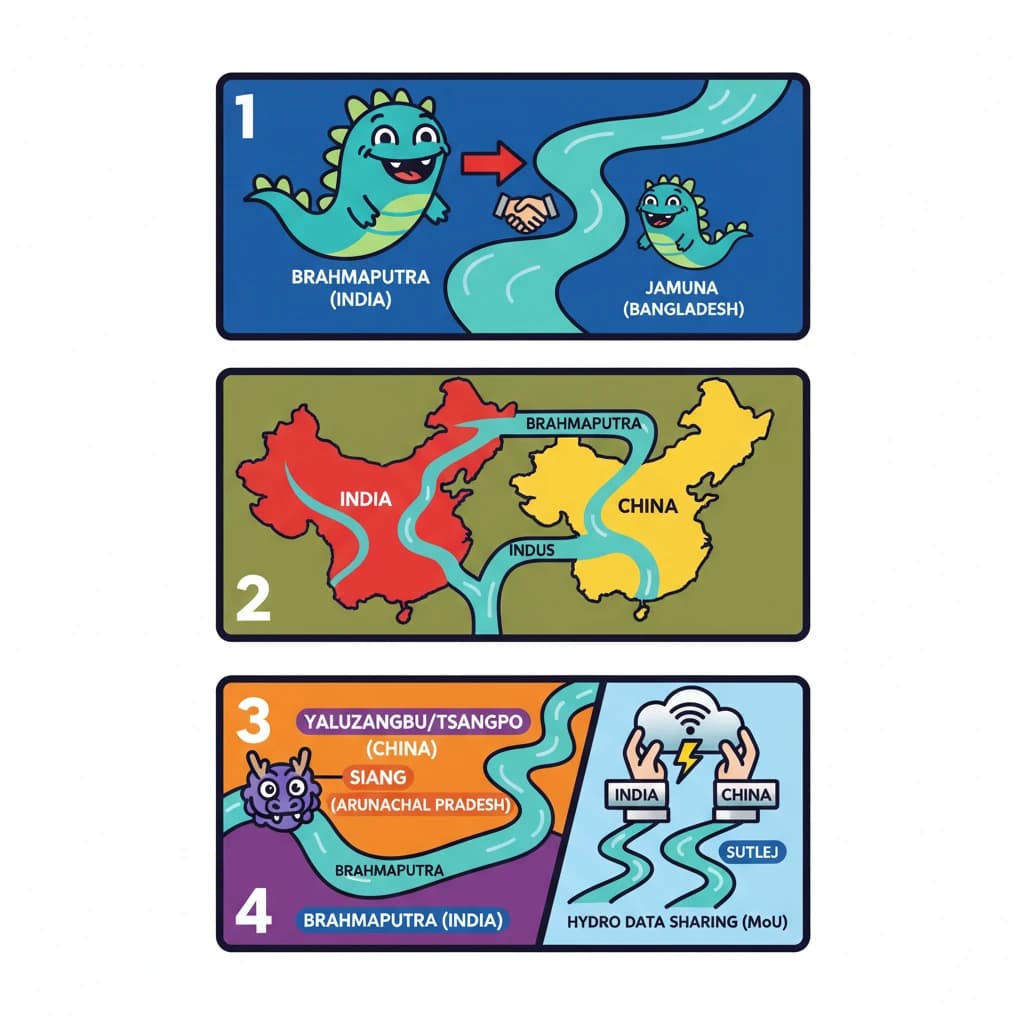
Memory Aid
95% Verified Content

Related Topics

Loading related topics...
Explore:Geography Topics·All Subjects·Daily Current Affairs·Editorial Analysis·Previous Year Questions·UPSC GPT
Jamuna (called Brahmaputra in India) - UPSC Geography