📖 Introduction
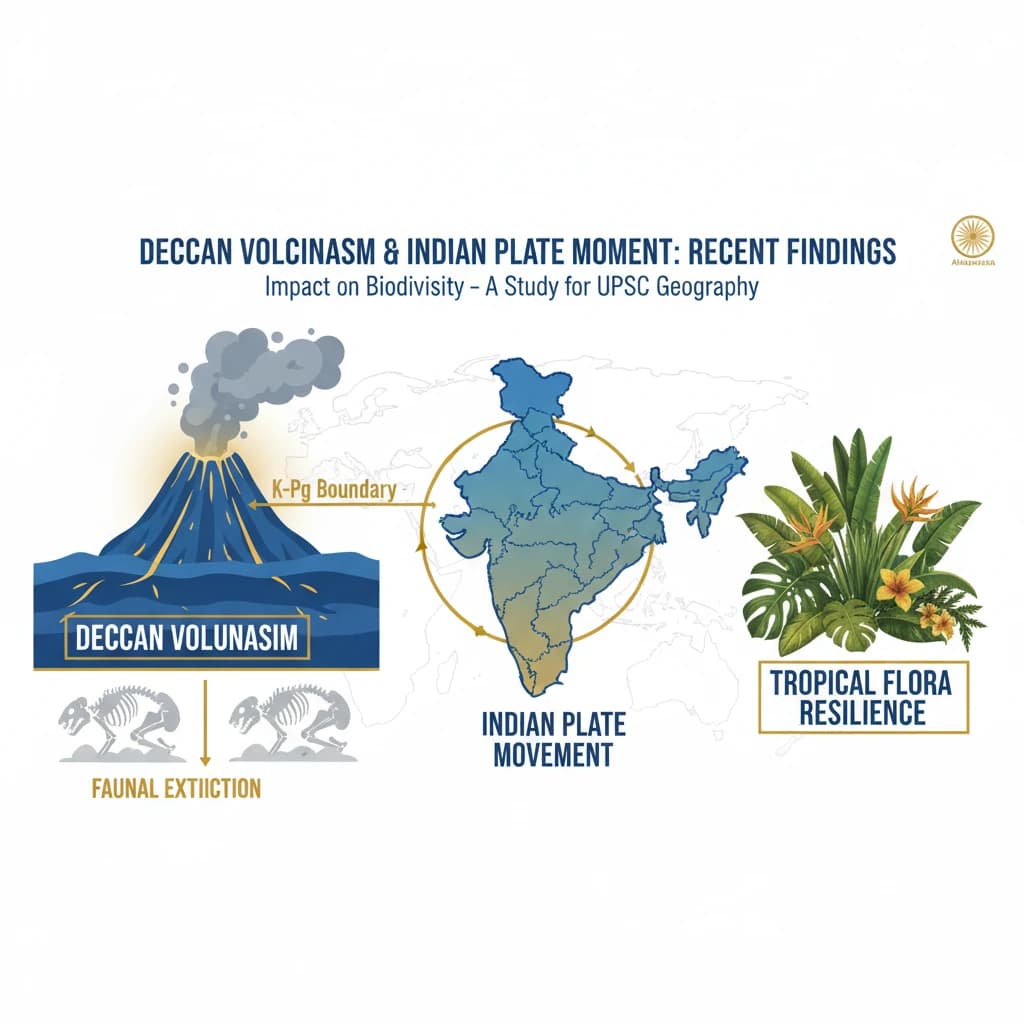
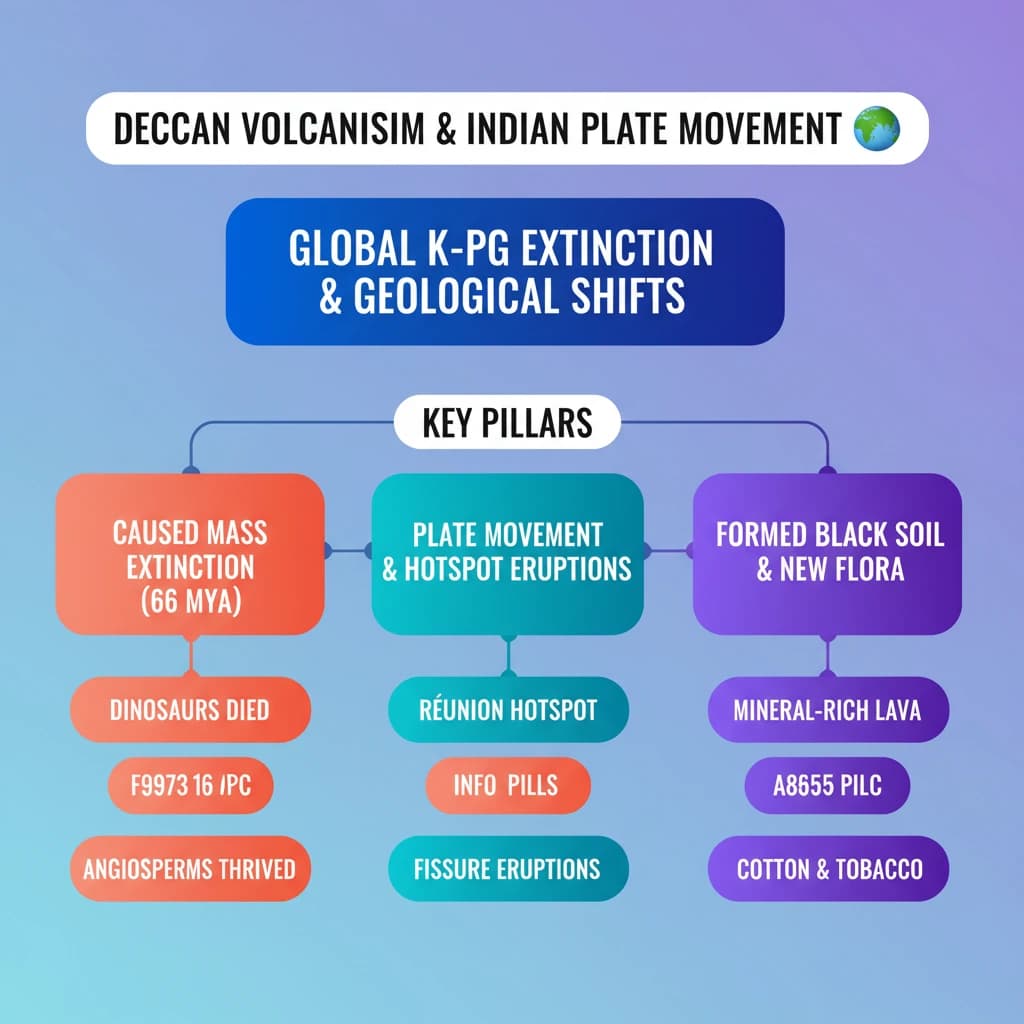
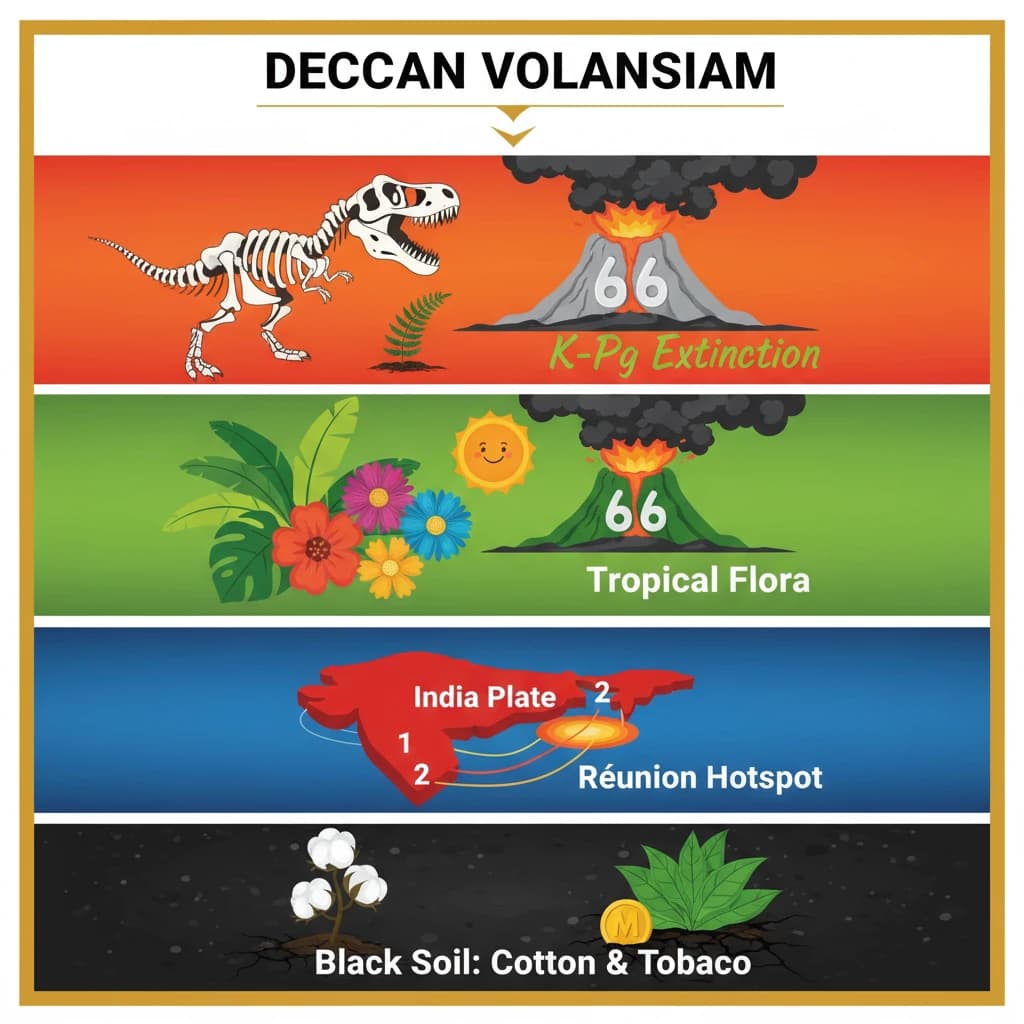
<h4>Context and Recent Study Findings</h4><p>A recent study has shed new light on the impact of <strong>Deccan Volcanism</strong> on the <strong>Indian Plate</strong>. The research indicates that while this massive volcanic activity led to widespread extinction of fauna, <strong>tropical flora</strong> demonstrated significant resilience.</p><p><strong>Mass extinctions</strong> are catastrophic events causing rapid loss of biodiversity. They are often triggered by factors like severe climate changes, asteroid impacts, or large-scale volcanic eruptions.</p><div class='exam-tip-box'><p><strong>UPSC Relevance:</strong> Understanding past mass extinction events like the <strong>K-Pg extinction</strong> provides crucial context for current biodiversity challenges and environmental studies (<strong>GS Paper 1 & 3</strong>).</p></div><h4>Impact on Fauna and Flora</h4><p>The <strong>Deccan Volcanism</strong> played a significant role in the mass extinction of <strong>dinosaurs</strong> and other associated fauna. It also negatively impacted <strong>gymnosperms</strong>, a group of primitive plants.</p><p>However, surprisingly, the volcanic activity supported a hyper-diverse <strong>tropical flora</strong>. It achieved this by creating fertile and relatively undisturbed habitats, which allowed <strong>angiosperms</strong> to thrive rather than face extinction.</p><p>A combination of a <strong>warm, humid climate</strong> during the volcanic period and the <strong>Indian Plate's movement through the equator</strong> significantly contributed to this flourishing floral diversity.</p><h4>Global and Regional Implications</h4><p>Globally, <strong>Deccan volcanism</strong> is recognized as a contributing factor to the <strong>Cretaceous-Paleogene (K-Pg) mass extinction event</strong>, which occurred approximately <strong>66 million years ago</strong>. This event famously led to the demise of <strong>ammonoids</strong> (invertebrate cephalopods) and <strong>dinosaurs</strong>.</p><p>Despite this global catastrophe, tropical rainforests on the <strong>Indian Plate</strong> adapted and flourished. This resilience highlights the inherent robustness of tropical flora when faced with severe climatic stresses.</p><div class='info-box'><p><strong>Tropical Flora:</strong> These are plant species that thrive in <strong>tropical regions</strong>, located between <strong>23.5° North and 23.5° South latitudes</strong>. These areas, found near the <strong>equator</strong> between the <strong>Tropic of Cancer</strong> and the <strong>Tropic of Capricorn</strong>, are characterized by consistently warm temperatures and high humidity year-round. Examples include <strong>Mahogany trees</strong>, <strong>Orchids</strong>, and <strong>Coconut palms</strong>.</p></div><div class='info-box'><p><strong>Gymnosperms:</strong> These plants produce <strong>'naked seeds'</strong>, meaning their seeds are not enclosed within an ovary. They are often found on cone-like structures and represent some of the oldest and most primitive plant forms.</p></div><div class='info-box'><p><strong>Angiosperms:</strong> Also known as <strong>flowering plants</strong>, angiosperms produce seeds that are enclosed within a fruit. After fertilization, the flower's ovary develops into a fruit containing the seeds.</p></div><h4>Deccan Volcanism Theory</h4><p>The <strong>Deccan Volcanism Theory</strong> posits that the massive volcanic eruptions responsible for forming the <strong>Deccan Traps</strong> played a crucial role in the mass extinction event around <strong>66 million years ago</strong>.</p><p>The <strong>Deccan Traps</strong> constitute a vast volcanic plateau situated in <strong>peninsular India</strong>. They were formed by extensive <strong>fissure volcanic eruptions</strong>.</p><div class='info-box'><p><strong>Fissure Volcanic Eruptions:</strong> This type of eruption occurs when magma emerges through long cracks or fissures in the Earth's crust, rather than through a single, central volcanic vent.</p></div><h4>Formation of Deccan Traps</h4><p>The formation of the <strong>Deccan Traps</strong> is attributed to intense volcanic activity driven by the <strong>Deccan mantle plume</strong>. This volcanic activity persisted for several hundred thousand years, depositing immense layers of lava.</p><div class='info-box'><p><strong>Mantle Plume:</strong> A <strong>mantle plume</strong> is a cylindrical upwelling of hot, molten rock originating from the Earth's mantle. These plumes are responsible for creating volcanic hotspots that are not directly linked to plate boundaries.</p></div><p>Today, the <strong>Deccan Traps</strong> are characterized by extensive layers of <strong>basaltic lava flows</strong>, which are the remnants of these colossal volcanic eruptions.</p><h4>Connection with Indian Plate Movement</h4><p>Historically, <strong>India</strong> was a large island positioned off the coast of <strong>Australia</strong>. It is believed that the <strong>Indian Plate</strong> commenced its northward journey approximately <strong>200 million years ago</strong>.</p><p>Beneath the <strong>Indian Plate</strong> lies the <strong>Réunion hotspot</strong>, which is a mantle plume of hot, molten rock originating from the Earth's interior. As the <strong>Indian Plate</strong> traversed over this <strong>Réunion hotspot</strong>, the resulting fissure volcanic eruptions led to the formation of the <strong>Deccan Traps</strong>.</p><div class='info-box'><p><strong>Réunion Hotspot:</strong> This is a significant volcanic hotspot located in the <strong>Indian Ocean</strong>, situated near the island of <strong>Réunion</strong> (a French overseas region). Its interaction with the moving Indian Plate is key to the Deccan Traps' origin.</p></div><h4>Economic Significance of Deccan Volcanism</h4><p>The geological legacy of <strong>Deccan Volcanism</strong> has several economic implications for India:</p><ul><li><strong>Major Rocks:</strong> The <strong>Deccan Traps</strong> are predominantly composed of <strong>basalt</strong>. In contrast, <strong>granite</strong> and <strong>gneiss</strong> are common in <strong>southern India</strong>, particularly in <strong>Karnataka</strong> and <strong>Tamil Nadu</strong>.</li><li><strong>Mineral Resources:</strong> The region is rich in mineral deposits. <strong>Iron ore</strong> is found in abundance in <strong>Karnataka</strong>, while <strong>bauxite</strong> deposits are significant in the <strong>Eastern Ghats</strong>.</li><li><strong>Agriculture:</strong> The weathering of volcanic rocks, especially <strong>basalt</strong>, gives rise to <strong>Black soil (Regur soil)</strong>. This soil is rich in minerals like <strong>iron, magnesium, calcium, and potassium</strong>, making it highly fertile and ideal for cultivating crops such as <strong>cotton</strong> and <strong>tobacco</strong>.</li></ul>