Loading page, please wait…
Gulf of Aden and Red Sea - UPSC Geography
What is Gulf of Aden and Red Sea in UPSC Geography?
Gulf of Aden and Red Sea is a key topic under Geography for UPSC Civil Services Examination. Key points include: Gulf of Aden and Red Sea are critical global maritime arteries, linking the Indian Ocean to the Mediterranean via the Suez Canal.. Bab el Mandeb Strait is a vital choke point connecting the Gulf of Aden and Red Sea.. The Red Sea is geologically unique, part of the Great Rift Valley, formed by a divergent plate boundary.. Understanding this topic is essential for both UPSC Prelims and Mains preparation.
Why is Gulf of Aden and Red Sea important for UPSC exam?
Gulf of Aden and Red Sea is a Medium-level topic in UPSC Geography. It is tested in both Prelims (factual MCQs) and Mains (analytical answer writing). Previous year UPSC questions have frequently covered aspects of Gulf of Aden and Red Sea, making it essential for comprehensive IAS preparation.
How to prepare Gulf of Aden and Red Sea for UPSC?
To prepare Gulf of Aden and Red Sea for UPSC: (1) Study the comprehensive notes covering all key concepts on Vaidra. (2) Practice previous year questions on this topic. (3) Connect it with current affairs using daily updates. (4) Revise using key takeaways and mind maps available for Geography. (5) Write practice answers linking Gulf of Aden and Red Sea to related GS Paper topics.
Key takeaways of Gulf of Aden and Red Sea for UPSC
- Gulf of Aden and Red Sea are critical global maritime arteries, linking the Indian Ocean to the Mediterranean via the Suez Canal.
- Bab el Mandeb Strait is a vital choke point connecting the Gulf of Aden and Red Sea.
- The Red Sea is geologically unique, part of the Great Rift Valley, formed by a divergent plate boundary.
- Region faces threats from piracy, terrorism, and regional conflicts, impacting global trade and energy security.
- India has significant economic and strategic interests, leading to active naval presence and diplomatic engagements.
- Naval Civilians are crucial non-uniformed personnel supporting the Navy's operational capabilities.
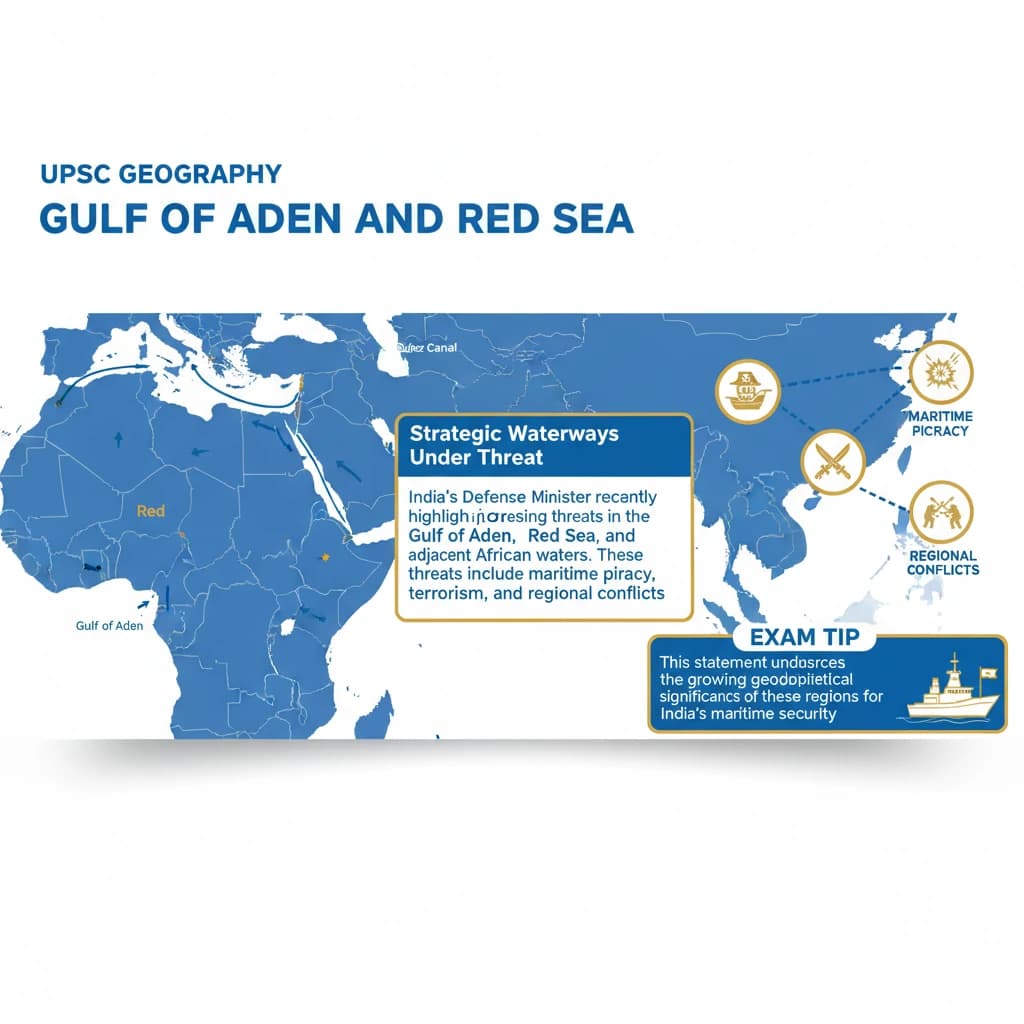
Gulf of Aden and Red Sea
Medium⏱️ 8 min read
geography
📖 Introduction
Introduction: Strategic Waterways Under Threat
India's Defence Minister recently highlighted increasing threats in the Gulf of Aden, Red Sea, and adjacent East African waters. These threats include maritime piracy, terrorism, and regional conflicts.
This statement underscores the growing geopolitical significance of these regions for India's maritime security and trade, a crucial topic for UPSC Mains GS-II (International Relations) and GS-III (Internal Security).
The 'Year of Naval Civilians'
The year 2024 was designated as the 'Year of Naval Civilians'. These individuals constitute approximately one-third of the Indian Navy's workforce.
Naval Civilians are essential personnel, often working without uniforms, who provide critical technical assistance, administrative management, and logistics support, significantly bolstering the operational strength of uniformed troops.
📍 Gulf of Aden: An Overview
The Gulf of Aden is a vital extension of the Indian Ocean. It is strategically positioned between the Arabian Peninsula to its north and the African continent to its south.
Location Boundaries:
- South: Somalia and the Socotra Islands
- North: Yemen
- East: Arabian Sea
- West: Djibouti
It forms a crucial link, connecting to the Somali Sea via the Guardafui Channel and to the Red Sea through the narrow Strait of Bab el Mandeb.
Economic Importance: The Gulf of Aden is a major global maritime artery. Approximately 10% of global seaborne petroleum transits through this gulf. Furthermore, over USD 110 billion of India’s trade relies on this passage.
📍 Red Sea: A Tropical Rift Sea
The Red Sea holds the distinction of being the world’s northernmost tropical sea. It is geologically unique, underlain by the Red Sea Rift, making it an integral part of the larger Great Rift Valley system.
The distinctive name Red Sea is believed to originate from the seasonal proliferation of a specific red-colored cyanobacteria, scientifically known as Trichodesmium erythraeum.
The Red Sea Rift represents a divergent plate boundary, where the African Plate and the Arabian Plate are moving apart. This geological feature extends from East Africa into the Middle East.
Location and Connections:
- The Red Sea is a semi-enclosed extension of the Indian Ocean, situated between the continents of Africa and Asia.
- In the south, it connects to the Indian Ocean and Arabian Sea via the Bab el Mandeb Strait and the Gulf of Aden.
- In the north, it branches into two gulfs at the Sinai Peninsula: the Gulf of Aqaba and the Gulf of Suez. The Gulf of Suez further connects to the Mediterranean Sea through the strategically important Suez Canal.
💡 Key Takeaways
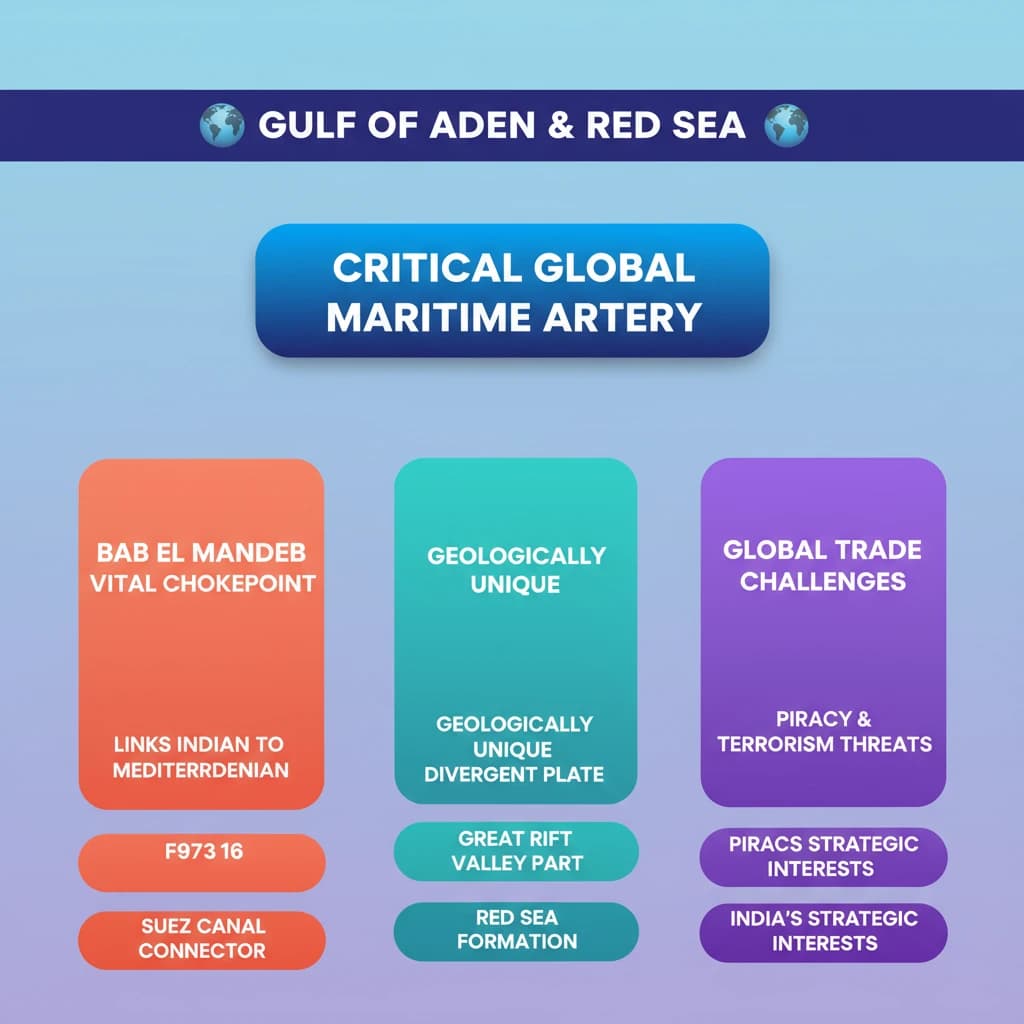
- •Gulf of Aden and Red Sea are critical global maritime arteries, linking the Indian Ocean to the Mediterranean via the Suez Canal.
- •Bab el Mandeb Strait is a vital choke point connecting the Gulf of Aden and Red Sea.
- •The Red Sea is geologically unique, part of the Great Rift Valley, formed by a divergent plate boundary.
- •Region faces threats from piracy, terrorism, and regional conflicts, impacting global trade and energy security.
- •India has significant economic and strategic interests, leading to active naval presence and diplomatic engagements.
- •Naval Civilians are crucial non-uniformed personnel supporting the Navy's operational capabilities.
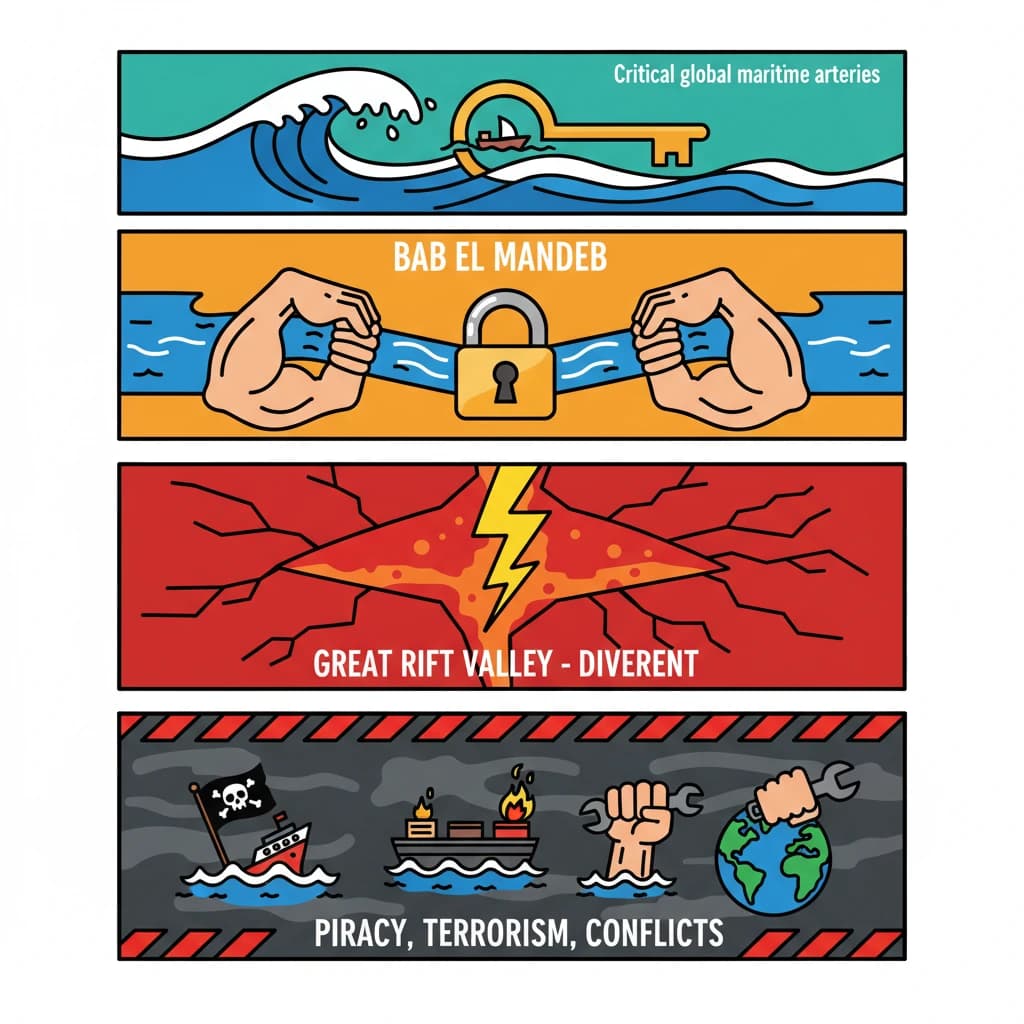
🧠 Memory Techniques
95% Verified Content
📚 Reference Sources
•Ministry of Defence, Government of India (for 'Year of Naval Civilians')
•UNCLOS (United Nations Convention on the Law of the Sea)
•International Maritime Organization (IMO) reports on piracy