Loading page, please wait…
How are Landslides in Himalayan Region Different from Landslides in Western Ghats? - UPSC Geography
What is How are Landslides in Himalayan Region Different from Landslides in Western Ghats? in UPSC Geography?
How are Landslides in Himalayan Region Different from Landslides in Western Ghats? is a key topic under Geography for UPSC Civil Services Examination. Key points include: Himalayan landslides are driven by high tectonic activity, steep slopes, unconsolidated debris, and snowmelt, in addition to heavy rainfall and deforestation.. Western Ghats landslides are primarily rainfall-induced on less steep but dual-layered, lateritic slopes, with less tectonic influence.. Anthropogenic factors like deforestation and construction exacerbate landslide risks in both regions.. Understanding this topic is essential for both UPSC Prelims and Mains preparation.
Why is How are Landslides in Himalayan Region Different from Landslides in Western Ghats? important for UPSC exam?
How are Landslides in Himalayan Region Different from Landslides in Western Ghats? is a Medium-level topic in UPSC Geography. It is tested in both Prelims (factual MCQs) and Mains (analytical answer writing). Previous year UPSC questions have frequently covered aspects of How are Landslides in Himalayan Region Different from Landslides in Western Ghats?, making it essential for comprehensive IAS preparation.
How to prepare How are Landslides in Himalayan Region Different from Landslides in Western Ghats? for UPSC?
To prepare How are Landslides in Himalayan Region Different from Landslides in Western Ghats? for UPSC: (1) Study the comprehensive notes covering all key concepts on Vaidra. (2) Practice previous year questions on this topic. (3) Connect it with current affairs using daily updates. (4) Revise using key takeaways and mind maps available for Geography. (5) Write practice answers linking How are Landslides in Himalayan Region Different from Landslides in Western Ghats? to related GS Paper topics.
Key takeaways of How are Landslides in Himalayan Region Different from Landslides in Western Ghats? for UPSC
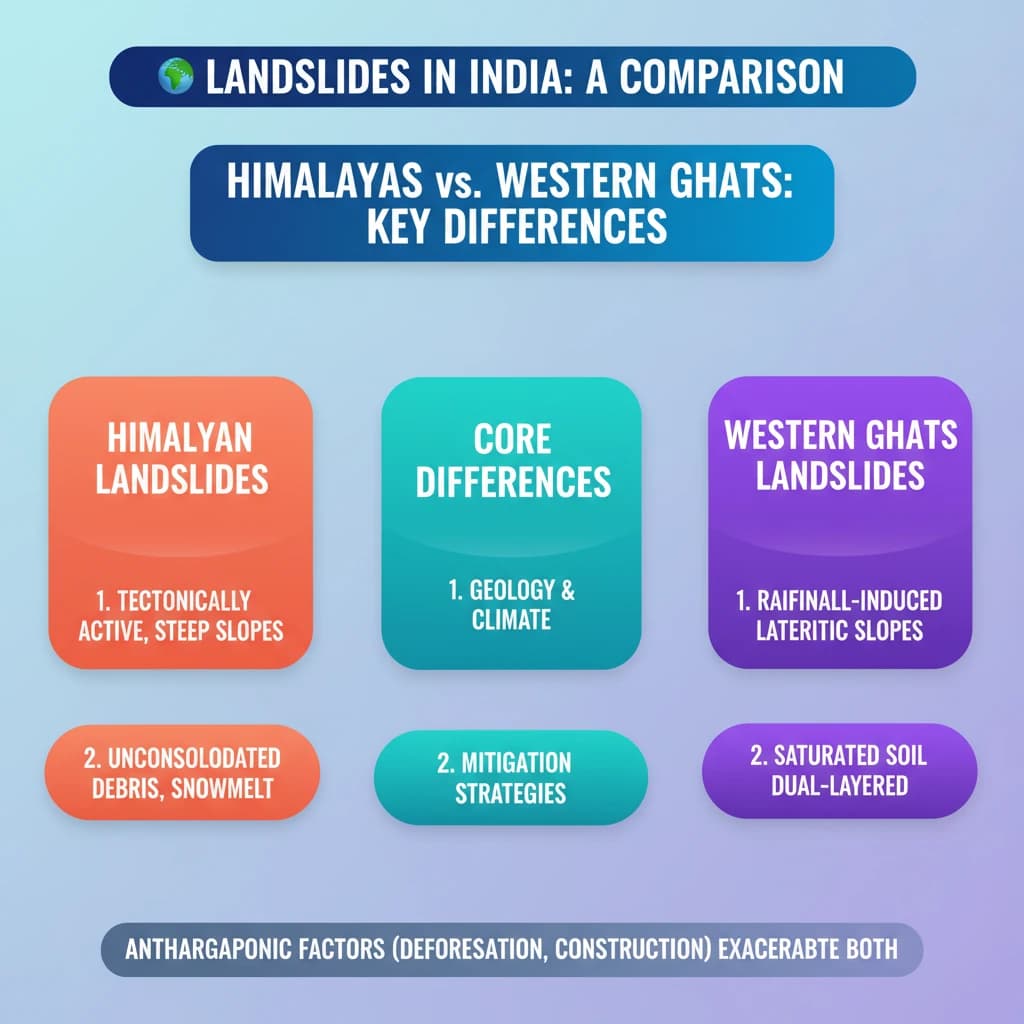
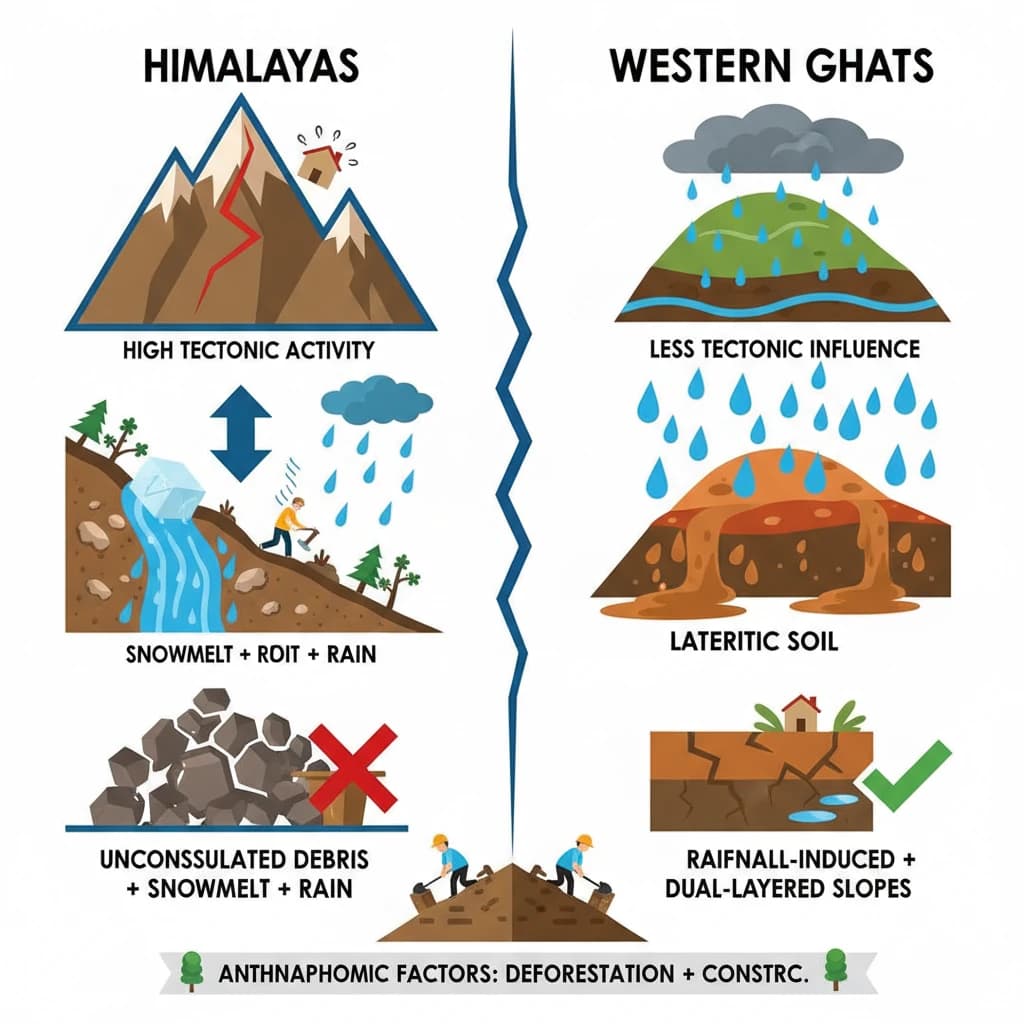
- Himalayan landslides are driven by high tectonic activity, steep slopes, unconsolidated debris, and snowmelt, in addition to heavy rainfall and deforestation.
- Western Ghats landslides are primarily rainfall-induced on less steep but dual-layered, lateritic slopes, with less tectonic influence.
- Anthropogenic factors like deforestation and construction exacerbate landslide risks in both regions.
- Soil and rock composition (fragile in Himalayas, stable but saturated in Western Ghats) are key differentiating geological factors.
- Effective mitigation requires region-specific strategies, integrating geological, climatic, and human factors.
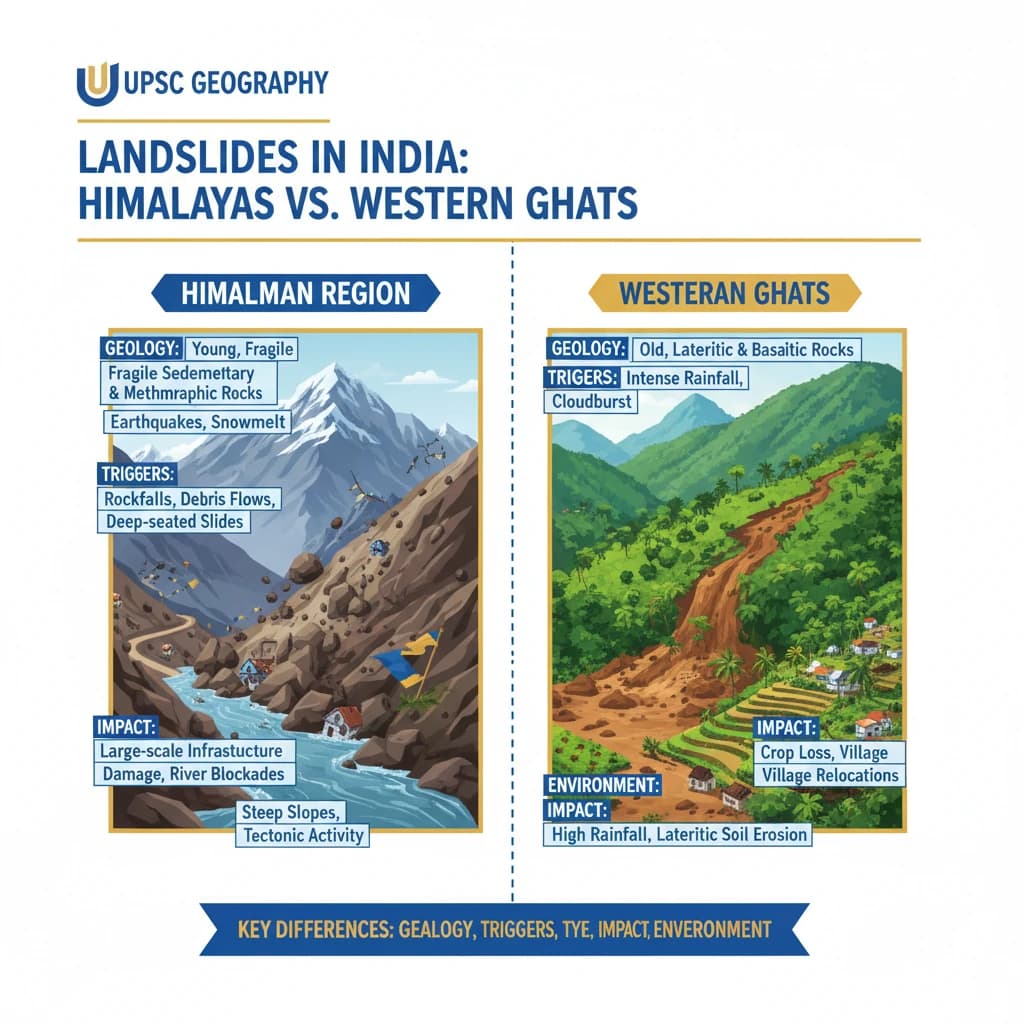
How are Landslides in Himalayan Region Different from Landslides in Western Ghats?
Medium⏱️ 10 min read
geography
📖 Introduction
Introduction to Landslides
A landslide is a form of mass wasting that involves the movement of a mass of rock, debris, or earth down a slope. These natural hazards are significantly influenced by a combination of geological, climatic, and anthropogenic factors, leading to distinct characteristics across different geographical regions.
In India, the Himalayan region and the Western Ghats are two prominent zones highly susceptible to landslides. However, the underlying causes and manifestations of these events differ considerably between the two.
Anthropogenic Factors
Anthropogenic factors play a crucial role in exacerbating slope instability in both the Himalayas and the Western Ghats. Human activities often disrupt the natural equilibrium of slopes, increasing landslide risks.
Deforestation is a primary concern. The removal of vegetation and tree roots significantly destabilizes slopes by eliminating the natural reinforcement provided by root systems and impairing the soil's capacity for water drainage.
Activities such as mining, road construction, and urban development further contribute to the problem. These activities disrupt natural drainage patterns and alter the load distribution on slopes, substantially raising the likelihood of landslides.
Geological Factors
Geological factors are fundamental in determining the inherent stability of slopes. These include the material composition, structure, and degree of weathering of the rocks and soil present in a region.
The Western Ghats, for instance, are characterized by steep, dual-layered terrain. This geological structure makes them particularly prone to landslides when heavy monsoon rainwater saturates the soil, which increases its weight and simultaneously reduces its overall stability.
Comparative Analysis: Himalayas vs. Western Ghats
Landslides in India exhibit distinct characteristics based on their geographical location. A comparative analysis of the Himalayan region and the Western Ghats reveals significant differences in their underlying causes and manifestations.
Understanding these regional variations is crucial for effective disaster management and mitigation strategies.
| Cause | Himalayas | Western Ghats |
|---|---|---|
| Slope and Terrain | Steep, rugged terrain with high-altitude, unstable slopes. | Less steep and more gradual slopes, which generally reduces landslide risk compared to the Himalayas. |
| Tectonic Activity | Highly tectonically active region due to the ongoing collision of the Indian and Eurasian plates. This frequently triggers earthquakes, which are major landslide initiators. | Less tectonic activity, resulting in minimal earthquake-triggered landslides. |
| Rainfall and Snowmelt | Heavy monsoon rainfall combined with rapid snowmelt from glaciers. This significantly increases soil saturation and instability, leading to frequent landslides. | Heavy rainfall during the monsoon season is a primary trigger. However, there is no snowmelt component, which differentiates the landslide triggers from the Himalayas. |
| Soil and Rock Composition | Characterized by unconsolidated debris (such as scree and moraine) and fragile rock formations. These are inherently prone to displacement and collapse. | Composed of more stable soil and rock types, which generally reduces the frequency of landslide occurrences. |
| Deforestation | High rates of deforestation for agriculture, timber, and fuel. This widespread removal of forest cover significantly weakens soil cohesion and stability. | Comparatively less deforestation than the Himalayas. However, it remains a significant environmental concern and a contributing factor to landslides in localized areas. |
For UPSC Mains, a comparative table like this is an excellent way to present information concisely and score well. Remember to highlight the underlying geological and climatic differences.
💡 Key Takeaways
- •Himalayan landslides are driven by high tectonic activity, steep slopes, unconsolidated debris, and snowmelt, in addition to heavy rainfall and deforestation.
- •Western Ghats landslides are primarily rainfall-induced on less steep but dual-layered, lateritic slopes, with less tectonic influence.
- •Anthropogenic factors like deforestation and construction exacerbate landslide risks in both regions.
- •Soil and rock composition (fragile in Himalayas, stable but saturated in Western Ghats) are key differentiating geological factors.
- •Effective mitigation requires region-specific strategies, integrating geological, climatic, and human factors.
🧠 Memory Techniques
95% Verified Content
📚 Reference Sources
•Geological Survey of India (GSI) publications on Landslides
•NCERT Geography Textbooks (Class XI - Physical Geography)
•Drishti IAS Summary (provided as source material)