Loading page, please wait…
Including Non-Mineralised Areas in Mining Leases - UPSC Geography
What is Including Non-Mineralised Areas in Mining Leases in UPSC Geography?
Including Non-Mineralised Areas in Mining Leases is a key topic under Geography for UPSC Civil Services Examination. Key points include: Centre now allows non-mineralised areas within mining leases for waste dumping, streamlining operations.. This is supported by MMDR Act, 1957, Mines Act, 1952, and Mineral Concession Rules, 2016.. Supreme Court's July 2024 ruling overturned its 1989 verdict, empowering states to tax mineral rights (Entry 50, State List).. Understanding this topic is essential for both UPSC Prelims and Mains preparation.
Why is Including Non-Mineralised Areas in Mining Leases important for UPSC exam?
Including Non-Mineralised Areas in Mining Leases is a Medium-level topic in UPSC Geography. It is tested in both Prelims (factual MCQs) and Mains (analytical answer writing). Previous year UPSC questions have frequently covered aspects of Including Non-Mineralised Areas in Mining Leases, making it essential for comprehensive IAS preparation.
How to prepare Including Non-Mineralised Areas in Mining Leases for UPSC?
To prepare Including Non-Mineralised Areas in Mining Leases for UPSC: (1) Study the comprehensive notes covering all key concepts on Vaidra. (2) Practice previous year questions on this topic. (3) Connect it with current affairs using daily updates. (4) Revise using key takeaways and mind maps available for Geography. (5) Write practice answers linking Including Non-Mineralised Areas in Mining Leases to related GS Paper topics.
Key takeaways of Including Non-Mineralised Areas in Mining Leases for UPSC
- Centre now allows non-mineralised areas within mining leases for waste dumping, streamlining operations.
- This is supported by MMDR Act, 1957, Mines Act, 1952, and Mineral Concession Rules, 2016.
- Supreme Court's July 2024 ruling overturned its 1989 verdict, empowering states to tax mineral rights (Entry 50, State List).
- The 2014 Goa Foundation case prohibited dumping outside valid lease areas, emphasizing environmental protection.
- MMDR Act, 1957, is pivotal; its 2015 amendment introduced auction, DMF, NMET, and 2021 amendment liberalized captive mines.
Including Non-Mineralised Areas in Mining Leases
Medium⏱️ 8 min read
geography
📖 Introduction
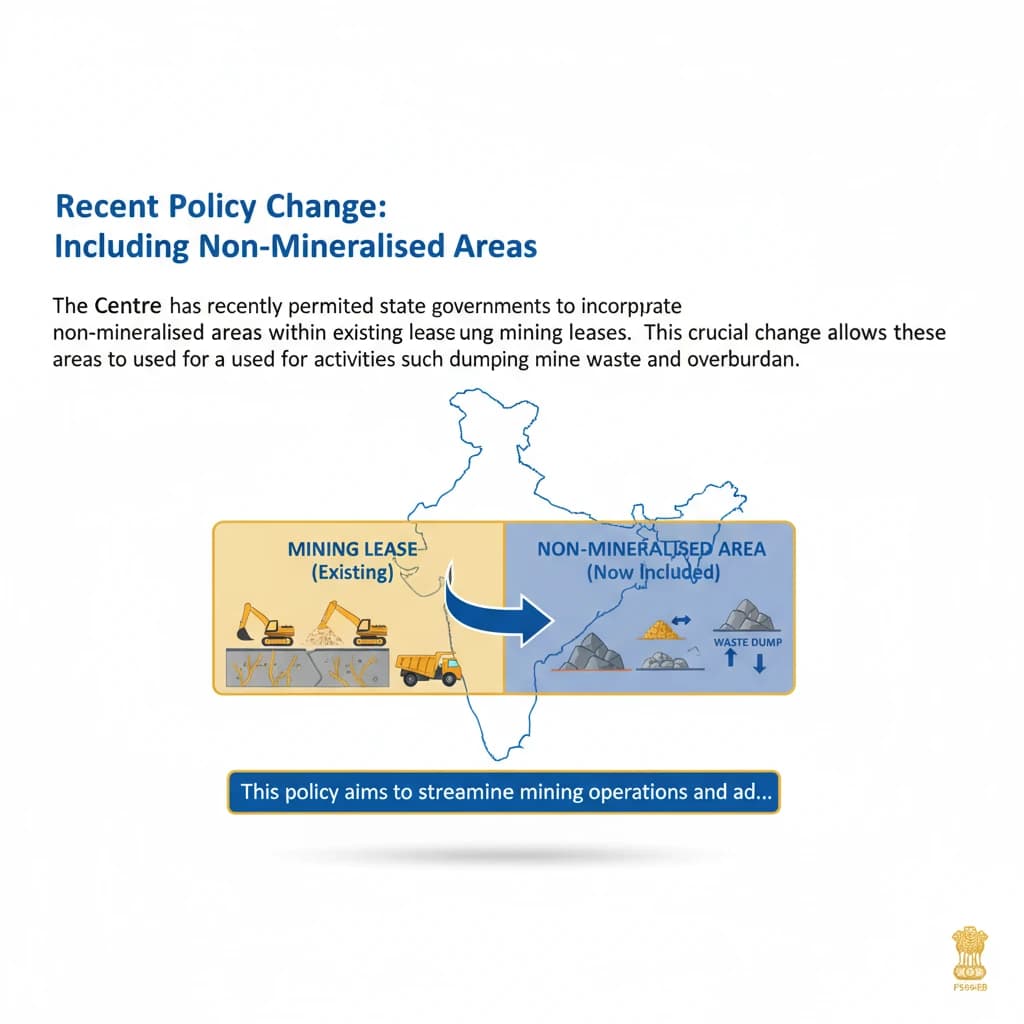
Recent Policy Change: Including Non-Mineralised Areas
The Centre has recently permitted state governments to incorporate non-mineralised areas within existing mining leases. This crucial change allows these areas to be used for activities such as dumping mine waste and overburden.
This policy aims to streamline mining operations and address long-standing industry challenges related to waste disposal. It represents a significant step towards practical and efficient resource management.
Legal Basis for the Policy Clarification
The Ministry of Mines clarified that the inclusion of non-mineralised areas for ancillary activities like waste disposal is permissible under the existing legal framework.
The interpretation is rooted in the Mines and Minerals (Development and Regulation) Act, 1957 (MMDR Act). Further support comes from the Mines Act, 1952, and Rule 57 of the Mineral Concession Rules, 2016, which collectively allow for ancillary zones within a lease area.
Supreme Court Rulings: Regulating Mining and Minerals
The Supreme Court has delivered several landmark judgments shaping the regulatory landscape of India's mining sector, particularly concerning the division of powers between the Centre and states.
Historical Ruling: Centre's Primary Authority (1989)
In 1989, a seven-judge Bench in the case of Orissa Cement Ltd. vs the State of Tamil Nadu ruled that mineral regulation falls primarily under the Centre’s authority.
This authority was established through the Mines and Minerals (Development and Regulation) Act, 1957, and was aligned with Entry 54 of the Union List in the Constitution.
State Authority on Taxes (Pre-2024)
In State of Orissa v. M.A. Tulloch & Co., it was held that states could only collect royalties, not impose additional taxes, as royalties were then classified as taxes.
A 2004 judgment in State of West Bengal v. Kesoram Industries Ltd. Case questioned this classification, leading to a review by a larger bench.
Overruling the 1989 Verdict: States' Power to Tax (July 2024)
In July 2024, the Supreme Court delivered a significant ruling, overturning its 1989 judgment. This new verdict asserted the states' power to tax mineral rights under Entry 50 of List II (State List).
While granting this power, the Court limited Parliament’s role to imposing constraints to ensure that mineral development is not hindered. Some judges, however, expressed concerns that unchecked state taxation could disrupt federal uniformity in mineral pricing and development, urging Parliament to intervene for consistency.
Goa Foundation v. Union of India Case, 2014: Against External Dumping
The Supreme Court in the Goa Foundation v. Union of India Case, 2014, issued a strict directive against dumping mine waste or overburden outside the boundaries of valid mining leases.
This ruling aimed to prevent environmental and legal violations and emphasized the protection of non-lease areas from mining-related activities. It reinforced compliance with the Mines and Minerals (Development and Regulation) Act, 1957, and other related laws.
This case highlighted the judiciary's role in environmental protection and the importance of adhering to lease boundaries for waste management, a critical point for UPSC Mains GS-III Environment.
Impact on Mining Practices (Post-2014)
Following the Goa Foundation ruling, mining operations were mandated to include waste management strategies strictly within their leased areas. This prompted significant changes in planning and allocation processes within the industry.
Mines and Minerals (Development and Regulation) Act, 1957 (MMDR Act)
The MMDR Act, 1957, is the pivotal legislation governing India’s mining sector. Its primary objective is to develop the industry, conserve minerals, and ensure transparency and efficiency in mineral exploitation.
Initial Objectives of MMDR Act
Initially, the Act focused on promoting mining, conserving resources, and regulating concessions through a system of licenses and leases.
2015 Amendment: Key Reforms
The 2015 Amendment introduced significant reforms to the MMDR Act, enhancing transparency and social responsibility.
- Auction Method: Introduced for granting mineral concessions, promoting transparency.
- District Mineral Foundation (DMF): Established to work for the welfare of mining-affected areas.
- National Minerals Exploration Trust (NMET): Created to boost exploration activities.
- Stringent Penalties: Imposed for illegal mining to deter unauthorized extraction.
2021 Amendment: Captive Mines Liberalization
The 2021 Amendment brought further changes, particularly for captive mines. These mines are operated by companies to extract minerals for their own industrial use.
The amendment allowed captive mines to sell up to 50% of their annual production in the open market after fulfilling the requirements of their end-use plant. This move aimed to liberalize the mining sector and improve mineral availability.
💡 Key Takeaways
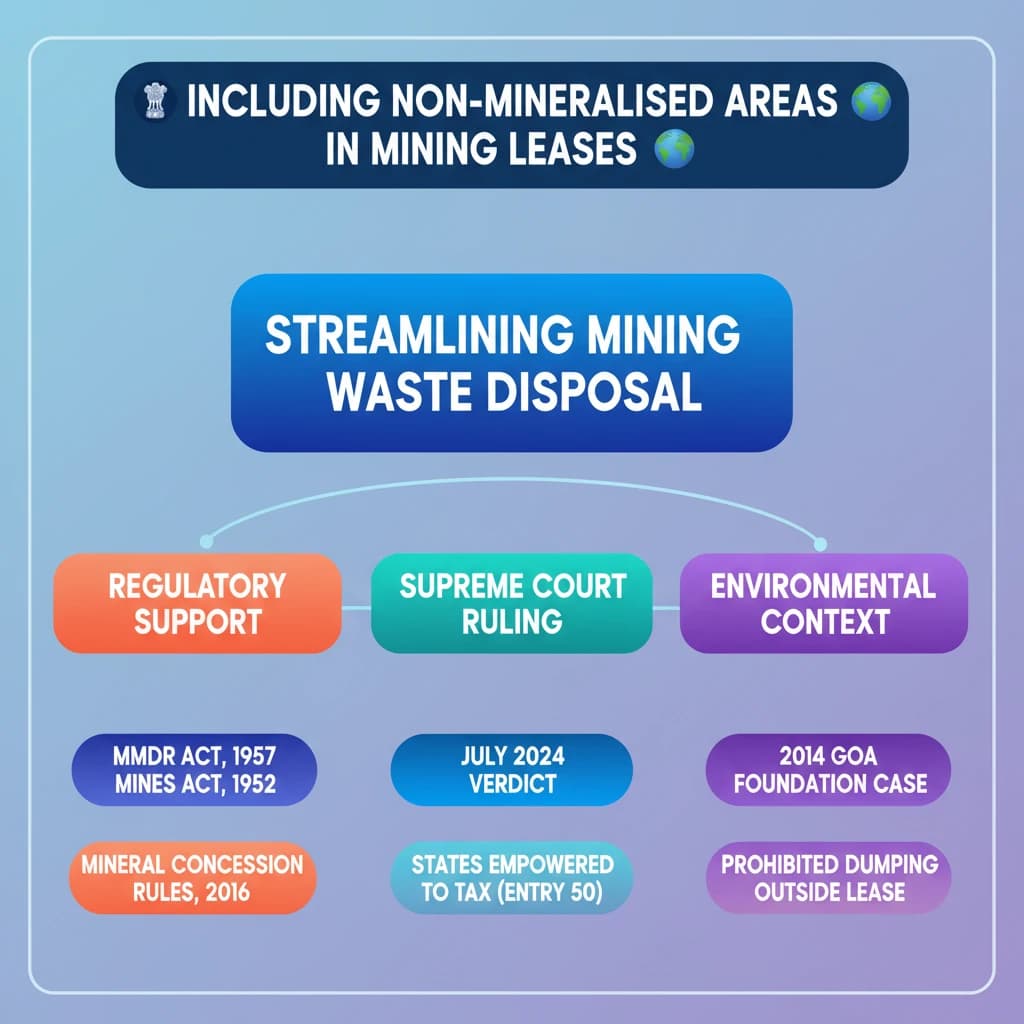
- •Centre now allows non-mineralised areas within mining leases for waste dumping, streamlining operations.
- •This is supported by MMDR Act, 1957, Mines Act, 1952, and Mineral Concession Rules, 2016.
- •Supreme Court's July 2024 ruling overturned its 1989 verdict, empowering states to tax mineral rights (Entry 50, State List).
- •The 2014 Goa Foundation case prohibited dumping outside valid lease areas, emphasizing environmental protection.
- •MMDR Act, 1957, is pivotal; its 2015 amendment introduced auction, DMF, NMET, and 2021 amendment liberalized captive mines.
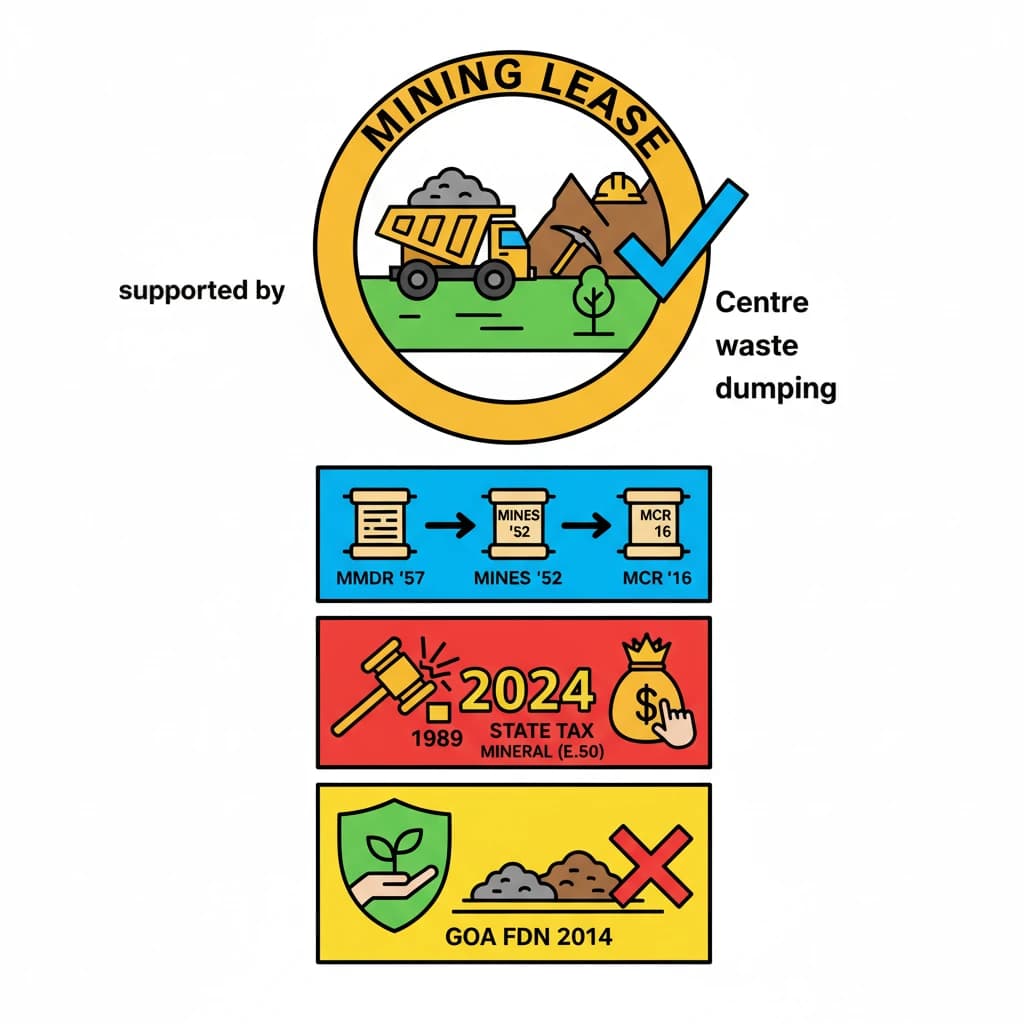
🧠 Memory Techniques
95% Verified Content