Loading page, please wait…
India Joins Sri Lanka in Seabed Mining Race - UPSC Geography
What is India Joins Sri Lanka in Seabed Mining Race in UPSC Geography?
India Joins Sri Lanka in Seabed Mining Race is a key topic under Geography for UPSC Civil Services Examination. Key points include: India applied to ISA for seabed exploration rights in the Indian Ocean, targeting the cobalt-rich Afanasy Nikitin Seamount (AN Seamount).. The move is driven by strategic resource needs and concerns over Chinese reconnaissance in the region.. AN Seamount is a 400x150 km feature in the Central Indian Basin, 1500 km from India's coast, rich in cobalt, nickel, manganese, and copper.. Understanding this topic is essential for both UPSC Prelims and Mains preparation.
Why is India Joins Sri Lanka in Seabed Mining Race important for UPSC exam?
India Joins Sri Lanka in Seabed Mining Race is a Medium-level topic in UPSC Geography. It is tested in both Prelims (factual MCQs) and Mains (analytical answer writing). Previous year UPSC questions have frequently covered aspects of India Joins Sri Lanka in Seabed Mining Race, making it essential for comprehensive IAS preparation.
How to prepare India Joins Sri Lanka in Seabed Mining Race for UPSC?
To prepare India Joins Sri Lanka in Seabed Mining Race for UPSC: (1) Study the comprehensive notes covering all key concepts on Vaidra. (2) Practice previous year questions on this topic. (3) Connect it with current affairs using daily updates. (4) Revise using key takeaways and mind maps available for Geography. (5) Write practice answers linking India Joins Sri Lanka in Seabed Mining Race to related GS Paper topics.
Key takeaways of India Joins Sri Lanka in Seabed Mining Race for UPSC
- India applied to ISA for seabed exploration rights in the Indian Ocean, targeting the cobalt-rich Afanasy Nikitin Seamount (AN Seamount).
- The move is driven by strategic resource needs and concerns over Chinese reconnaissance in the region.
- AN Seamount is a 400x150 km feature in the Central Indian Basin, 1500 km from India's coast, rich in cobalt, nickel, manganese, and copper.
- Exploration requires a license from the International Seabed Authority (ISA), an autonomous body under UNCLOS.
- Seabed mining in the open ocean (60% of world's seas) is challenging due to high costs and technical complexities.
India Joins Sri Lanka in Seabed Mining Race
Medium⏱️ 7 min read
geography
📖 Introduction
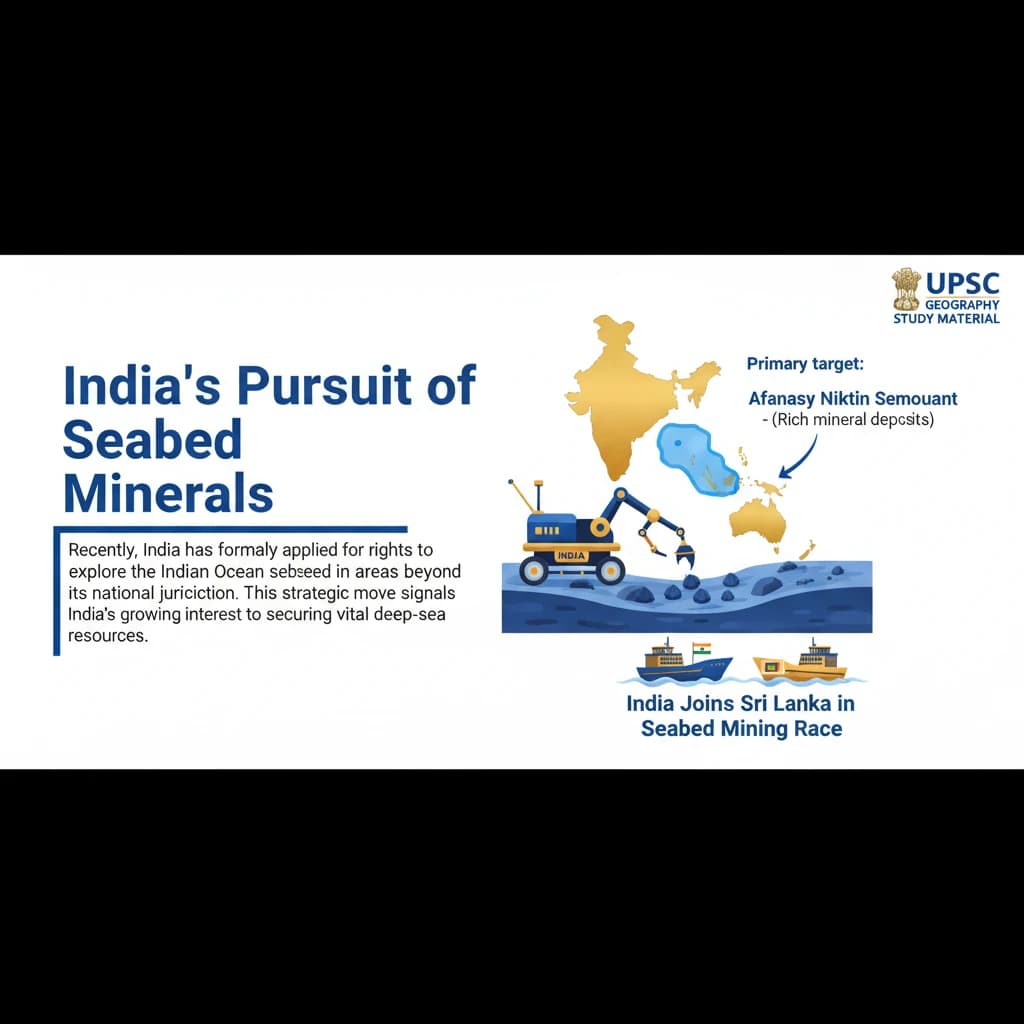
India's Pursuit of Seabed Minerals
Recently, India has formally applied for rights to explore the Indian Ocean seabed in areas beyond its national jurisdiction. This strategic move signals India's growing interest in securing vital deep-sea resources.
The primary target for India's exploration is the Afanasy Nikitin Seamount (AN Seamount), known for its rich mineral deposits. This application underscores India's proactive approach to resource security.
Strategic Motivations and Geopolitical Context
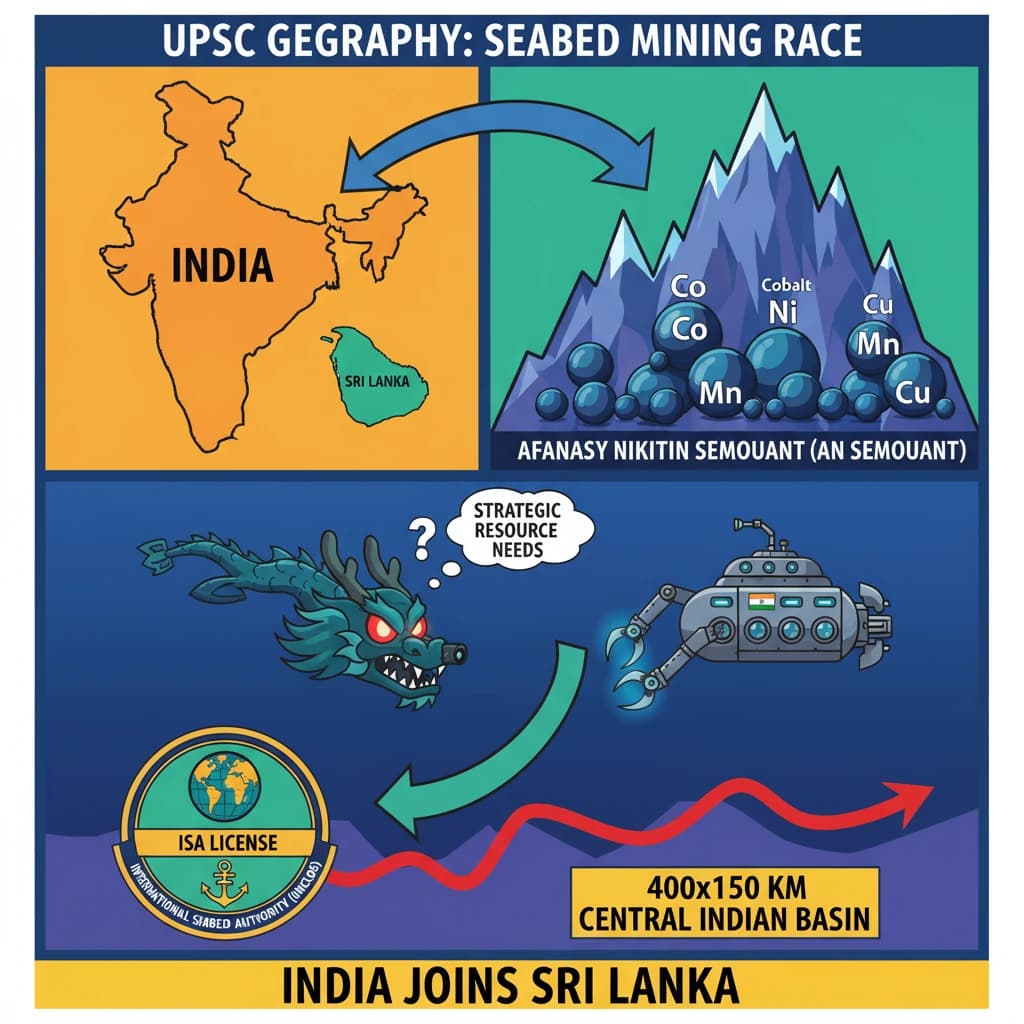
India's heightened interest in seabed exploration is significantly influenced by geopolitical concerns. There have been reports of Chinese vessels conducting reconnaissance activities in the same region, prompting India to accelerate its own efforts.
UPSC Insight: The 'Why in News' section often highlights contemporary geopolitical shifts. Understanding the motivations behind such actions (e.g., resource security, countering rival influence) is crucial for GS-II (International Relations) and GS-III (Economy, Security).
Complicating the situation, Sri Lanka has already laid claim to rights in parts of this region under a separate set of international laws. This creates a potential overlap of interests in the resource-rich Indian Ocean basin.
Understanding the Afanasy Nikitin Seamount (AN Seamount)
- Location: The AN Seamount is a significant structural feature situated in the Central Indian Basin.
- Distance: It lies approximately 1,500 km away from India's coast.
- Dimensions: The seamount is roughly 400 km long and 150 km wide.
- Depth Profile: It rises from an oceanic depth of about 4,800 meters to approximately 1,200 meters below the surface.
- Mineral Riches: The AN Seamount is particularly rich in valuable mineral deposits, including cobalt, nickel, manganese, and copper.
Regulatory Framework for Seabed Mining
To proceed with the extraction of minerals from the deep seabed, any interested party or country must first secure an exploration license. This license is issued by the International Seabed Authority (ISA).
The International Seabed Authority (ISA) is an autonomous intergovernmental body established under the United Nations Convention on the Law of the Sea (UNCLOS). It is responsible for organizing, regulating, and controlling all mineral-related activities in the international seabed area beyond the limits of national jurisdiction.
These exploration and extraction rights are specifically applicable to areas designated as the open ocean, also known as the high seas. These regions fall outside the exclusive economic zones of individual nations.
The open ocean constitutes approximately 60% of the world's seas. While these vast areas are believed to hold significant mineral wealth, the practical challenges and prohibitive costs associated with deep-sea extraction remain substantial barriers.
💡 Key Takeaways
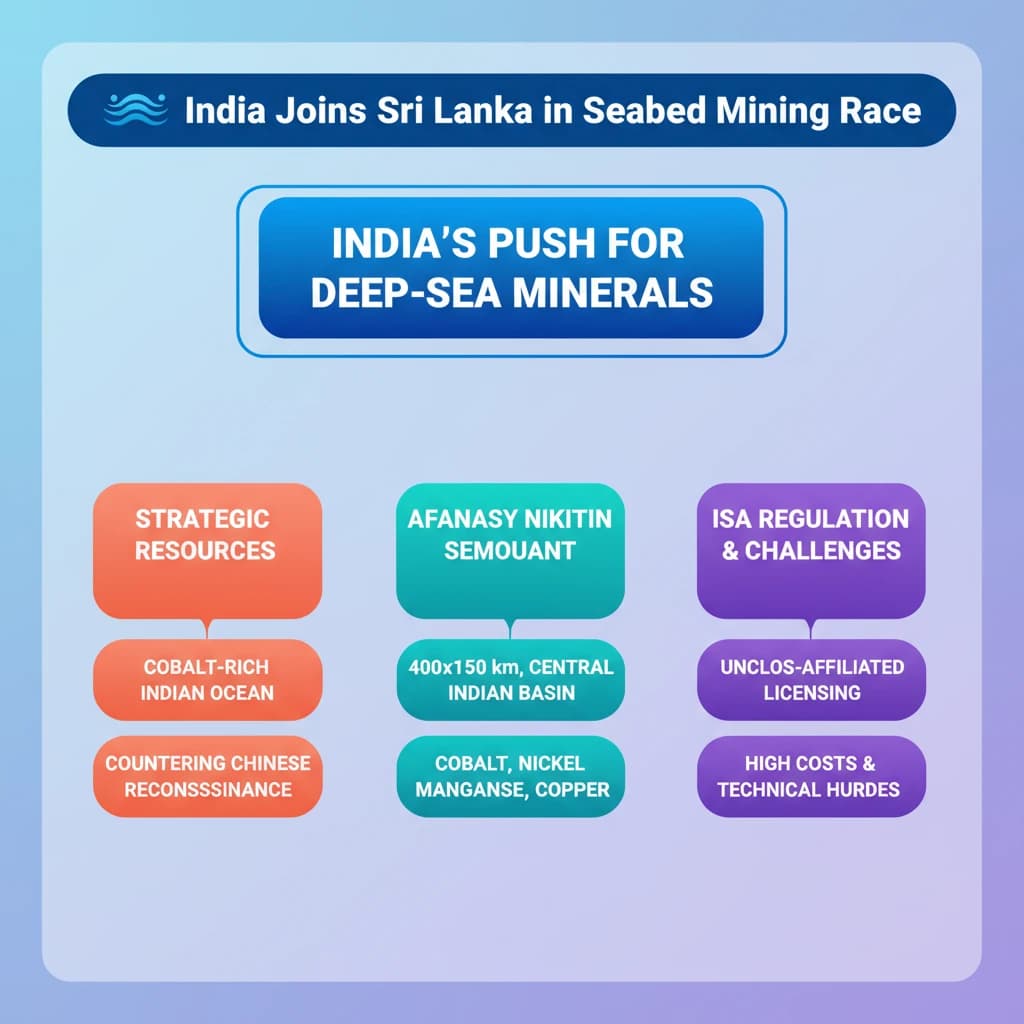
- •India applied to ISA for seabed exploration rights in the Indian Ocean, targeting the cobalt-rich Afanasy Nikitin Seamount (AN Seamount).
- •The move is driven by strategic resource needs and concerns over Chinese reconnaissance in the region.
- •AN Seamount is a 400x150 km feature in the Central Indian Basin, 1500 km from India's coast, rich in cobalt, nickel, manganese, and copper.
- •Exploration requires a license from the International Seabed Authority (ISA), an autonomous body under UNCLOS.
- •Seabed mining in the open ocean (60% of world's seas) is challenging due to high costs and technical complexities.
🧠 Memory Techniques
95% Verified Content
📚 Reference Sources
•United Nations Convention on the Law of the Sea (UNCLOS) official documentation
•International Seabed Authority (ISA) official website
•Ministry of Earth Sciences (MoES) documentation on Deep Ocean Mission