Loading page, please wait…
International Asteroid Day - UPSC Geography
What is International Asteroid Day in UPSC Geography?
International Asteroid Day is a key topic under Geography for UPSC Civil Services Examination. Key points include: International Asteroid Day, observed on June 30th, raises awareness about the threat of asteroid impacts, commemorating the 1908 Tunguska event.. The Tunguska event, an asteroid airburst in Siberia, flattened 80 million trees, demonstrating the destructive potential of NEOs.. The UN designated International Asteroid Day in 2016 to promote global planetary defense efforts.. Understanding this topic is essential for both UPSC Prelims and Mains preparation.
Why is International Asteroid Day important for UPSC exam?
International Asteroid Day is a Medium-level topic in UPSC Geography. It is tested in both Prelims (factual MCQs) and Mains (analytical answer writing). Previous year UPSC questions have frequently covered aspects of International Asteroid Day, making it essential for comprehensive IAS preparation.
How to prepare International Asteroid Day for UPSC?
To prepare International Asteroid Day for UPSC: (1) Study the comprehensive notes covering all key concepts on Vaidra. (2) Practice previous year questions on this topic. (3) Connect it with current affairs using daily updates. (4) Revise using key takeaways and mind maps available for Geography. (5) Write practice answers linking International Asteroid Day to related GS Paper topics.
Key takeaways of International Asteroid Day for UPSC
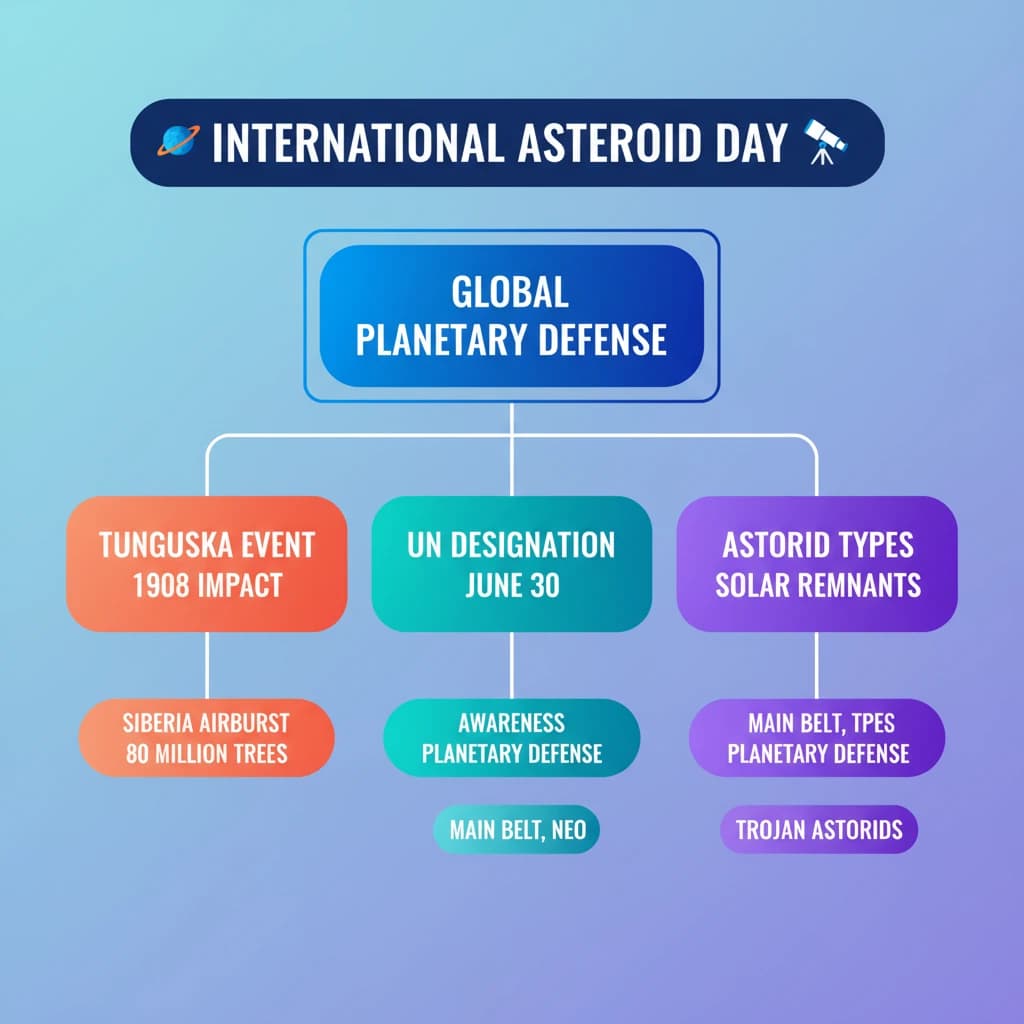
- International Asteroid Day, observed on June 30th, raises awareness about the threat of asteroid impacts, commemorating the 1908 Tunguska event.
- The Tunguska event, an asteroid airburst in Siberia, flattened 80 million trees, demonstrating the destructive potential of NEOs.
- The UN designated International Asteroid Day in 2016 to promote global planetary defense efforts.
- Asteroids are remnants from the solar system's formation, categorized into Main Belt, Trojan, and Near-Earth Asteroids.
- Global initiatives like DART, Hera, and ISRO's NETRA project are actively monitoring and developing strategies for Near-Earth Objects (NEOs).
- ISRO has expressed interest in participating in the international mission to study the asteroid Apophis, which will pass close to Earth in 2029.

International Asteroid Day
Medium⏱️ 8 min read
geography
📖 Introduction
What is International Asteroid Day?
International Asteroid Day is observed annually on June 30th. Its primary purpose is to raise global awareness about the potential threat of asteroid impacts on Earth.
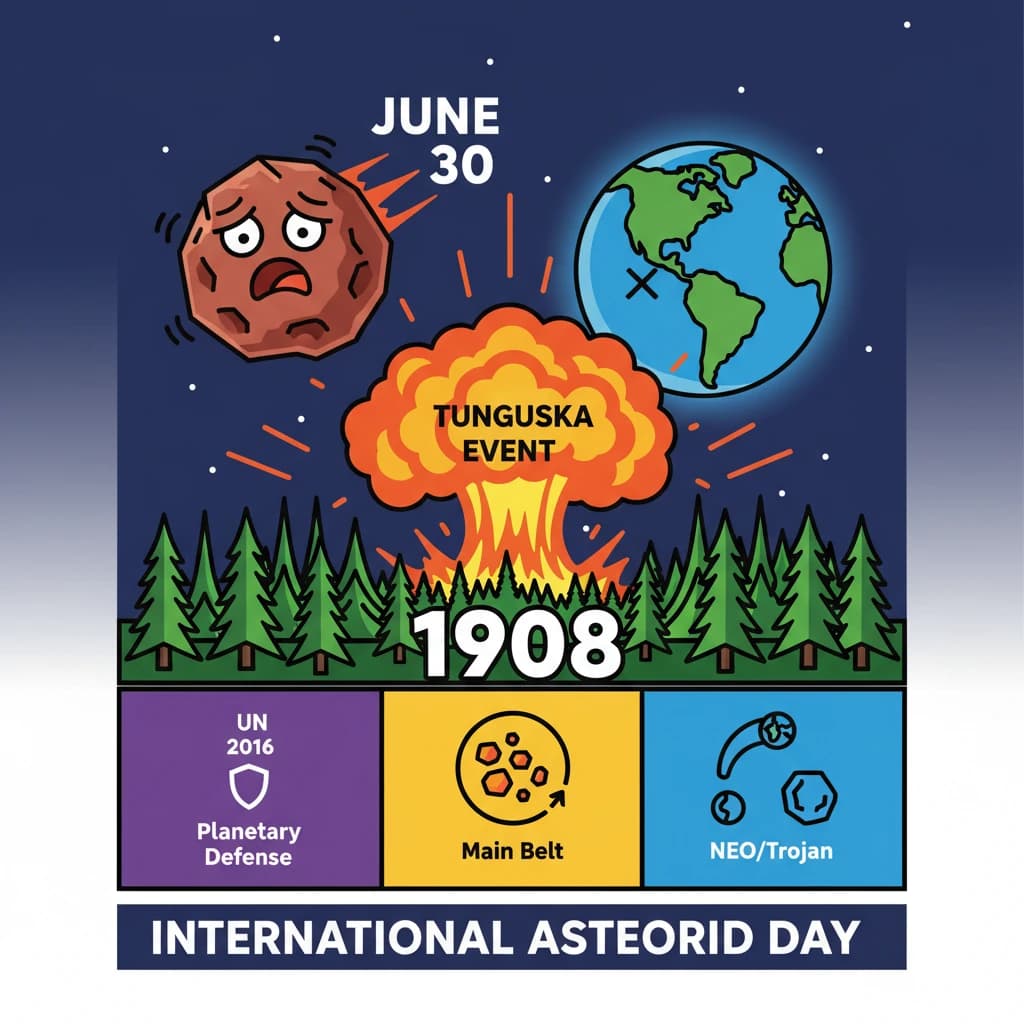
The date commemorates the historic Tunguska event of 1908, a significant asteroid-related incident that highlighted the destructive power of such celestial objects.
The Tunguska Event (1908)
The Tunguska event occurred in Siberia, Russia, on June 30, 1908. It was caused by an asteroid explosion in the atmosphere, not a direct ground impact.
Key Facts about Tunguska Event:
- Cause: Asteroid explosion in the atmosphere.
- Impact: Flattened approximately 80 million trees.
- Area Affected: Over 830 square miles (2,150 square kilometers).
- Casualties: Minimal human casualties due to its extremely remote location.
- Effect: The shock wave was reportedly felt hundreds of miles away.
United Nations Recognition
The significance of asteroid impacts led to the formal designation of International Asteroid Day by the United Nations in 2016. This recognition aims to promote global efforts in planetary defense.
NASA's Perspective: The National Aeronautics and Space Administration (NASA) has emphasized that a collision of Near-Earth Objects (NEOs) with Earth is the only natural disaster humanity could potentially prevent completely.
What are Asteroids?
Asteroids, often referred to as minor planets, are rocky, airless remnants left over from the early formation of our solar system. They originated approximately 4.6 billion years ago.
Characteristics of Asteroids:
- Shape: Predominantly exhibit irregular shapes, though some larger ones can be nearly spherical.
- Moons: Many asteroids are known to have small moons, with some even possessing two.
- Binary/Triple Systems: Binary asteroids consist of two similar-sized rocky bodies orbiting each other, and rare triple asteroid systems also exist.
Categorization of Asteroids
Asteroids are broadly categorized based on their location and orbital characteristics within our solar system:
- Main Asteroid Belt: This is the most populated region, located between the orbits of Mars and Jupiter. The vast majority of known asteroids reside here.
- Trojan Asteroids: These asteroids share an orbit with a larger planet, typically residing near stable gravitational points known as Lagrangian Points (specifically L4 and L5). At these points, the gravitational forces of the sun and the planet are balanced, preventing collisions with the larger planet.
- Near-Earth Asteroids (NEAs): These asteroids have orbits that bring them relatively close to Earth's orbit. A subset of NEAs, specifically those whose orbits actually intersect Earth's orbital path, are termed Earth-crossers.
💡 Key Takeaways
- •International Asteroid Day, observed on June 30th, raises awareness about the threat of asteroid impacts, commemorating the 1908 Tunguska event.
- •The Tunguska event, an asteroid airburst in Siberia, flattened 80 million trees, demonstrating the destructive potential of NEOs.
- •The UN designated International Asteroid Day in 2016 to promote global planetary defense efforts.
- •Asteroids are remnants from the solar system's formation, categorized into Main Belt, Trojan, and Near-Earth Asteroids.
- •Global initiatives like DART, Hera, and ISRO's NETRA project are actively monitoring and developing strategies for Near-Earth Objects (NEOs).
- •ISRO has expressed interest in participating in the international mission to study the asteroid Apophis, which will pass close to Earth in 2029.
🧠 Memory Techniques
98% Verified Content
📚 Reference Sources
•NASA official statements on planetary defense and DART mission
•United Nations Office for Outer Space Affairs (UNOOSA) on International Asteroid Day
•European Space Agency (ESA) on Hera mission