Loading page, please wait…
Ken-Betwa Link Project - UPSC Geography
What is Ken-Betwa Link Project in UPSC Geography?
Ken-Betwa Link Project is a key topic under Geography for UPSC Civil Services Examination. Key points include: KBLP is India's first river interlinking project under the 1980 National Perspective Plan.. It transfers surplus water from Ken River (MP) to Betwa River (UP), both Yamuna tributaries.. Aims to provide irrigation for 6.3 lakh hectares and drinking water for 62 lakh people in Bundelkhand.. Understanding this topic is essential for both UPSC Prelims and Mains preparation.
Why is Ken-Betwa Link Project important for UPSC exam?
Ken-Betwa Link Project is a Medium-level topic in UPSC Geography. It is tested in both Prelims (factual MCQs) and Mains (analytical answer writing). Previous year UPSC questions have frequently covered aspects of Ken-Betwa Link Project, making it essential for comprehensive IAS preparation.
How to prepare Ken-Betwa Link Project for UPSC?
To prepare Ken-Betwa Link Project for UPSC: (1) Study the comprehensive notes covering all key concepts on Vaidra. (2) Practice previous year questions on this topic. (3) Connect it with current affairs using daily updates. (4) Revise using key takeaways and mind maps available for Geography. (5) Write practice answers linking Ken-Betwa Link Project to related GS Paper topics.
Key takeaways of Ken-Betwa Link Project for UPSC
- KBLP is India's first river interlinking project under the 1980 National Perspective Plan.
- It transfers surplus water from Ken River (MP) to Betwa River (UP), both Yamuna tributaries.
- Aims to provide irrigation for 6.3 lakh hectares and drinking water for 62 lakh people in Bundelkhand.
- Includes 100 MW hydropower and 27 MW solar energy generation.
- Faces environmental concerns, notably submergence of over 10% of Panna Tiger Reserve's core area.
- Crucial for addressing water scarcity and reducing migration in the drought-prone Bundelkhand region.
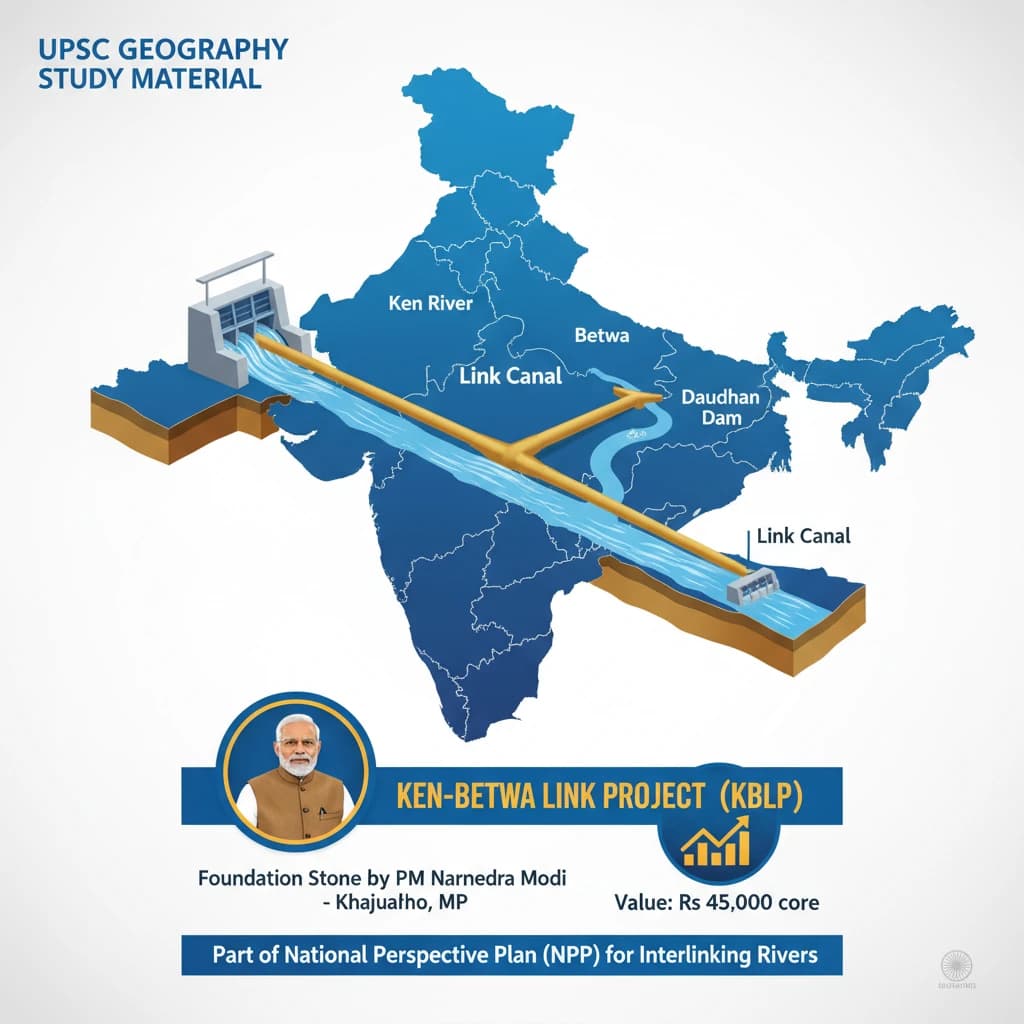
Ken-Betwa Link Project
Medium⏱️ 7 min read
geography
📖 Introduction
Context and Recent Developments
Recently, Prime Minister Narendra Modi laid the foundation stone for the ambitious Ken-Betwa Link Project (KBLP) in Khajuraho, Madhya Pradesh. This significant event marks a crucial step in India's efforts to address water scarcity.
The project, valued at approximately Rs 45,000 crore, is a key component of the National Perspective Plan (NPP) for interlinking rivers. Its primary goal is to alleviate water shortages, particularly in the drought-prone Bundelkhand region.
Alongside the KBLP, the Prime Minister also initiated the foundation for five major Dam Irrigation Projects. These projects are designed to provide irrigation to an estimated 11 lakh hectares of agricultural land in the region.
Furthermore, Madhya Pradesh's first floating solar energy project was inaugurated at Omkareshwar, highlighting a commitment to renewable energy adoption.
About the Ken-Betwa Link Project (KBLP)
The KBLP stands as India's first river interlinking project under the National Perspective Plan (NPP), which was formulated in 1980. It is being implemented by the Ken-Betwa Link Project Authority.
The core objective of the project is to transfer surplus water from the Ken River in Madhya Pradesh to the water-deficit Betwa River in Uttar Pradesh. Both Ken and Betwa are vital tributaries of the Yamuna River.
Phases of the Project
The Ken-Betwa Link Project is structured into two distinct phases to ensure systematic development and implementation:
- Phase I: Involves the construction of the Daudhan Dam complex, along with low-level and high-level tunnels. This phase also includes the development of the Ken-Betwa link canal and associated powerhouses.
- Phase II: Focuses on the development of the Lower Orr Dam, situated across the Orr River (a tributary of the Betwa). Additionally, this phase encompasses the Bina Complex Project and the construction of the Kotha Barrage.
Key Benefits of KBLP
The project is envisioned to bring about multifaceted benefits to the region:
- Irrigation: It will provide annual irrigation for approximately 6.3 lakh hectares of agricultural land, significantly boosting agricultural productivity.
- Drinking Water: The project aims to ensure a stable supply of drinking water for about 62 lakh people, addressing a critical need in the region.
- Power Generation: Provisions are included for generating 100 Megawatts (MW) of hydropower and an additional 27 MW of solar energy, contributing to the region's energy security.
Importance for the Bundelkhand Region
Bundelkhand is a geographically distinct region that encompasses 13 districts spread across both Uttar Pradesh and Madhya Pradesh. This area has historically been plagued by severe droughts and chronic water shortages.
The persistent water crisis in Bundelkhand has often led to forced migration of its inhabitants in search of employment and better living conditions.
The KBLP is critical for Bundelkhand as it promises enhanced access to drinking water, stable irrigation for agriculture, and overall regional development. These benefits are expected to significantly reduce migration pressures and foster economic growth.
Environmental Concerns and Criticisms
Despite its developmental potential, the Ken-Betwa Link Project has faced considerable opposition due to environmental concerns.
Critics have specifically highlighted the potential adverse impact on the Panna Tiger Reserve. It is estimated that over 10% of the core area of this vital tiger habitat could be submerged due to the project, raising serious conservation issues.
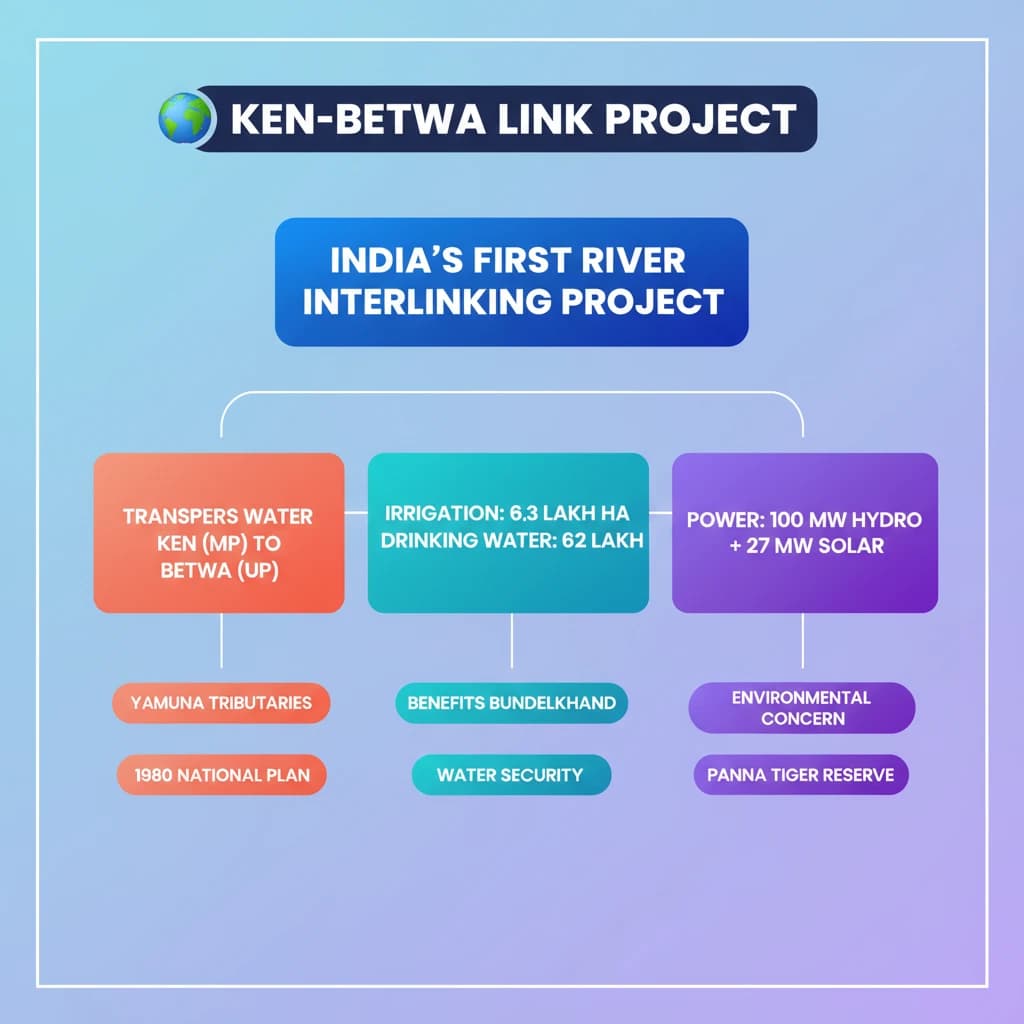
💡 Key Takeaways
- •KBLP is India's first river interlinking project under the 1980 National Perspective Plan.
- •It transfers surplus water from Ken River (MP) to Betwa River (UP), both Yamuna tributaries.
- •Aims to provide irrigation for 6.3 lakh hectares and drinking water for 62 lakh people in Bundelkhand.
- •Includes 100 MW hydropower and 27 MW solar energy generation.
- •Faces environmental concerns, notably submergence of over 10% of Panna Tiger Reserve's core area.
- •Crucial for addressing water scarcity and reducing migration in the drought-prone Bundelkhand region.
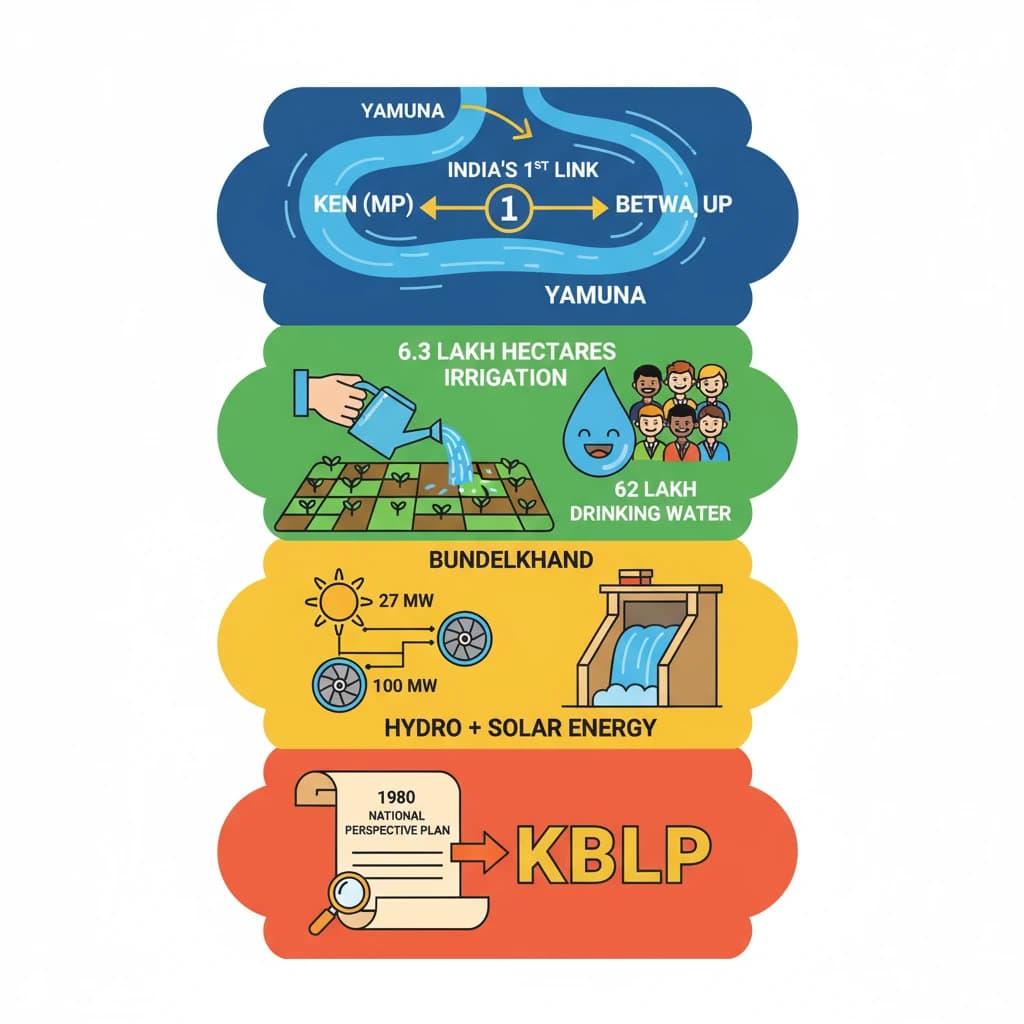
🧠 Memory Techniques
95% Verified Content