Loading page, please wait…
Mishra Committee Report of 1976 Regarding Joshimath Crisis - UPSC Geography
What is Mishra Committee Report of 1976 Regarding Joshimath Crisis in UPSC Geography?
Mishra Committee Report of 1976 Regarding Joshimath Crisis is a key topic under Geography for UPSC Civil Services Examination. Key points include: The Mishra Committee Report of 1976 warned about Joshimath's geological instability.. Joshimath is built on ancient landslide debris, making it highly susceptible to subsidence.. Key recommendations included restricting heavy construction, tree felling, blasting, and improving drainage.. Understanding this topic is essential for both UPSC Prelims and Mains preparation.
Why is Mishra Committee Report of 1976 Regarding Joshimath Crisis important for UPSC exam?
Mishra Committee Report of 1976 Regarding Joshimath Crisis is a Medium-level topic in UPSC Geography. It is tested in both Prelims (factual MCQs) and Mains (analytical answer writing). Previous year UPSC questions have frequently covered aspects of Mishra Committee Report of 1976 Regarding Joshimath Crisis, making it essential for comprehensive IAS preparation.
How to prepare Mishra Committee Report of 1976 Regarding Joshimath Crisis for UPSC?
To prepare Mishra Committee Report of 1976 Regarding Joshimath Crisis for UPSC: (1) Study the comprehensive notes covering all key concepts on Vaidra. (2) Practice previous year questions on this topic. (3) Connect it with current affairs using daily updates. (4) Revise using key takeaways and mind maps available for Geography. (5) Write practice answers linking Mishra Committee Report of 1976 Regarding Joshimath Crisis to related GS Paper topics.
Key takeaways of Mishra Committee Report of 1976 Regarding Joshimath Crisis for UPSC
- The Mishra Committee Report of 1976 warned about Joshimath's geological instability.
- Joshimath is built on ancient landslide debris, making it highly susceptible to subsidence.
- Key recommendations included restricting heavy construction, tree felling, blasting, and improving drainage.
- The 2023 Joshimath crisis highlighted that these warnings were largely unheeded.
- The case underscores the critical need for sustainable development and robust EIAs in the Himalayas.
- It serves as a crucial example for disaster management and urban planning in fragile ecosystems.
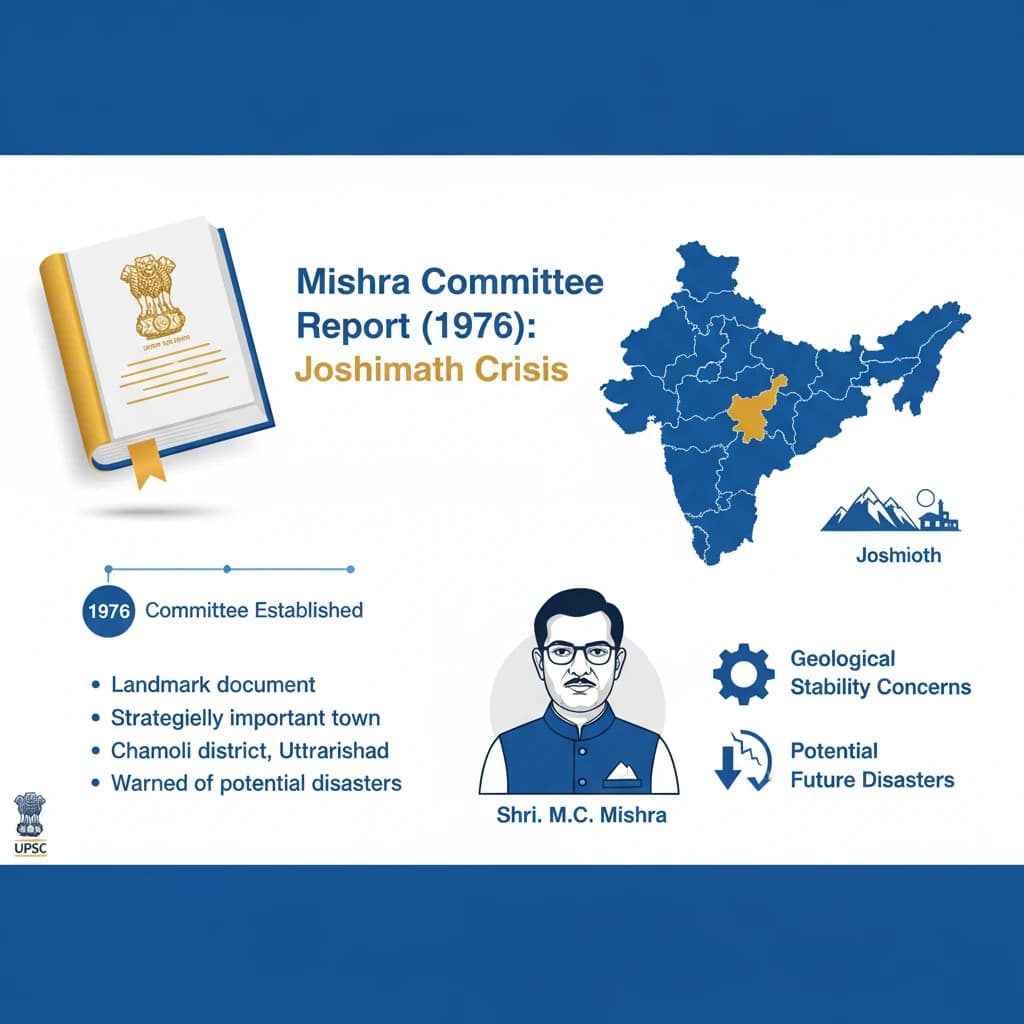
Mishra Committee Report of 1976 Regarding Joshimath Crisis
Medium⏱️ 10 min read
geography
📖 Introduction
Introduction to the Mishra Committee Report (1976)
The Mishra Committee Report of 1976 is a landmark document concerning the geological stability of Joshimath, a strategically important town in the Chamoli district of Uttarakhand. This report highlighted critical concerns about the town's foundation and warned of potential future disasters.
In 1976, a specialized committee was established under the chairmanship of Mahesh Chandra Mishra, the then Commissioner of Garhwal. Its primary mandate was to thoroughly investigate the underlying causes of the recurring sinking phenomenon and land subsidence observed in the Joshimath region.
Committee Formation: Established in 1976. Chairman: Mahesh Chandra Mishra. Objective: Investigate causes of land subsidence in Joshimath.
Key Findings and Recommendations of the Report
The Mishra Committee conclusively identified that Joshimath is situated on an ancient landslide debris, not on solid rock. This geological characteristic makes the area inherently unstable and highly susceptible to land subsidence and landslides.
The committee put forth several crucial recommendations aimed at mitigating the risks and ensuring the long-term stability of the town. These recommendations were foundational for any future developmental activities in the region.
Core Finding: Joshimath is built on ancient landslide debris, making it geologically fragile and prone to instability.
Among its significant recommendations, the report emphasized strict regulations on construction and development. It called for a cautious approach to urbanization in such a sensitive ecological zone.
- Restriction on Heavy Construction: Advised against large-scale construction activities, particularly those involving heavy machinery or deep foundations.
- Prohibition of Tree Felling: Recommended a ban on felling trees, emphasizing the role of vegetation in stabilizing slopes.
- Ban on Blasting: Suggested an immediate prohibition on blasting for road construction or other purposes, as it destabilizes the fragile terrain.
- Improved Drainage Systems: Stressed the need for well-planned and efficient drainage systems to prevent water seepage into the ground, which exacerbates subsidence.
- Slope Stabilization: Recommended measures for slope stabilization, including afforestation and construction of retaining walls in vulnerable areas.
The Mishra Committee Report is a classic case study for UPSC Mains GS Paper 1 (Geography) and GS Paper 3 (Disaster Management). Understanding its findings and recommendations is crucial for analyzing current events like the Joshimath crisis of 2023.
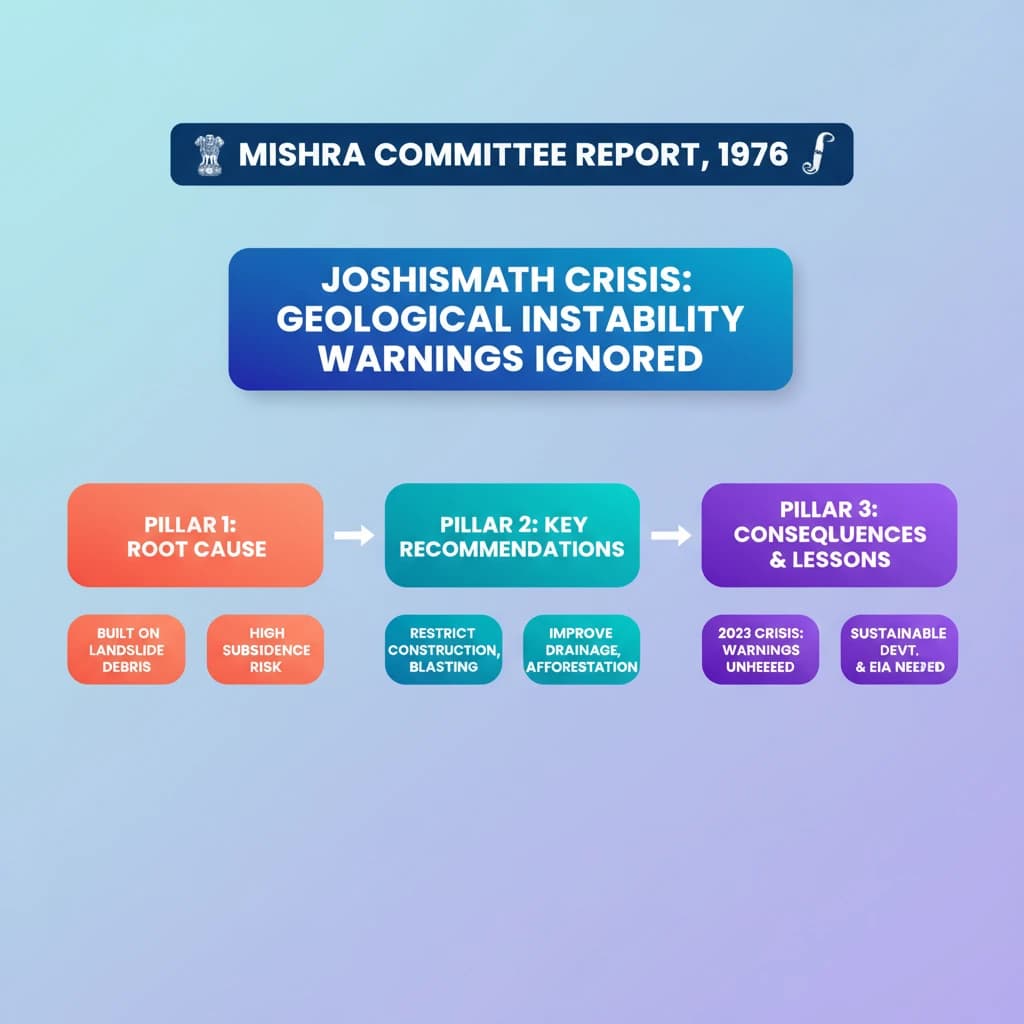
💡 Key Takeaways
- •The Mishra Committee Report of 1976 warned about Joshimath's geological instability.
- •Joshimath is built on ancient landslide debris, making it highly susceptible to subsidence.
- •Key recommendations included restricting heavy construction, tree felling, blasting, and improving drainage.
- •The 2023 Joshimath crisis highlighted that these warnings were largely unheeded.
- •The case underscores the critical need for sustainable development and robust EIAs in the Himalayas.
- •It serves as a crucial example for disaster management and urban planning in fragile ecosystems.
🧠 Memory Techniques

95% Verified Content
📚 Reference Sources
•Reports and articles from The Hindu, Indian Express on Joshimath Crisis 2023
•Geological Survey of India (GSI) reports (general knowledge about Himalayan geology)
•Government of Uttarakhand reports on disaster management