Loading page, please wait…
Ninetyeast Ridge: Formation, Composition, and Significance - UPSC Geography
What is Ninetyeast Ridge: Formation, Composition, and Significance in UPSC Geography?
Ninetyeast Ridge: Formation, Composition, and Significance is a key topic under Geography for UPSC Civil Services Examination. Key points include: Rock glaciers are mixtures of rock fragments and ice, found in high-altitude permafrost regions.. They are classified as active (moving, ice-rich) or relict (stable, little ice).. Recent studies show over 100 active rock glaciers in the Jhelum basin, Kashmir Himalayas.. Understanding this topic is essential for both UPSC Prelims and Mains preparation.
Why is Ninetyeast Ridge: Formation, Composition, and Significance important for UPSC exam?
Ninetyeast Ridge: Formation, Composition, and Significance is a Medium-level topic in UPSC Geography. It is tested in both Prelims (factual MCQs) and Mains (analytical answer writing). Previous year UPSC questions have frequently covered aspects of Ninetyeast Ridge: Formation, Composition, and Significance, making it essential for comprehensive IAS preparation.
How to prepare Ninetyeast Ridge: Formation, Composition, and Significance for UPSC?
To prepare Ninetyeast Ridge: Formation, Composition, and Significance for UPSC: (1) Study the comprehensive notes covering all key concepts on Vaidra. (2) Practice previous year questions on this topic. (3) Connect it with current affairs using daily updates. (4) Revise using key takeaways and mind maps available for Geography. (5) Write practice answers linking Ninetyeast Ridge: Formation, Composition, and Significance to related GS Paper topics.
Key takeaways of Ninetyeast Ridge: Formation, Composition, and Significance for UPSC
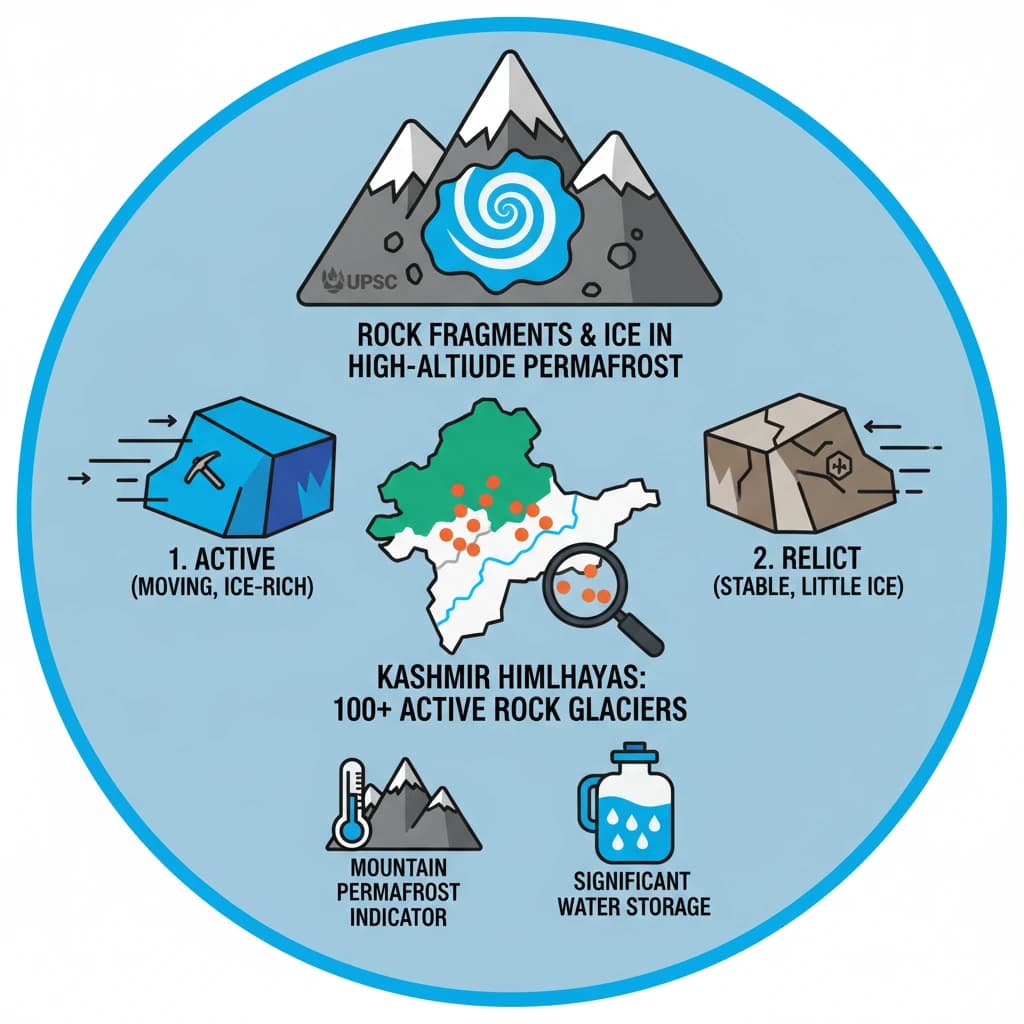
- Rock glaciers are mixtures of rock fragments and ice, found in high-altitude permafrost regions.
- They are classified as active (moving, ice-rich) or relict (stable, little ice).
- Recent studies show over 100 active rock glaciers in the Jhelum basin, Kashmir Himalayas.
- They are important indicators of mountain permafrost and store significant amounts of water.
- Active rock glaciers pose risks of GLOFs, landslides, and thermokarst formation.
- Thermokarst is terrain formed by thawing permafrost, exemplified by Russia's Batagaika Crater.
- Understanding rock glaciers is crucial for climate change adaptation and disaster management in mountain regions.
Ninetyeast Ridge: Formation, Composition, and Significance
Medium⏱️ 10 min read
geography
📖 Introduction
Introduction: Rock Glaciers in the News
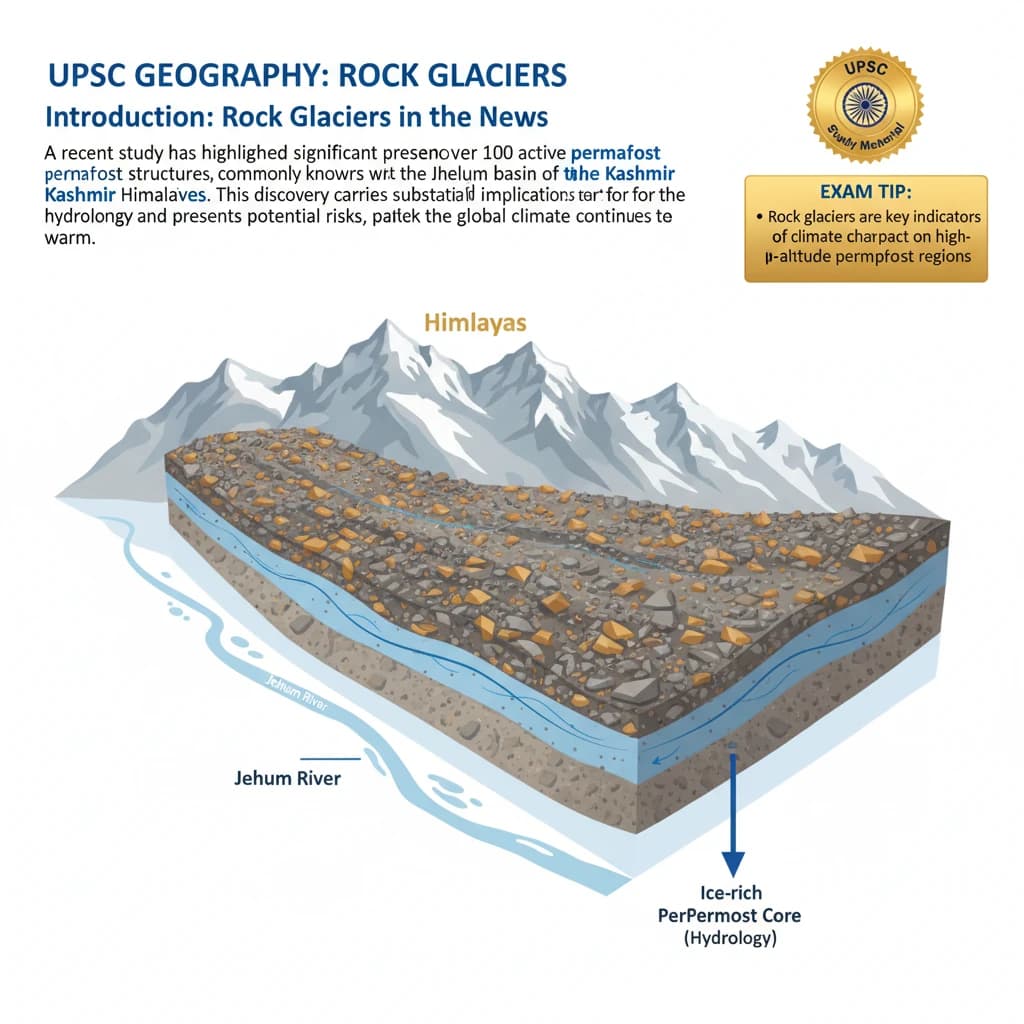
A recent study has highlighted the significant presence of over 100 active permafrost structures, commonly known as rock glaciers, within the Jhelum basin of the Kashmir Himalayas. This discovery carries substantial implications for the region's hydrology and presents potential risks, particularly as the global climate continues to warm.
Understanding the context of "Why in News" is crucial for UPSC. It helps in linking static concepts to current affairs, often forming the basis of questions in GS Paper 1 (Geography) and GS Paper 3 (Environment & Disaster Management).
What are Rock Glaciers?
Rock glaciers are unique landforms composed of a mixture of rock fragments and ice. They are typically found in mountainous regions where specific environmental conditions prevail.
Formation Conditions: Rock glaciers require a combination of permafrost, abundant rock debris, and ice to form. They occur in highly elevated regions with steep slopes.
One common formation scenario involves a pre-existing glacier that accumulates substantial amounts of debris and rocks during its movement. If this glacier subsequently recedes or thaws, the debris-covered ice can gradually transform into a rock glacier.
To the unaided eye, rock glaciers often resemble ordinary ground. Their proper identification necessitates a specialized geomorphological view, distinguishing them from other landforms.
Understanding Permafrost
Permafrost is defined as a layer of ground that remains permanently frozen for at least two consecutive years. It can be found either on or beneath the Earth's surface.
Composition: Permafrost primarily consists of soil, gravel, and sand, which are typically bound together by ice. This frozen matrix is fundamental to the formation and stability of rock glaciers.
Classification of Rock Glaciers
Rock glaciers are broadly categorized based on their internal ice content and movement characteristics:
- Active Rock Glaciers: These structures contain significant amounts of ice and exhibit ongoing, albeit slow, movement. They are considered more dynamic and potentially hazardous.
- Relict Rock Glaciers: These are more stable and inert, having little to no ice and showing no significant movement. They represent past periods of permafrost activity.
The distinction between active and relict rock glaciers is critical for assessing their potential impacts and risks in a changing climate.
Importance of Rock Glaciers
Rock glaciers serve as crucial indicators and reservoirs in high-altitude environments:
- Mountain Permafrost Indicators: They are vital indicators of mountain permafrost, the permanently frozen ground underlying many high-altitude regions. Their presence signifies specific cryospheric conditions.
- Water Storage: Rock glaciers store substantial volumes of water within their frozen cores. This stored water could become a valuable resource, especially in regions facing increasing water scarcity and rapid glacial retreat.
Potential Impacts of Active Rock Glaciers
The presence and potential thawing of active rock glaciers pose several significant environmental and societal risks:
Glacial Lake Outburst Floods (GLOFs)
GLOFs are sudden and catastrophic floods resulting from the failure of a natural or artificial dam containing a glacial lake. This releases large volumes of water and debris downstream.
Increased Risk: Active rock glaciers can heighten the risk of GLOFs by destabilizing slopes or compromising the integrity of natural dams holding back glacial lakes. The study specifically noted rock glaciers near Chirsar Lake and Bramsar Lake increasing GLOF risk.
Landslides
Landslides involve the rapid downward movement of soil, rock, or snow along a slope, often triggered by events like earthquakes, heavy rainfall, or human activities.
Trigger Mechanism: Active rock glaciers can contribute to landslides by weakening slope stability. Furthermore, their melting can release water, which acts as a lubricant, facilitating the sliding of unconsolidated mass.
Thermokarst Formation
Thermokarst refers to a distinctive type of terrain characterized by irregular surfaces, marshy hollows, and small hummocks. These features form due to the thawing of ice-rich permafrost.
Landscape Alteration: Active rock glaciers can lead to the formation of thermokarst features, such as ponds or lakes. These changes can significantly alter the regional hydrology, ecology, and carbon cycle.
The presence of water bodies near Kargil-Zanskar in Jammu and Kashmir suggests the existence of underground permafrost, resembling ‘thermokarst lakes’. This phenomenon poses further risks due to the potential for collapse.
The melting of ice beneath the Earth's surface carries a high risk of ground collapse. This collapse creates a unique landscape featuring sinkholes, hummocks, caverns, and tunnels.
The Batagaika Crater in the Sakha Republic, Russia, is a prominent example of thermokarst. It is recognized as the world's largest permafrost crater, illustrating the scale of such phenomena.
💡 Key Takeaways
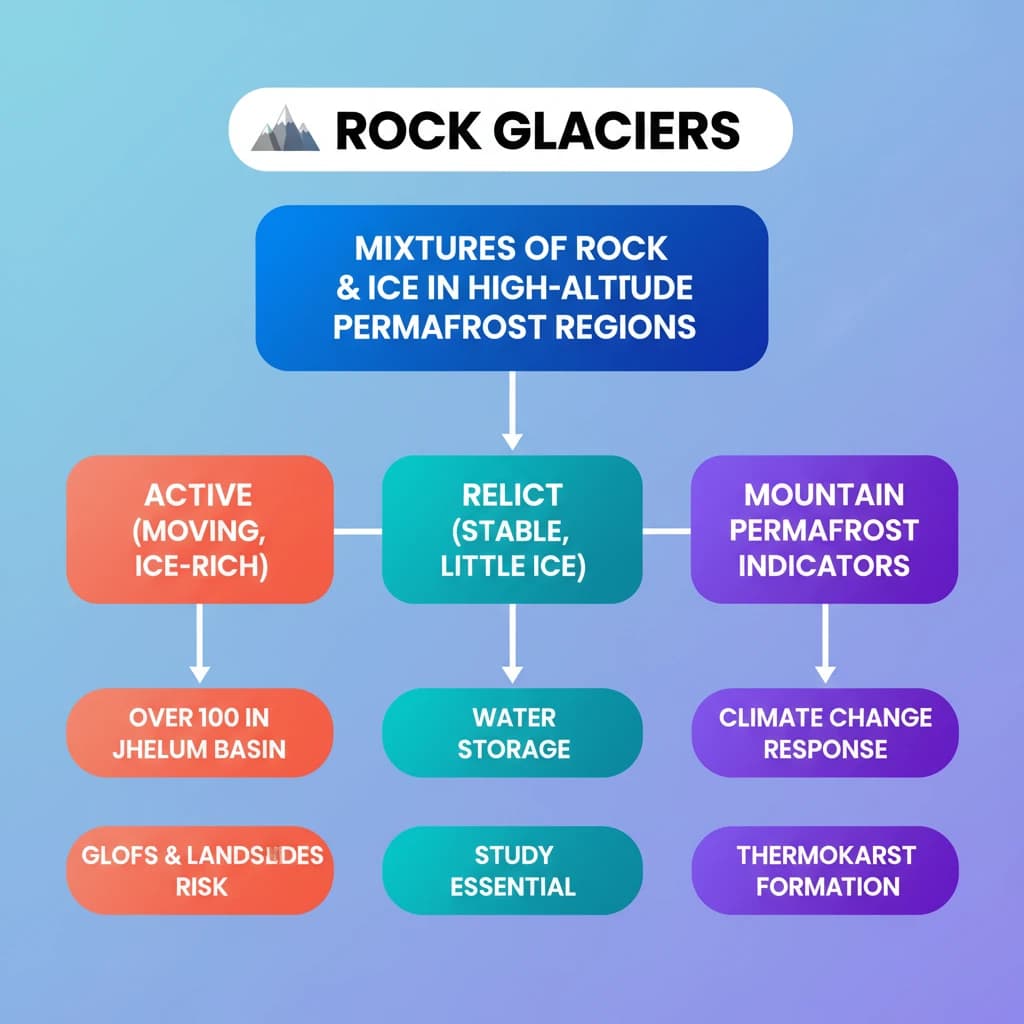
- •Rock glaciers are mixtures of rock fragments and ice, found in high-altitude permafrost regions.
- •They are classified as active (moving, ice-rich) or relict (stable, little ice).
- •Recent studies show over 100 active rock glaciers in the Jhelum basin, Kashmir Himalayas.
- •They are important indicators of mountain permafrost and store significant amounts of water.
- •Active rock glaciers pose risks of GLOFs, landslides, and thermokarst formation.
- •Thermokarst is terrain formed by thawing permafrost, exemplified by Russia's Batagaika Crater.
- •Understanding rock glaciers is crucial for climate change adaptation and disaster management in mountain regions.
🧠 Memory Techniques
85% Verified Content