Loading page, please wait…
Poleward Shift of Atmospheric Rivers - UPSC Geography
What is Poleward Shift of Atmospheric Rivers in UPSC Geography?
Poleward Shift of Atmospheric Rivers is a key topic under Geography for UPSC Civil Services Examination. Key points include: Atmospheric Rivers (ARs) have shifted 6-10 degrees poleward over 40 years.. This shift causes droughts in subtropics (e.g., California) and intense floods in higher latitudes (e.g., US Pacific Northwest).. ARs contribute significantly to Arctic sea ice melting (36% rise in summer moisture since 1979).. Understanding this topic is essential for both UPSC Prelims and Mains preparation.
Why is Poleward Shift of Atmospheric Rivers important for UPSC exam?
Poleward Shift of Atmospheric Rivers is a Medium-level topic in UPSC Geography. It is tested in both Prelims (factual MCQs) and Mains (analytical answer writing). Previous year UPSC questions have frequently covered aspects of Poleward Shift of Atmospheric Rivers, making it essential for comprehensive IAS preparation.
How to prepare Poleward Shift of Atmospheric Rivers for UPSC?
To prepare Poleward Shift of Atmospheric Rivers for UPSC: (1) Study the comprehensive notes covering all key concepts on Vaidra. (2) Practice previous year questions on this topic. (3) Connect it with current affairs using daily updates. (4) Revise using key takeaways and mind maps available for Geography. (5) Write practice answers linking Poleward Shift of Atmospheric Rivers to related GS Paper topics.
Key takeaways of Poleward Shift of Atmospheric Rivers for UPSC
- Atmospheric Rivers (ARs) have shifted 6-10 degrees poleward over 40 years.
- This shift causes droughts in subtropics (e.g., California) and intense floods in higher latitudes (e.g., US Pacific Northwest).
- ARs contribute significantly to Arctic sea ice melting (36% rise in summer moisture since 1979).
- Key drivers include cooling eastern tropical Pacific SSTs (linked to La Niña), strengthened Walker Circulation, and poleward-shifting jet streams due to global warming.
- Predicting future AR behavior is challenging due to natural variability like El Niño/La Niña oscillations.
- The shift has major implications for water resource management, disaster preparedness, and climate stability globally.
Poleward Shift of Atmospheric Rivers
Medium⏱️ 8 min read
geography
📖 Introduction
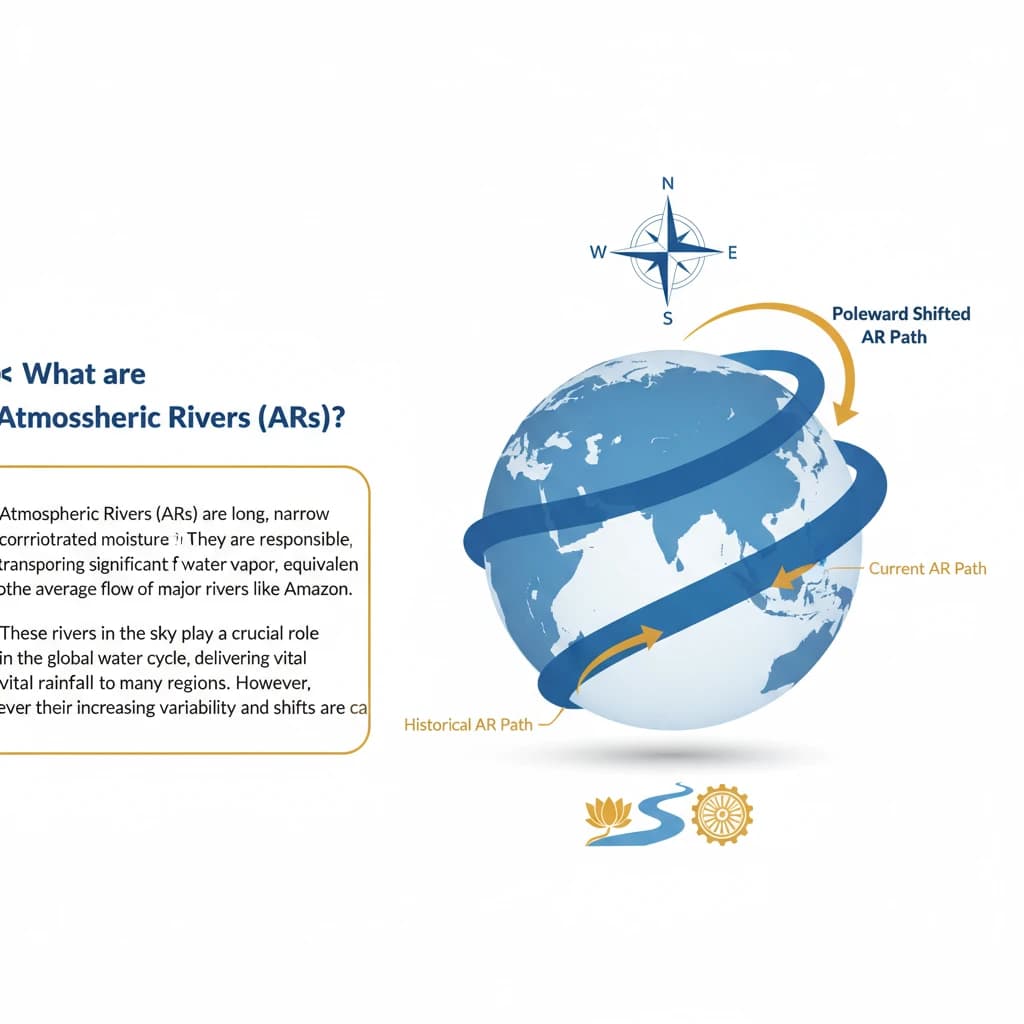
What are Atmospheric Rivers (ARs)?
Atmospheric Rivers (ARs) are long, narrow corridors of concentrated moisture in the atmosphere. They are responsible for transporting significant amounts of water vapor, often equivalent to the average flow of major rivers like the Amazon.
These rivers in the sky play a crucial role in the global water cycle, delivering vital rainfall to many regions. However, their increasing variability and shifts are causing significant concern.
Recent Study Highlights Poleward Shift
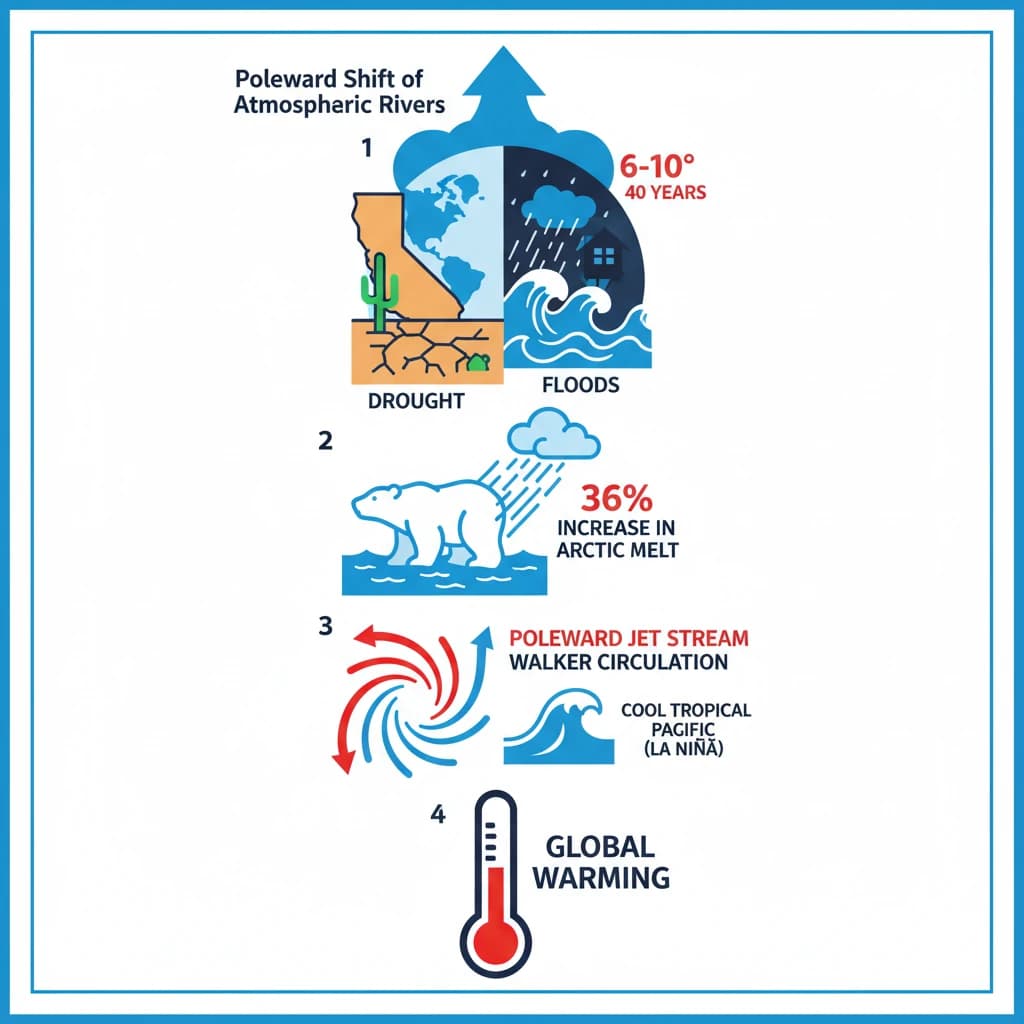
A recent study has reported a significant change in the behavior of Atmospheric Rivers. Over the past 40 years, these moisture-laden currents have shifted their trajectory by approximately 6 to 10 degrees poleward.
This shift is profoundly influencing global weather patterns. It is leading to increased droughts in certain regions while simultaneously intensifying floods in others, with major implications for water resources and climate stability.
Major Implications of the Poleward Shift
1. Water Resource Management Challenges
Subtropical regions, which historically rely on ARs for essential rainfall, are now facing severe challenges. Areas like California in the US and southern Brazil may experience longer droughts and increased water shortages due to less frequent AR activity.
This reduction in vital precipitation puts immense stress on agriculture, threatening food security and impacting local communities that depend on these water resources.
UPSC Relevance: This directly relates to GS-III topics on water scarcity, agriculture challenges, and climate change impacts on resources.
2. Increased Flooding and Landslides
Conversely, higher latitude areas are experiencing the opposite effect. Regions such as the US Pacific Northwest, parts of Europe, and even polar regions are witnessing more extreme rainfall events.
The increased intensity of precipitation from shifted ARs leads to a higher risk of flooding and landslides, which can severely threaten critical infrastructure and public safety.
3. Arctic Climate Impact
The poleward movement of Atmospheric Rivers into the Arctic region has a direct and alarming impact on its delicate climate. This influx of warmer, moist air can significantly accelerate sea ice melting.
Research indicates that atmospheric rivers have contributed to a substantial 36% rise in summer moisture over the Arctic since 1979, exacerbating the melting trend.
4. Predictive Challenges
The complex interplay of natural processes makes predicting the future behavior of atmospheric rivers extremely difficult. The variability introduced by phenomena like the oscillation between El Niño and La Niña conditions adds layers of complexity.
This inherent variability poses significant challenges for climate models and forecasting, making it harder for regions to prepare for future water-related extremes.
Why are Atmospheric Rivers Shifting Polewards?
1. Sea Surface Temperature Changes
A primary driver for the poleward shift of Atmospheric Rivers is the observable cooling of sea surface temperatures in the eastern tropical Pacific since the year 2000. This cooling trend is strongly associated with the prevalence of La Niña conditions.
As a direct consequence, subtropical regions are prone to more prolonged droughts and acute water scarcity, while high latitudes are increasingly exposed to more extreme rainfall and flooding events.
2. Strengthening of Walker Circulation
During periods dominated by La Niña, a critical atmospheric phenomenon known as the Walker Circulation strengthens over the western Pacific Ocean. This strengthening leads to an expansion of the tropical rainfall belt.
Combined with alterations in atmospheric eddy patterns, this change creates distinct high-pressure anomalies. These anomalies act as steering mechanisms, effectively pushing and guiding Atmospheric Rivers towards the poles.
The Walker Circulation is a crucial cyclic pattern of air movement around the equator, profoundly influencing global climate and weather systems.
3. Long-term Climate Trends (Global Warming)
The broader context of long-term climate trends, primarily driven by global warming, also plays a significant role. Reports from the IPCC (Intergovernmental Panel on Climate Change) indicate that global temperatures have risen by approximately 1.1°C since the pre-industrial era.
These warmer conditions have fundamentally altered global jet stream patterns, causing them to shift poleward. This poleward movement of jet streams, in turn, pushes Atmospheric Rivers towards higher latitudes, intensifying weather patterns and increasing the frequency of extreme events in those areas.
UPSC Insight: Understanding this link is vital for questions on climate change impacts, global weather phenomena, and environmental geography (GS-I, GS-III).
💡 Key Takeaways
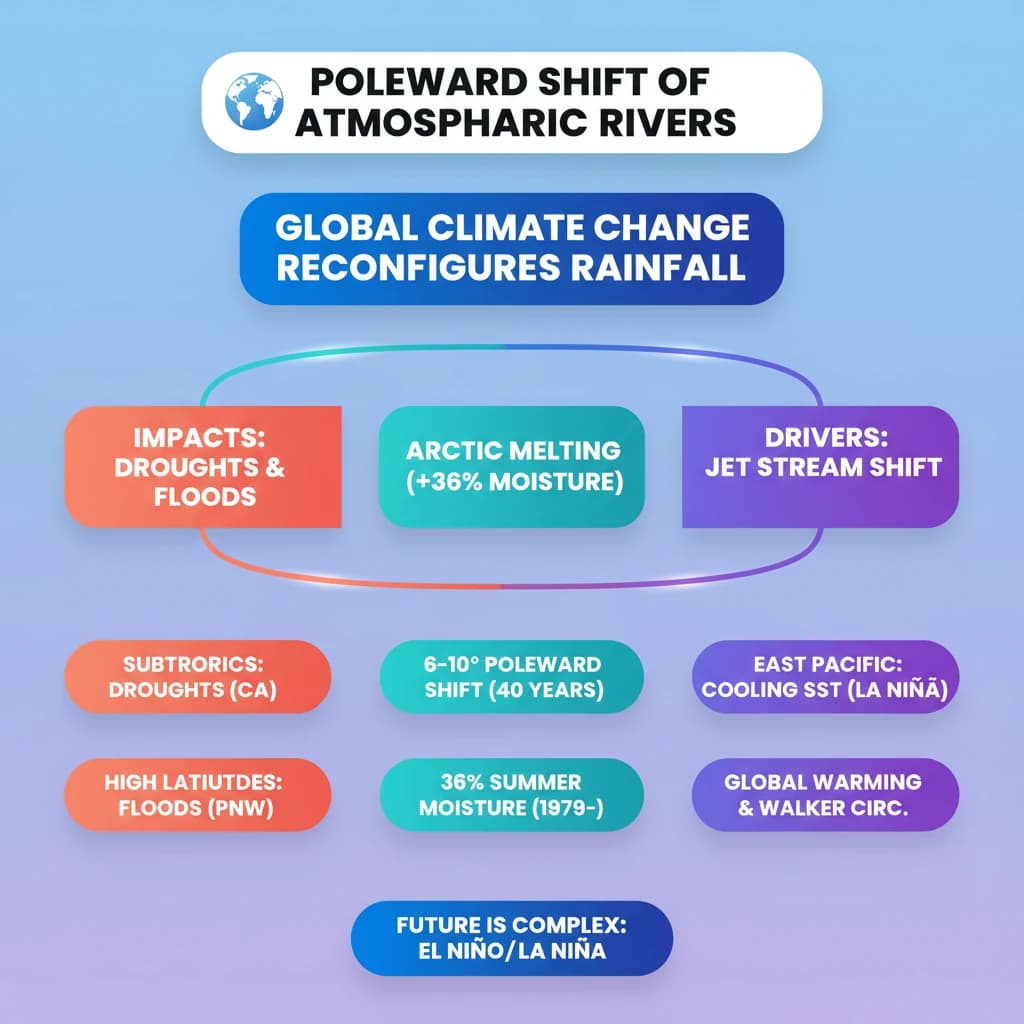
- •Atmospheric Rivers (ARs) have shifted 6-10 degrees poleward over 40 years.
- •This shift causes droughts in subtropics (e.g., California) and intense floods in higher latitudes (e.g., US Pacific Northwest).
- •ARs contribute significantly to Arctic sea ice melting (36% rise in summer moisture since 1979).
- •Key drivers include cooling eastern tropical Pacific SSTs (linked to La Niña), strengthened Walker Circulation, and poleward-shifting jet streams due to global warming.
- •Predicting future AR behavior is challenging due to natural variability like El Niño/La Niña oscillations.
- •The shift has major implications for water resource management, disaster preparedness, and climate stability globally.
🧠 Memory Techniques
95% Verified Content
📚 Reference Sources
•Intergovernmental Panel on Climate Change (IPCC) reports (implied for global temperature rise and long-term climate trends)
•Scientific studies referenced by Drishti IAS (e.g., research on Arctic moisture rise)