Loading page, please wait…
Red Sea & Gulf of Aden: Location, Economic Significance, and Red Sea Rift - UPSC Geography
What is Red Sea & Gulf of Aden: Location, Economic Significance, and Red Sea Rift in UPSC Geography?
Red Sea & Gulf of Aden: Location, Economic Significance, and Red Sea Rift is a key topic under Geography for UPSC Civil Services Examination. Key points include: The Red Sea is the world's northernmost tropical sea, formed by the Red Sea Rift (African and Arabian Plates diverging).. It connects to the Indian Ocean via Bab el Mandeb Strait/Gulf of Aden and to the Mediterranean via the Suez Canal.. The Gulf of Aden is crucial for global seaborne petroleum (10%) and India's trade (over USD 110 billion).. Understanding this topic is essential for both UPSC Prelims and Mains preparation.
Why is Red Sea & Gulf of Aden: Location, Economic Significance, and Red Sea Rift important for UPSC exam?
Red Sea & Gulf of Aden: Location, Economic Significance, and Red Sea Rift is a Medium-level topic in UPSC Geography. It is tested in both Prelims (factual MCQs) and Mains (analytical answer writing). Previous year UPSC questions have frequently covered aspects of Red Sea & Gulf of Aden: Location, Economic Significance, and Red Sea Rift, making it essential for comprehensive IAS preparation.
How to prepare Red Sea & Gulf of Aden: Location, Economic Significance, and Red Sea Rift for UPSC?
To prepare Red Sea & Gulf of Aden: Location, Economic Significance, and Red Sea Rift for UPSC: (1) Study the comprehensive notes covering all key concepts on Vaidra. (2) Practice previous year questions on this topic. (3) Connect it with current affairs using daily updates. (4) Revise using key takeaways and mind maps available for Geography. (5) Write practice answers linking Red Sea & Gulf of Aden: Location, Economic Significance, and Red Sea Rift to related GS Paper topics.
Key takeaways of Red Sea & Gulf of Aden: Location, Economic Significance, and Red Sea Rift for UPSC
- The Red Sea is the world's northernmost tropical sea, formed by the Red Sea Rift (African and Arabian Plates diverging).
- It connects to the Indian Ocean via Bab el Mandeb Strait/Gulf of Aden and to the Mediterranean via the Suez Canal.
- The Gulf of Aden is crucial for global seaborne petroleum (10%) and India's trade (over USD 110 billion).
- Bab el Mandeb Strait is a critical choke point, essential for East-West maritime trade.
- Historically, the Red Sea was a key part of the Spice Route, revitalized by the Suez Canal in 1869.
- Current relevance includes global energy security, India's trade, and maritime security challenges like piracy and regional tensions.
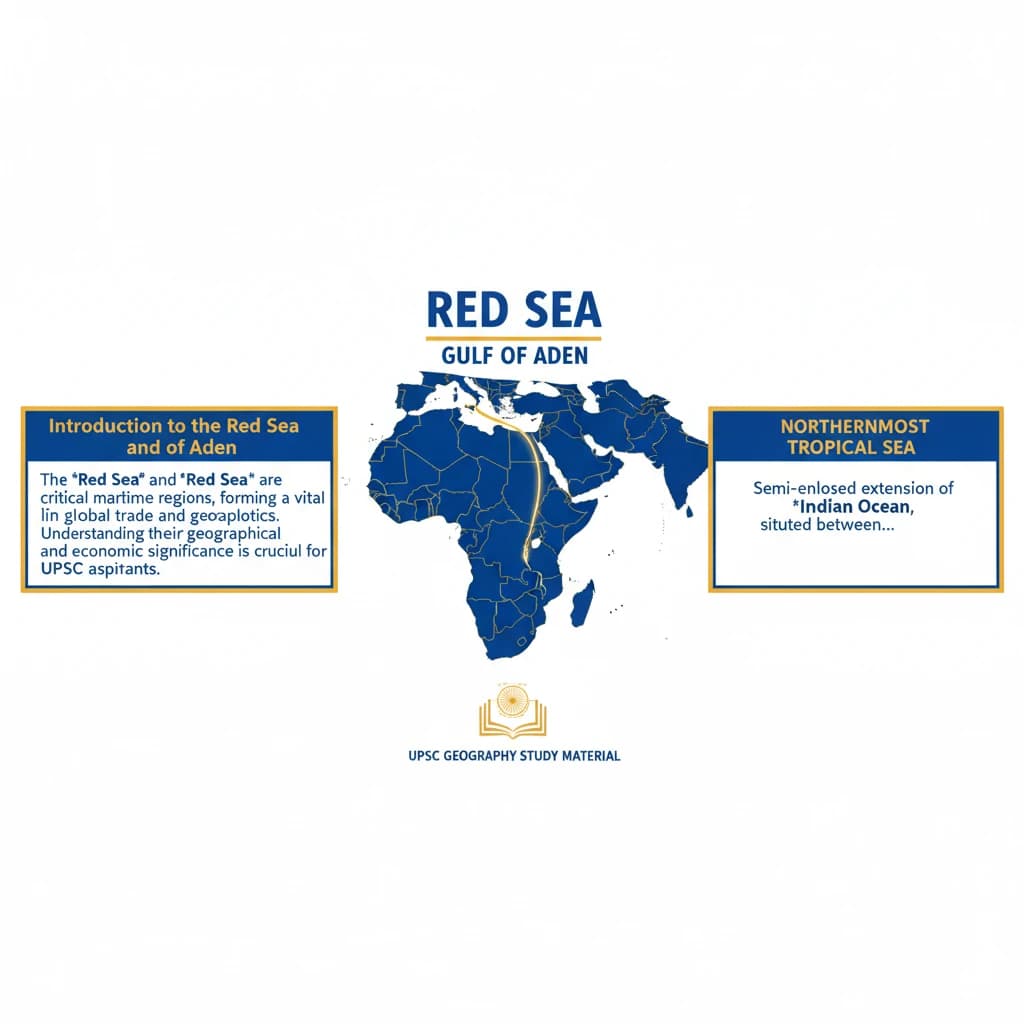
Red Sea & Gulf of Aden: Location, Economic Significance, and Red Sea Rift
Medium⏱️ 8 min read
geography
📖 Introduction
Introduction to the Red Sea and Gulf of Aden
The Red Sea and Gulf of Aden are critical maritime regions, forming a vital link in global trade and geopolitics. Understanding their geographical and economic significance is crucial for UPSC aspirants.
The Red Sea is the world’s northernmost tropical sea. It is a semi-enclosed extension of the Indian Ocean, situated between Africa and Asia.
Geographical Location and Connections of the Red Sea
The Red Sea is strategically positioned, connecting major continents. Its unique geographical features make it a significant waterway.
- Southern Connection: It connects to the Indian Ocean and Arabian Sea via the Bab el Mandeb Strait and the Gulf of Aden.
- Northern Bifurcation: In the north, it splits into two major gulfs: the Gulf of Aqaba and the Gulf of Suez, located at the Sinai Peninsula.
- Mediterranean Link: The Gulf of Suez is connected to the Mediterranean Sea through the historic Suez Canal.
Geological Formation: The Red Sea Rift
The Red Sea is underlain by the Red Sea Rift, a significant geological feature. This rift is a testament to ongoing tectonic activity in the region.
The Red Sea Rift represents a divergent boundary between the African Plate and the Arabian Plate. It is an integral part of the larger Great Rift Valley system, which extends from East Africa all the way to the Middle East.
Etymology of the Name 'Red Sea'
The origin of the name Red Sea is often debated, but a prominent theory links it to natural phenomena.
The name Red Sea is believed to originate from the seasonal blooms of a specific red-colored cyanobacteria, known scientifically as Trichodesmium erythraeum. These blooms can tint the water's surface reddish.
The Gulf of Aden: Location and Connections
The Gulf of Aden is another crucial body of water, adjacent to the Red Sea and equally important for maritime activities.
- Eastern Boundary: It is bounded by Somalia and the Socotra Islands to the east, and Yemen to the north.
- Western Boundary: Djibouti lies to its west.
- Northern Boundary: The Arabian Sea is situated to its east.
- Connections: It connects to the Somali Sea via the Guardafui Channel and to the Red Sea through the Strait of Bab el Mandeb.
Economic Importance of the Gulf of Aden
The Gulf of Aden serves as a critical maritime corridor, facilitating a significant portion of global trade, particularly in energy resources.
Approximately 10% of global seaborne petroleum passes through the Gulf of Aden. Furthermore, trade worth over USD 110 billion for India transits through this vital waterway annually.
UPSC Insight: Questions on strategic waterways like the Red Sea and Gulf of Aden often appear in Geography (GS Paper 1) and International Relations (GS Paper 2). Focus on their geographical features, economic significance, and geopolitical implications.
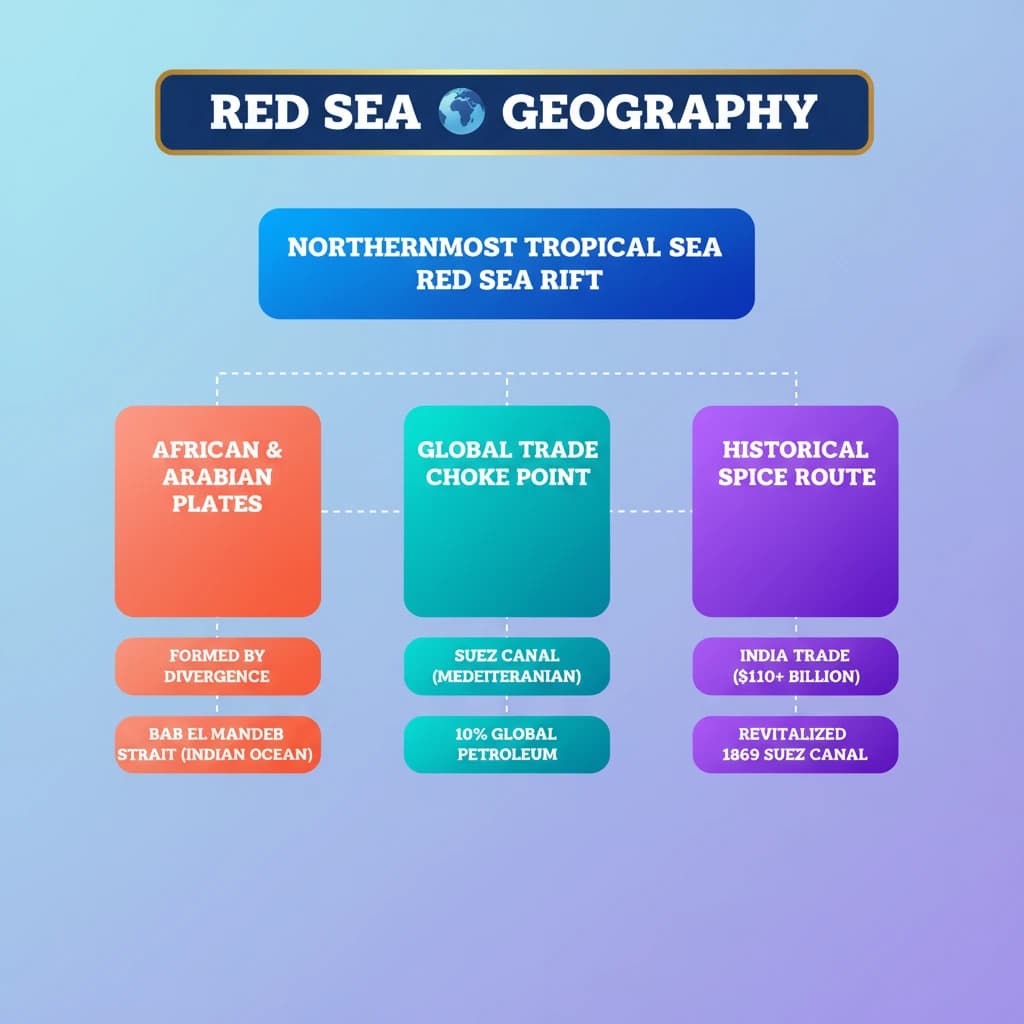
💡 Key Takeaways
- •The Red Sea is the world's northernmost tropical sea, formed by the Red Sea Rift (African and Arabian Plates diverging).
- •It connects to the Indian Ocean via Bab el Mandeb Strait/Gulf of Aden and to the Mediterranean via the Suez Canal.
- •The Gulf of Aden is crucial for global seaborne petroleum (10%) and India's trade (over USD 110 billion).
- •Bab el Mandeb Strait is a critical choke point, essential for East-West maritime trade.
- •Historically, the Red Sea was a key part of the Spice Route, revitalized by the Suez Canal in 1869.
- •Current relevance includes global energy security, India's trade, and maritime security challenges like piracy and regional tensions.
🧠 Memory Techniques
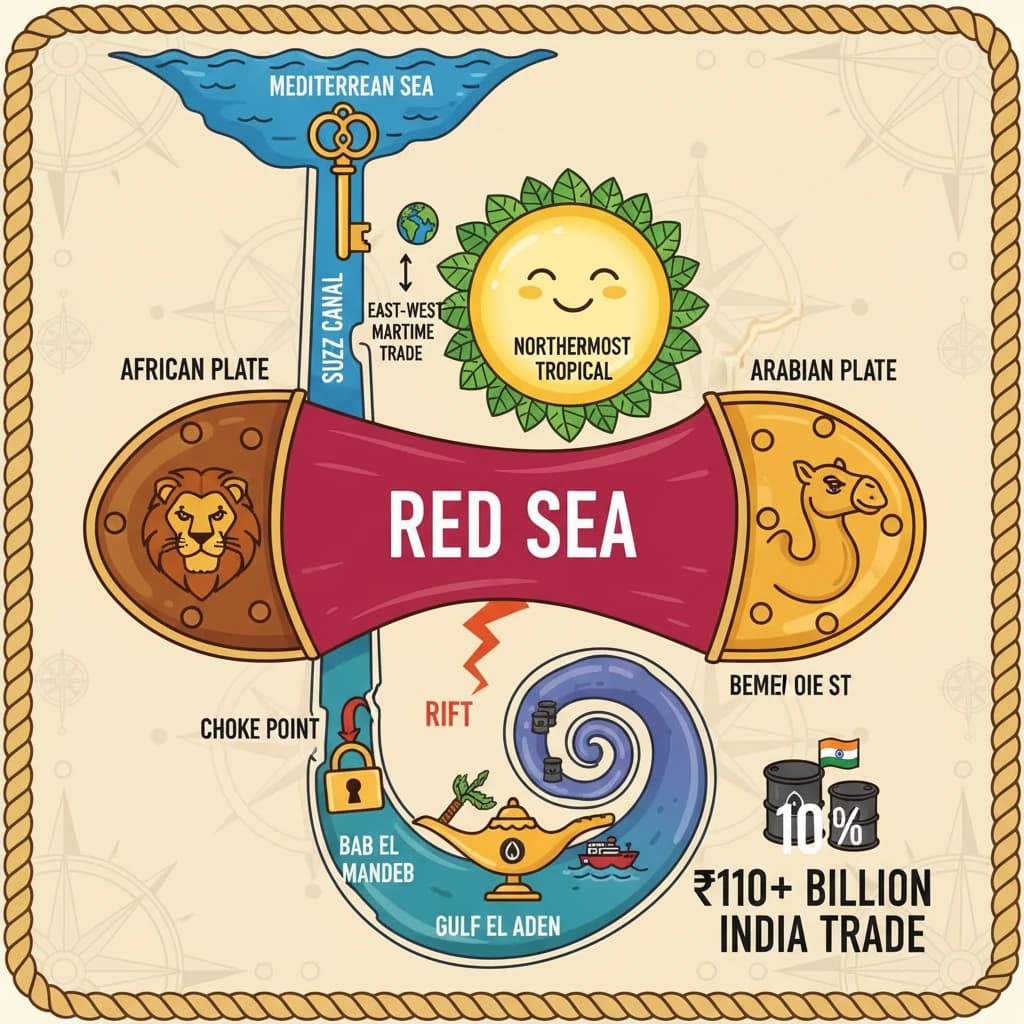
95% Verified Content
📚 Reference Sources
•National Geographic (for geological context)
•EIA (Energy Information Administration) for trade data confirmation