Loading page, please wait…
Rossby Waves: Formation, Characteristics, and Impact on Global Weather - UPSC Geography
What is Rossby Waves: Formation, Characteristics, and Impact on Global Weather in UPSC Geography?
Rossby Waves: Formation, Characteristics, and Impact on Global Weather is a key topic under Geography for UPSC Civil Services Examination. Key points include: Rossby Waves are large-scale atmospheric (planetary) waves in mid-latitudes.. They form in west-to-east flowing jet streams, exhibiting a meandering pattern.. Most prominent where there's a large temperature contrast between equator and poles.. Understanding this topic is essential for both UPSC Prelims and Mains preparation.
Why is Rossby Waves: Formation, Characteristics, and Impact on Global Weather important for UPSC exam?
Rossby Waves: Formation, Characteristics, and Impact on Global Weather is a Medium-level topic in UPSC Geography. It is tested in both Prelims (factual MCQs) and Mains (analytical answer writing). Previous year UPSC questions have frequently covered aspects of Rossby Waves: Formation, Characteristics, and Impact on Global Weather, making it essential for comprehensive IAS preparation.
How to prepare Rossby Waves: Formation, Characteristics, and Impact on Global Weather for UPSC?
To prepare Rossby Waves: Formation, Characteristics, and Impact on Global Weather for UPSC: (1) Study the comprehensive notes covering all key concepts on Vaidra. (2) Practice previous year questions on this topic. (3) Connect it with current affairs using daily updates. (4) Revise using key takeaways and mind maps available for Geography. (5) Write practice answers linking Rossby Waves: Formation, Characteristics, and Impact on Global Weather to related GS Paper topics.
Key takeaways of Rossby Waves: Formation, Characteristics, and Impact on Global Weather for UPSC
- Rossby Waves are large-scale atmospheric (planetary) waves in mid-latitudes.
- They form in west-to-east flowing jet streams, exhibiting a meandering pattern.
- Most prominent where there's a large temperature contrast between equator and poles.
- Crucial for shaping global weather patterns, affecting temperature and precipitation.
- Play a key role in balancing global heat distribution, preventing extremes.
Rossby Waves: Formation, Characteristics, and Impact on Global Weather
Medium⏱️ 6 min read
geography
📖 Introduction
Introduction to Rossby Waves
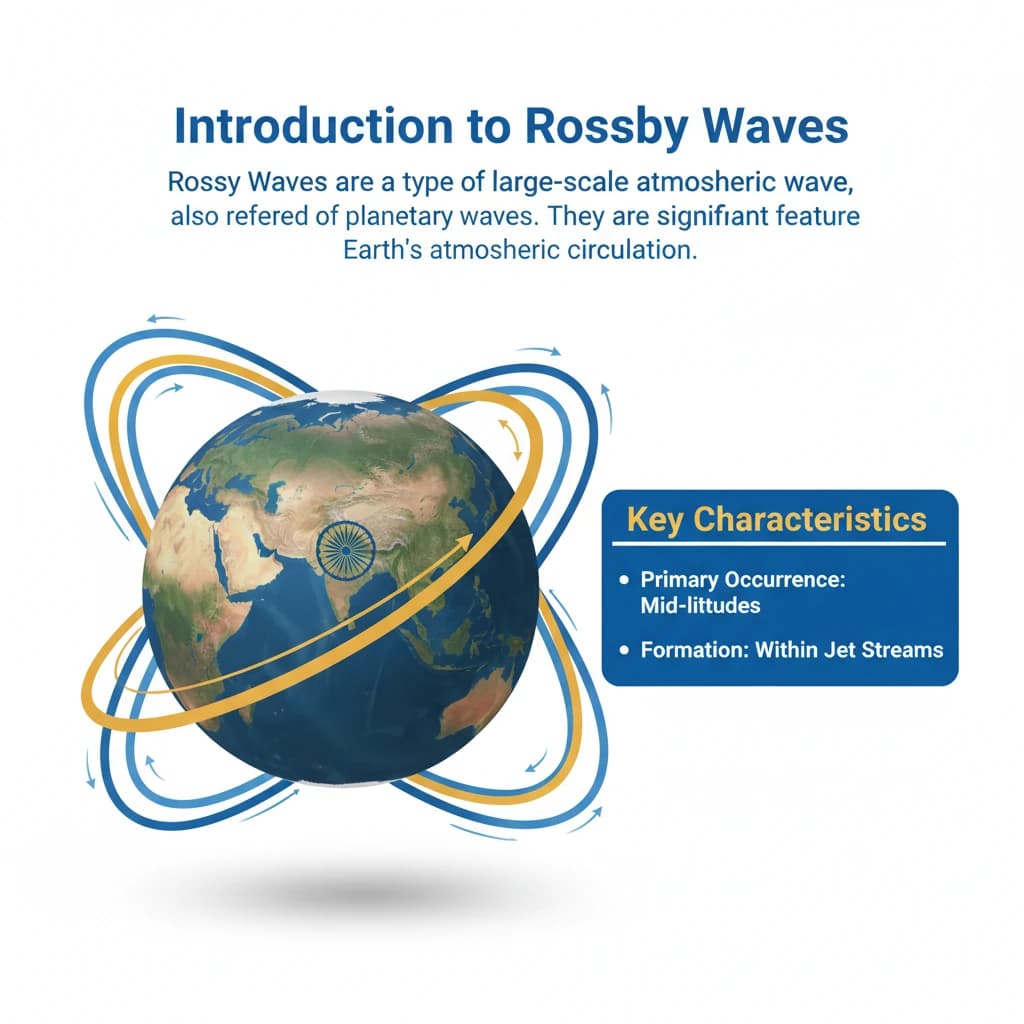
Rossby Waves are a type of large-scale atmospheric wave, also referred to as planetary waves. They are a significant feature of Earth's atmospheric circulation.
- Primary Occurrence: These waves occur predominantly in the mid-latitudes of the Earth’s atmosphere.
- Formation: They form within jet streams, which are high-altitude air currents.
- Flow Direction: The air currents within which they form flow from west to east.
- Pattern: They exhibit a distinctive meandering pattern.
Formation and Key Characteristics
The formation of Rossby waves is most prominent in regions where there is a substantial temperature contrast. This contrast typically exists between the equator and the poles.
Their meandering pattern is crucial as it influences weather patterns across both the Northern and Southern Hemispheres.
The amplitude and wavelength of Rossby waves are directly influenced by the strength of the Coriolis effect and the latitudinal temperature gradient.
Influence on Global Weather Patterns
Rossby waves play a pivotal role in shaping global weather patterns. Their movement and characteristics directly affect regional weather conditions.
They are instrumental in determining various atmospheric phenomena, including temperature extremes and overall precipitation levels across different regions.
Role in Global Heat Distribution
A critical function of Rossby waves is their contribution to balancing global heat distribution. They act as a natural mechanism for thermal regulation.
These waves prevent polar regions from becoming excessively cold and similarly prevent equatorial regions from experiencing extreme overheating, maintaining a more balanced planetary climate.
Understanding Rossby waves is essential for topics like atmospheric circulation, jet streams, and climate dynamics, which are frequently tested in UPSC GS Paper 1 (Geography).
💡 Key Takeaways
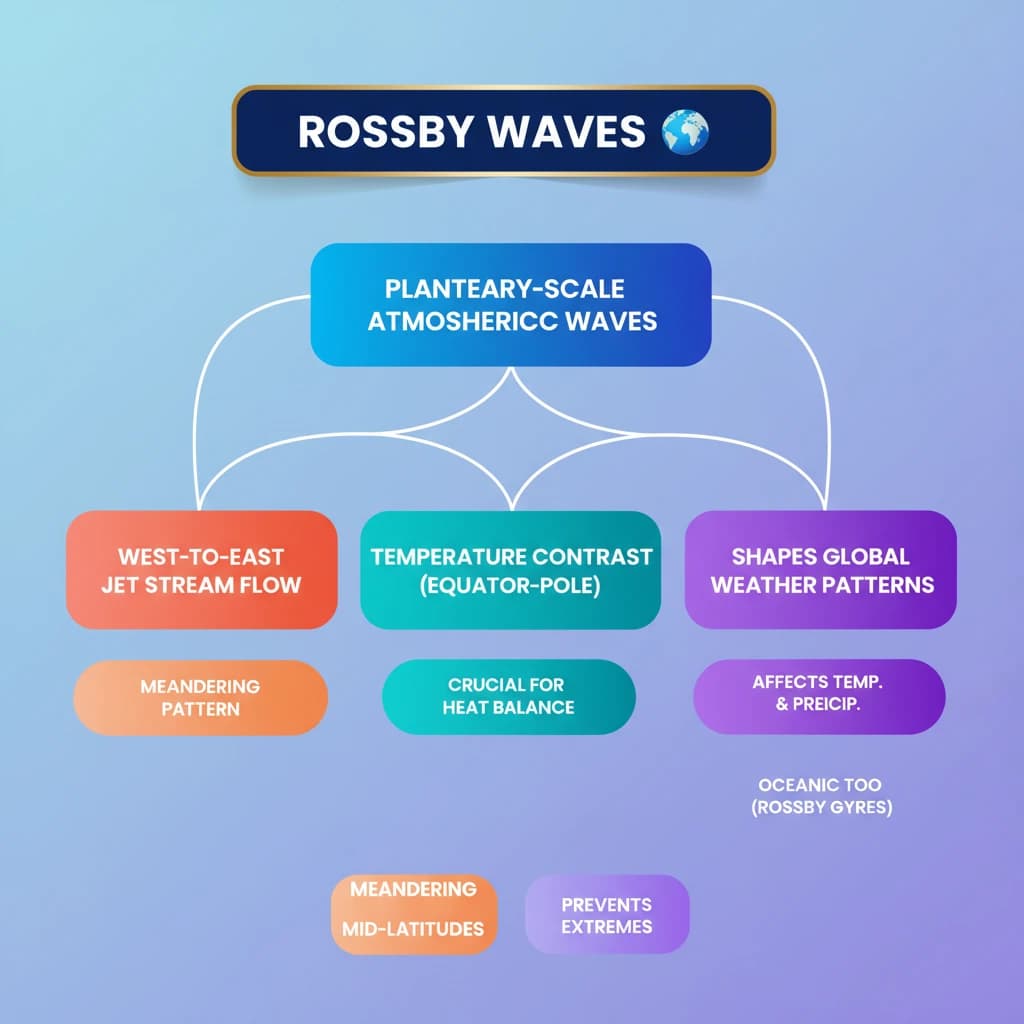
- •Rossby Waves are large-scale atmospheric (planetary) waves in mid-latitudes.
- •They form in west-to-east flowing jet streams, exhibiting a meandering pattern.
- •Most prominent where there's a large temperature contrast between equator and poles.
- •Crucial for shaping global weather patterns, affecting temperature and precipitation.
- •Play a key role in balancing global heat distribution, preventing extremes.
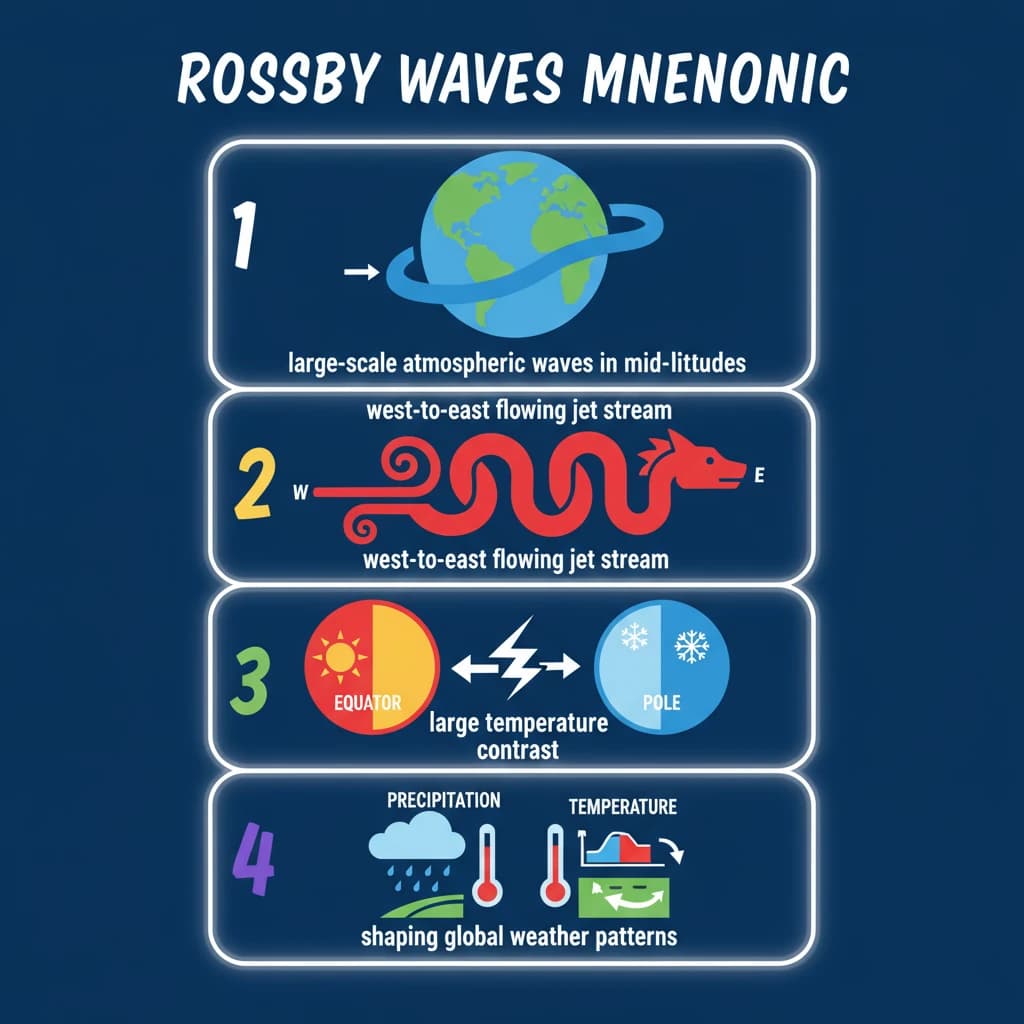
🧠 Memory Techniques
98% Verified Content
📚 Reference Sources
•NCERT Geography Textbooks (Class XI, XII)
•Standard Meteorology Textbooks (e.g., Ahrens, Wallace & Hobbs)
•National Oceanic and Atmospheric Administration (NOAA) resources
•World Meteorological Organization (WMO) publications