Loading page, please wait…
Surge in Demand of Copper - UPSC Geography
What is Surge in Demand of Copper in UPSC Geography?
Surge in Demand of Copper is a key topic under Geography for UPSC Civil Services Examination. Key points include: Copper demand surged 16% in FY23, driven by economic growth and green technologies.. It is a malleable, ductile metal with excellent electrical/thermal conductivity, corrosion resistance, and antimicrobial properties.. Key applications include construction, consumer durables, transportation, industrial manufacturing, and crucial clean energy technologies (EVs, solar).. Understanding this topic is essential for both UPSC Prelims and Mains preparation.
Why is Surge in Demand of Copper important for UPSC exam?
Surge in Demand of Copper is a Medium-level topic in UPSC Geography. It is tested in both Prelims (factual MCQs) and Mains (analytical answer writing). Previous year UPSC questions have frequently covered aspects of Surge in Demand of Copper, making it essential for comprehensive IAS preparation.
How to prepare Surge in Demand of Copper for UPSC?
To prepare Surge in Demand of Copper for UPSC: (1) Study the comprehensive notes covering all key concepts on Vaidra. (2) Practice previous year questions on this topic. (3) Connect it with current affairs using daily updates. (4) Revise using key takeaways and mind maps available for Geography. (5) Write practice answers linking Surge in Demand of Copper to related GS Paper topics.
Key takeaways of Surge in Demand of Copper for UPSC
- Copper demand surged 16% in FY23, driven by economic growth and green technologies.
- It is a malleable, ductile metal with excellent electrical/thermal conductivity, corrosion resistance, and antimicrobial properties.
- Key applications include construction, consumer durables, transportation, industrial manufacturing, and crucial clean energy technologies (EVs, solar).
- Copper is 100% recyclable, supporting a circular economy.
- Found in sulphide, carbonate, silicate deposits, and as native copper; India's ore grade is ~1%.
- Open-pit mining dominates (80%); major Indian deposits are in Jharkhand, MP, and Rajasthan.
- Its historical use from the Copper Age to the Electrical Age underscores its enduring importance.
- Copper is a critical mineral for global energy transition, economic growth, and has significant geopolitical implications.
Surge in Demand of Copper
Medium⏱️ 12 min read
geography
📖 Introduction
Context of Copper Demand Surge
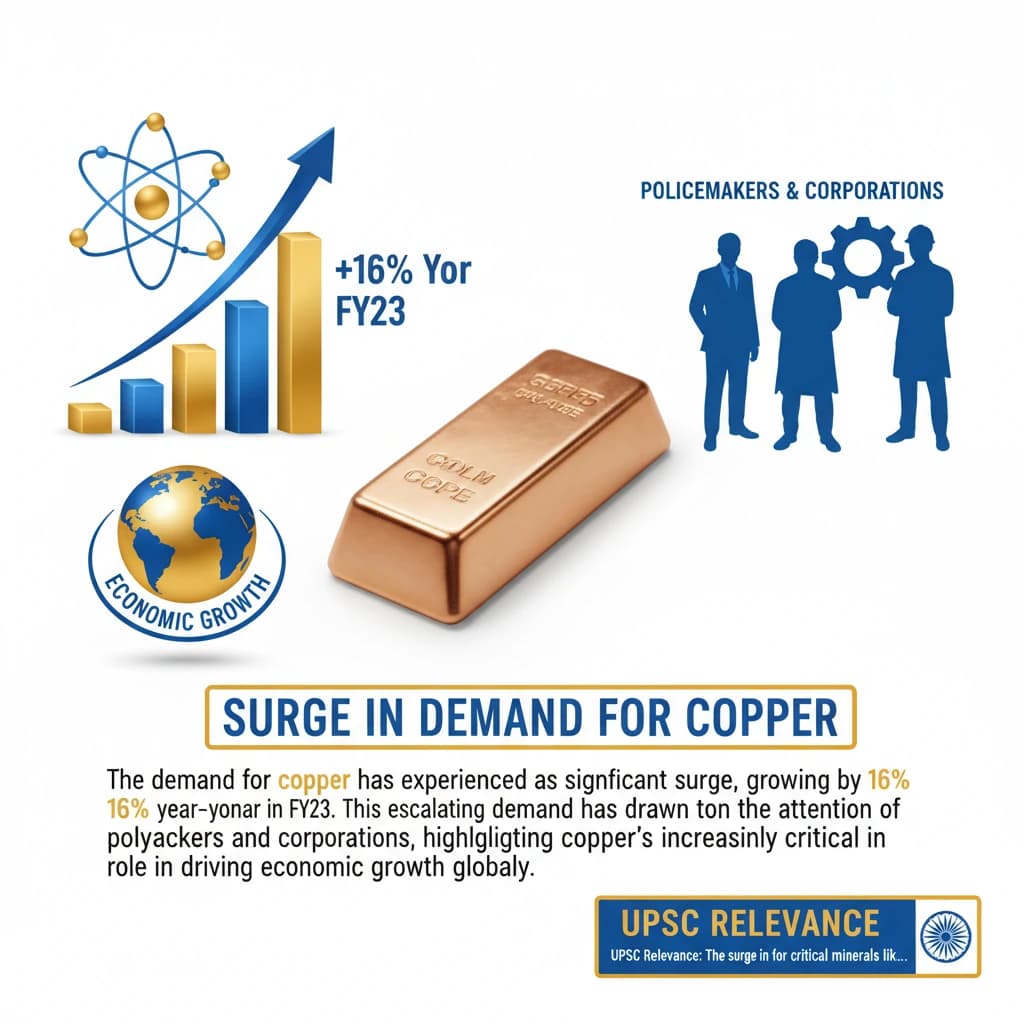
The demand for copper has experienced a significant surge, growing by 16% year-on-year in FY23. This escalating demand has drawn the attention of policymakers and corporations, highlighting copper's increasingly critical role in driving economic growth globally.
UPSC Relevance: The surge in demand for critical minerals like copper is a recurring theme in GS Paper 1 (Geography) and GS Paper 3 (Economy, Environment), especially concerning resource geopolitics and sustainable development.
About Copper: Key Properties
Copper is a highly valued metal known for its distinctive properties. It is a malleable and ductile metal, making it versatile for various industrial applications. Its exceptional heat and electricity conductivity are paramount to its widespread use.
Furthermore, copper exhibits strong corrosion resistance and possesses inherent antimicrobial properties, adding to its utility in diverse environments.
Malleability: The ability of a material to be pressed or rolled into thin sheets without breaking or cracking.
Ductility: The property of a material that allows it to be stretched or drawn out into a thin wire without losing its strength or breaking.
Applications of Copper
Copper's versatility leads to its extensive use across numerous sectors:
- Construction: Integral for wiring, plumbing, and roofing.
- Consumer Durables: Found in electronics, appliances, and household items.
- Transportation: Essential for wiring harnesses and components in vehicles.
- Industrial Manufacturing: Used in machinery, heat exchangers, and electrical equipment.
Critically, copper is also a foundational material for clean energy technologies. This includes components in solar panels, wiring in electric vehicles (EVs), and efficient motors for various applications.
Circular Economy: Copper is a 100% recyclable metal, which significantly contributes to the principles of a circular economy by reducing the need for virgin material extraction and minimizing waste.
Occurrence and Composition of Copper
Copper occurs naturally in various forms within the Earth’s crust. Its presence is typically found in different types of mineral deposits.
- Sulphide Deposits: Commonly found as chalcopyrite, bornite, and chalcocite.
- Carbonate Deposits: Occurs as minerals like azurite and malachite.
- Silicate Deposits: Present in minerals such as chrysocolla and dioptase.
- Native Copper: Can also be found in its pure, uncombined metallic form.
Ore Grade: Most commercial copper ore deposits contain an average grade of 0.8% copper. In contrast, copper ore in India typically has a slightly higher average copper content of around 1%.
Copper Mining Methods
There are two primary methods employed for extracting copper from the Earth:
- Open-pit Mining: This method involves excavating large, open pits from the surface.
- Underground Mining: This technique involves creating tunnels and shafts to access deeper ore bodies.
Open-pit mining is the dominant method globally, accounting for approximately 80% of all copper mining operations due to its efficiency for large, shallow deposits.
Copper Deposits in India
Significant copper deposits in India are primarily located in specific districts across a few states:
- Singhbhum district in Jharkhand.
- Balaghat district in Madhya Pradesh.
- Jhunjhunu and Alwar districts in Rajasthan.
💡 Key Takeaways
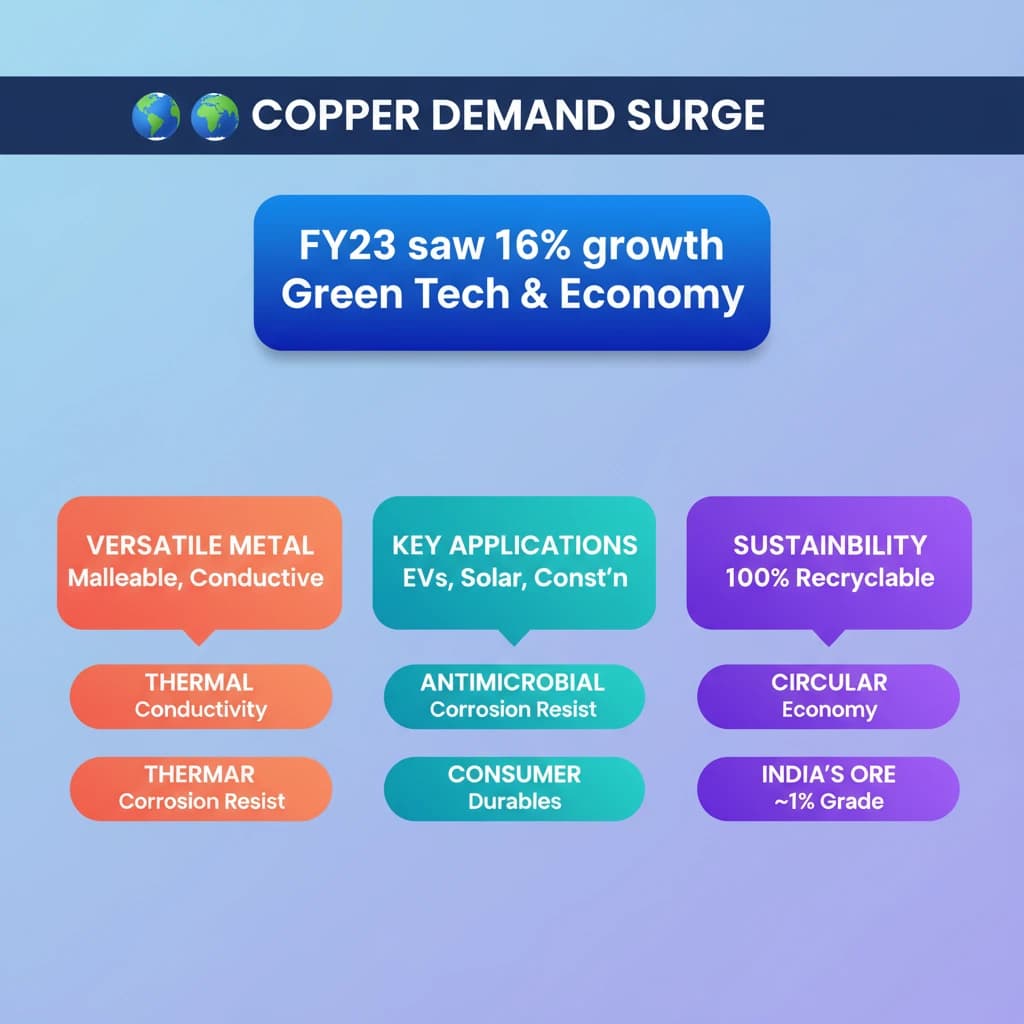
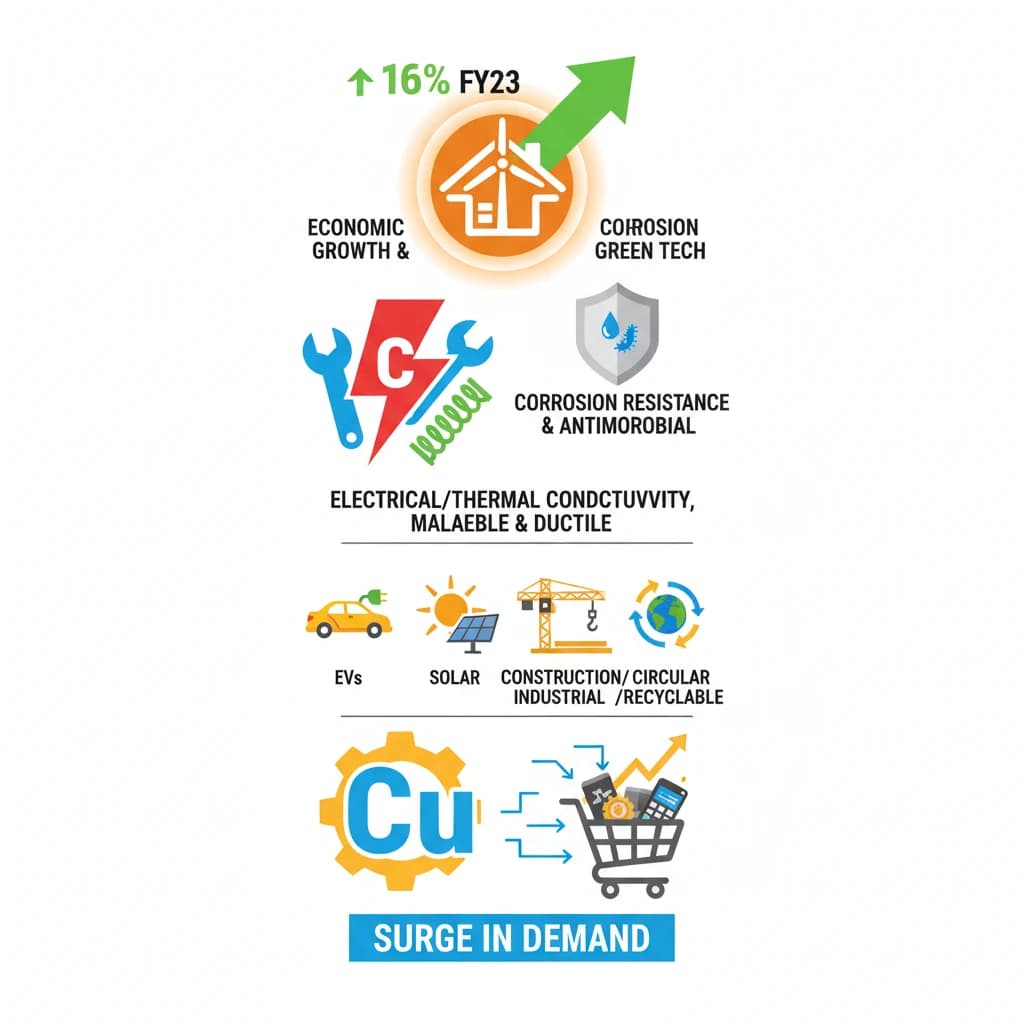
- •Copper demand surged 16% in FY23, driven by economic growth and green technologies.
- •It is a malleable, ductile metal with excellent electrical/thermal conductivity, corrosion resistance, and antimicrobial properties.
- •Key applications include construction, consumer durables, transportation, industrial manufacturing, and crucial clean energy technologies (EVs, solar).
- •Copper is 100% recyclable, supporting a circular economy.
- •Found in sulphide, carbonate, silicate deposits, and as native copper; India's ore grade is ~1%.
- •Open-pit mining dominates (80%); major Indian deposits are in Jharkhand, MP, and Rajasthan.
- •Its historical use from the Copper Age to the Electrical Age underscores its enduring importance.
- •Copper is a critical mineral for global energy transition, economic growth, and has significant geopolitical implications.
🧠 Memory Techniques
95% Verified Content
📚 Reference Sources
•Geological Survey of India (GSI) reports on mineral resources
•International Copper Association (ICA) publications
•Ministry of Mines, Government of India reports
•General knowledge on critical minerals and energy transition