Loading page, please wait…
Transboundary Rivers of India - UPSC Geography
What is Transboundary Rivers of India in UPSC Geography?
Transboundary Rivers of India is a key topic under Geography for UPSC Civil Services Examination. Key points include: India and Bangladesh share 54 transboundary rivers, making water management a critical bilateral issue.. The Gumti River, originating in Tripura, was central to recent flood concerns in Bangladesh, clarified as heavy rainfall.. Dumbur Dam on Gumti in Tripura generates power, with Bangladesh drawing 40 MW.. Understanding this topic is essential for both UPSC Prelims and Mains preparation.
Why is Transboundary Rivers of India important for UPSC exam?
Transboundary Rivers of India is a Medium-level topic in UPSC Geography. It is tested in both Prelims (factual MCQs) and Mains (analytical answer writing). Previous year UPSC questions have frequently covered aspects of Transboundary Rivers of India, making it essential for comprehensive IAS preparation.
How to prepare Transboundary Rivers of India for UPSC?
To prepare Transboundary Rivers of India for UPSC: (1) Study the comprehensive notes covering all key concepts on Vaidra. (2) Practice previous year questions on this topic. (3) Connect it with current affairs using daily updates. (4) Revise using key takeaways and mind maps available for Geography. (5) Write practice answers linking Transboundary Rivers of India to related GS Paper topics.
Key takeaways of Transboundary Rivers of India for UPSC
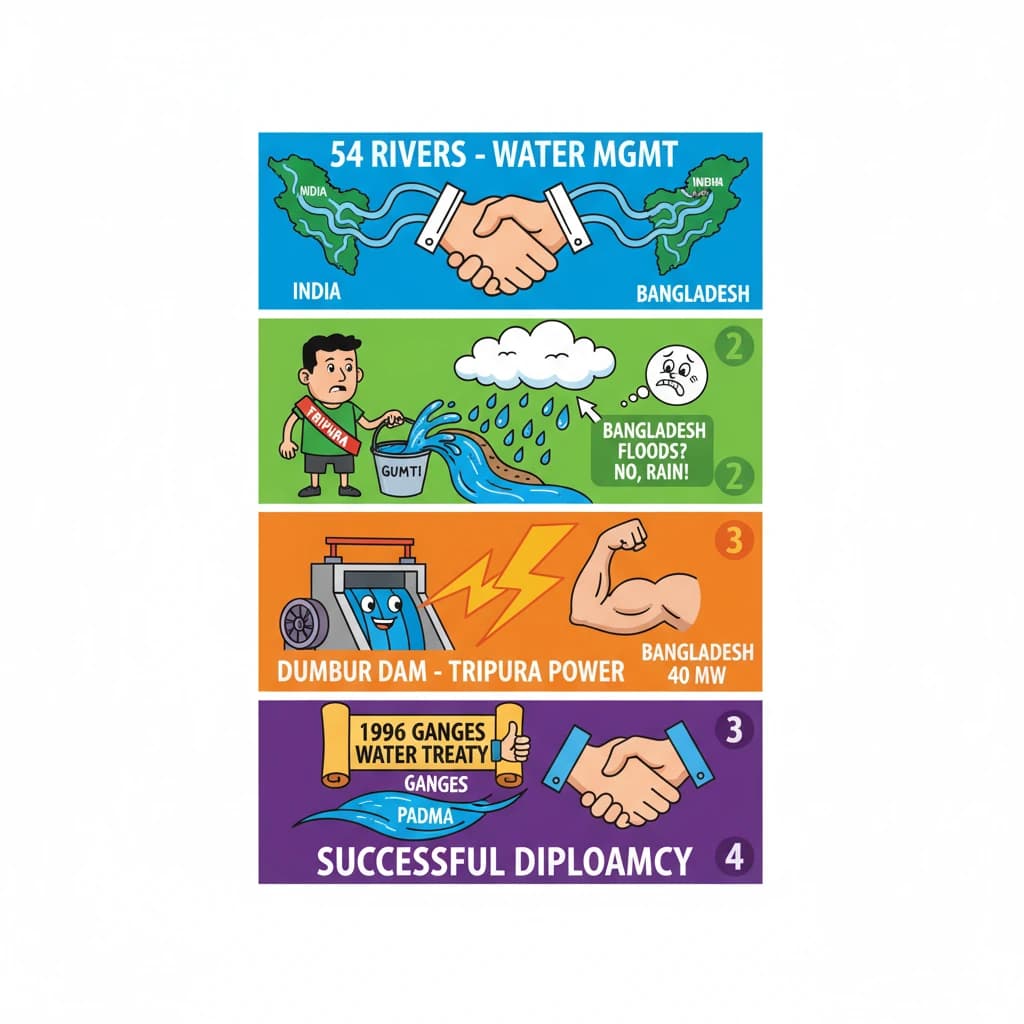
- India and Bangladesh share 54 transboundary rivers, making water management a critical bilateral issue.
- The Gumti River, originating in Tripura, was central to recent flood concerns in Bangladesh, clarified as heavy rainfall.
- Dumbur Dam on Gumti in Tripura generates power, with Bangladesh drawing 40 MW.
- The Ganges (Padma) River is governed by the 1996 Ganges Water Treaty, a successful example of water diplomacy.
- The Teesta River water-sharing remains an unresolved dispute, impacting India-Bangladesh relations.
- Transboundary river management requires cooperation, data sharing, and adherence to international water laws.
Transboundary Rivers of India
Medium⏱️ 10 min read
geography
📖 Introduction
Context and Recent Developments
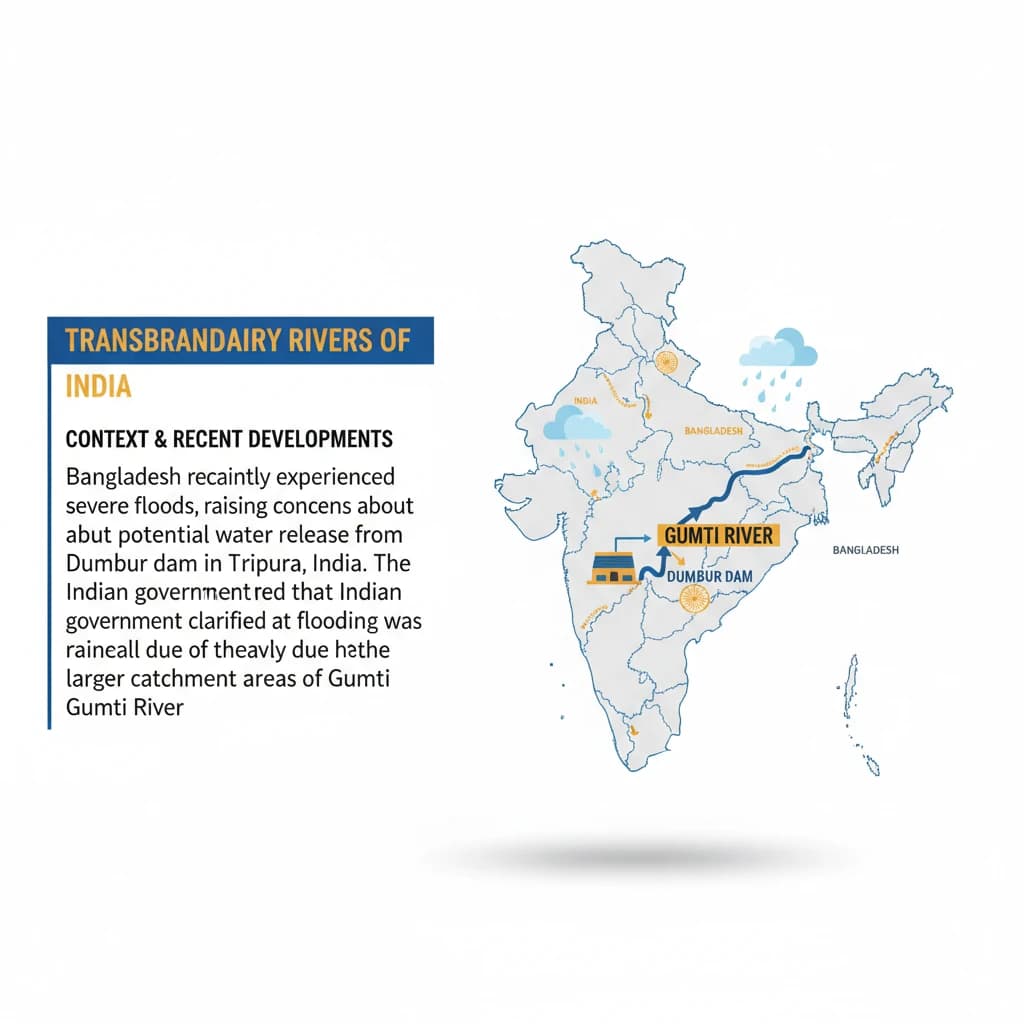
Bangladesh recently experienced severe floods, raising concerns about potential water release from the Dumbur dam in Tripura, India. This incident highlighted the complexities of managing shared water resources.
The Indian government clarified that the flooding was primarily due to heavy rainfall in the larger catchment areas of the Gumti River. This river flows through both nations, and the dam's water release was not the cause of the extensive inundation.
The Gumti River System
The Gumti River, also known as Gomti or Gumati, originates in Tripura, India. It subsequently flows into the district of Comilla in Bangladesh, making it a significant transboundary waterway.
Right Bank Tributaries of Gumti River:
- Korchi Gang
- Pitra Gang
- San Gang
- Mailak Chhara
- Surma Chhara
Left Bank Tributaries of Gumti River:
- Ek Chhari
- Maharani Chhara
- Ganga
Dumbur Dam and Power Generation
The Dumbur Dam is constructed on the Gumti River within Tripura. It plays a crucial role in regional power generation.
- Height: 30 metres
- Purpose: Generates power that feeds into a grid.
- Beneficiary: Bangladesh draws 40 Megawatts (MW) of power from Tripura.
Dumboor Lake: Source and Significance
Dumboor Lake is located in Gandacherra, near Agartala. It is now part of the Jatanbari/Hydel Project and is recognized as the source of the Gumti River.
The lake is formed by the confluence of the Raima and Sarma rivers. It is particularly noted for its diverse species of fish.
An annual cultural event, the “Poush Sankranti Mela”, is hosted at the lake every year on January 14th.
Transboundary Rivers Shared by India and Bangladesh
India and Bangladesh share a total of 54 rivers. India has the largest number of rivers flowing into the Bay of Bengal via Bangladesh, highlighting the extensive hydrological connectivity between the two nations.
The Ganges River System (Padma in Bangladesh)
The Ganges is a major transboundary river, flowing from India into Bangladesh. It traverses the vast Gangetic plain of North India before entering Bangladesh, where it is known as the Padma.
Major Left Bank Tributaries (India):
- Gomti
- Ghaghara
- Gandak
- Kosi
Major Right Bank Tributaries (India):
- Yamuna
- Son
- Punpun
- Damodar
In Bangladesh, the Ganges (Padma) has only one primary tributary, the Mahananda. However, it gives rise to several significant distributaries.
Ganges Distributaries (Bangladesh):
- Khamati
- Nabaganga
- Bhairab
- Kumar
- Gorai-Madhumati
- Arial Khan
The Ghaghara River
The Ghaghara River originates in the Tibetan Plateau. It is known for its high discharge, especially during the monsoon season, and eventually joins the Ganges near Patna.
The Son River
The Son River flows through the Kaimur Range. It covers a distance of 487 miles before merging with the Ganges upstream of Patna, Bihar.
The Teesta River and Water Sharing Dispute
The Teesta River originates in the Himalayas and flows through Sikkim and West Bengal in India. It then merges with the Brahmaputra (known as Jamuna in Bangladesh) after entering Bangladesh.
Bangladesh has consistently advocated for a fair allocation of Teesta River waters from India. This request aims for an arrangement similar to the successful Ganga Water Treaty of 1996, but a resolution is still pending.
The 1996 Ganges Water Treaty
The 1996 Ganges Water Treaty between India and Bangladesh was a landmark agreement. Its primary objective was to resolve disputes over water flow entitlements, particularly concerning the Ganges River.
The disputes emerged after the construction of the Farakka Barrage in 1975. This barrage was built to divert Ganges water to the Hooghly River to maintain the navigability and ecological health of Calcutta port.
Understanding the dynamics of transboundary rivers like the Ganges and Teesta, along with their associated treaties and disputes, is crucial for UPSC Mains GS Paper 2 (International Relations) and GS Paper 1 (Geography). Focus on geographical facts, bilateral relations, and environmental impacts.
💡 Key Takeaways
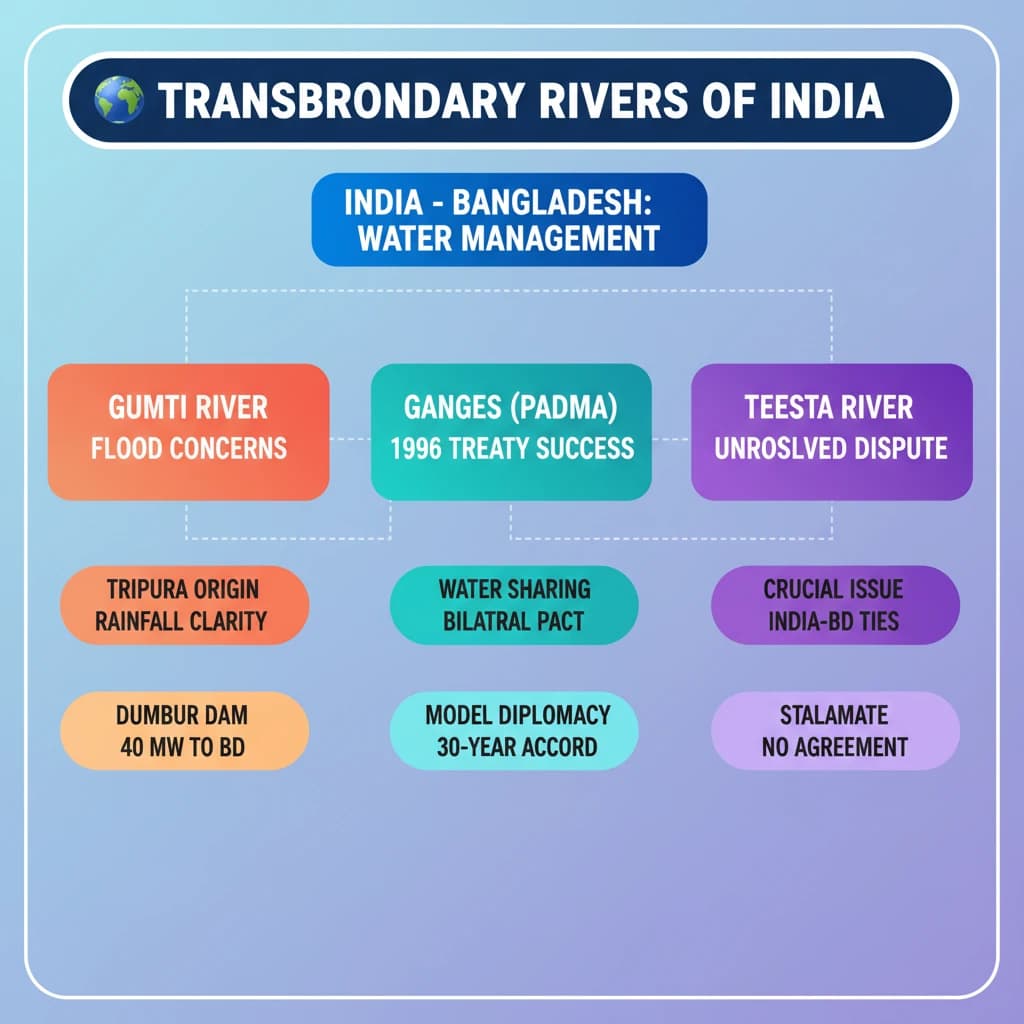
- •India and Bangladesh share 54 transboundary rivers, making water management a critical bilateral issue.
- •The Gumti River, originating in Tripura, was central to recent flood concerns in Bangladesh, clarified as heavy rainfall.
- •Dumbur Dam on Gumti in Tripura generates power, with Bangladesh drawing 40 MW.
- •The Ganges (Padma) River is governed by the 1996 Ganges Water Treaty, a successful example of water diplomacy.
- •The Teesta River water-sharing remains an unresolved dispute, impacting India-Bangladesh relations.
- •Transboundary river management requires cooperation, data sharing, and adherence to international water laws.
🧠 Memory Techniques
95% Verified Content