Loading page, please wait…
Warming of Great Barrier Reef Waters - UPSC Geography
What is Warming of Great Barrier Reef Waters in UPSC Geography?
Warming of Great Barrier Reef Waters is a key topic under Geography for UPSC Civil Services Examination. Key points include: Great Barrier Reef (GBR) waters hit highest temperatures in 400 years over the last decade.. Mass coral bleaching occurred repeatedly between 2016 and 2024.. GBR is the world's largest coral reef system, stretching 2,300 km, home to 400 coral types and 1,500 fish species.. Understanding this topic is essential for both UPSC Prelims and Mains preparation.
Why is Warming of Great Barrier Reef Waters important for UPSC exam?
Warming of Great Barrier Reef Waters is a Medium-level topic in UPSC Geography. It is tested in both Prelims (factual MCQs) and Mains (analytical answer writing). Previous year UPSC questions have frequently covered aspects of Warming of Great Barrier Reef Waters, making it essential for comprehensive IAS preparation.
How to prepare Warming of Great Barrier Reef Waters for UPSC?
To prepare Warming of Great Barrier Reef Waters for UPSC: (1) Study the comprehensive notes covering all key concepts on Vaidra. (2) Practice previous year questions on this topic. (3) Connect it with current affairs using daily updates. (4) Revise using key takeaways and mind maps available for Geography. (5) Write practice answers linking Warming of Great Barrier Reef Waters to related GS Paper topics.
Key takeaways of Warming of Great Barrier Reef Waters for UPSC
- Great Barrier Reef (GBR) waters hit highest temperatures in 400 years over the last decade.
- Mass coral bleaching occurred repeatedly between 2016 and 2024.
- GBR is the world's largest coral reef system, stretching 2,300 km, home to 400 coral types and 1,500 fish species.
- It is a UNESCO World Heritage site (inscribed 1981) and habitat for endangered species like dugongs and green turtles.
- Widespread bleaching events have been recorded since 1998, with increasing frequency in recent years (1998, 2002, 2016, 2017, 2020, 2022, 2024).
Warming of Great Barrier Reef Waters
Medium⏱️ 6 min read
geography
📖 Introduction
Recent Developments: Mass Bleaching Events
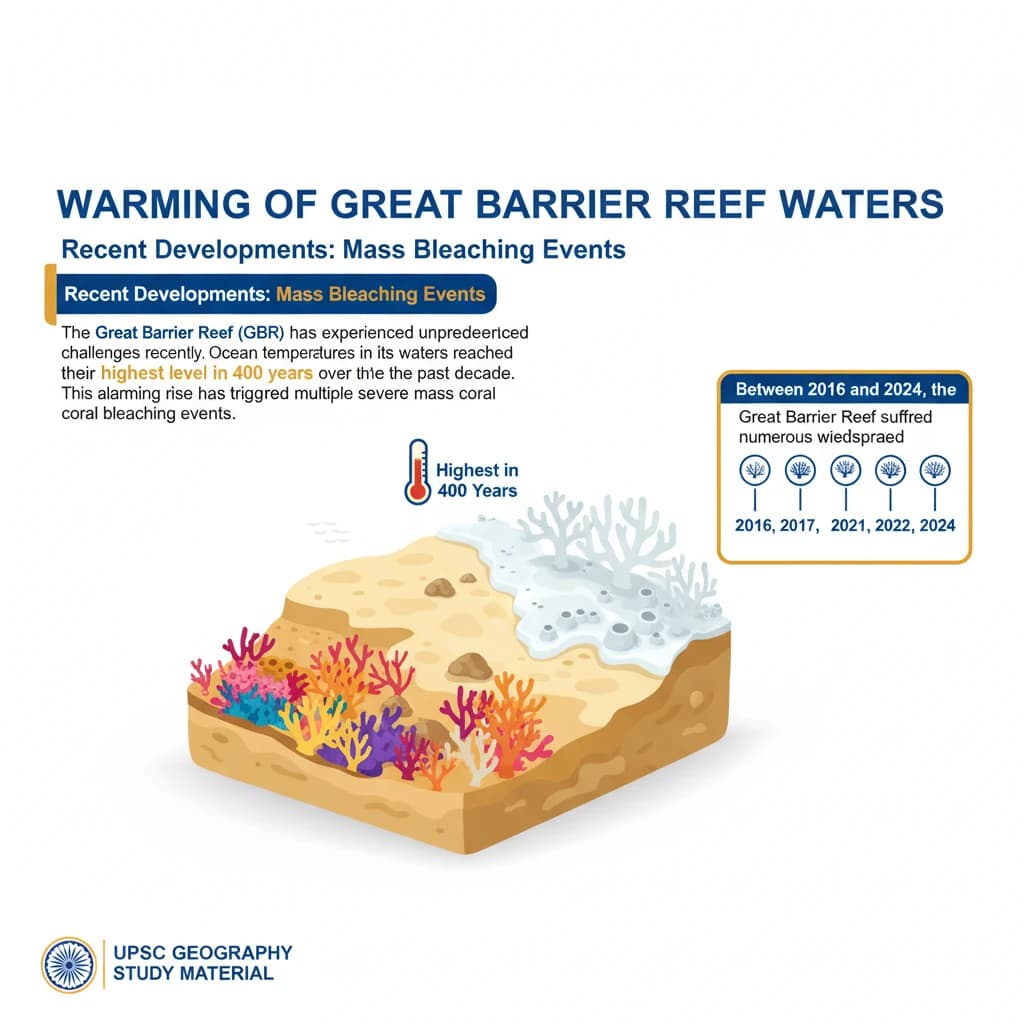
The Great Barrier Reef (GBR) has experienced unprecedented challenges recently. Ocean temperatures in its waters reached their highest level in 400 years over the past decade. This alarming rise has triggered multiple severe mass coral bleaching events.
Between 2016 and 2024, the Great Barrier Reef suffered numerous widespread mass coral bleaching events, indicating significant environmental stress.
Understanding the Great Barrier Reef (GBR)
The Great Barrier Reef is globally recognized as the world’s largest coral reef system. It is strategically located in the Coral Sea, just off the coast of Queensland, Australia.
- Length: The reef stretches approximately 2,300 km.
- Composition: It comprises around 3,000 individual reefs and 900 islands.
- Biodiversity: Home to over 400 types of coral and 1,500 species of fish.
Ecological Significance of GBR
Beyond its sheer size and beauty, the GBR is a critical habitat for diverse marine life. It supports numerous species, including several that are endangered.
The reef provides sanctuary for endangered species such as the dugong and the large green turtle, highlighting its immense ecological value.
Recognizing its outstanding universal value, the GBR was designated a UNESCO World Heritage site in 1981.
Historical Bleaching Incidents
While recent events are severe, mass bleaching is not entirely new to the Great Barrier Reef. The first widespread incident was recorded decades ago, with recurring events since.
Significant mass bleaching events on the Great Barrier Reef have occurred in: 1998, 2002, 2016, 2017, 2020, 2022, and 2024. This pattern underscores a worrying trend of increasing frequency.
💡 Key Takeaways
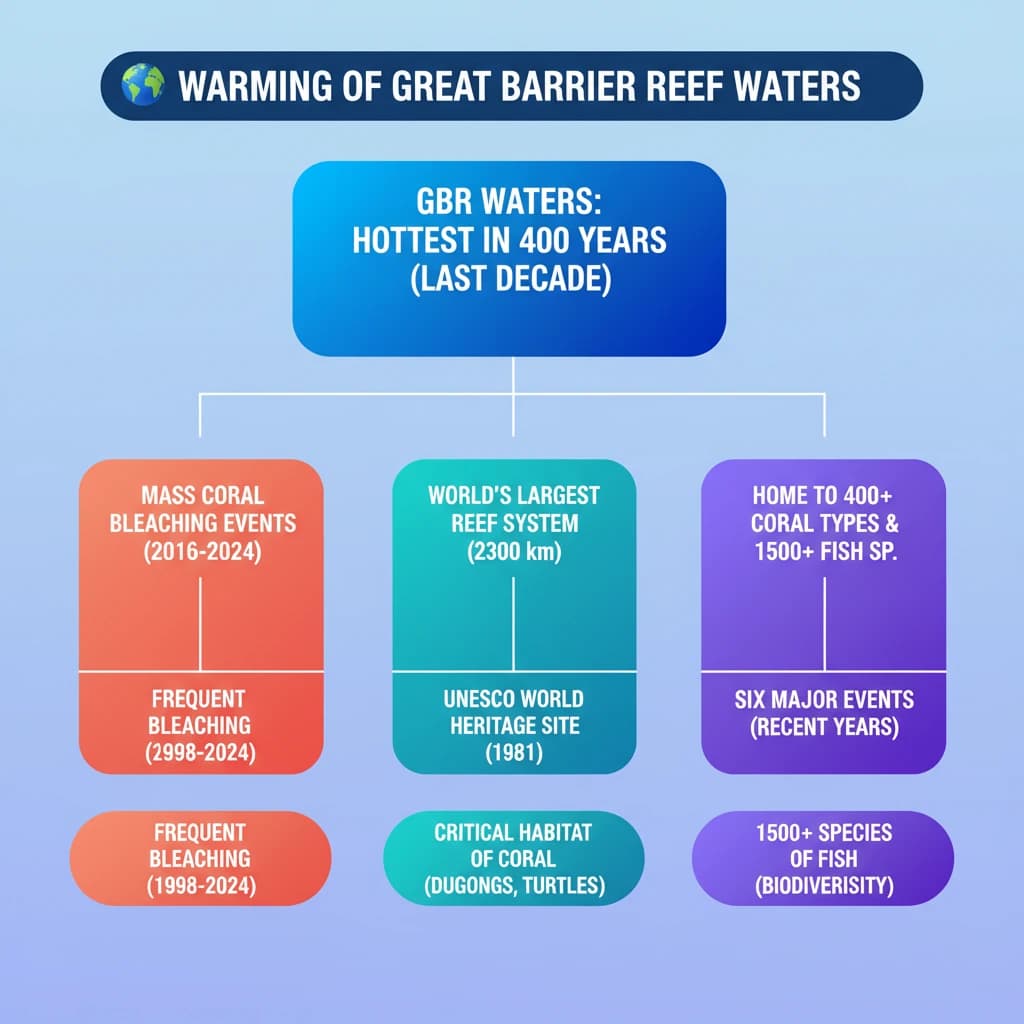
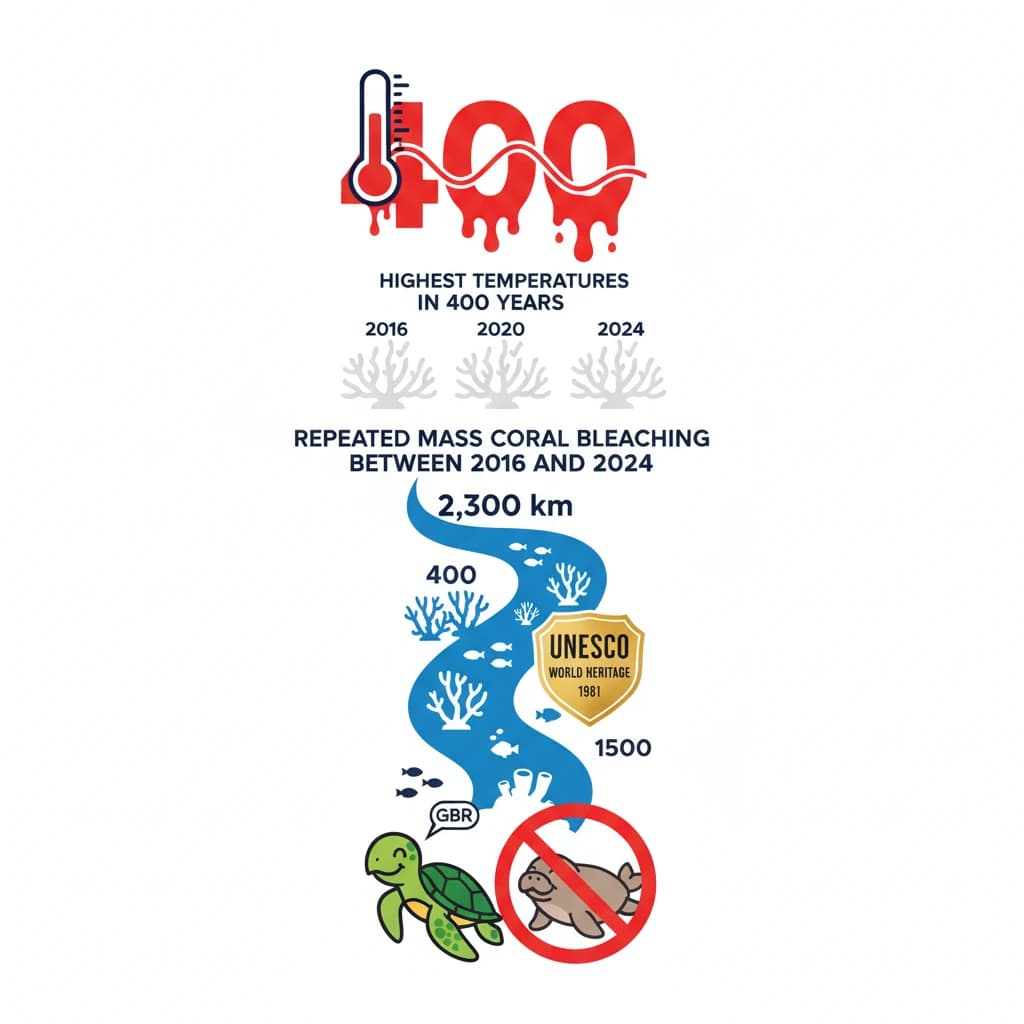
- •Great Barrier Reef (GBR) waters hit highest temperatures in 400 years over the last decade.
- •Mass coral bleaching occurred repeatedly between 2016 and 2024.
- •GBR is the world's largest coral reef system, stretching 2,300 km, home to 400 coral types and 1,500 fish species.
- •It is a UNESCO World Heritage site (inscribed 1981) and habitat for endangered species like dugongs and green turtles.
- •Widespread bleaching events have been recorded since 1998, with increasing frequency in recent years (1998, 2002, 2016, 2017, 2020, 2022, 2024).
🧠 Memory Techniques
95% Verified Content