Loading page, please wait…
What are Key Facts About the Ganga River System? - UPSC Geography
What is What are Key Facts About the Ganga River System? in UPSC Geography?
What are Key Facts About the Ganga River System? is a key topic under Geography for UPSC Civil Services Examination. Key points include: The Ganga originates as Bhagirathi from Gangotri Glacier, acquiring its name at Devprayag (Bhagirathi + Alaknanda).. The Panch Prayag are five key confluences of the Alaknanda with other headstreams (Dhauliganga, Nandakini, Pindar, Mandakini, Bhagirathi).. Major tributaries include the Yamuna (right bank) and Ghaghara, Gandak, Kosi, Mahananda (left bank).. Understanding this topic is essential for both UPSC Prelims and Mains preparation.
Why is What are Key Facts About the Ganga River System? important for UPSC exam?
What are Key Facts About the Ganga River System? is a Medium-level topic in UPSC Geography. It is tested in both Prelims (factual MCQs) and Mains (analytical answer writing). Previous year UPSC questions have frequently covered aspects of What are Key Facts About the Ganga River System?, making it essential for comprehensive IAS preparation.
How to prepare What are Key Facts About the Ganga River System? for UPSC?
To prepare What are Key Facts About the Ganga River System? for UPSC: (1) Study the comprehensive notes covering all key concepts on Vaidra. (2) Practice previous year questions on this topic. (3) Connect it with current affairs using daily updates. (4) Revise using key takeaways and mind maps available for Geography. (5) Write practice answers linking What are Key Facts About the Ganga River System? to related GS Paper topics.
Key takeaways of What are Key Facts About the Ganga River System? for UPSC
- The Ganga originates as Bhagirathi from Gangotri Glacier, acquiring its name at Devprayag (Bhagirathi + Alaknanda).
- The Panch Prayag are five key confluences of the Alaknanda with other headstreams (Dhauliganga, Nandakini, Pindar, Mandakini, Bhagirathi).
- Major tributaries include the Yamuna (right bank) and Ghaghara, Gandak, Kosi, Mahananda (left bank).
- It forms the world's largest delta with the Brahmaputra (as Padma-Meghna) before flowing into the Bay of Bengal.
- The Ganga is culturally sacred and economically vital but faces severe pollution, addressed by initiatives like Namami Gange.
What are Key Facts About the Ganga River System?
Medium⏱️ 8 min read
geography
📖 Introduction
Introduction to the Ganga River System
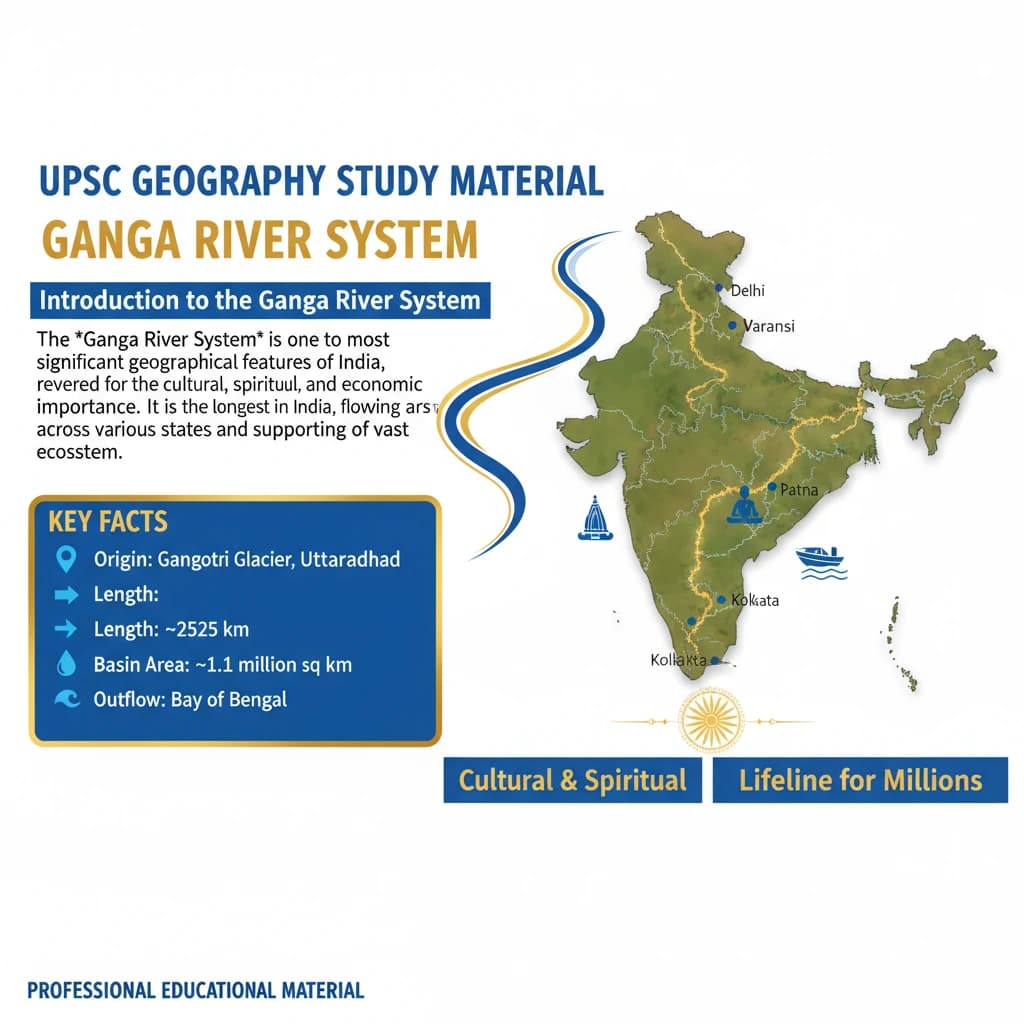
The Ganga River System is one of the most significant geographical features of India, revered for its cultural, spiritual, and economic importance. It is the longest river in India, flowing across various states and supporting a vast ecosystem.
The Ganga traverses approximately 2525 km before emptying into the Bay of Bengal, making it a lifeline for millions.
Origin and Headwaters
The Ganga originates as the Bhagirathi River from the Gangotri Glacier in Uttrakhand. This glacial source is located at an elevation of 3,892 meters, marking the initial point of this mighty river system.
Many small streams contribute to the headwaters of the Ganga. Key among these are the Alaknanda, Dhauliganga, Pindar, Mandakini, and Bhilangana rivers.
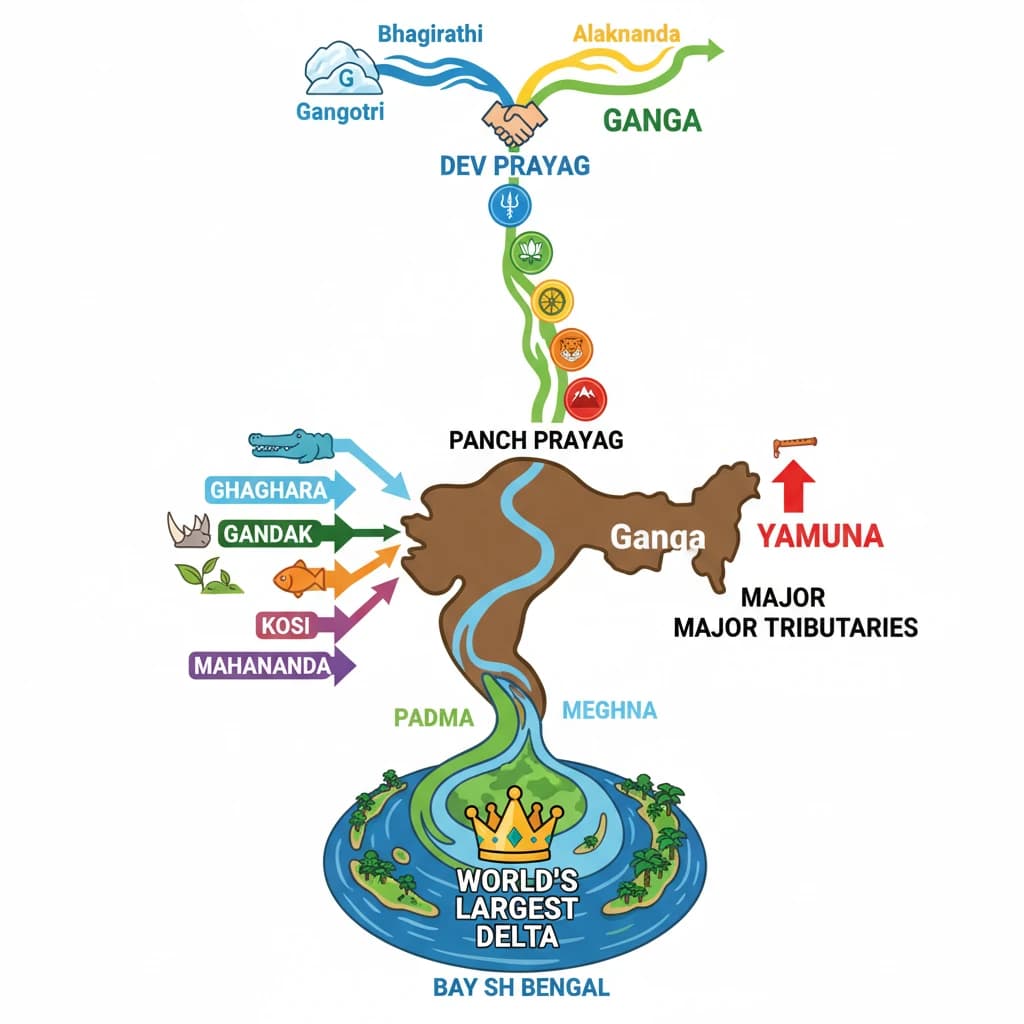
The river officially acquires the name Ganga at Devprayag, where the Alaknanda river merges with the Bhagirathi.
The Panch Prayag (Five Confluences)
The Ganga is formed from six primary headstreams and their five significant confluences, known as the Panch Prayag. These confluences are vital pilgrimage sites and geographical landmarks.
- Devprayag: Confluence of Bhagirathi river and Alaknanda river.
- Rudraprayag: Confluence of Mandakini river and Alaknanda river.
- Nandaprayag: Confluence of Nandakini river and Alaknanda river.
- Karnaprayag: Confluence of Pindar river and Alaknanda river.
- Vishnuprayag: Confluence of Dhauliganga river and Alaknanda river.
Major Tributaries of the Ganga
The Ganga River System is fed by numerous tributaries, which significantly increase its volume and spread its influence across the vast Gangetic Plains. These tributaries are categorized based on whether they join from the left or right bank.
Left Bank Tributaries:
- Ramganga
- Gomti
- Ghaghara
- Gandak
- Burhi Gandak
- Koshi
- Mahananda
Right Bank Tributaries:
- Yamuna
- Tons
- Karamnasa
- Sone
- Punpun
- Falgu
- Kiul
- Chandan
- Ajay
- Damodar
- Rupnarayan
The Ganga transitions from the hills to the plains at a point where it meets the Yamuna in Allahabad (now Prayagraj), a significant confluence known as the Triveni Sangam.
Delta Formation and Outflow
After its extensive journey, the Ganga River enters Bangladesh and undergoes a complex deltaic formation before meeting the sea. This region is one of the largest deltas in the world.
In Bangladesh, the Ganga River merges with the Brahmaputra River, forming the combined stream known as the Padma River. This confluence is a critical hydrological event.
Subsequently, the Padma River joins the Meghna River, and together they flow into the Bay of Bengal through the vast Meghna Estuary, forming the immense Ganga-Brahmaputra Delta.
💡 Key Takeaways
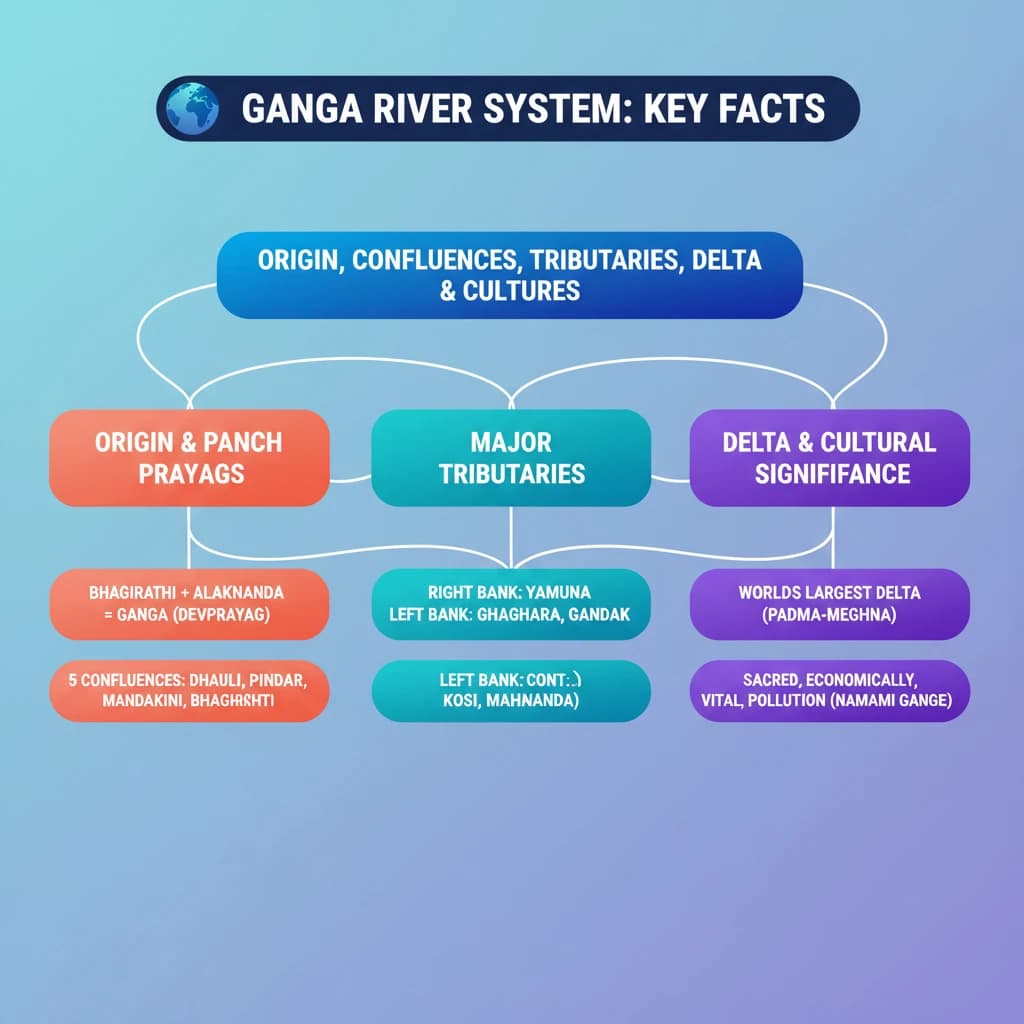
- •The Ganga originates as Bhagirathi from Gangotri Glacier, acquiring its name at Devprayag (Bhagirathi + Alaknanda).
- •The Panch Prayag are five key confluences of the Alaknanda with other headstreams (Dhauliganga, Nandakini, Pindar, Mandakini, Bhagirathi).
- •Major tributaries include the Yamuna (right bank) and Ghaghara, Gandak, Kosi, Mahananda (left bank).
- •It forms the world's largest delta with the Brahmaputra (as Padma-Meghna) before flowing into the Bay of Bengal.
- •The Ganga is culturally sacred and economically vital but faces severe pollution, addressed by initiatives like Namami Gange.
🧠 Memory Techniques
95% Verified Content
📚 Reference Sources
•NCERT Geography Textbooks (Class XI & XII)
•Government of India - Ministry of Jal Shakti (Namami Gange)
•National Water Mission Reports