Loading page, please wait…
What are the Key Facts about the Tethys Sea? - UPSC Geography
What is What are the Key Facts about the Tethys Sea? in UPSC Geography?
What are the Key Facts about the Tethys Sea? is a key topic under Geography for UPSC Civil Services Examination. Key points include: The Tethys Sea was an ancient ocean existing during the Mesozoic Era (250-20 Ma).. It separated the supercontinents Gondwana (south) and Laurasia (north).. Gondwana included South America, Africa, Arabia, Madagascar, India, Australia, and Antarctica.. Understanding this topic is essential for both UPSC Prelims and Mains preparation.
Why is What are the Key Facts about the Tethys Sea? important for UPSC exam?
What are the Key Facts about the Tethys Sea? is a Medium-level topic in UPSC Geography. It is tested in both Prelims (factual MCQs) and Mains (analytical answer writing). Previous year UPSC questions have frequently covered aspects of What are the Key Facts about the Tethys Sea?, making it essential for comprehensive IAS preparation.
How to prepare What are the Key Facts about the Tethys Sea? for UPSC?
To prepare What are the Key Facts about the Tethys Sea? for UPSC: (1) Study the comprehensive notes covering all key concepts on Vaidra. (2) Practice previous year questions on this topic. (3) Connect it with current affairs using daily updates. (4) Revise using key takeaways and mind maps available for Geography. (5) Write practice answers linking What are the Key Facts about the Tethys Sea? to related GS Paper topics.
Key takeaways of What are the Key Facts about the Tethys Sea? for UPSC
- The Tethys Sea was an ancient ocean existing during the Mesozoic Era (250-20 Ma).
- It separated the supercontinents Gondwana (south) and Laurasia (north).
- Gondwana included South America, Africa, Arabia, Madagascar, India, Australia, and Antarctica.
- Laurasia included North America, Europe, and Asia (except peninsular India).
- Its closure led to the formation of major mountain ranges like the Himalayas and Alps.
- The Mediterranean Sea is considered a remnant of the Tethys Sea.

What are the Key Facts about the Tethys Sea?
Medium⏱️ 6 min read
geography
📖 Introduction
Formation and Location of the Tethys Sea
The Tethys Sea was an ancient ocean that played a pivotal role in Earth's geological history. It began to form during the early stages of the Mesozoic Era, specifically in the Triassic period.
Key Timeline: The Tethys Sea existed approximately from 250 to 20 million years ago, spanning a significant portion of the Mesozoic Era.
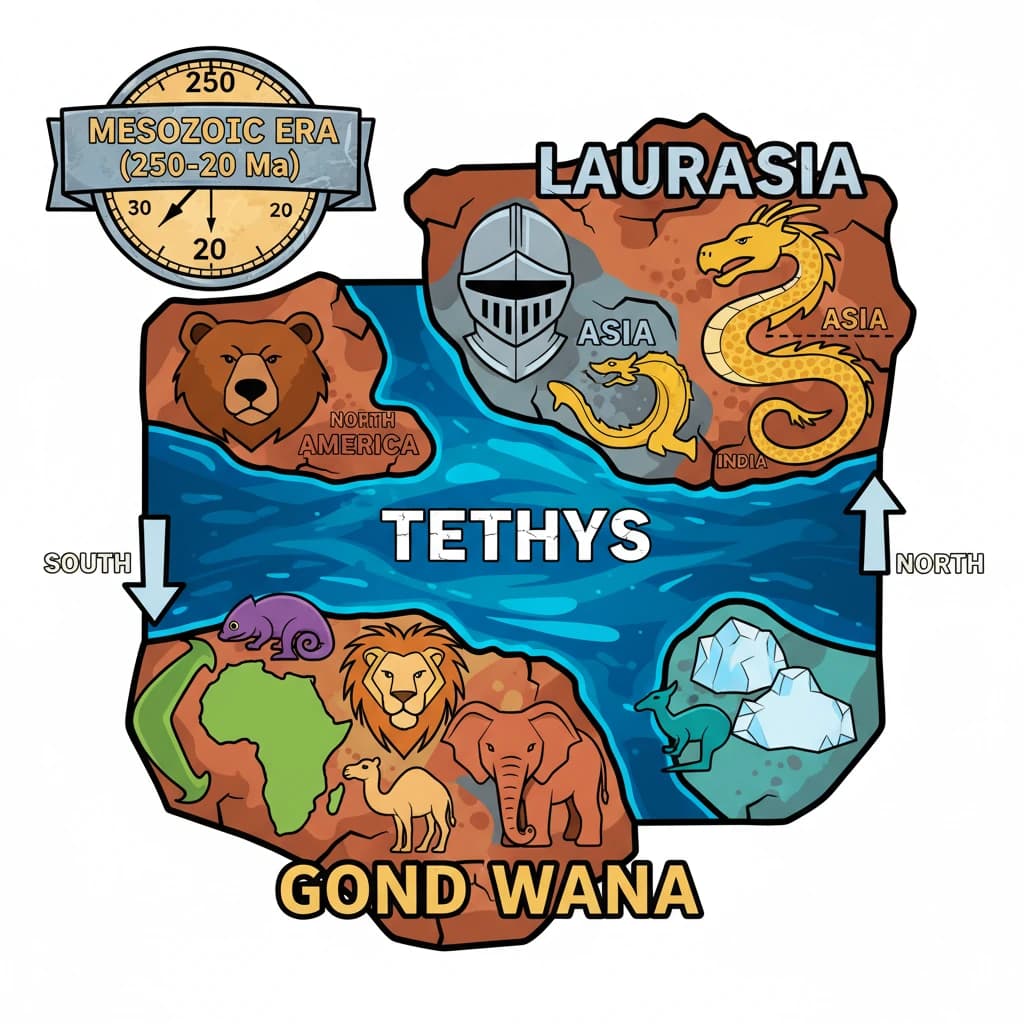
Geographically, the Tethys Sea was situated as a vast body of water separating two immense landmasses. These were the supercontinents of Gondwana to the south and Laurasia to the north.
Gondwana: The Southern Supercontinent
Gondwana, often referred to as Gondwanaland, was the colossal southern supercontinent. It comprised several landmasses that are distinct continents today.
- It included present-day South America.
- The continent of Africa was a part of Gondwana.
- The Arabian Peninsula, known as Arabia, was also integrated.
- Madagascar, a large island nation, belonged to this southern landmass.
- The Indian subcontinent, India, was a component of Gondwana.
- Australia and Antarctica completed the vast expanse of Gondwanaland.
Laurasia: The Northern Supercontinent
Conversely, Laurasia represented the northern supercontinent. It too was a massive landmass that later fragmented into the continents we recognize today.
- North America formed a significant part of Laurasia.
- The European continent, Europe, was included within Laurasia.
- Most of Asia was part of this northern supercontinent.
- It is important to note that peninsular India was an exception, as it belonged to Gondwana, not Laurasia.
UPSC Insight: Understanding the location and components of Gondwana and Laurasia is crucial for topics like Continental Drift Theory, Plate Tectonics, and the formation of the Himalayas. Questions often test the geographical distribution of ancient landmasses.
💡 Key Takeaways
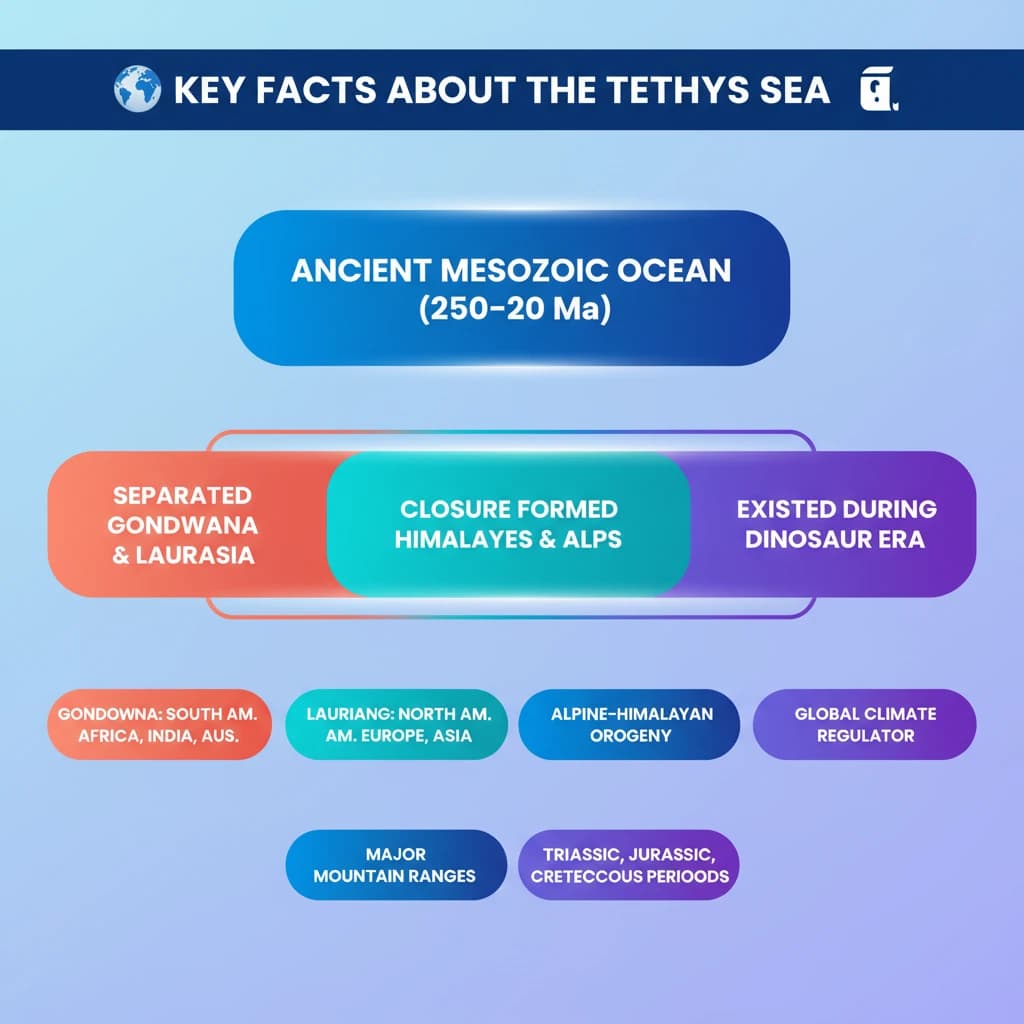
- •The Tethys Sea was an ancient ocean existing during the Mesozoic Era (250-20 Ma).
- •It separated the supercontinents Gondwana (south) and Laurasia (north).
- •Gondwana included South America, Africa, Arabia, Madagascar, India, Australia, and Antarctica.
- •Laurasia included North America, Europe, and Asia (except peninsular India).
- •Its closure led to the formation of major mountain ranges like the Himalayas and Alps.
- •The Mediterranean Sea is considered a remnant of the Tethys Sea.
🧠 Memory Techniques
98% Verified Content
📚 Reference Sources
•NCERT Geography Textbooks (Class XI & XII)
•Physical Geography by Savindra Singh
•Geological Survey of India publications