Loading page, please wait…
What are the Key Findings of the Study? - UPSC Geography
What is What are the Key Findings of the Study? in UPSC Geography?
What are the Key Findings of the Study? is a key topic under Geography for UPSC Civil Services Examination. Key points include: Monsoon strength fluctuated significantly during the Last Glacial Maximum-Holocene period, impacting weathering and sedimentation.. Giant magnetofossil formation requires an optimal balance of iron, organic carbon, and suboxic conditions, not necessarily warming events.. Magnetofossils encode vital information about past nutrient availability, oxygen levels, and water stratification in aquatic environments.. Understanding this topic is essential for both UPSC Prelims and Mains preparation.
Why is What are the Key Findings of the Study? important for UPSC exam?
What are the Key Findings of the Study? is a Medium-level topic in UPSC Geography. It is tested in both Prelims (factual MCQs) and Mains (analytical answer writing). Previous year UPSC questions have frequently covered aspects of What are the Key Findings of the Study?, making it essential for comprehensive IAS preparation.
How to prepare What are the Key Findings of the Study? for UPSC?
To prepare What are the Key Findings of the Study? for UPSC: (1) Study the comprehensive notes covering all key concepts on Vaidra. (2) Practice previous year questions on this topic. (3) Connect it with current affairs using daily updates. (4) Revise using key takeaways and mind maps available for Geography. (5) Write practice answers linking What are the Key Findings of the Study? to related GS Paper topics.
Key takeaways of What are the Key Findings of the Study? for UPSC
- Monsoon strength fluctuated significantly during the Last Glacial Maximum-Holocene period, impacting weathering and sedimentation.
- Giant magnetofossil formation requires an optimal balance of iron, organic carbon, and suboxic conditions, not necessarily warming events.
- Magnetofossils encode vital information about past nutrient availability, oxygen levels, and water stratification in aquatic environments.
- Major Indian rivers (Godavari, Mahanadi, Ganga-Brahmaputra, Cauvery, Penner) contribute essential nutrients and iron to the Bay of Bengal, facilitating magnetofossil growth.
- This study enhances our understanding of paleoenvironments and provides insights for predicting future climate and environmental changes.

What are the Key Findings of the Study?
Medium⏱️ 8 min read
geography
📖 Introduction
Monsoon Fluctuations and Sediments
A detailed analysis of sediment samples provided crucial insights into past climatic conditions. These samples revealed significant variations in the strength of the monsoon during a critical geological period.
The period under study was the Last Glacial Maximum-Holocene transition. This era witnessed major shifts from glacial conditions to the warmer interglacial period we are in today.
These fluctuations in monsoon strength directly impacted processes like weathering (the breakdown of rocks) and sedimentation (the deposition of eroded material). Stronger monsoons generally lead to increased weathering and sediment transport.
Optimal Conditions for Magnetofossil Growth
The study challenged previous assumptions regarding the formation of giant magnetofossils. It was found that warming events are not a prerequisite for their development.
Instead, the critical factor is an optimal balance of specific environmental elements. This includes sufficient iron, adequate organic carbon, and crucially, suboxic conditions.
Suboxic conditions refer to environments with very low, but not entirely absent, oxygen levels. This specific oxygen range is ideal for the bacteria that produce these unique magnetic structures.
Information Encoded by Magnetofossils
Magnetofossils serve as remarkable natural archives, effectively "encoding" information about ancient aquatic environments. They are microscopic magnetic crystals produced by certain bacteria.
The characteristics of these magnetofossils can reveal various aspects of past ecological conditions. This includes the availability of nutrients, the levels of oxygen present, and the degree of water stratification.
Understanding magnetofossils helps reconstruct paleoenvironments and paleoclimates, a key area in UPSC Geography (GS-I) and Environmental Science.
Role of Indian Rivers in Magnetofossil Formation
Several major Indian rivers play a significant role in contributing to the formation of magnetofossils in the Bay of Bengal. These rivers transport vital materials from the land to the marine environment.
- The rivers identified include Godavari, Mahanadi, Ganga-Brahmaputra, Cauvery, and Penner.
- They discharge into the Bay of Bengal, carrying large quantities of sediment.
These rivers supply nutrient-rich sediment and reactive iron, which are essential ingredients for the growth of magnetofossil-producing bacteria in the marine environment.
💡 Key Takeaways
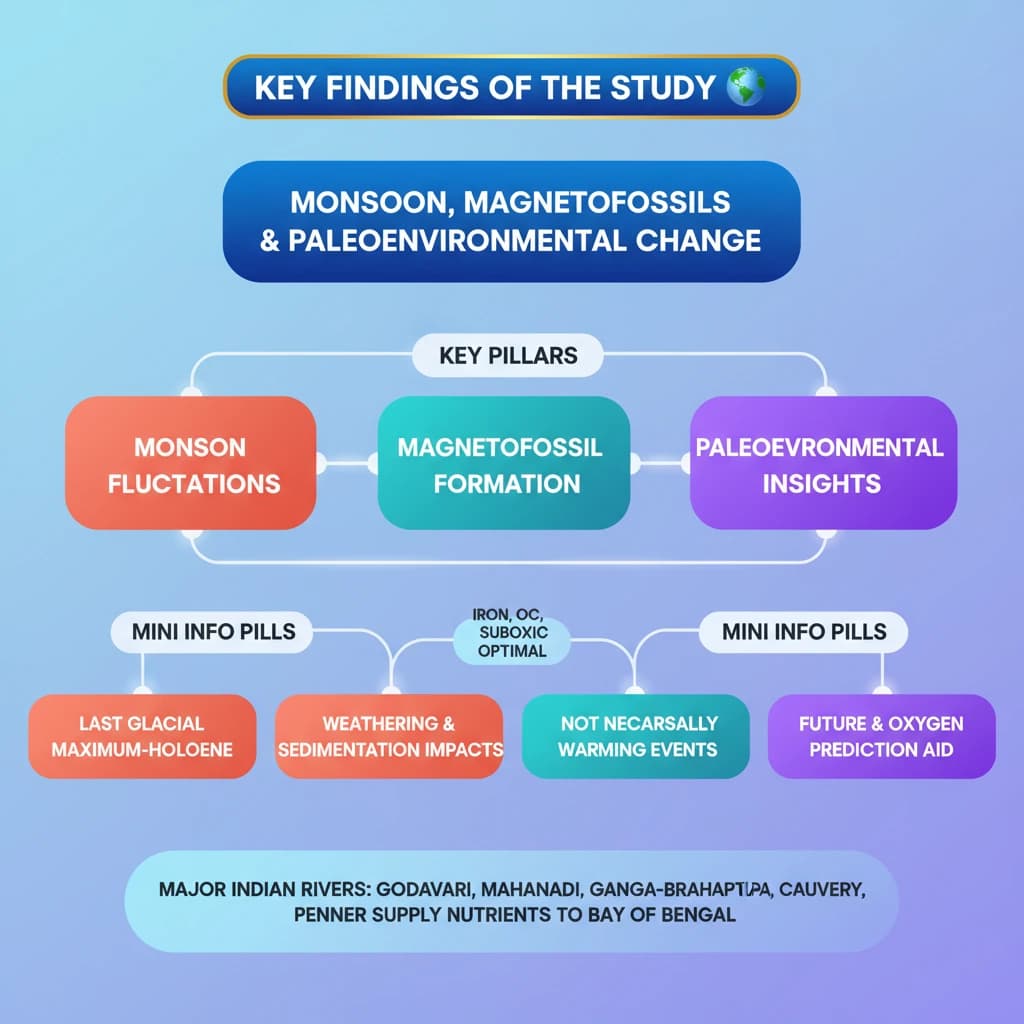
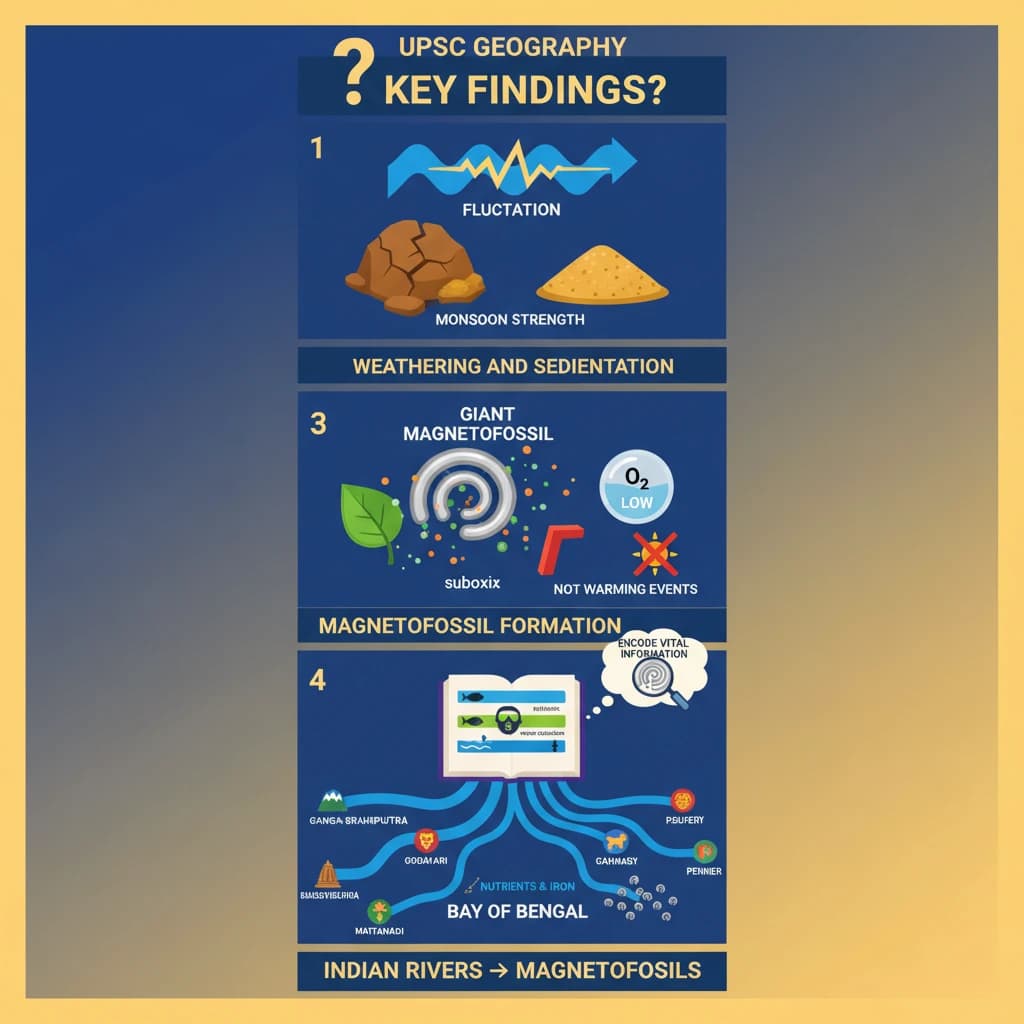
- •Monsoon strength fluctuated significantly during the Last Glacial Maximum-Holocene period, impacting weathering and sedimentation.
- •Giant magnetofossil formation requires an optimal balance of iron, organic carbon, and suboxic conditions, not necessarily warming events.
- •Magnetofossils encode vital information about past nutrient availability, oxygen levels, and water stratification in aquatic environments.
- •Major Indian rivers (Godavari, Mahanadi, Ganga-Brahmaputra, Cauvery, Penner) contribute essential nutrients and iron to the Bay of Bengal, facilitating magnetofossil growth.
- •This study enhances our understanding of paleoenvironments and provides insights for predicting future climate and environmental changes.
🧠 Memory Techniques
95% Verified Content
📚 Reference Sources
•General scientific literature on magnetofossils and paleoclimatology (assumed underlying study)