Loading page, please wait…
What are the Key Highlights About Aurora Sightings - UPSC Geography
What is What are the Key Highlights About Aurora Sightings in UPSC Geography?
What are the Key Highlights About Aurora Sightings is a key topic under Geography for UPSC Civil Services Examination. Key points include: Auroras are natural light displays caused by solar particles interacting with Earth's magnetosphere.. Coronal Mass Ejections (CMEs) from the Sun are the primary cause, linked to the 11-year solar activity cycle.. Solar Cycle 25 is peaking in 2024, leading to increased aurora activity and potential lower-latitude sightings.. Understanding this topic is essential for both UPSC Prelims and Mains preparation.
Why is What are the Key Highlights About Aurora Sightings important for UPSC exam?
What are the Key Highlights About Aurora Sightings is a Medium-level topic in UPSC Geography. It is tested in both Prelims (factual MCQs) and Mains (analytical answer writing). Previous year UPSC questions have frequently covered aspects of What are the Key Highlights About Aurora Sightings, making it essential for comprehensive IAS preparation.
How to prepare What are the Key Highlights About Aurora Sightings for UPSC?
To prepare What are the Key Highlights About Aurora Sightings for UPSC: (1) Study the comprehensive notes covering all key concepts on Vaidra. (2) Practice previous year questions on this topic. (3) Connect it with current affairs using daily updates. (4) Revise using key takeaways and mind maps available for Geography. (5) Write practice answers linking What are the Key Highlights About Aurora Sightings to related GS Paper topics.
Key takeaways of What are the Key Highlights About Aurora Sightings for UPSC
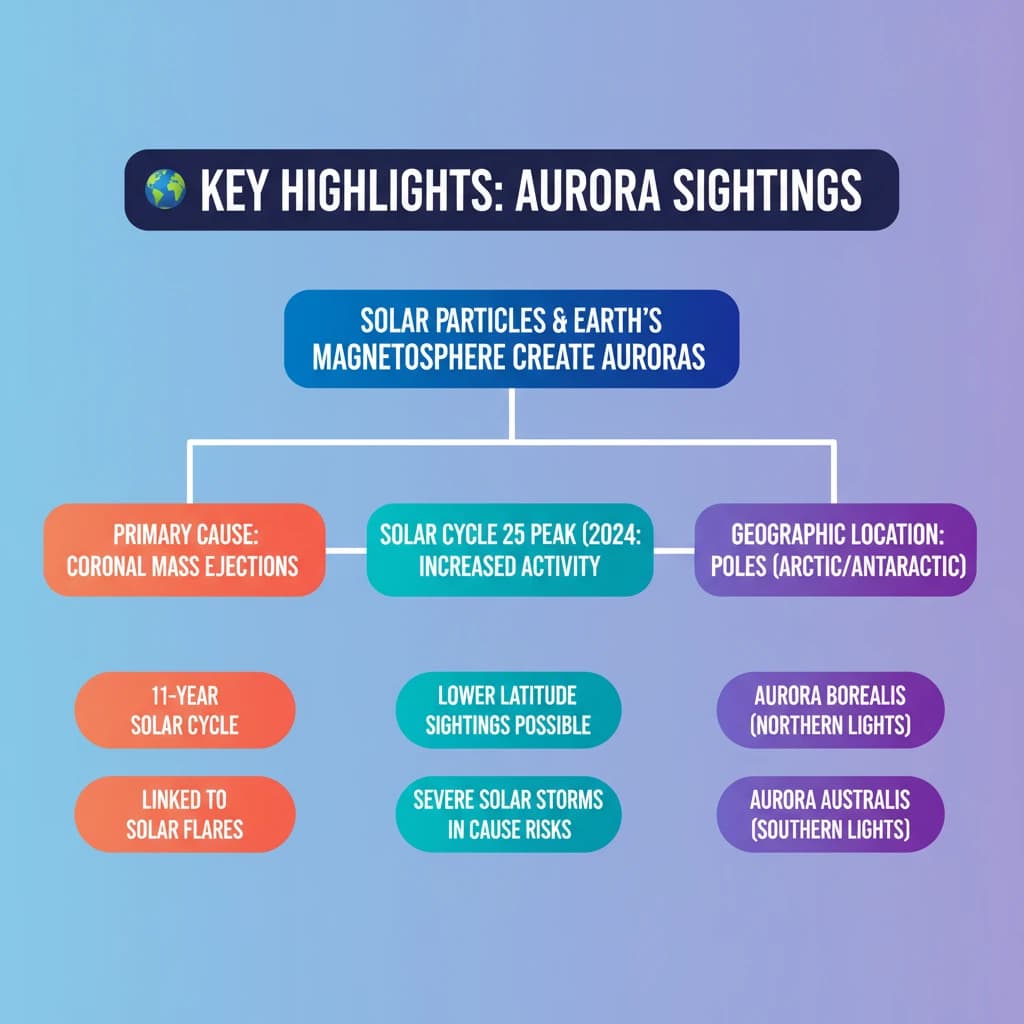
- Auroras are natural light displays caused by solar particles interacting with Earth's magnetosphere.
- Coronal Mass Ejections (CMEs) from the Sun are the primary cause, linked to the 11-year solar activity cycle.
- Solar Cycle 25 is peaking in 2024, leading to increased aurora activity and potential lower-latitude sightings.
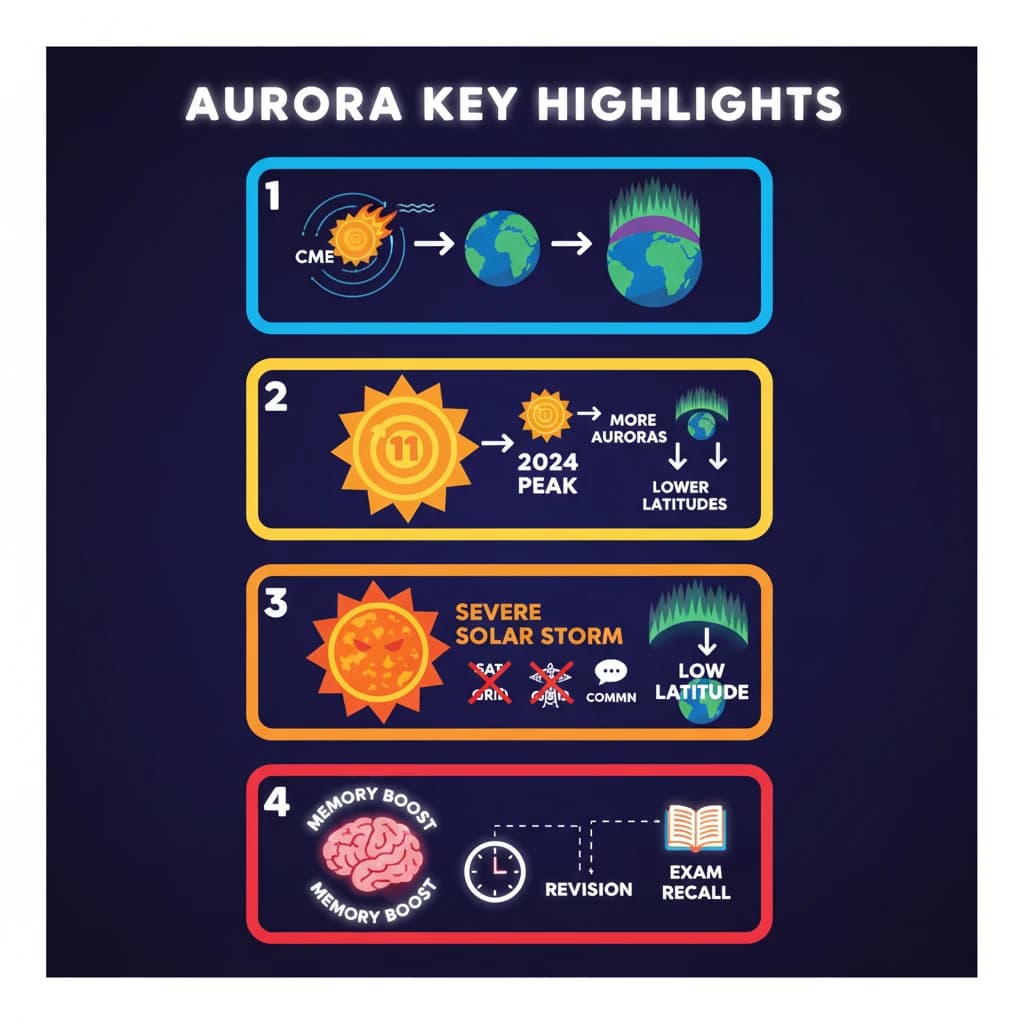
- Severe solar storms can cause auroras at lower latitudes and pose significant risks to satellites, power grids, and communications.
- Auroras are typically seen near the Arctic (aurora borealis) and Antarctic (aurora australis) Circles.
- Aurora colors depend on the excited atmospheric gases (oxygen for green/yellow, nitrogen for red/blue).
What are the Key Highlights About Aurora Sightings
Medium⏱️ 5 min read
geography
📖 Introduction
Understanding Auroras and Solar Activity
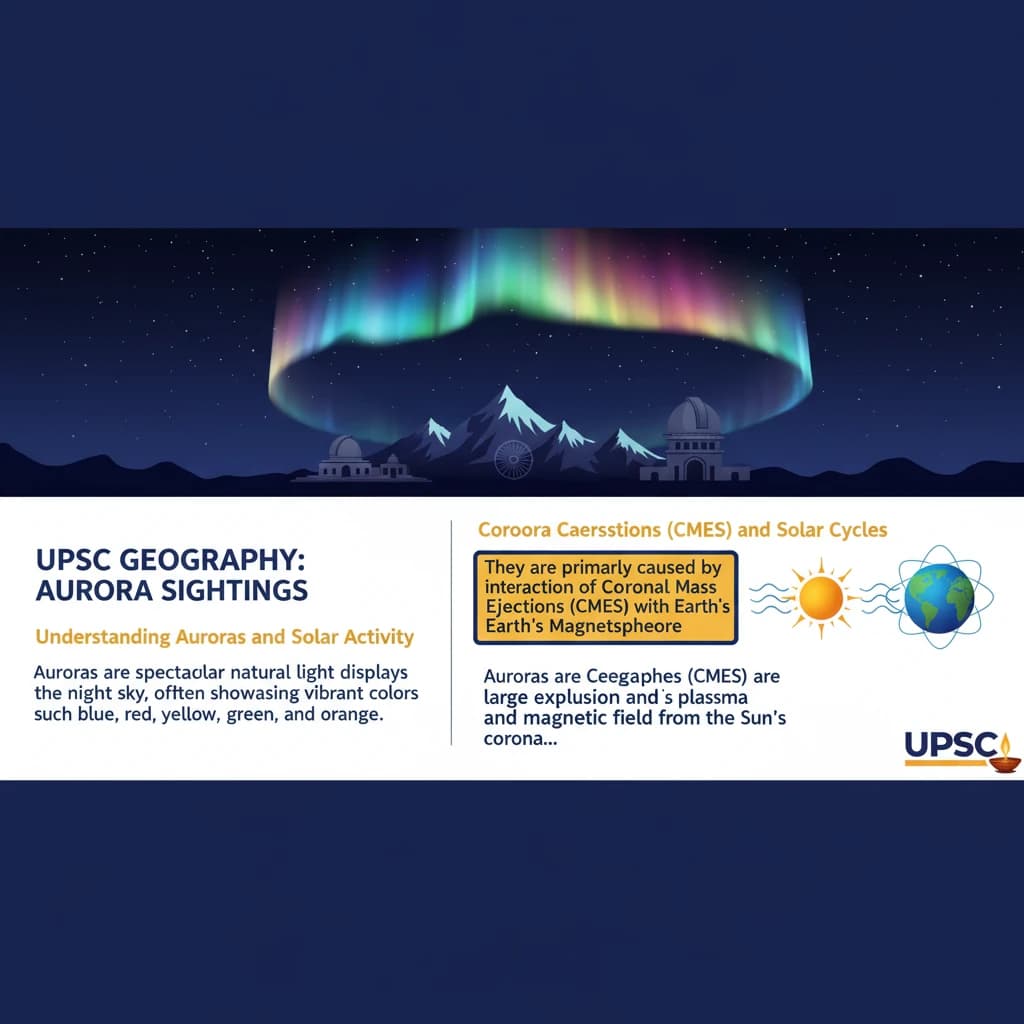
Auroras are spectacular natural light displays visible in the night sky, often showcasing vibrant colors such as blue, red, yellow, green, and orange.
They are primarily caused by the interaction of coronal mass ejections (CMEs) with Earth’s Magnetosphere.
Coronal Mass Ejections (CMEs) and Solar Cycles
Coronal Mass Ejections (CMEs) are massive expulsions of plasma and magnetic field from the Sun's corona.
These ejections are integral to the solar activity cycle, which typically spans around 11 years.
The current solar cycle, designated as Solar Cycle 25, is anticipated to reach its peak activity in 2024.
Lower Latitude Aurora Sightings
While auroras are usually confined to polar regions, severe solar storms can lead to sightings in lower-latitude regions.
A recent instance involved a severe solar storm, initially categorized as a level 4 (on a scale from 1 to 5), which resulted in such rare aurora sightings.
Geographical Distribution of Auroras
Auroras are most frequently observed near the Arctic and Antarctic Circles.
This corresponds to approximately 66.5 degrees north and south of the Equator.
- The northern aurora is known as aurora borealis, often called the northern lights.
- Its southern counterpart is referred to as aurora australis, or the southern lights.
Impact of Severe Solar Storms
Beyond triggering widespread aurora displays, severe solar storms pose significant risks to technological infrastructure.
- They can accelerate satellite decay.
- Extreme storms have the potential to destroy satellites entirely.
- Such events can also disrupt power grids, leading to widespread outages.
- Furthermore, they may cause extensive communication blackouts.
Characteristics and Colors of Auroras
The specific colors observed in an aurora depend on the type of gas atom involved and the altitude of the collision.
The most common greenish-yellow auroras occur when ions collide with oxygen atoms at lower atmospheric altitudes.
Reddish and bluish lights, often visible at the lower edges of auroras, are produced by interactions between ions and nitrogen atoms.
Collisions involving hydrogen and helium atoms can generate blue and purple auroras, though these specific colors are seldom discernible to the naked eye.
💡 Key Takeaways
- •Auroras are natural light displays caused by solar particles interacting with Earth's magnetosphere.
- •Coronal Mass Ejections (CMEs) from the Sun are the primary cause, linked to the 11-year solar activity cycle.
- •Solar Cycle 25 is peaking in 2024, leading to increased aurora activity and potential lower-latitude sightings.
- •Severe solar storms can cause auroras at lower latitudes and pose significant risks to satellites, power grids, and communications.
- •Auroras are typically seen near the Arctic (aurora borealis) and Antarctic (aurora australis) Circles.
- •Aurora colors depend on the excited atmospheric gases (oxygen for green/yellow, nitrogen for red/blue).
🧠 Memory Techniques
95% Verified Content