Loading page, please wait…
What are the Potential Impacts of the Active Rock Glaciers on the Region? - UPSC Geography
What is What are the Potential Impacts of the Active Rock Glaciers on the Region? in UPSC Geography?
What are the Potential Impacts of the Active Rock Glaciers on the Region? is a key topic under Geography for UPSC Civil Services Examination. Key points include: Active rock glaciers are moving masses of rock and ice, distinct from true glaciers.. They significantly increase the risk of Glacial Lake Outburst Floods (GLOFs) by destabilizing lake dams.. Examples like Chirsar and Bramsar Lakes highlight the GLOF risk due to nearby rock glaciers.. Understanding this topic is essential for both UPSC Prelims and Mains preparation.
Why is What are the Potential Impacts of the Active Rock Glaciers on the Region? important for UPSC exam?
What are the Potential Impacts of the Active Rock Glaciers on the Region? is a Medium-level topic in UPSC Geography. It is tested in both Prelims (factual MCQs) and Mains (analytical answer writing). Previous year UPSC questions have frequently covered aspects of What are the Potential Impacts of the Active Rock Glaciers on the Region?, making it essential for comprehensive IAS preparation.
How to prepare What are the Potential Impacts of the Active Rock Glaciers on the Region? for UPSC?
To prepare What are the Potential Impacts of the Active Rock Glaciers on the Region? for UPSC: (1) Study the comprehensive notes covering all key concepts on Vaidra. (2) Practice previous year questions on this topic. (3) Connect it with current affairs using daily updates. (4) Revise using key takeaways and mind maps available for Geography. (5) Write practice answers linking What are the Potential Impacts of the Active Rock Glaciers on the Region? to related GS Paper topics.
Key takeaways of What are the Potential Impacts of the Active Rock Glaciers on the Region? for UPSC
- Active rock glaciers are moving masses of rock and ice, distinct from true glaciers.
- They significantly increase the risk of Glacial Lake Outburst Floods (GLOFs) by destabilizing lake dams.
- Examples like Chirsar and Bramsar Lakes highlight the GLOF risk due to nearby rock glaciers.
- Rock glaciers also directly contribute to landslide hazards by making slopes unstable.
- Climate change is accelerating rock glacier movement, intensifying these geohazards.
- Monitoring and early warning systems are crucial for disaster risk reduction in affected regions.
What are the Potential Impacts of the Active Rock Glaciers on the Region?
Medium⏱️ 7 min read
geography
📖 Introduction
Understanding Active Rock Glaciers
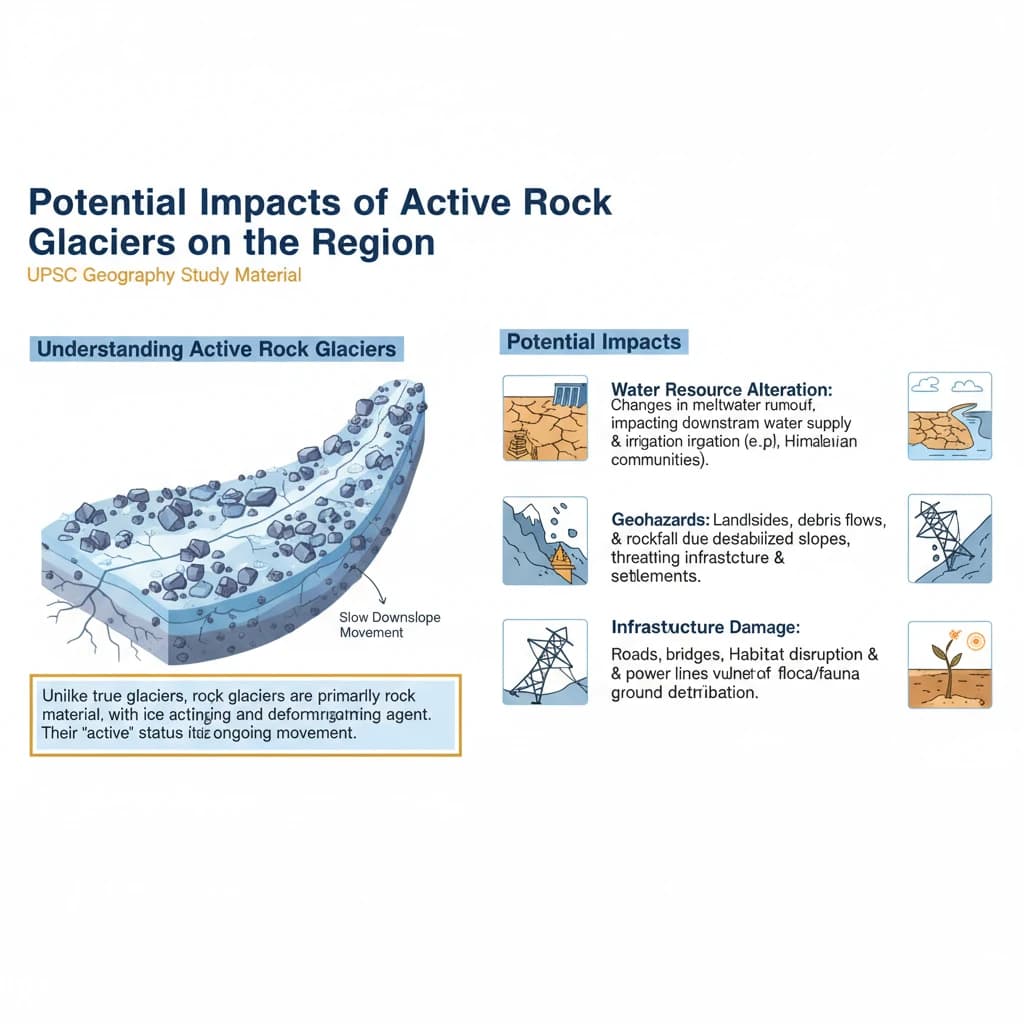
Active rock glaciers are distinct periglacial landforms composed of rock debris, ice, and interstitial ice, which move downslope under the influence of gravity and the deformation of ice within them.
Unlike true glaciers, rock glaciers are primarily rock material, with ice acting as a cementing and deforming agent. Their 'active' status indicates ongoing movement.
Potential Impacts on the Region
The presence and activity of rock glaciers can have significant and often hazardous impacts on mountainous regions, particularly in the Himalayas and other periglacial environments.
These impacts are exacerbated by climate change, which can alter the stability and movement rates of these landforms.
Impact 1: Glacial Lake Outburst Floods (GLOFs)
One of the most severe potential impacts of active rock glaciers is their contribution to the risk of Glacial Lake Outburst Floods (GLOFs).
GLOFs are sudden and catastrophic floods that occur when a glacial lake bursts its natural or artificial dam, releasing large volumes of water and debris downstream.
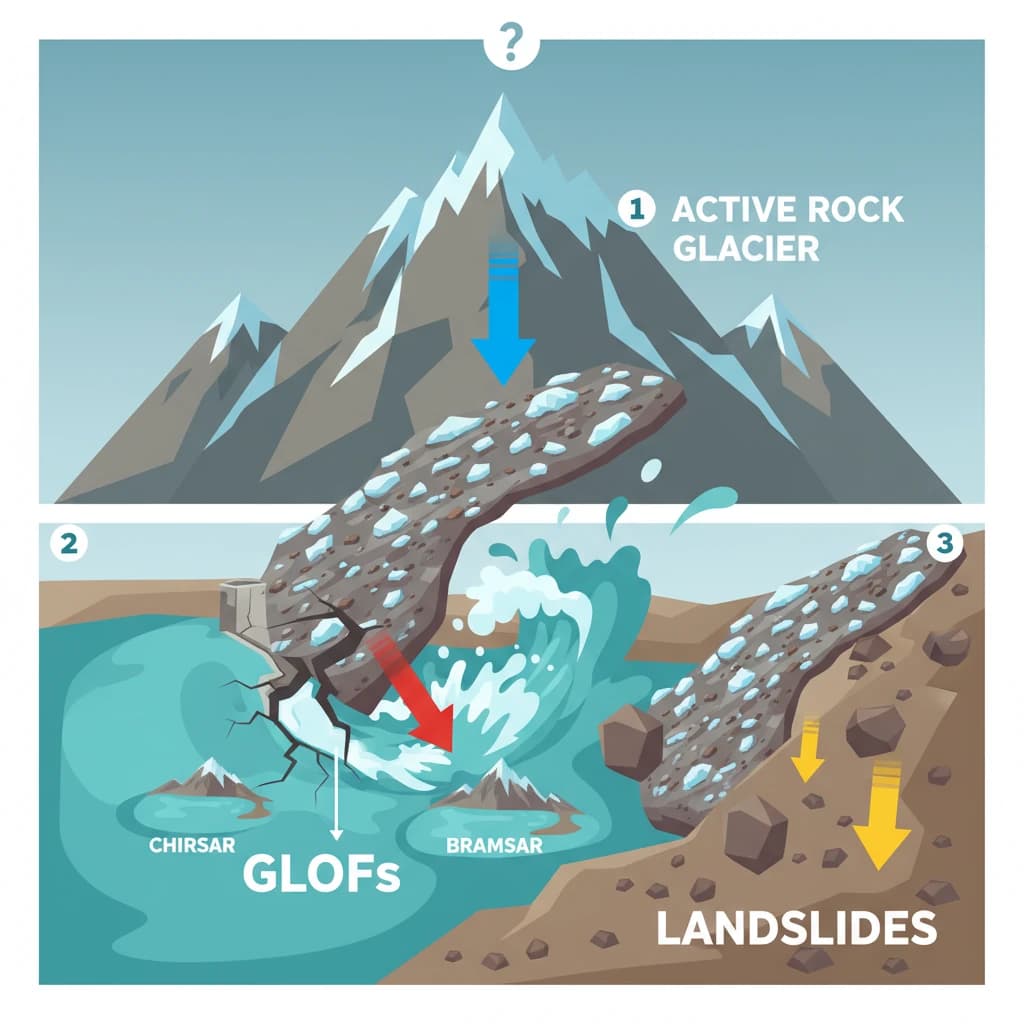
Active rock glaciers can significantly increase the risk of GLOFs by destabilizing the slopes surrounding glacial lakes or directly impacting the structural integrity of their natural dams.
- The movement of a rock glacier can cause landsliding into a lake, creating displacement waves or overtopping the dam.
- Subsurface ice melt within the rock glacier can also contribute to slope instability near lake boundaries.
Specific examples highlight this risk, such as Chirsar Lake and Bramsar Lake, where nearby rock glaciers elevate the potential for catastrophic flooding events.
UPSC often asks about natural disasters in mountainous regions. Understanding the role of rock glaciers in GLOFs adds depth to answers on disaster management and climate change impacts.
Impact 2: Landslides
Beyond contributing to GLOFs, active rock glaciers also pose a direct risk of triggering landslides in their vicinity.
Landslides are rapid movements of soil, rock, or snow down a slope, often triggered by various factors.
The continuous, albeit slow, movement of a rock glacier can inherently destabilize surrounding slopes, making them more susceptible to collapse.
- Triggers for such landslides include natural phenomena like earthquakes and heavy rainfall.
- Human activities, such as infrastructure development or mining in unstable periglacial zones, can also exacerbate the risk.
The interaction between rock glacier movement and external triggers creates a complex hazard scenario, particularly in seismically active and precipitation-prone mountainous regions.
💡 Key Takeaways
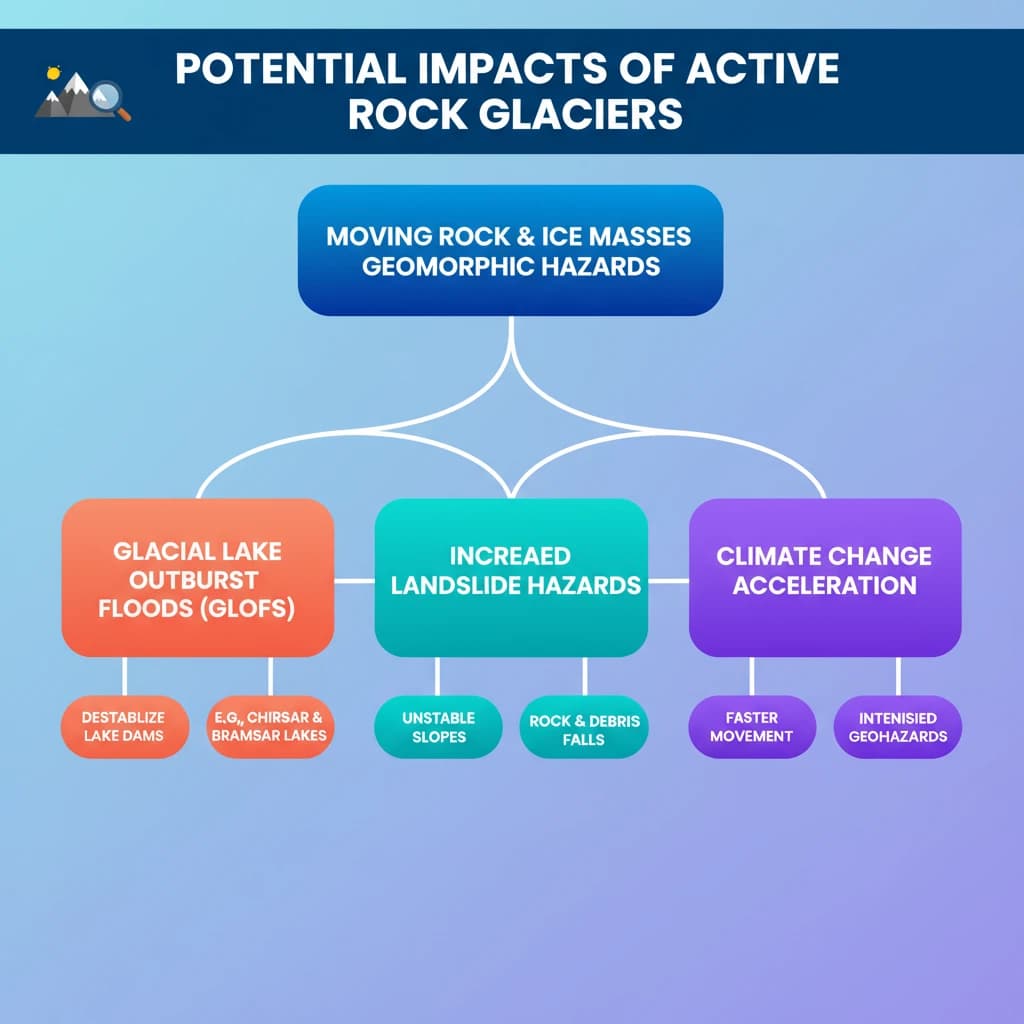
- •Active rock glaciers are moving masses of rock and ice, distinct from true glaciers.
- •They significantly increase the risk of Glacial Lake Outburst Floods (GLOFs) by destabilizing lake dams.
- •Examples like Chirsar and Bramsar Lakes highlight the GLOF risk due to nearby rock glaciers.
- •Rock glaciers also directly contribute to landslide hazards by making slopes unstable.
- •Climate change is accelerating rock glacier movement, intensifying these geohazards.
- •Monitoring and early warning systems are crucial for disaster risk reduction in affected regions.
🧠 Memory Techniques
95% Verified Content