Loading page, please wait…
What are the Types of Mountain? - UPSC Geography
What is What are the Types of Mountain? in UPSC Geography?
What are the Types of Mountain? is a key topic under Geography for UPSC Civil Services Examination. Key points include: Mountains are classified by mode of origin (Volcanic, Fold, Block, Dome, Plateau) and period of origin (Precambrian, Caledonian, Hercynian, Alpine).. Volcanic mountains form from magma eruptions (Hawaii); Fold mountains from tectonic plate collisions (Himalayas).. Block mountains result from faulting (Sierra Nevada); Dome mountains from magma pushing crust up (Black Hills).. Understanding this topic is essential for both UPSC Prelims and Mains preparation.
Why is What are the Types of Mountain? important for UPSC exam?
What are the Types of Mountain? is a Medium-level topic in UPSC Geography. It is tested in both Prelims (factual MCQs) and Mains (analytical answer writing). Previous year UPSC questions have frequently covered aspects of What are the Types of Mountain?, making it essential for comprehensive IAS preparation.
How to prepare What are the Types of Mountain? for UPSC?
To prepare What are the Types of Mountain? for UPSC: (1) Study the comprehensive notes covering all key concepts on Vaidra. (2) Practice previous year questions on this topic. (3) Connect it with current affairs using daily updates. (4) Revise using key takeaways and mind maps available for Geography. (5) Write practice answers linking What are the Types of Mountain? to related GS Paper topics.
Key takeaways of What are the Types of Mountain? for UPSC
- Mountains are classified by mode of origin (Volcanic, Fold, Block, Dome, Plateau) and period of origin (Precambrian, Caledonian, Hercynian, Alpine).
- Volcanic mountains form from magma eruptions (Hawaii); Fold mountains from tectonic plate collisions (Himalayas).
- Block mountains result from faulting (Sierra Nevada); Dome mountains from magma pushing crust up (Black Hills).
- Plateau mountains are uplifted landmasses shaped by erosion, distinct from dome mountains.
- Precambrian (Aravallis) are oldest; Alpine (Himalayas, Alps) are youngest and most active.
- Each type has distinct formation processes, geological characteristics, and examples.
- Understanding mountain types is crucial for UPSC geography, linking to plate tectonics, climate, and natural hazards.
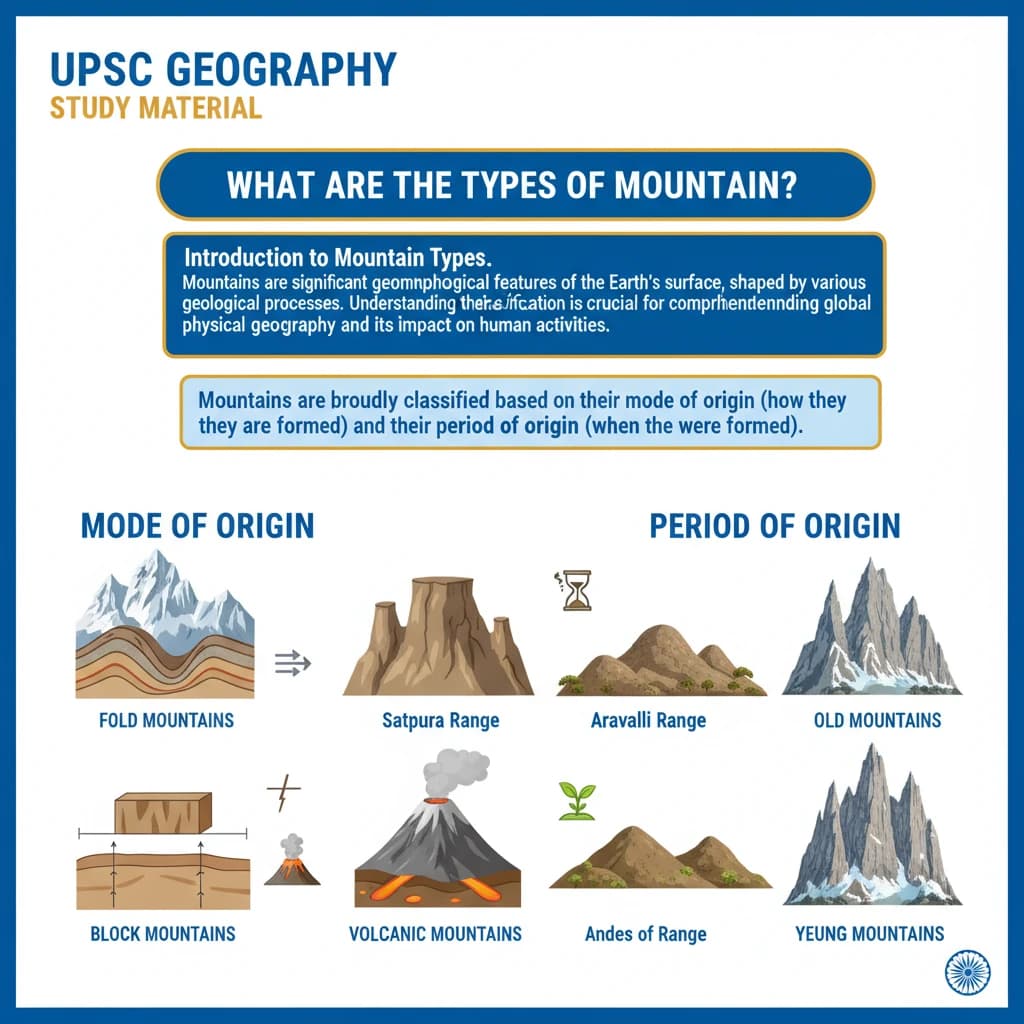
What are the Types of Mountain?
Medium⏱️ 8 min read
geography
📖 Introduction
Introduction to Mountain Types
Mountains are significant geomorphological features of the Earth's surface, shaped by various geological processes. Understanding their classification is crucial for comprehending global physical geography and its impact on human activities.
Mountains are broadly classified based on their mode of origin (how they are formed) and their period of origin (when they were formed).
Classification Based on Mode of Origin
This classification categorizes mountains based on the specific geological forces and processes that led to their creation.
Volcanic Mountains: Formation and Examples
Volcanic mountains are formed directly by the eruption of magma from the Earth’s interior. As magma, ash, and rocks accumulate around a vent, they build up conical or shield-like structures.
Formation Process: Repeated eruptions of lava and ash lead to the gradual accumulation of material, forming a mountain over time.
Key Examples: Prominent examples include the mountains in Hawaii and Fiji, known for their distinct volcanic origins.
Fold Mountains: Tectonic Collisions
Fold mountains are the most common type of mountain, created when two or more of Earth's tectonic plates collide. This immense pressure causes the Earth's crust to buckle and fold.
Formation Process: The compression forces cause layers of rock to crumple into folds, known as anticlines (upfolds) and synclines (downfolds).
Key Examples: The majestic Himalayas in Asia and the extensive Andes in South America are prime examples of young fold mountains.
Block Mountains: Faulting and Uplift
Block mountains are formed due to faulting and the vertical movement of large blocks of the Earth’s crust. These movements occur along faults, which are fractures in the Earth's crust.
Formation Process: Tensional or compressional forces cause sections of the crust to be uplifted (horsts) or dropped down (grabens), creating distinct block-like mountain ranges.
Key Example: The Sierra Nevada mountain range in the United States is a classic illustration of a block mountain.
Dome Mountains: Magmatic Uplift
Dome mountains are created when a large amount of magma pushes the Earth’s crust upward from beneath, but without erupting. This upward pressure creates a dome-like bulge on the surface.
Formation Process: The overlying sedimentary layers are uplifted into a rounded, dome-shaped structure. Subsequent erosion often exposes the underlying igneous core.
Key Example: The Black Hills in the United States are a well-known example of dome mountains, where erosion has revealed the core.
Plateau Mountains: Erosion of Uplifted Land
Plateau mountains, while resembling dome mountains in some aspects, are formed primarily by the uplift of large landmasses due to colliding tectonic plates, followed by significant weathering and erosion.
Formation Process: Large areas of land are uplifted, forming plateaus. Over geological time, rivers and other erosional agents carve out valleys and canyons, leaving behind mountain-like structures.
Distinction: Unlike dome mountains formed by localized magma push, plateau mountains involve broader tectonic uplift and extensive erosional sculpting.
Classification Based on Period of Origin
This classification categorizes mountains based on the geological era or period during which their primary formation occurred. It reflects their age and the extent of subsequent erosion and modification.
Precambrian Mountains: Ancient Relics
Precambrian mountains are the oldest mountain ranges on Earth, formed during the vast Precambrian era, which spans from 4.6 billion to 541 million years ago. These ranges have undergone extensive geological changes.
Characteristics: They have experienced billions of years of erosion and metamorphism, leading to highly weathered and often low-lying residual formations.
Key Example: The Aravallis in India are a prime example of ancient Precambrian mountains, now existing as highly eroded remnants.
Caledonian Mountains: Paleozoic Formation
The Caledonian mountains were formed during the Paleozoic Era, approximately 430 million years ago. This period saw significant tectonic activity contributing to their uplift.
Geological Period: Their formation is associated with the Caledonian Orogeny, a mountain-building event that affected parts of Europe and North America.
Key Example: The Appalachian Mountains in North America are often cited as an example of Caledonian mountain ranges, though they also experienced later Hercynian activity.
Hercynian Mountains: Carboniferous to Permian Era
Hercynian mountains originated during the late Paleozoic Era, specifically from the Carboniferous to Permian Periods, approximately 340 million to 225 million years ago.
Geological Period: Also known as the Variscan Orogeny, this event created mountain ranges across Europe and parts of North Africa.
Key Example: The Ural Mountains, which form a natural boundary between Europe and Asia, are a classic example of Hercynian mountain systems.
Alpine Mountains: The Youngest Systems
Alpine mountains represent the youngest major mountain systems on Earth, formed during the relatively recent Tertiary period, which began approximately 66 million years ago.
Characteristics: These mountains are typically high, rugged, and still undergoing active geological processes, indicating their youth.
Key Examples: The magnificent Himalayas and the majestic Alps are prominent examples of Alpine mountain ranges, characterized by their towering peaks and ongoing uplift.
UPSC Insight: Distinguishing between Fold Mountains (mode of origin) and Alpine Mountains (period of origin) is important. While the Himalayas are both Fold and Alpine, not all fold mountains are Alpine, and vice-versa (e.g., older fold mountains exist). Focus on the classification criteria.
💡 Key Takeaways
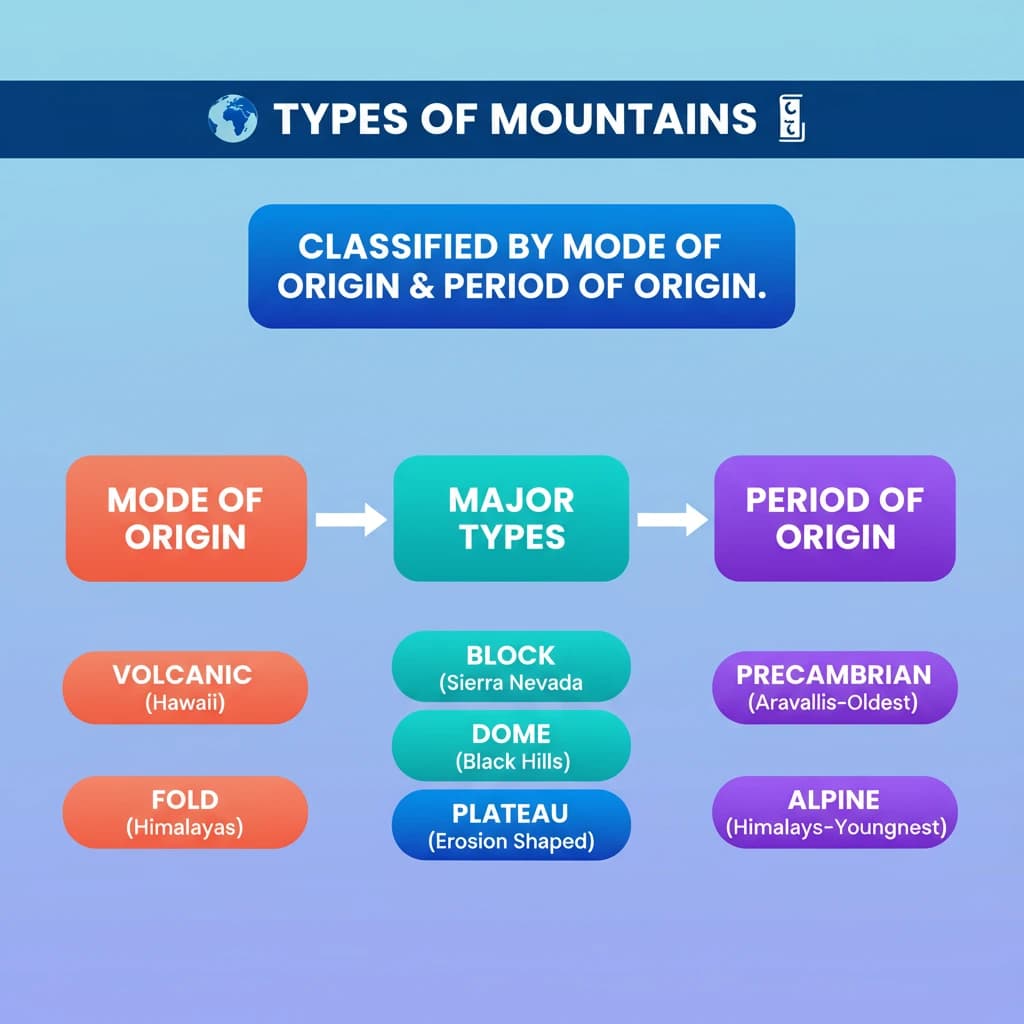
- •Mountains are classified by mode of origin (Volcanic, Fold, Block, Dome, Plateau) and period of origin (Precambrian, Caledonian, Hercynian, Alpine).
- •Volcanic mountains form from magma eruptions (Hawaii); Fold mountains from tectonic plate collisions (Himalayas).
- •Block mountains result from faulting (Sierra Nevada); Dome mountains from magma pushing crust up (Black Hills).
- •Plateau mountains are uplifted landmasses shaped by erosion, distinct from dome mountains.
- •Precambrian (Aravallis) are oldest; Alpine (Himalayas, Alps) are youngest and most active.
- •Each type has distinct formation processes, geological characteristics, and examples.
- •Understanding mountain types is crucial for UPSC geography, linking to plate tectonics, climate, and natural hazards.
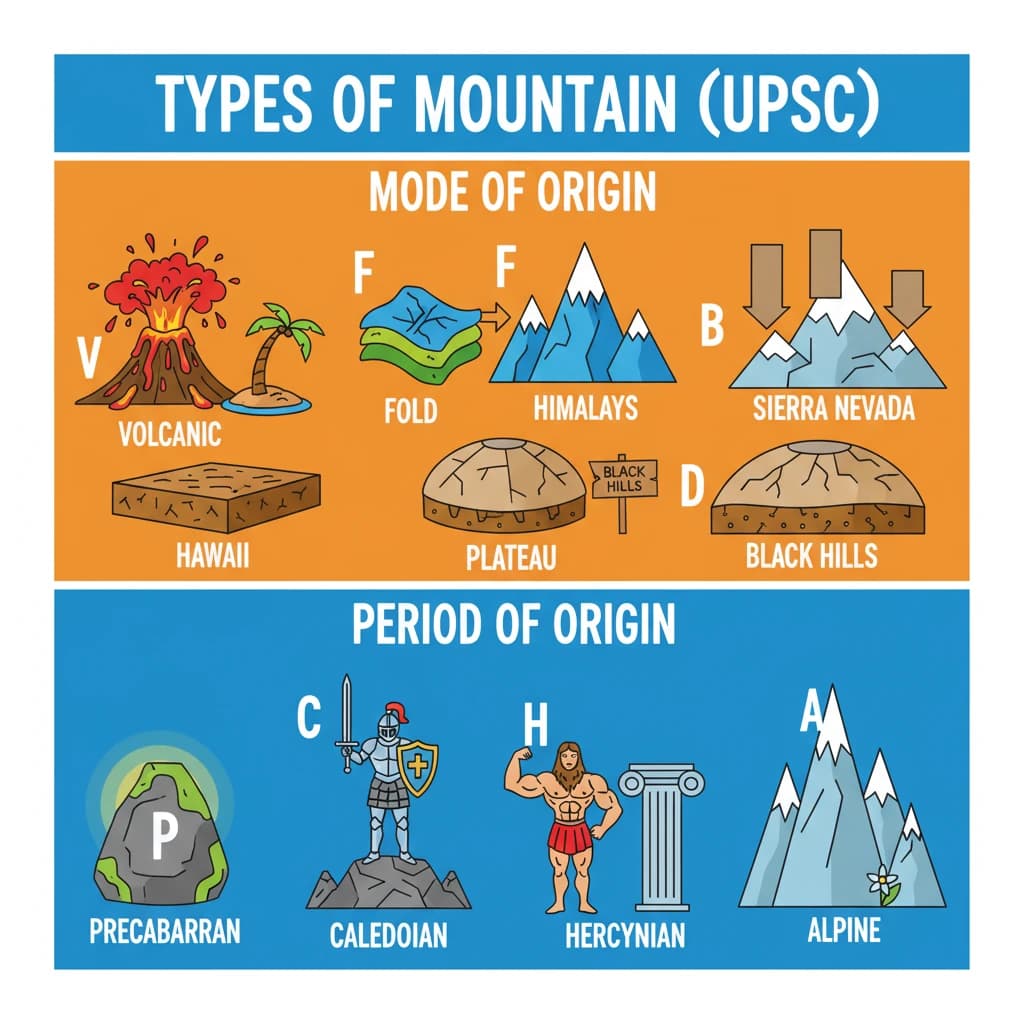
🧠 Memory Techniques
98% Verified Content