Loading page, please wait…
What is the Indian Summer Monsoon Rainfall (ISMR)? - UPSC Geography
What is What is the Indian Summer Monsoon Rainfall (ISMR)? in UPSC Geography?
What is the Indian Summer Monsoon Rainfall (ISMR)? is a key topic under Geography for UPSC Civil Services Examination. Key points include: ISMR is a major climatic event from July-September, peaking in July-August.. It is caused by moist air from the Indian Ocean moving towards the Indian subcontinent.. Key factors influencing ISMR include ocean surface temperatures (Indian, Atlantic, Pacific) and circum-global teleconnection (CGT).. Understanding this topic is essential for both UPSC Prelims and Mains preparation.
Why is What is the Indian Summer Monsoon Rainfall (ISMR)? important for UPSC exam?
What is the Indian Summer Monsoon Rainfall (ISMR)? is a Medium-level topic in UPSC Geography. It is tested in both Prelims (factual MCQs) and Mains (analytical answer writing). Previous year UPSC questions have frequently covered aspects of What is the Indian Summer Monsoon Rainfall (ISMR)?, making it essential for comprehensive IAS preparation.
How to prepare What is the Indian Summer Monsoon Rainfall (ISMR)? for UPSC?
To prepare What is the Indian Summer Monsoon Rainfall (ISMR)? for UPSC: (1) Study the comprehensive notes covering all key concepts on Vaidra. (2) Practice previous year questions on this topic. (3) Connect it with current affairs using daily updates. (4) Revise using key takeaways and mind maps available for Geography. (5) Write practice answers linking What is the Indian Summer Monsoon Rainfall (ISMR)? to related GS Paper topics.
Key takeaways of What is the Indian Summer Monsoon Rainfall (ISMR)? for UPSC
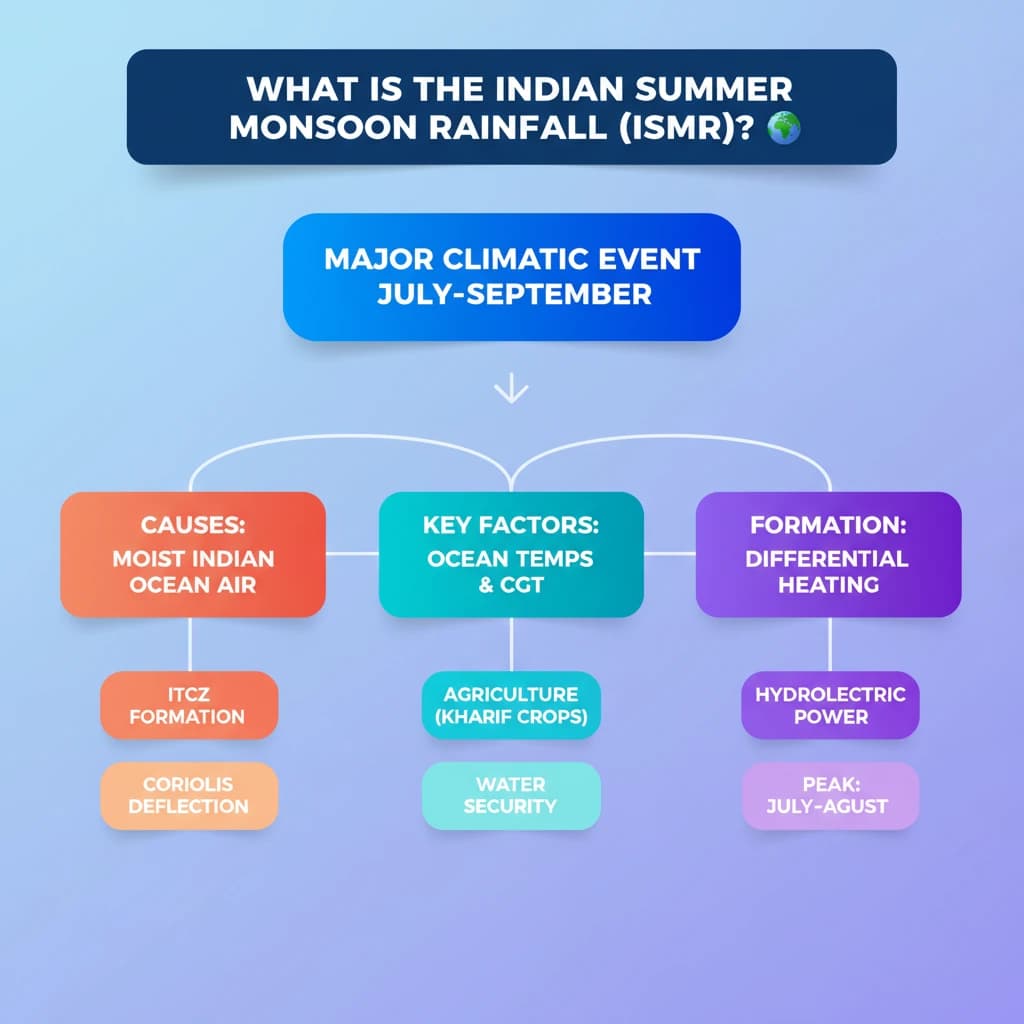
- ISMR is a major climatic event from July-September, peaking in July-August.
- It is caused by moist air from the Indian Ocean moving towards the Indian subcontinent.
- Key factors influencing ISMR include ocean surface temperatures (Indian, Atlantic, Pacific) and circum-global teleconnection (CGT).
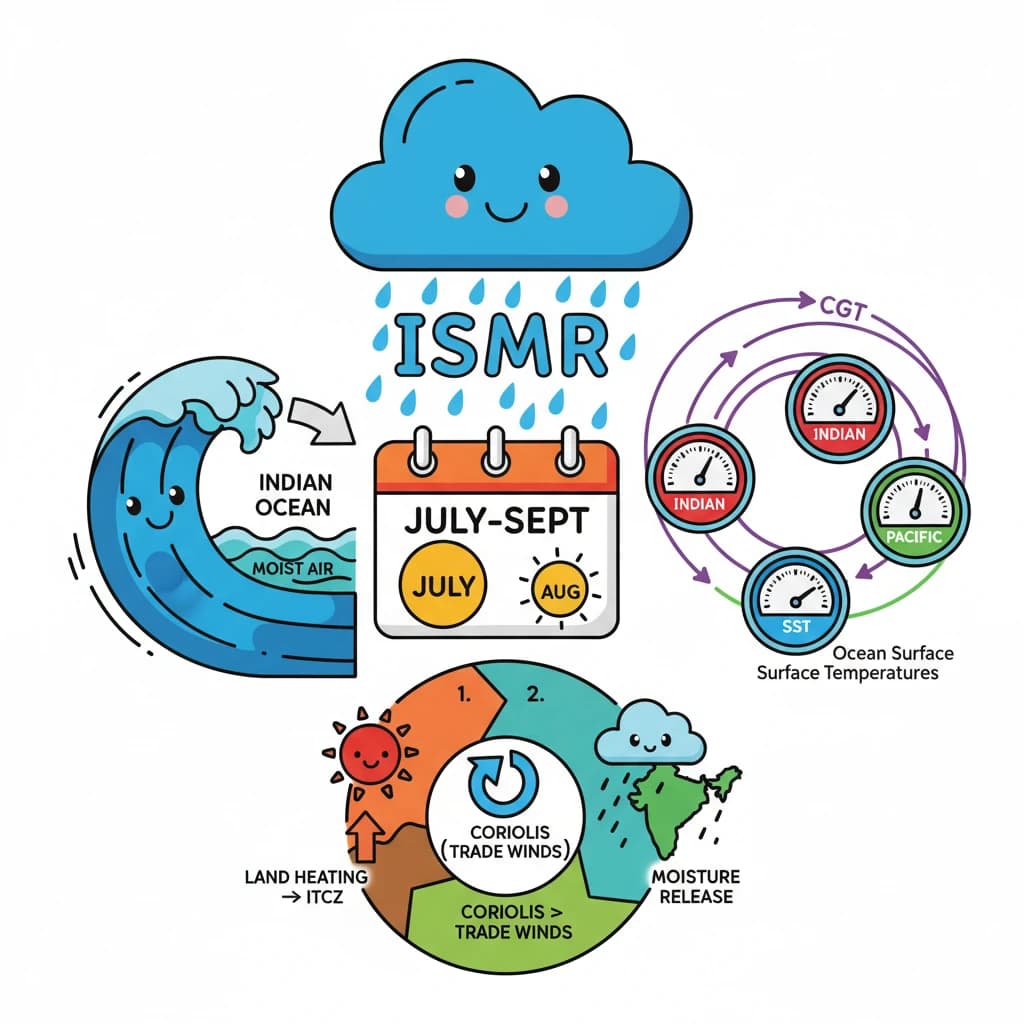
- Formation involves differential heating of land (creating ITCZ), Coriolis force deflecting trade winds, and moisture release over India.
- ISMR is vital for Indian agriculture (Kharif crops), water security, and hydroelectric power.
- Global phenomena like El Niño can significantly impact ISMR variability, often leading to weaker monsoons.

What is the Indian Summer Monsoon Rainfall (ISMR)?
Medium⏱️ 8 min read
geography
📖 Introduction
Introduction to Indian Summer Monsoon Rainfall (ISMR)
The Indian Summer Monsoon Rainfall (ISMR) is a critical climatic phenomenon for the Indian subcontinent. It is characterized by the movement of moist air from the Indian Ocean towards the landmass.
Definition: ISMR refers to the seasonal rainfall occurring over the Indian subcontinent due to the influx of moisture-laden winds from the Indian Ocean.
Timing and Duration of ISMR
This significant rainfall event primarily occurs over the Indian subcontinent during the months of July to September.
The peak rainfall activity, contributing the majority of the total precipitation, is typically recorded in July and August.
Key Factors Influencing ISMR
The intensity and distribution of ISMR are influenced by a complex interplay of various global and regional atmospheric and oceanic factors.
Major Influencers:
- Surface temperatures of the Indian, Atlantic, and Pacific Oceans play a crucial role.
- The circum-global teleconnection (CGT), a large-scale atmospheric wave, impacts ISMR from the mid-latitudes.
Mechanism of ISMR Formation
The formation of the Indian Summer Monsoon Rainfall is a result of differential heating between land and sea, coupled with atmospheric circulation patterns.
- Differential Heating: During summer, the Central Asian and Indian landmass warms up significantly faster than the surrounding ocean bodies due to their lower specific heat capacity.
- Low-Pressure Formation: This intense heating creates a strong low-pressure band over the land, known as the Intertropical Convergence Zone (ITCZ), which shifts northward.
- Wind Deflection: Trade winds originating from the southeast hemisphere are drawn towards this low-pressure area. As these winds cross the equator, the Coriolis force deflects them towards the Indian landmass.
- Moisture Accumulation & Release: These deflected winds, now blowing as south-westerly monsoons, traverse over the Arabian Sea and the Bay of Bengal, gathering substantial moisture. Upon reaching the Indian subcontinent, they release this moisture as widespread rainfall.
💡 Key Takeaways
- •ISMR is a major climatic event from July-September, peaking in July-August.
- •It is caused by moist air from the Indian Ocean moving towards the Indian subcontinent.
- •Key factors influencing ISMR include ocean surface temperatures (Indian, Atlantic, Pacific) and circum-global teleconnection (CGT).
- •Formation involves differential heating of land (creating ITCZ), Coriolis force deflecting trade winds, and moisture release over India.
- •ISMR is vital for Indian agriculture (Kharif crops), water security, and hydroelectric power.
- •Global phenomena like El Niño can significantly impact ISMR variability, often leading to weaker monsoons.
🧠 Memory Techniques
95% Verified Content
📚 Reference Sources
•NCERT Geography Textbooks (Class XI & XII)
•India Meteorological Department (IMD) general information on Monsoon
•Standard academic resources on Climatology and Indian Geography