Loading page, please wait…
Vaidra Logo
Vaidra

Top 4 items + smart groups

UPSC GPT
New
Current Affairs
Daily Solutions
Daily Puzzle
Mains Evaluator

Version 2.0.0 • Built with ❤️ for UPSC aspirants

Loading...
Loading...
Loading...
Loading...
Loading...
Loading...
Loading...
Loading...
Loading...
Loading...
Loading...
Loading...
Loading...
Santhal Hul of 1855 - UPSC History

Santhal Hul of 1855 - UPSC History

What is Santhal Hul of 1855 in UPSC History?

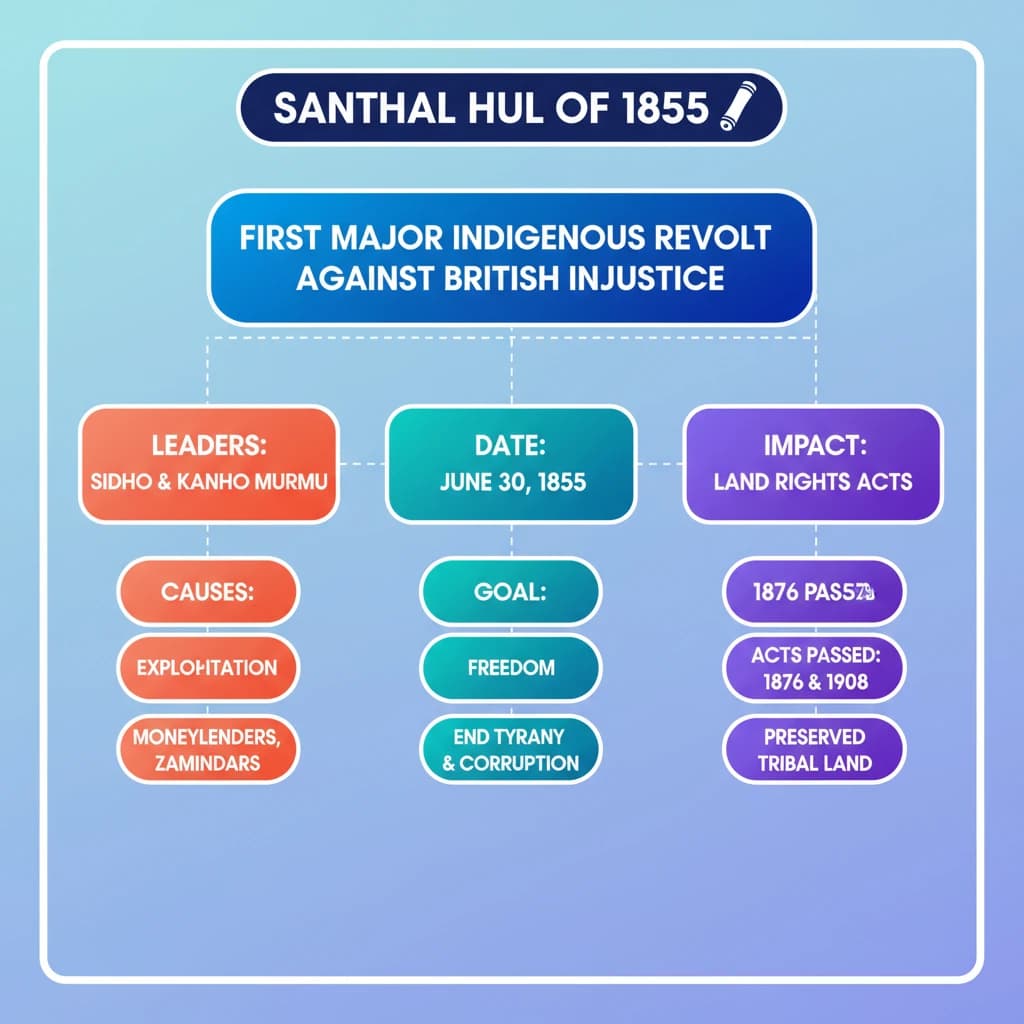
Santhal Hul of 1855 is a key topic under History for UPSC Civil Services Examination. Key points include: The Santhal Hul of 1855 was a significant peasant revolt against British colonial oppression, led by Sidho and Kanho Murmu.. It began on June 30, 1855, driven by exploitation from moneylenders, zamindars, and corrupt British officials.. The revolt, though suppressed, led to the enactment of the Santhal Pargana Tenancy Act (1876) and Chotanagpur Tenancy Act (1908).. Understanding this topic is essential for both UPSC Prelims and Mains preparation.

Why is Santhal Hul of 1855 important for UPSC exam?

Santhal Hul of 1855 is a Medium-level topic in UPSC History. It is tested in both Prelims (factual MCQs) and Mains (analytical answer writing). Previous year UPSC questions have frequently covered aspects of Santhal Hul of 1855, making it essential for comprehensive IAS preparation.

How to prepare Santhal Hul of 1855 for UPSC?

To prepare Santhal Hul of 1855 for UPSC: (1) Study the comprehensive notes covering all key concepts on Vaidra. (2) Practice previous year questions on this topic. (3) Connect it with current affairs using daily updates. (4) Revise using key takeaways and mind maps available for History. (5) Write practice answers linking Santhal Hul of 1855 to related GS Paper topics.

Key takeaways of Santhal Hul of 1855 for UPSC

  • The Santhal Hul of 1855 was a significant peasant revolt against British colonial oppression, led by Sidho and Kanho Murmu.
  • It began on June 30, 1855, driven by exploitation from moneylenders, zamindars, and corrupt British officials.
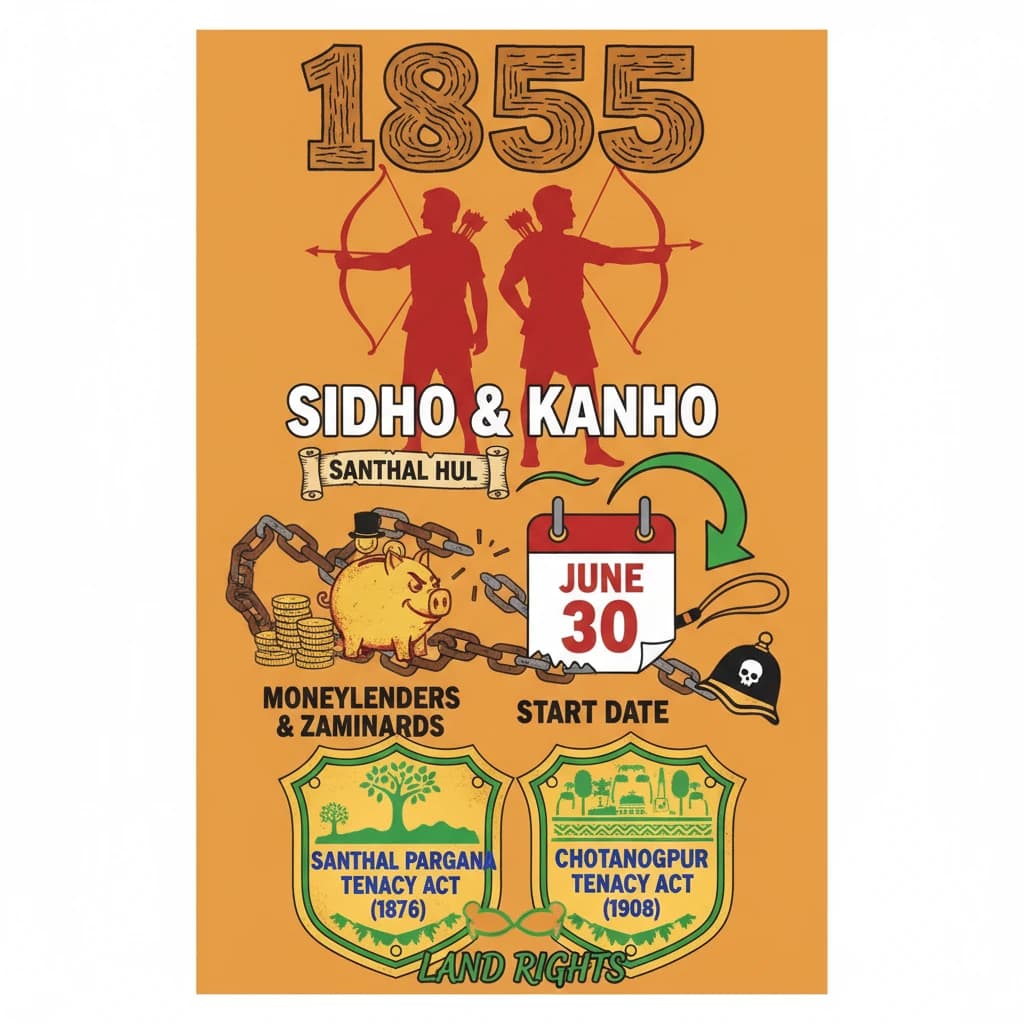
  • The revolt, though suppressed, led to the enactment of the Santhal Pargana Tenancy Act (1876) and Chotanagpur Tenancy Act (1908).
  • These acts were crucial for preserving tribal land rights and cultural autonomy.
  • The Hul is considered one of the earliest major uprisings before the Revolt of 1857, highlighting indigenous resistance.
Santhal Hul of 1855

Santhal Hul of 1855

Medium⏱️ 8 min read✓ 95% Verified
history

📖 Introduction

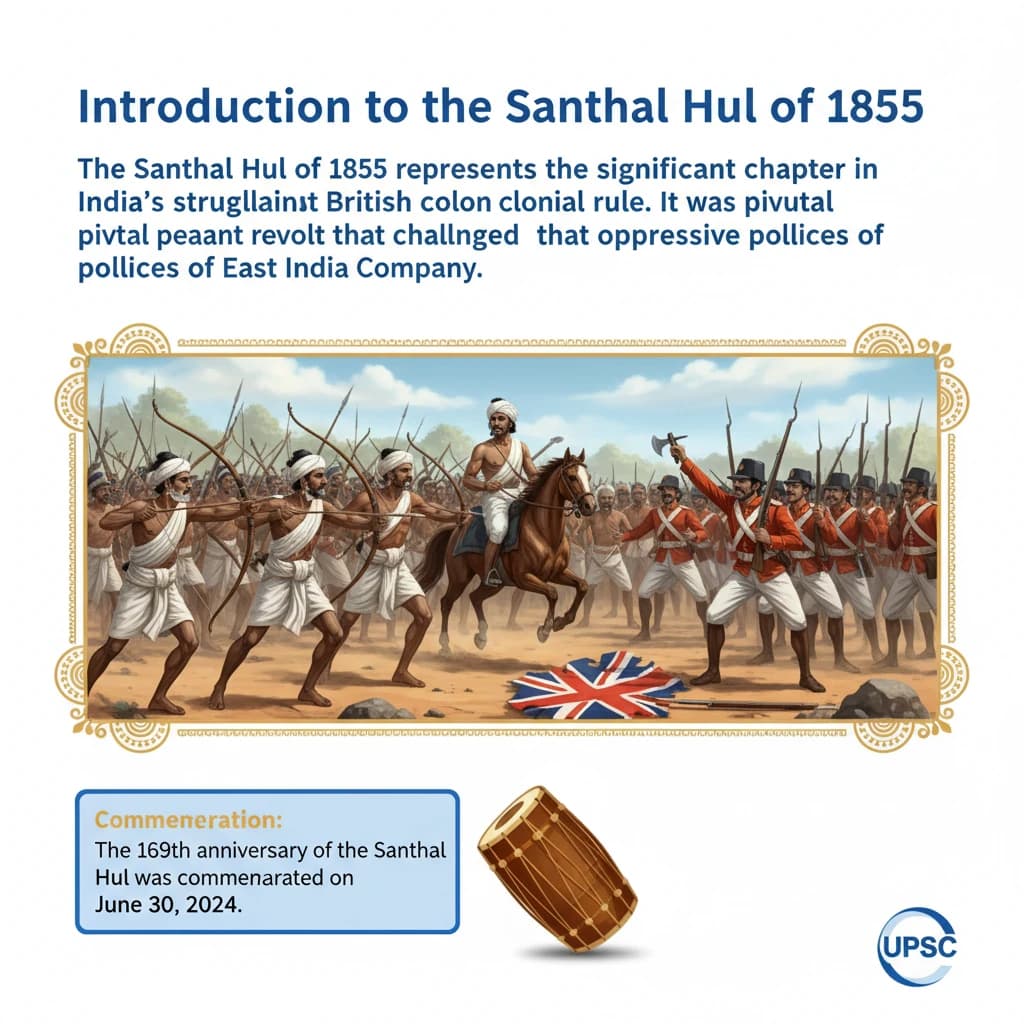
<h4>Introduction to the Santhal Hul of 1855</h4><p>The <strong>Santhal Hul</strong> of <strong>1855</strong> represents a significant chapter in India's struggle against <strong>British colonial rule</strong>. It was a pivotal <strong>peasant revolt</strong> that challenged the oppressive policies of the East India Company.</p><div class='info-box'><p><strong>Commemoration:</strong> The <strong>169th anniversary</strong> of the <strong>Santhal Hul</strong> was commemorated on <strong>June 30, 2024</strong>, highlighting its enduring legacy and importance in Indian history.</p></div><h4>Leadership of the Santhal Hul</h4><p>The revolt was spearheaded by four courageous brothers: <strong>Sidho Murmu</strong>, <strong>Kanho Murmu</strong>, <strong>Chand Murmu</strong>, and <strong>Bhairav Murmu</strong>. Their leadership galvanized the Santhal community.</p><p>Equally vital were the contributions of their sisters, <strong>Phulo Murmu</strong> and <strong>Jhano Murmu</strong>, who played significant roles in mobilizing and supporting the uprising.</p><h4>Origins and Commencement of the Revolt</h4><p>The <strong>Santhal Hul</strong> officially commenced on <strong>June 30, 1855</strong>. It emerged from deep-seated grievances against exploitation by moneylenders, zamindars, and the British administration.</p><div class='key-point-box'><p><strong>Key Concept:</strong> The term '<strong>Hul</strong>' in the Santhali language signifies a <strong>movement</strong> or a <strong>revolt</strong>, encapsulating the spirit of resistance against injustice.</p></div><h4>Legislative Outcomes of the Santhal Hul</h4><p>Despite its suppression, the <strong>Santhal Hul</strong> had profound long-term impacts, leading to crucial legislative changes aimed at protecting tribal rights.</p><ul><li>The <strong>Santhal Pargana Tenancy Act</strong> of <strong>1876</strong> was enacted to safeguard Santhal land from alienation.</li><li>The <strong>Chotanagpur Tenancy Act</strong> of <strong>1908</strong> further extended protections to tribal land rights across the Chotanagpur region.</li></ul><p>These acts were instrumental in preserving <strong>tribal land rights</strong> and fostering <strong>cultural autonomy</strong> for indigenous communities in India.</p><div class='exam-tip-box'><p><strong>UPSC Insight:</strong> The <strong>Santhal Hul</strong> is often cited as one of the earliest and most significant <strong>peasant uprisings</strong> preceding the <strong>Revolt of 1857</strong>. Understanding its causes and consequences is crucial for the <strong>Modern Indian History</strong> section (<strong>GS Paper I</strong>).</p></div>
Concept Diagram

💡 Key Takeaways

  • •The Santhal Hul of 1855 was a significant peasant revolt against British colonial oppression, led by Sidho and Kanho Murmu.
  • •It began on June 30, 1855, driven by exploitation from moneylenders, zamindars, and corrupt British officials.
  • •The revolt, though suppressed, led to the enactment of the Santhal Pargana Tenancy Act (1876) and Chotanagpur Tenancy Act (1908).
  • •These acts were crucial for preserving tribal land rights and cultural autonomy.
  • •The Hul is considered one of the earliest major uprisings before the Revolt of 1857, highlighting indigenous resistance.

🧠 Memory Techniques
Memory Aid
95% Verified Content

📚 Reference Sources

•General knowledge of Modern Indian History (NCERTs, standard textbooks)

Related Topics

Loading related topics...
Explore:History Topics·All Subjects·Daily Current Affairs·Editorial Analysis·Previous Year Questions·UPSC GPT
Back
All Subjects

Topics

0 topics • 0 completed

Loading topics...
Loading...
Loading...
Loading...
Loading...
Loading...
Overall Progress0%