Loading page, please wait…
Vaidra Logo
Vaidra

Top 4 items + smart groups

UPSC GPT
New
Current Affairs
Daily Solutions
Daily Puzzle
Mains Evaluator

Version 2.0.0 • Built with ❤️ for UPSC aspirants

Loading...
Loading...
Loading...
Loading...
Loading...
Loading...
Loading...
Loading...
Loading...
Loading...
Loading...
Loading...
Loading...
Back
All Subjects

Topics

0 topics • 0 completed

Loading topics...
Loading...
Loading...
Loading...
Loading...
Loading...
Overall Progress0%

Muslim League and Rise of Communal Politics in India - UPSC History

What is Muslim League and Rise of Communal Politics in India in UPSC History?

Muslim League and Rise of Communal Politics in India is a key topic under History for UPSC Civil Services Examination. Key points include: The All-India Muslim League was founded in 1906 in Dhaka to protect Muslim rights and demand separate representation.. Under Muhammad Ali Jinnah, the League transformed into a mass party, advocating for Muslim political demands, notably through his Fourteen Points (1929).. The Lucknow Pact (1916) showed Hindu-Muslim unity but legitimized separate electorates, inadvertently fueling communal politics.. Understanding this topic is essential for both UPSC Prelims and Mains preparation.

Why is Muslim League and Rise of Communal Politics in India important for UPSC exam?

Muslim League and Rise of Communal Politics in India is a Medium-level topic in UPSC History. It is tested in both Prelims (factual MCQs) and Mains (analytical answer writing). Previous year UPSC questions have frequently covered aspects of Muslim League and Rise of Communal Politics in India, making it essential for comprehensive IAS preparation.

How to prepare Muslim League and Rise of Communal Politics in India for UPSC?

To prepare Muslim League and Rise of Communal Politics in India for UPSC: (1) Study the comprehensive notes covering all key concepts on Vaidra. (2) Practice previous year questions on this topic. (3) Connect it with current affairs using daily updates. (4) Revise using key takeaways and mind maps available for History. (5) Write practice answers linking Muslim League and Rise of Communal Politics in India to related GS Paper topics.

Key takeaways of Muslim League and Rise of Communal Politics in India for UPSC

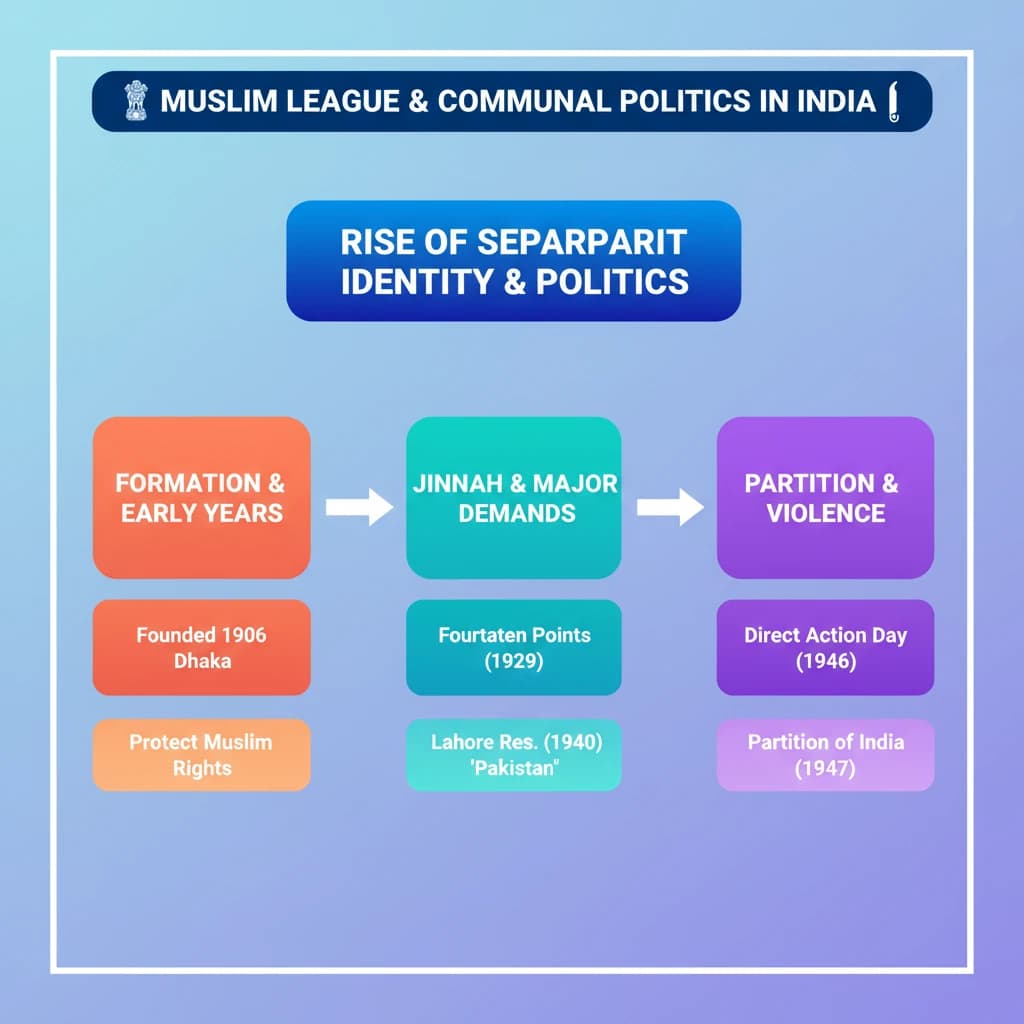
  • The All-India Muslim League was founded in 1906 in Dhaka to protect Muslim rights and demand separate representation.
  • Under Muhammad Ali Jinnah, the League transformed into a mass party, advocating for Muslim political demands, notably through his Fourteen Points (1929).
  • The Lucknow Pact (1916) showed Hindu-Muslim unity but legitimized separate electorates, inadvertently fueling communal politics.
  • The Lahore Resolution (1940) formally demanded 'Independent States' for Muslims, becoming the basis for Pakistan.
  • Direct Action Day (1946) led to severe communal violence, deepening divisions and accelerating the Partition of India in 1947.
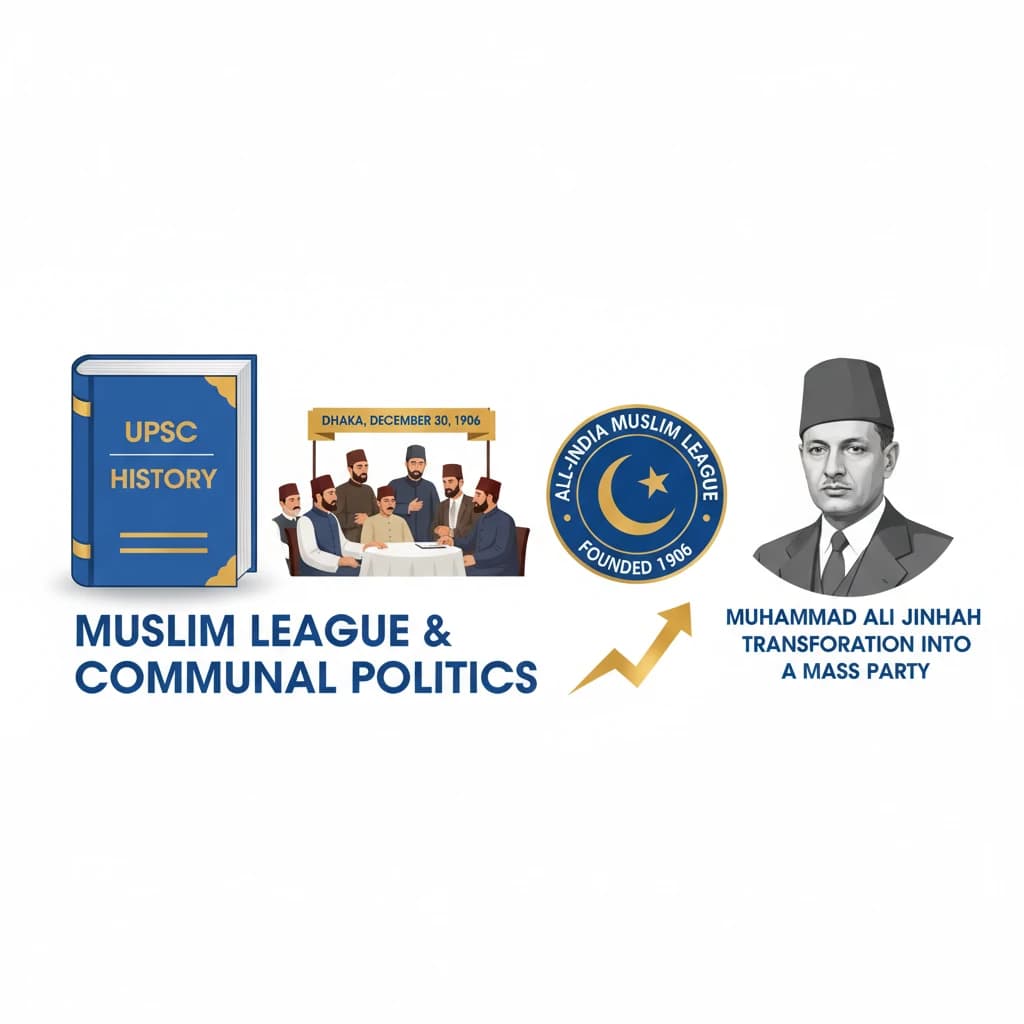
Muslim League and Rise of Communal Politics in India

Muslim League and Rise of Communal Politics in India

Medium⏱️ 10 min read✓ 95% Verified
history

📖 Introduction

<h4>Founding of the All-India Muslim League</h4><p>The <strong>All-India Muslim League</strong> was established on <strong>December 30, 1906</strong>, in <strong>Dhaka</strong>. This marked the beginning of a significant political organization that would profoundly influence India's future.</p><p>Initially, it comprised a group of <strong>elite Muslim men</strong>. Over time, it transformed into a mass political party, particularly under the leadership of <strong>Muhammad Ali Jinnah</strong>, ultimately advocating for the creation of <strong>Pakistan</strong>.</p><div class='info-box'><p><strong>Founders:</strong> Key figures included <strong>Nawab Salimullah of Dhaka</strong>, <strong>Nawab Viqar-ul-Mulk</strong>, <strong>Nawab Mohsin Ul-Mulk</strong>, and <strong>Aga Khan</strong>.</p></div><h4>Precursors to Formation</h4><p>The formation of the League was influenced by earlier movements and events that highlighted Muslim political aspirations and concerns.</p><ul><li><strong>Aligarh Movement:</strong> This movement, led by <strong>Sir Syed Ahmed Khan</strong>, focused on modern education for Muslims and fostering their political awareness.</li><li><strong>Simla Deputation (1906):</strong> A delegation of Muslim leaders met <strong>Lord Minto II (1905-1910)</strong> to articulate their demand for <strong>special representation</strong> in legislative bodies.</li></ul><h4>Initial Objectives of the League</h4><p>The primary goals of the <strong>All-India Muslim League</strong> at its inception were centered on safeguarding Muslim interests.</p><div class='key-point-box'><ul><li>To protect the <strong>political and religious rights of Muslims</strong> in British India.</li><li>To secure <strong>separate representation</strong> for Muslims in legislative bodies, a demand that significantly shaped future communal politics.</li></ul></div><h4>Emergence of Jinnah's Leadership</h4><p><strong>Muhammad Ali Jinnah</strong> played a crucial role in transforming the League from an elite body into a powerful mass political force.</p><p>His influence grew significantly after the articulation of his <strong>Fourteen Points in 1929</strong>, which clearly outlined the Muslim community's political demands.</p><div class='info-box'><p><strong>Jinnah's Fourteen Points (1929):</strong> These demands included calls for <strong>federalism</strong>, robust <strong>minority safeguards</strong>, and provincial <strong>autonomy</strong>, among others, reflecting Muslim political aspirations.</p></div><h4>Key Agreements and Resolutions</h4><h4>The Lucknow Pact (1916)</h4><p>The <strong>Lucknow Pact</strong> represented a rare moment of cooperation between the <strong>Indian National Congress</strong> and the <strong>All-India Muslim League</strong>.</p><p>Leaders like <strong>Bal Gangadhar Tilak</strong> (Congress) and <strong>Muhammad Ali Jinnah</strong> (League) signed this pact, agreeing to work together for India's independence.</p><div class='key-point-box'><p>Crucially, the <strong>Congress accepted separate electorates for Muslims</strong>, a long-standing demand of the League. While a sign of unity, this also inadvertently fueled the rise of <strong>communal politics</strong>.</p></div><p>The pact advocated for increased <strong>Indian representation</strong> in legislative and executive councils, marking a high point of <strong>Hindu-Muslim unity</strong> in the freedom struggle.</p><h4>The Lahore Resolution (1940)</h4><p>By <strong>1940</strong>, under <strong>Jinnah's</strong> leadership, the Muslim League had adopted a clear stance favoring the <strong>Partition of India</strong>.</p><p>At its session in <strong>Lahore</strong> in <strong>1940</strong>, the League passed a resolution demanding "<strong>Independent States</strong>" for Muslims in the northwestern and eastern regions where they formed a majority.</p><div class='highlight-box'><p>This resolution, later famously known as the <strong>Pakistan Resolution</strong>, became the fundamental ideological basis for the eventual creation of <strong>Pakistan in 1947</strong>.</p></div><h4>Direct Action Day (1946)</h4><p>Observed on <strong>August 16, 1946</strong>, <strong>Direct Action Day</strong> was a communal strike called by the <strong>All-India Muslim League</strong>, led by <strong>Muhammad Ali Jinnah</strong>.</p><p>The League's objective was to forcefully press its demand for the creation of <strong>Pakistan</strong> through mass action.</p><div class='exam-tip-box'><p>This event led to widespread <strong>communal riots</strong>, particularly in <strong>Calcutta</strong>, resulting in thousands of deaths and extensive property destruction. It significantly deepened the <strong>Hindu-Muslim divide</strong> and accelerated the demand for <strong>Partition</strong>.</p></div><h4>Role in Partition and Post-Partition Status</h4><p>Under <strong>Jinnah's</strong> leadership, the <strong>Muslim League</strong> spearheaded the demand for <strong>Pakistan</strong>, arguing that Muslims would not receive fair treatment in a Hindu-majority independent India.</p><p>This persistent advocacy culminated in the <strong>1947 Partition</strong>, leading to the creation of two independent nations: <strong>India</strong> and <strong>Pakistan</strong>.</p><p>Post-Partition, the League became the dominant political party in <strong>Pakistan</strong> but eventually fragmented into various factions. Its influence in <strong>India</strong> largely waned, with some remnants forming regional political groups.</p>
Concept Diagram

💡 Key Takeaways

  • •The All-India Muslim League was founded in 1906 in Dhaka to protect Muslim rights and demand separate representation.
  • •Under Muhammad Ali Jinnah, the League transformed into a mass party, advocating for Muslim political demands, notably through his Fourteen Points (1929).
  • •The Lucknow Pact (1916) showed Hindu-Muslim unity but legitimized separate electorates, inadvertently fueling communal politics.
  • •The Lahore Resolution (1940) formally demanded 'Independent States' for Muslims, becoming the basis for Pakistan.
  • •Direct Action Day (1946) led to severe communal violence, deepening divisions and accelerating the Partition of India in 1947.

🧠 Memory Techniques
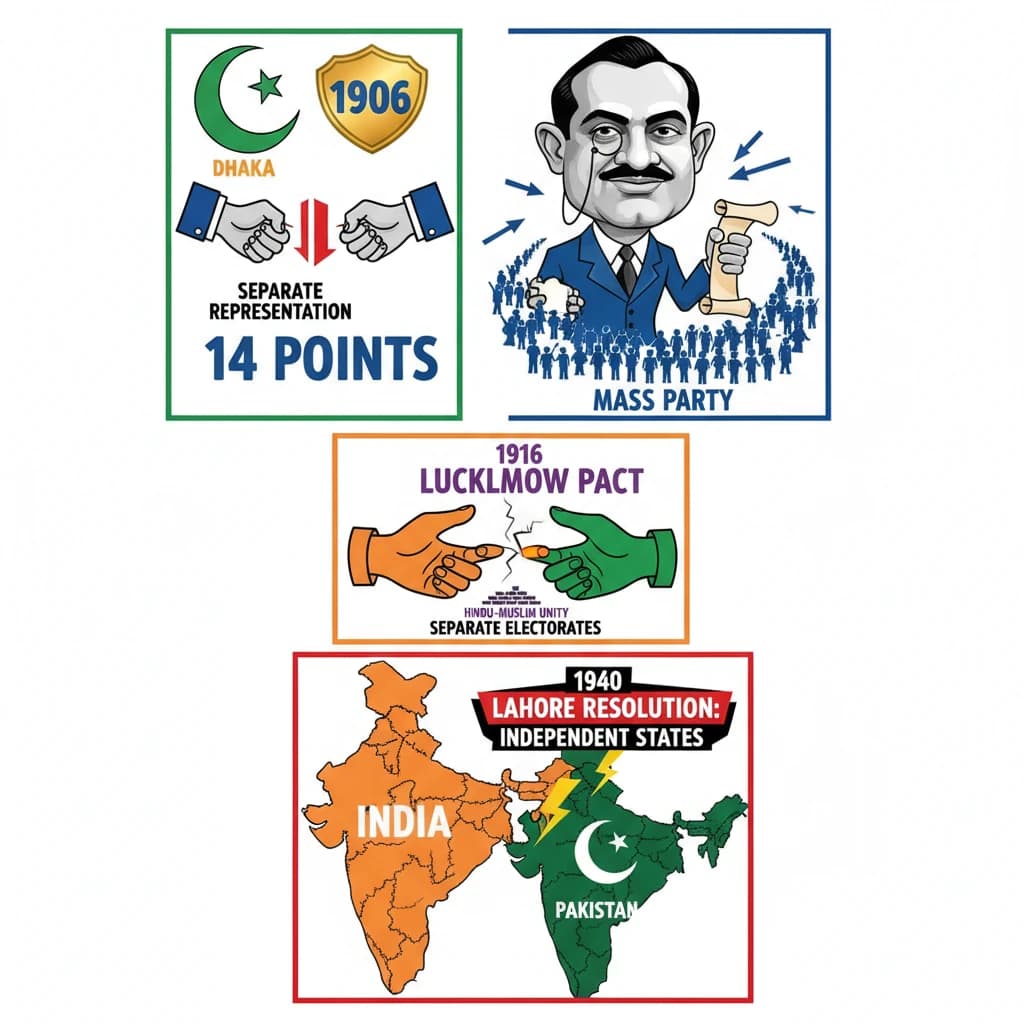
Memory Aid
95% Verified Content

Related Topics

Loading related topics...
Explore:History Topics·All Subjects·Daily Current Affairs·Editorial Analysis·Previous Year Questions·UPSC GPT
Muslim League and Rise of Communal Politics in India - UPSC History