Loading page, please wait…
Vaidra Logo
Vaidra

Top 4 items + smart groups

UPSC GPT
New
Current Affairs
Daily Solutions
Daily Puzzle
Mains Evaluator

Version 2.0.0 • Built with ❤️ for UPSC aspirants

Loading...
Loading...
Loading...
Loading...
Loading...
Loading...
Loading...
Loading...
Loading...
Loading...
Loading...
Loading...
Loading...
Quit India Movement: An Overview - UPSC History
Back
All Subjects

Topics

0 topics • 0 completed

Loading topics...
Loading...
Loading...
Loading...
Loading...
Loading...
Overall Progress0%

Quit India Movement: An Overview - UPSC History

What is Quit India Movement: An Overview in UPSC History?

Quit India Movement: An Overview is a key topic under History for UPSC Civil Services Examination. Key points include: QIM was launched in August 1942, demanding immediate British withdrawal.. Triggered by the failure of the Cripps Mission and wartime discontent.. Mahatma Gandhi's 'Do or Die' call galvanized the nation.. Understanding this topic is essential for both UPSC Prelims and Mains preparation.

Why is Quit India Movement: An Overview important for UPSC exam?

Quit India Movement: An Overview is a Medium-level topic in UPSC History. It is tested in both Prelims (factual MCQs) and Mains (analytical answer writing). Previous year UPSC questions have frequently covered aspects of Quit India Movement: An Overview, making it essential for comprehensive IAS preparation.

How to prepare Quit India Movement: An Overview for UPSC?

To prepare Quit India Movement: An Overview for UPSC: (1) Study the comprehensive notes covering all key concepts on Vaidra. (2) Practice previous year questions on this topic. (3) Connect it with current affairs using daily updates. (4) Revise using key takeaways and mind maps available for History. (5) Write practice answers linking Quit India Movement: An Overview to related GS Paper topics.

Key takeaways of Quit India Movement: An Overview for UPSC

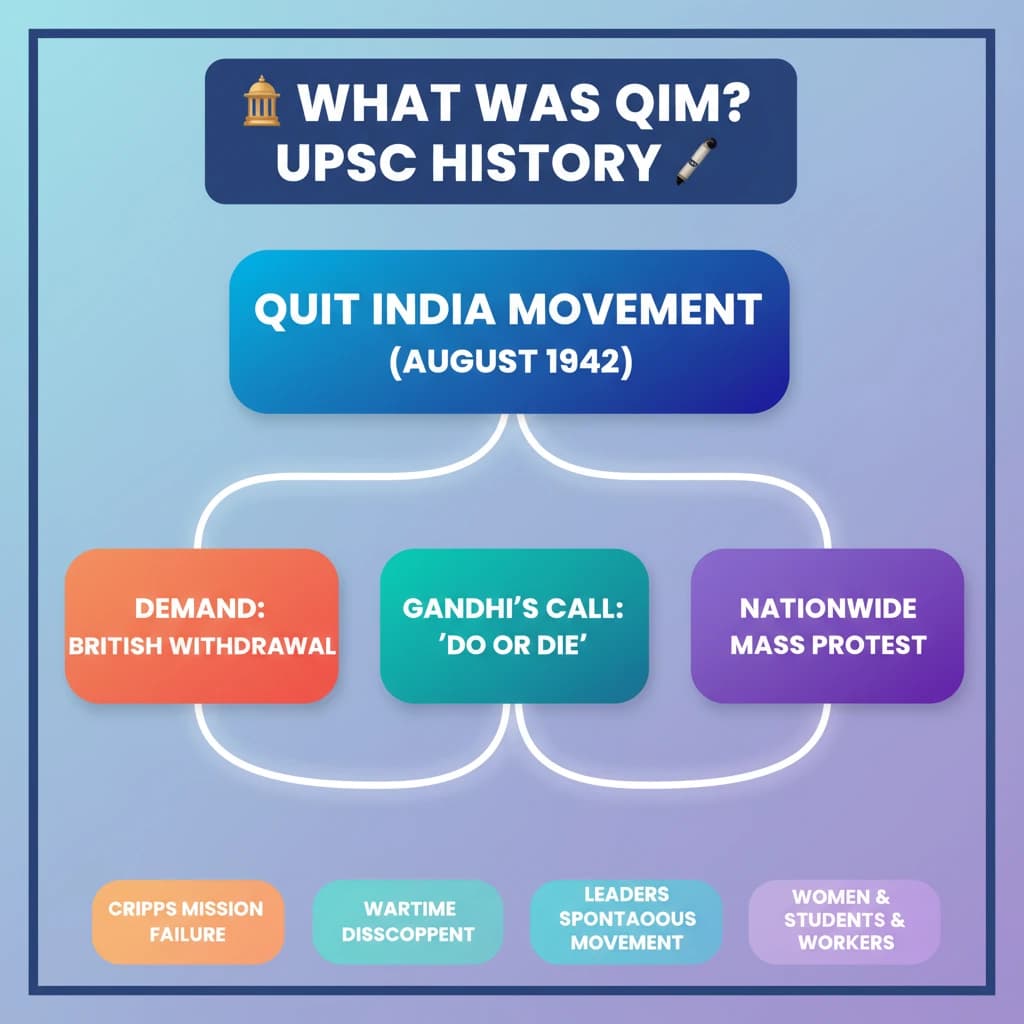
  • QIM was launched in August 1942, demanding immediate British withdrawal.
  • Triggered by the failure of the Cripps Mission and wartime discontent.
  • Mahatma Gandhi's 'Do or Die' call galvanized the nation.
  • Characterized by widespread arrests of leaders, leading to a spontaneous, leaderless movement.
  • Saw extensive mass participation, including women, students, and peasants.
  • Led to the formation of parallel governments in several regions (e.g., Ballia, Satara, Tamluk).
  • Despite brutal suppression, it cemented India's resolve for complete independence.
Quit India Movement: An Overview

Quit India Movement: An Overview

Medium⏱️ 10 min read✓ 98% Verified
history

📖 Introduction

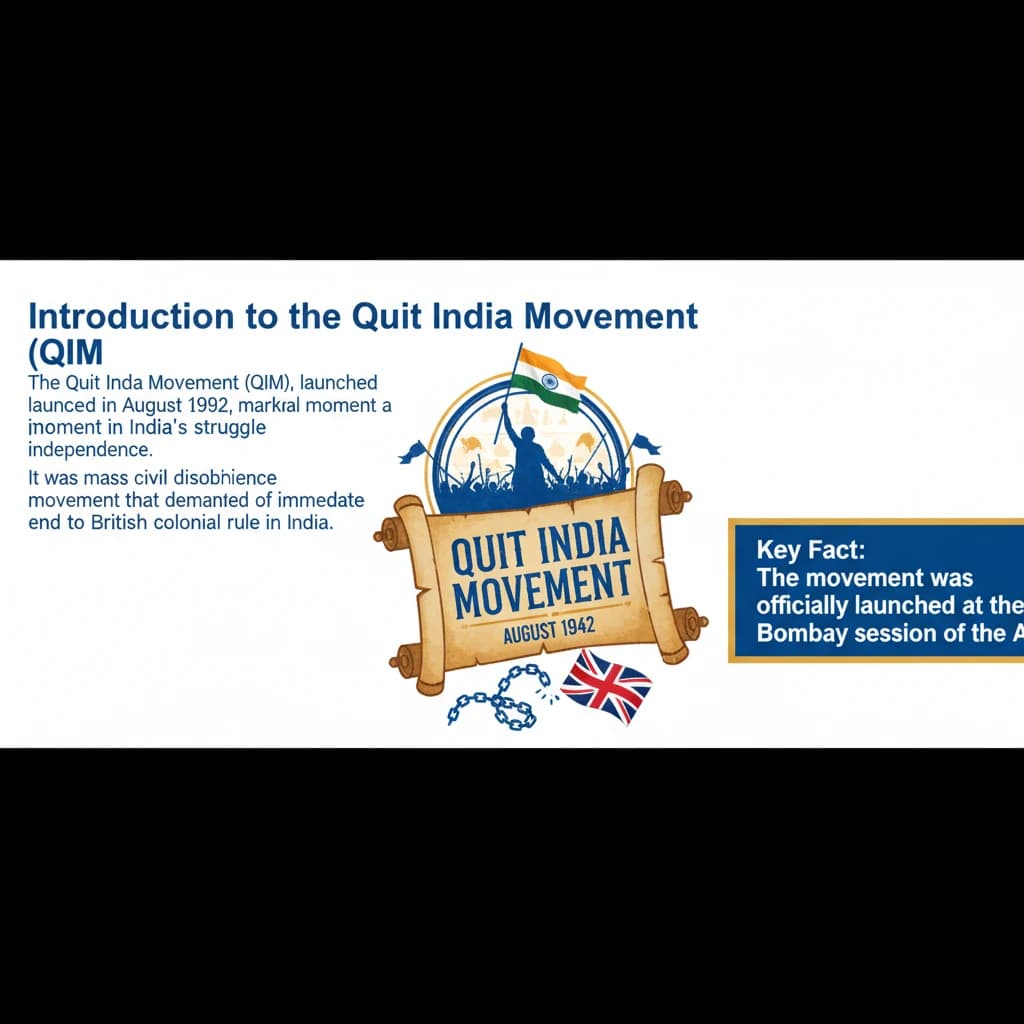
<h4>Introduction to the Quit India Movement (QIM)</h4><p>The <strong>Quit India Movement (QIM)</strong>, launched in <strong>August 1942</strong>, marked a <strong>pivotal moment</strong> in India’s struggle for independence. It was a mass civil disobedience movement that demanded an immediate end to <strong>British colonial rule</strong> in India.</p><div class='info-box'><p><strong>Key Fact:</strong> The movement was officially launched at the <strong>Bombay session</strong> of the <strong>All-India Congress Committee (AICC)</strong> on <strong>August 8, 1942</strong>.</p></div><h4>Genesis and Immediate Causes</h4><p>The failure of the <strong>Cripps Mission</strong> in <strong>March 1942</strong> was a primary catalyst for the QIM. The mission offered India dominion status after <strong>World War II</strong>, which was rejected by Indian leaders who demanded complete independence.</p><p>Growing discontent among the Indian populace due to rising prices, wartime shortages, and the perceived indifference of the British government further fueled the demand for immediate self-rule. The threat of a Japanese invasion also made Indians question British protection.</p><h4>Mahatma Gandhi's Call: 'Do or Die'</h4><p><strong>Mahatma Gandhi</strong> delivered his famous <strong>'Do or Die'</strong> speech at the <strong>Gowalia Tank Maidan</strong> in Bombay. This powerful message urged Indians to either achieve complete independence or die in the attempt, signifying a new, uncompromising phase of the struggle.</p><div class='key-point-box'><p><strong>Core Principle:</strong> Gandhi's call was for <strong>non-violent resistance</strong>, but with an intensified commitment to achieving freedom. It empowered individuals to act as if they were free.</p></div><h4>Nature and Spread of the Movement</h4><p>The movement began with widespread arrests of major Congress leaders, including <strong>Gandhi</strong>, almost immediately after its launch. This led to a leaderless, spontaneous outburst of anger and protest across the country.</p><p>It manifested through strikes, demonstrations, sabotage of government property, and the establishment of <strong>parallel governments</strong> in certain areas. Students, peasants, and workers participated enthusiastically, often leading the movement locally.</p><h4>Government Repression and Impact</h4><p>The British government responded with extreme repression, including mass arrests, lathi charges, and firing. Despite the harsh measures, the movement demonstrated the depth of nationalist sentiment and the widespread desire for freedom.</p><div class='exam-tip-box'><p><strong>UPSC Insight:</strong> The QIM is crucial for understanding the final phase of India's independence struggle. Focus on its spontaneous nature, lack of central leadership, and the extent of mass participation for GS Paper 1.</p></div>
Concept Diagram

💡 Key Takeaways

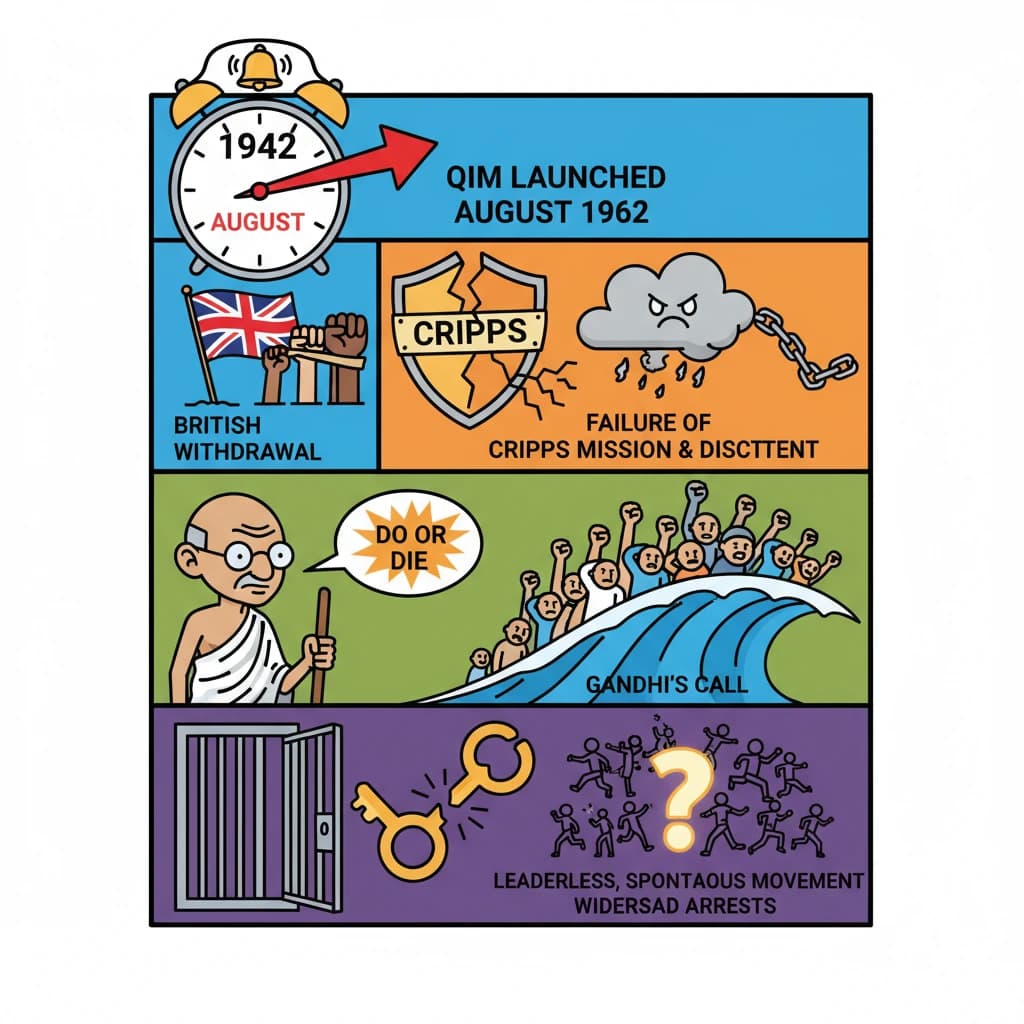
  • •QIM was launched in August 1942, demanding immediate British withdrawal.
  • •Triggered by the failure of the Cripps Mission and wartime discontent.
  • •Mahatma Gandhi's 'Do or Die' call galvanized the nation.
  • •Characterized by widespread arrests of leaders, leading to a spontaneous, leaderless movement.
  • •Saw extensive mass participation, including women, students, and peasants.
  • •Led to the formation of parallel governments in several regions (e.g., Ballia, Satara, Tamluk).
  • •Despite brutal suppression, it cemented India's resolve for complete independence.

🧠 Memory Techniques
Memory Aid
98% Verified Content

📚 Reference Sources

•A Brief History of Modern India by Spectrum Books
•NCERT History Textbooks (Class 12)
•The Story of My Experiments with Truth by M.K. Gandhi

Related Topics

Loading related topics...
Explore:History Topics·All Subjects·Daily Current Affairs·Editorial Analysis·Previous Year Questions·UPSC GPT