Loading page, please wait…
100 Years of Vaikom Satyagraha - UPSC History
What is 100 Years of Vaikom Satyagraha in UPSC History?
100 Years of Vaikom Satyagraha is a key topic under History for UPSC Civil Services Examination. Key points include: Vaikom Satyagraha (1924-1925) was a nonviolent protest against untouchability and caste discrimination in Travancore, Kerala.. It was India's first major temple entry movement, inspiring subsequent social reforms.. Key leaders included T.K. Madhavan, K.P. Kesava Menon, K. Kelappan, with significant contributions from Periyar and Mahatma Gandhi.. Understanding this topic is essential for both UPSC Prelims and Mains preparation.
Why is 100 Years of Vaikom Satyagraha important for UPSC exam?
100 Years of Vaikom Satyagraha is a Medium-level topic in UPSC History. It is tested in both Prelims (factual MCQs) and Mains (analytical answer writing). Previous year UPSC questions have frequently covered aspects of 100 Years of Vaikom Satyagraha, making it essential for comprehensive IAS preparation.
How to prepare 100 Years of Vaikom Satyagraha for UPSC?
To prepare 100 Years of Vaikom Satyagraha for UPSC: (1) Study the comprehensive notes covering all key concepts on Vaidra. (2) Practice previous year questions on this topic. (3) Connect it with current affairs using daily updates. (4) Revise using key takeaways and mind maps available for History. (5) Write practice answers linking 100 Years of Vaikom Satyagraha to related GS Paper topics.
Key takeaways of 100 Years of Vaikom Satyagraha for UPSC
- Vaikom Satyagraha (1924-1925) was a nonviolent protest against untouchability and caste discrimination in Travancore, Kerala.
- It was India's first major temple entry movement, inspiring subsequent social reforms.
- Key leaders included T.K. Madhavan, K.P. Kesava Menon, K. Kelappan, with significant contributions from Periyar and Mahatma Gandhi.
- Achieved partial success initially, leading to the opening of three out of four temple roads.
- Its lasting legacy culminated in the historic Travancore Temple Entry Proclamation of 1936, opening all state temples to marginalized castes.
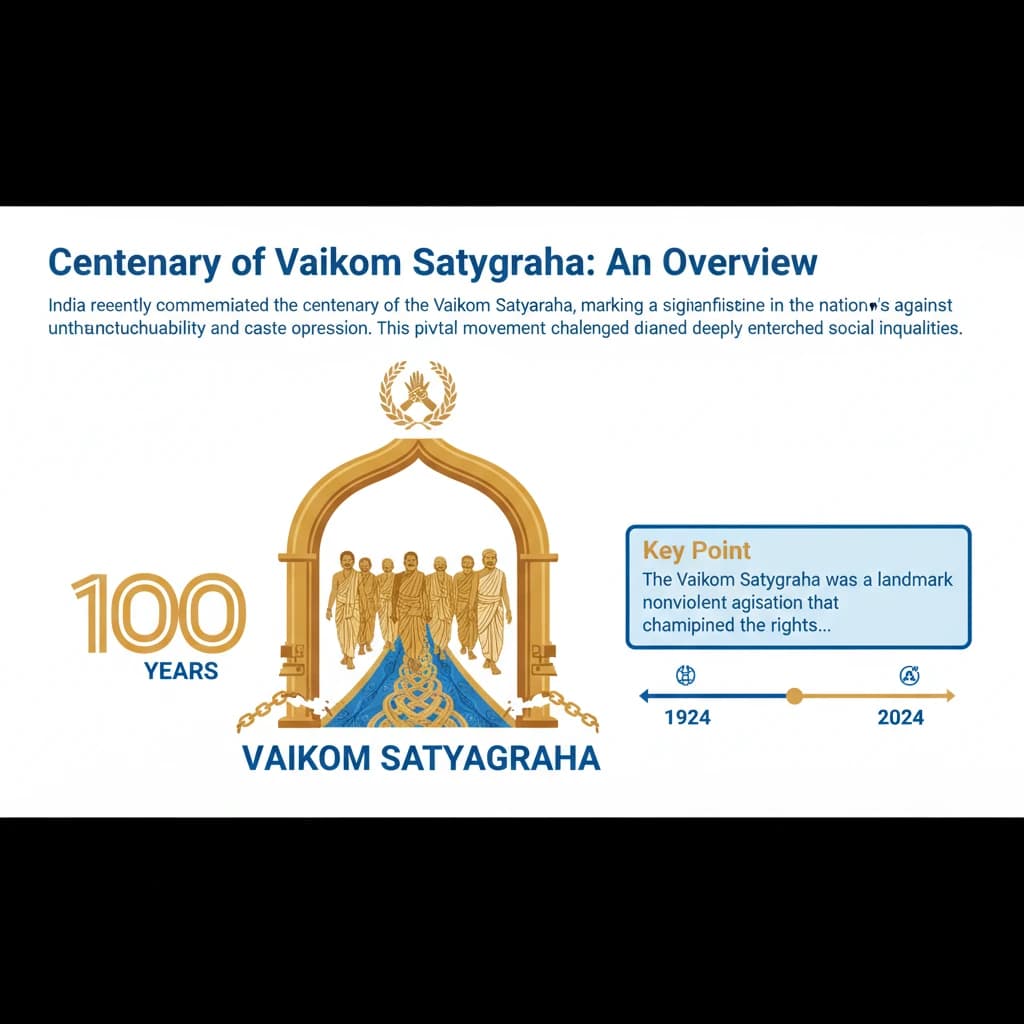
100 Years of Vaikom Satyagraha
Medium⏱️ 10 min read
history
📖 Introduction
Introduction to Vaikom Satyagraha Centenary
India commemorated the centenary of the Vaikom Satyagraha, a crucial movement in its history.
This agitation significantly challenged untouchability and caste oppression.
It remains a symbol of social reform and resistance against discrimination.
Genesis and Location
The Vaikom Satyagraha was a nonviolent agitation that took place in Vaikom.
Vaikom is situated within the erstwhile princely state of Travancore, located in present-day Kerala.
The movement spanned from March 30, 1924, to November 23, 1925.
Duration: 30th March 1924 – 23rd November 1925 (approx. 600 days)
Location: Vaikom, Travancore (Kerala)
Core Issue: Untouchability and Road Access
The movement primarily protested against the deeply entrenched practices of untouchability and caste discrimination.
It was specifically triggered by the prohibition of oppressed classes, particularly the Ezhavas, from using roads surrounding the Vaikom Mahadeva temple.
These roads were considered sacred and restricted to upper castes.
Pioneering Temple Entry Movement
The Vaikom Satyagraha holds the distinction of being the first among the temple entry movements in India.
It effectively paved the way and set a precedent for similar social reform movements across the entire country.
The Vaikom Satyagraha is a critical example for questions on social reform movements and Gandhian methods in UPSC Mains GS Paper I.
Integration with Nationalist Aspirations
The movement emerged during a period of a burgeoning nationalist movement in India.
It aimed to bring social reform to the forefront, alongside the prevailing political aspirations for independence.
This demonstrated the interconnectedness of social emancipation and political freedom.
Key Leaders and Influences
The Satyagraha was spearheaded by visionary leaders from Kerala.
Prominent figures included Ezhava leader T.K. Madhavan, K.P. Kesava Menon, and K. Kelappan.
Local Leaders: T.K. Madhavan (Ezhava leader), K.P. Kesava Menon, K. Kelappan.
Periyar's Pivotal Role
Erode Venkatappa Ramasamy, widely known as Periyar or Thanthai Periyar, played an exceptionally crucial role.
He mobilized volunteers, delivered powerful speeches, and endured imprisonment for the cause.
His significant contributions earned him the esteemed title 'Vaikom Hero'.
Mahatma Gandhi's Intervention
The movement gained significant momentum and national attention with the arrival of Mahatma Gandhi in Vaikom in March 1925.
Gandhi held crucial discussions with leaders from various caste groups, lending his moral authority and strategic guidance.
His involvement underscored the national importance of the struggle.
Strategies Employed
The Satyagraha initially concentrated on opening the roads surrounding the Vaikom temple to people from all castes.
Leaders deliberately adopted nonviolent methods, deeply inspired by Gandhian principles of protest.
This adherence to nonviolence was a hallmark of the movement's strategy.
Significant Outcome and Partial Success
The Vaikom Satyagraha ultimately led to notable reforms in the region.
Three out of the four roads surrounding the Vaikom Mahadeva temple were opened to people of all castes.
While not a complete victory, it was a significant step towards dismantling caste barriers.
Long-term Legacy: Temple Entry Proclamation
The momentum generated by the Satyagraha continued, culminating in a historic event in November 1936.
The Maharaja of Travancore signed the landmark Temple Entry Proclamation.
This proclamation completely removed the age-old ban on the entry of marginalized castes into all state-owned temples of Travancore.
The Temple Entry Proclamation of 1936 was a direct and profound consequence, significantly expanding the rights of marginalized communities.
Divergent Interpretations of the Movement
The Vaikom Satyagraha has been subject to varying interpretations over time.
Some view it primarily as a Hindu reformist movement, aiming to purify and broaden the scope of Hinduism.
Others perceive it fundamentally as a crucial fight against pervasive caste-based atrocities and discrimination.
Commemoration and Remembrance
The enduring significance of the movement is honored through various memorials.
These include the Vaikom Satyagraha Memorial Museum and Periyar's Memorial.
Such memorials ensure that the struggle and its lessons are not forgotten.
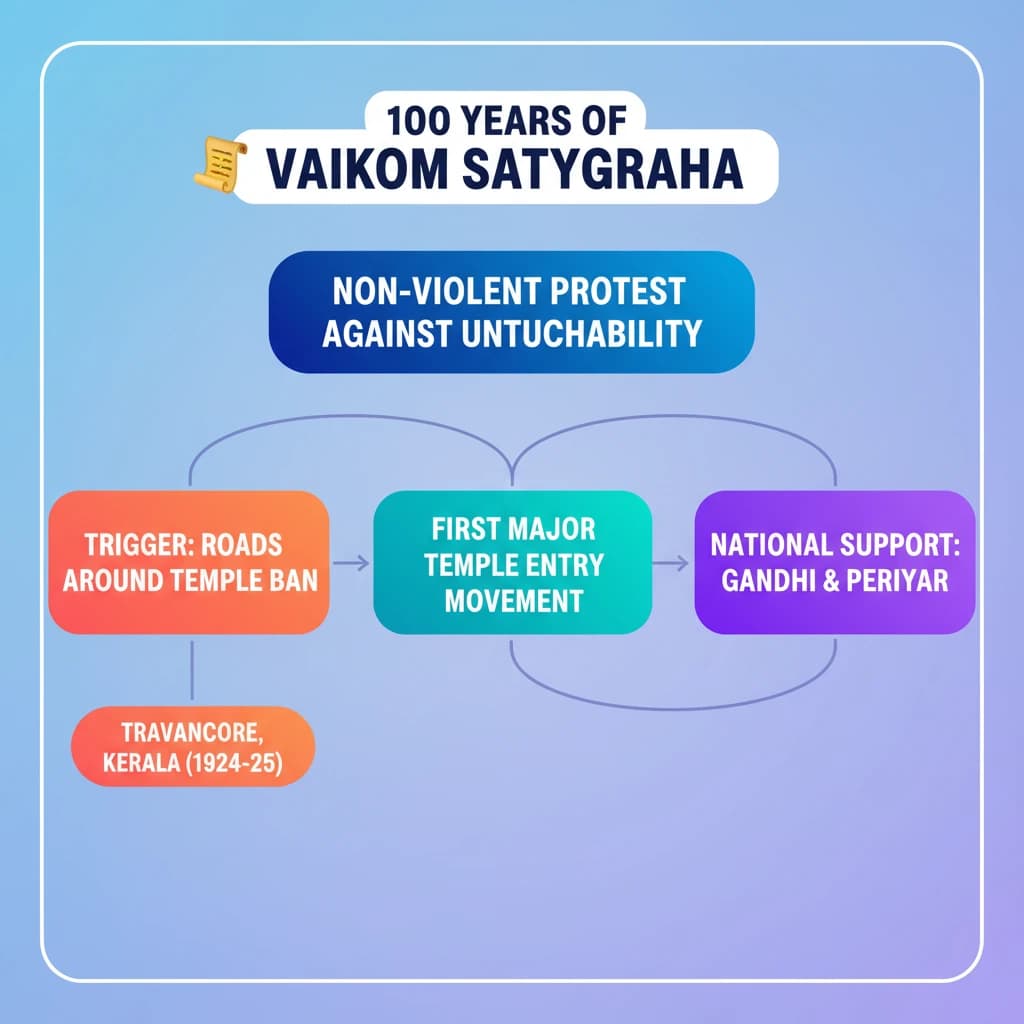
💡 Key Takeaways
- •Vaikom Satyagraha (1924-1925) was a nonviolent protest against untouchability and caste discrimination in Travancore, Kerala.
- •It was India's first major temple entry movement, inspiring subsequent social reforms.
- •Key leaders included T.K. Madhavan, K.P. Kesava Menon, K. Kelappan, with significant contributions from Periyar and Mahatma Gandhi.
- •Achieved partial success initially, leading to the opening of three out of four temple roads.
- •Its lasting legacy culminated in the historic Travancore Temple Entry Proclamation of 1936, opening all state temples to marginalized castes.
🧠 Memory Techniques
95% Verified Content