Loading page, please wait…
Vaidra Logo
Vaidra

Top 4 items + smart groups

UPSC GPT
New
Current Affairs
Daily Solutions
Daily Puzzle
Mains Evaluator

Version 2.0.0 • Built with ❤️ for UPSC aspirants

Loading...
Loading...
Loading...
Loading...
Loading...
Loading...
Loading...
Loading...
Loading...
Loading...
Loading...
Loading...
Loading...
Back
All Subjects

Topics

0 topics • 0 completed

Loading topics...
Loading...
Loading...
Loading...
Loading...
Loading...
Overall Progress0%
What are the Key Highlights of the Accession of Hyderabad to India? - UPSC History

What are the Key Highlights of the Accession of Hyderabad to India? - UPSC History

What is What are the Key Highlights of the Accession of Hyderabad to India? in UPSC History?

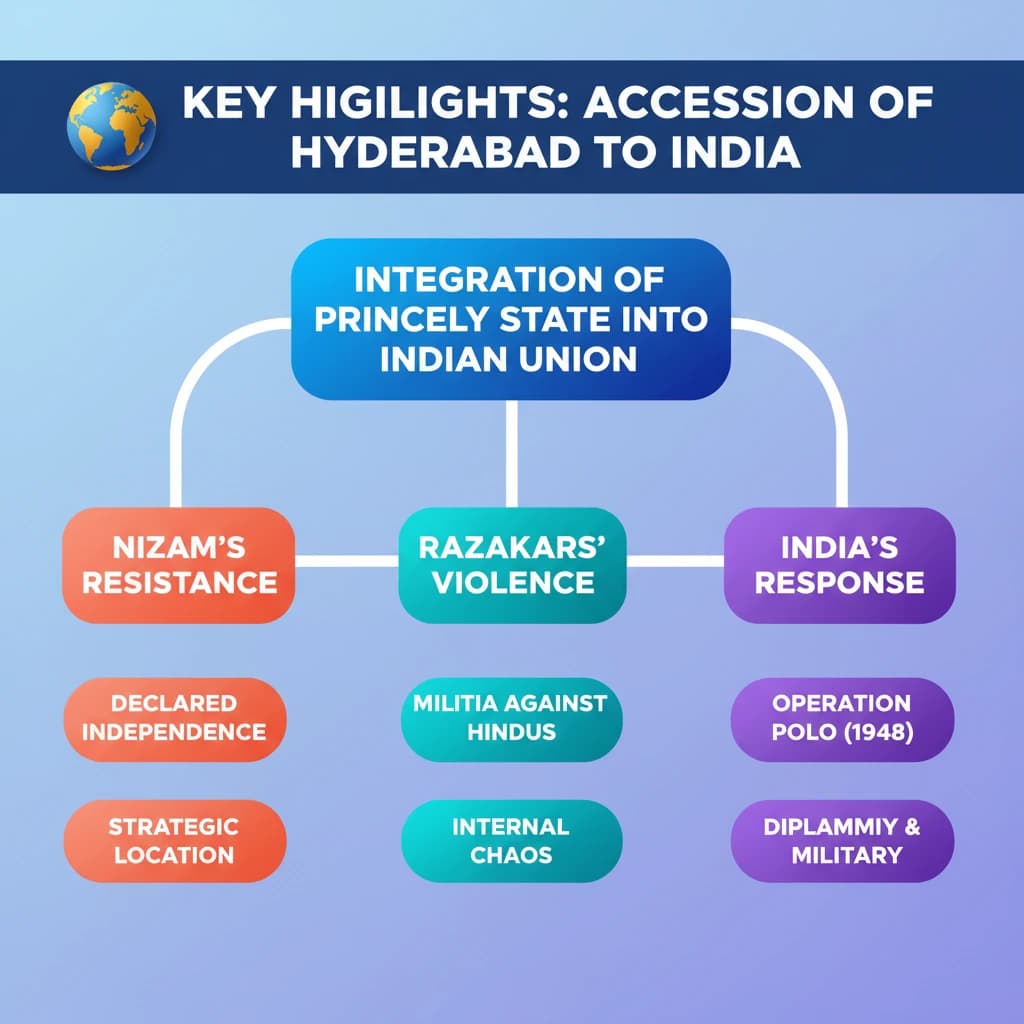
What are the Key Highlights of the Accession of Hyderabad to India? is a key topic under History for UPSC Civil Services Examination. Key points include: Hyderabad was a large princely state with a Hindu majority ruled by Muslim Nizam Osman Ali Khan.. The Nizam declared independence in 1947, rejecting accession to India due to strategic location concerns.. The Razakars, a pro-Nizam militia, used violence against Hindus and pro-India Muslims, creating internal chaos.. Understanding this topic is essential for both UPSC Prelims and Mains preparation.

Why is What are the Key Highlights of the Accession of Hyderabad to India? important for UPSC exam?

What are the Key Highlights of the Accession of Hyderabad to India? is a Medium-level topic in UPSC History. It is tested in both Prelims (factual MCQs) and Mains (analytical answer writing). Previous year UPSC questions have frequently covered aspects of What are the Key Highlights of the Accession of Hyderabad to India?, making it essential for comprehensive IAS preparation.

How to prepare What are the Key Highlights of the Accession of Hyderabad to India? for UPSC?

To prepare What are the Key Highlights of the Accession of Hyderabad to India? for UPSC: (1) Study the comprehensive notes covering all key concepts on Vaidra. (2) Practice previous year questions on this topic. (3) Connect it with current affairs using daily updates. (4) Revise using key takeaways and mind maps available for History. (5) Write practice answers linking What are the Key Highlights of the Accession of Hyderabad to India? to related GS Paper topics.

Key takeaways of What are the Key Highlights of the Accession of Hyderabad to India? for UPSC

  • Hyderabad was a large princely state with a Hindu majority ruled by Muslim Nizam Osman Ali Khan.
  • The Nizam declared independence in 1947, rejecting accession to India due to strategic location concerns.
  • The Razakars, a pro-Nizam militia, used violence against Hindus and pro-India Muslims, creating internal chaos.
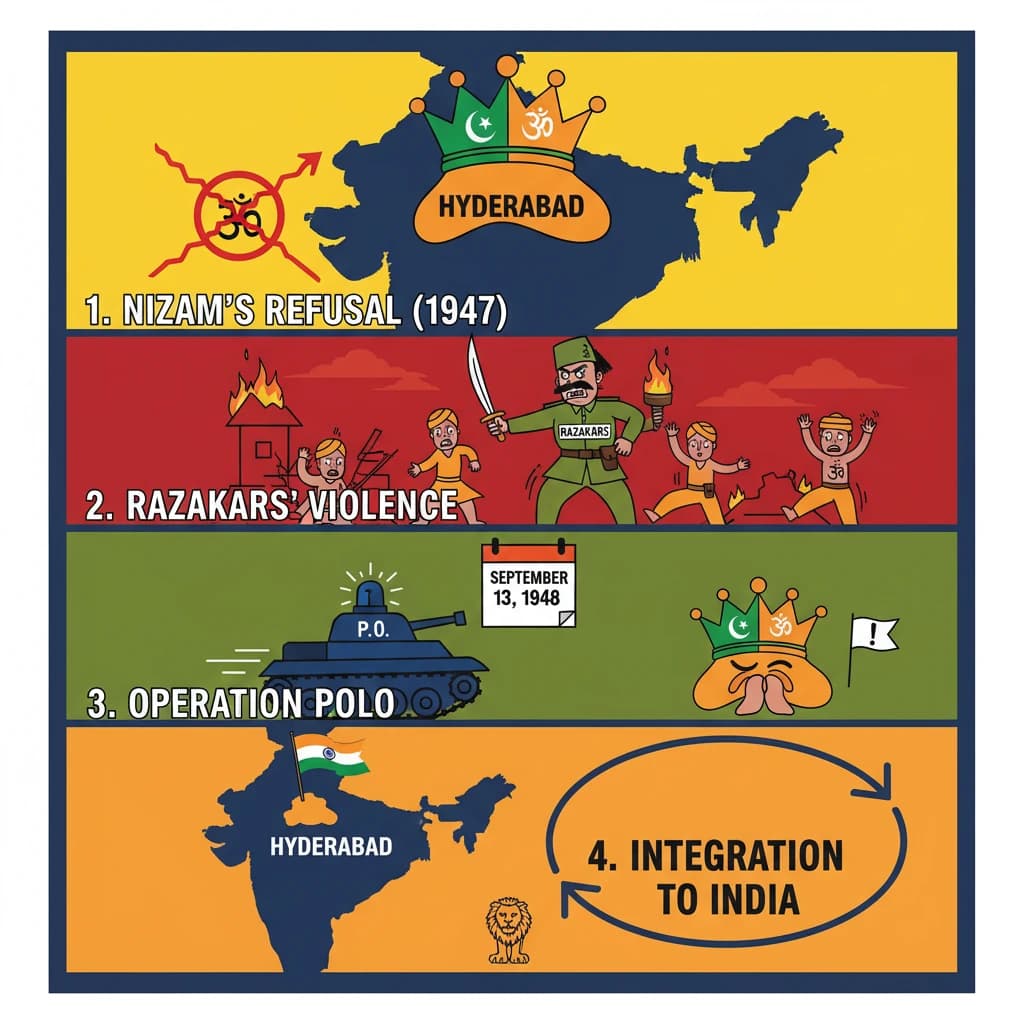
  • India launched 'Operation Polo' (Police Action) on 13th September 1948, integrating Hyderabad after the Nizam's surrender.
  • The accession highlighted India's resolve for national unity and the blend of diplomatic and military strategies.
What are the Key Highlights of the Accession of Hyderabad to India?

What are the Key Highlights of the Accession of Hyderabad to India?

Medium⏱️ 7 min read✓ 95% Verified
history

📖 Introduction

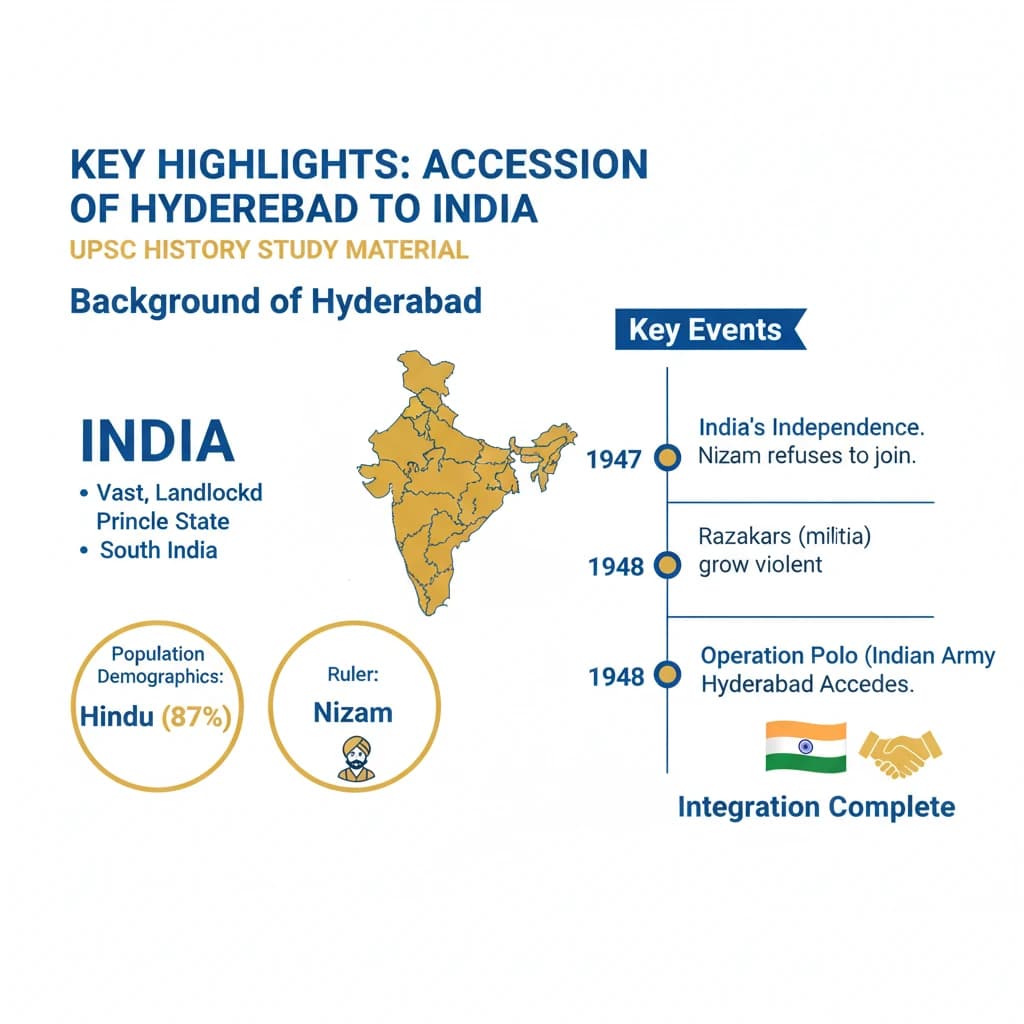
<h4>Background of Hyderabad</h4><p><strong>Hyderabad</strong> was a vast, landlocked <strong>princely state</strong> located in South India. Its territory encompassed parts of present-day <strong>Telangana</strong>, <strong>Andhra Pradesh</strong>, <strong>Karnataka</strong>, and the <strong>Marathwada region of Maharashtra</strong>.</p><div class='info-box'><p><strong>Population Demographics:</strong> The state's population was predominantly <strong>Hindu (87%)</strong>.</p><p><strong>Ruler:</strong> The ruler was <strong>Nizam Osman Ali Khan</strong>, a Muslim, who was supported by a Muslim elite.</p></div><p>The <strong>Nizam</strong> and the <strong>Ittehad-ul-Muslimeen</strong>, a pro-Nizam Muslim political party, advocated for <strong>Hyderabad's independence</strong>. They aimed for Hyderabad to hold a status equal to that of <strong>India</strong> and <strong>Pakistan</strong>.</p><h4>Nizam's Declaration of Independence</h4><p>In <strong>June 1947</strong>, <strong>Nizam Osman Ali Khan</strong> issued a <strong>firman</strong>, a royal decree, formally declaring <strong>Hyderabad's intention to remain independent</strong>. This declaration came after the British transfer of power in India.</p><div class='key-point-box'><p><strong>India's Stance:</strong> India vehemently rejected Hyderabad's claim to independence. Its primary argument was the state's critical <strong>strategic location</strong>, which was deemed vital for India's national security.</p></div><p>To gain time and avoid immediate confrontation, a temporary <strong>Standstill Agreement</strong> was signed. This agreement aimed to maintain the existing status quo between India and Hyderabad. However, despite this, Hyderabad still did not accede to India.</p><h4>Hyderabad's Moves Towards Independence</h4><p>The <strong>Nizam</strong> took several actions that heightened India's suspicions regarding his intentions. He reportedly provided <strong>Rs. 200 million to Pakistan</strong> and stationed a <strong>bomber squadron</strong> there.</p><div class='info-box'><p><strong>Actions by Hyderabad:</strong></p><ul><li>Banned <strong>Indian currency</strong> within the state.</li><li>Imported <strong>arms from Pakistan</strong>.</li><li>Significantly expanded its <strong>military forces</strong>, particularly the notorious <strong>Razakars militia</strong>.</li><li>Hired <strong>Australian aviator Sidney Cotton</strong> to smuggle weapons into Hyderabad.</li></ul></div><h4>Role of the Razakars</h4><p>The <strong>Razakars</strong> were a paramilitary militia closely aligned with the <strong>Ittehad-ul-Muslimeen</strong>, also known as the <strong>All India Council for Unity of Muslims</strong>. They were led by <strong>Qasim Razvi</strong>.</p><div class='key-point-box'><p><strong>Razakars' Objective:</strong> Their primary goal was to protect the <strong>Muslim ruling class</strong> and suppress any uprisings or opposition within Hyderabad.</p></div><p>The <strong>Razakars</strong> were infamous for their <strong>violent suppression of opposition</strong>. They committed numerous atrocities, particularly against the <strong>Hindu population</strong>, which further escalated tensions. They also targeted <strong>Hyderabadi Muslims</strong> who favored integration with India.</p><h4>Political Agitation within Hyderabad</h4><p>Internally, <strong>Hyderabad</strong> faced significant unrest. A widespread <strong>Communist uprising</strong> erupted in the <strong>Telangana region</strong>, which the <strong>Nizam's forces</strong> struggled to quell. This internal revolt severely weakened his position.</p><p>Simultaneously, the <strong>Hyderabad State Congress</strong>, an organization affiliated with the <strong>Indian National Congress</strong>, launched a strong <strong>political agitation</strong>. Their objective was the immediate <strong>integration of Hyderabad with India</strong>.</p><h4>International Appeals by the Nizam</h4><p>The <strong>Nizam</strong> initially sought diplomatic support from the <strong>British government</strong>. When these efforts proved unsuccessful, he attempted to involve international powers, including <strong>US President Harry Truman</strong> and the <strong>United Nations</strong>.</p><div class='exam-tip-box'><p><strong>Diplomatic Failure:</strong> After <strong>Lord Mountbatten's</strong> efforts for a negotiated settlement failed, the <strong>Nizam</strong>, fearing an imminent Indian invasion, appealed to the <strong>UN Security Council</strong> and the <strong>International Court of Justice</strong> in <strong>August 1948</strong>. These international appeals ultimately did not prevent India's action.</p></div><h4>Operation Polo (Hyderabad Police Action)</h4><p><strong>Sardar Patel</strong>, India's Deputy Prime Minister, grew increasingly anxious as negotiations with the <strong>Nizam</strong> dragged on without resolution.</p><p>On <strong>13th September 1948</strong>, the <strong>Indian Army</strong> launched a military operation code-named <strong>“Operation Polo”</strong>. India justified this action by citing grave concerns over internal law and order within Hyderabad, particularly the escalating violence of the Razakars.</p>
Concept Diagram

💡 Key Takeaways

  • •Hyderabad was a large princely state with a Hindu majority ruled by Muslim Nizam Osman Ali Khan.
  • •The Nizam declared independence in 1947, rejecting accession to India due to strategic location concerns.
  • •The Razakars, a pro-Nizam militia, used violence against Hindus and pro-India Muslims, creating internal chaos.
  • •India launched 'Operation Polo' (Police Action) on 13th September 1948, integrating Hyderabad after the Nizam's surrender.
  • •The accession highlighted India's resolve for national unity and the blend of diplomatic and military strategies.

🧠 Memory Techniques
Memory Aid
95% Verified Content

Related Topics

Loading related topics...
Explore:History Topics·All Subjects·Daily Current Affairs·Editorial Analysis·Previous Year Questions·UPSC GPT