Loading page, please wait…
Vaidra Logo
Vaidra

Top 4 items + smart groups

UPSC GPT
New
Current Affairs
Daily Solutions
Daily Puzzle
Mains Evaluator

Version 2.0.0 • Built with ❤️ for UPSC aspirants

Loading...
Loading...
Loading...
Loading...
Loading...
Loading...
Loading...
Loading...
Loading...
Loading...
Loading...
Loading...
Loading...
Back
All Subjects

Topics

0 topics • 0 completed

Loading topics...
Loading...
Loading...
Loading...
Loading...
Loading...
Overall Progress0%
What are Key Facts about the Chola Administration? - UPSC History

What are Key Facts about the Chola Administration? - UPSC History

What is What are Key Facts about the Chola Administration? in UPSC History?

What are Key Facts about the Chola Administration? is a key topic under History for UPSC Civil Services Examination. Key points include: Chola administration was a blend of centralized authority (King & Council) and strong local autonomy.. The empire was divided into Mandalams, Kottams/Valanadus, Nadus, and Urs.. Land revenue (1/6th yield) was the main income, supplemented by various other taxes.. Understanding this topic is essential for both UPSC Prelims and Mains preparation.

Why is What are Key Facts about the Chola Administration? important for UPSC exam?

What are Key Facts about the Chola Administration? is a Medium-level topic in UPSC History. It is tested in both Prelims (factual MCQs) and Mains (analytical answer writing). Previous year UPSC questions have frequently covered aspects of What are Key Facts about the Chola Administration?, making it essential for comprehensive IAS preparation.

How to prepare What are Key Facts about the Chola Administration? for UPSC?

To prepare What are Key Facts about the Chola Administration? for UPSC: (1) Study the comprehensive notes covering all key concepts on Vaidra. (2) Practice previous year questions on this topic. (3) Connect it with current affairs using daily updates. (4) Revise using key takeaways and mind maps available for History. (5) Write practice answers linking What are Key Facts about the Chola Administration? to related GS Paper topics.

Key takeaways of What are Key Facts about the Chola Administration? for UPSC

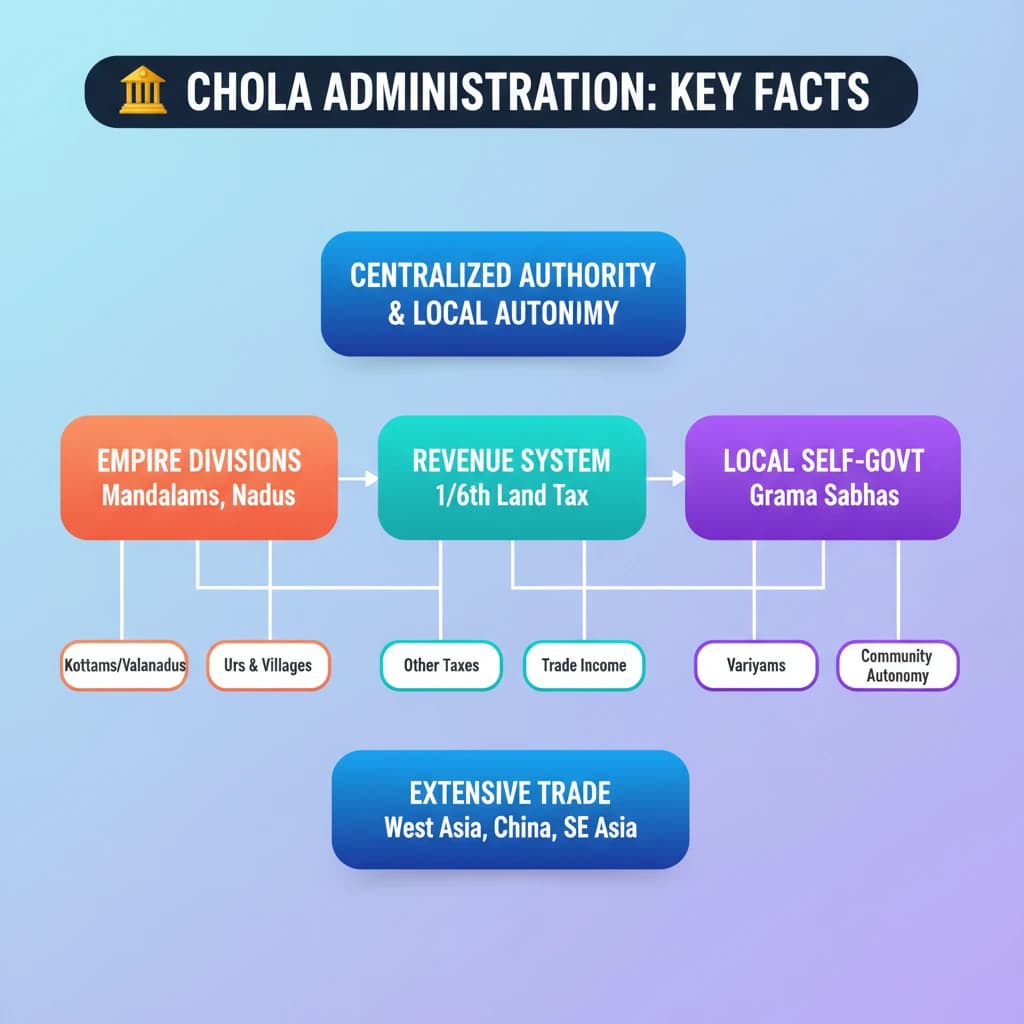
  • Chola administration was a blend of centralized authority (King & Council) and strong local autonomy.
  • The empire was divided into Mandalams, Kottams/Valanadus, Nadus, and Urs.
  • Land revenue (1/6th yield) was the main income, supplemented by various other taxes.
  • Local self-governance, through Grama Sabhas and Variyams, was the most distinctive feature.
  • Cholas fostered extensive local (nanadesis, nagaram) and maritime trade (West Asia, China, SE Asia).
  • The Brihadisvara Temple, built by Rajaraja I, exemplifies pure Dravidian architecture and Chola artistic achievements.
What are Key Facts about the Chola Administration?

What are Key Facts about the Chola Administration?

Medium⏱️ 8 min read✓ 95% Verified
history

📖 Introduction

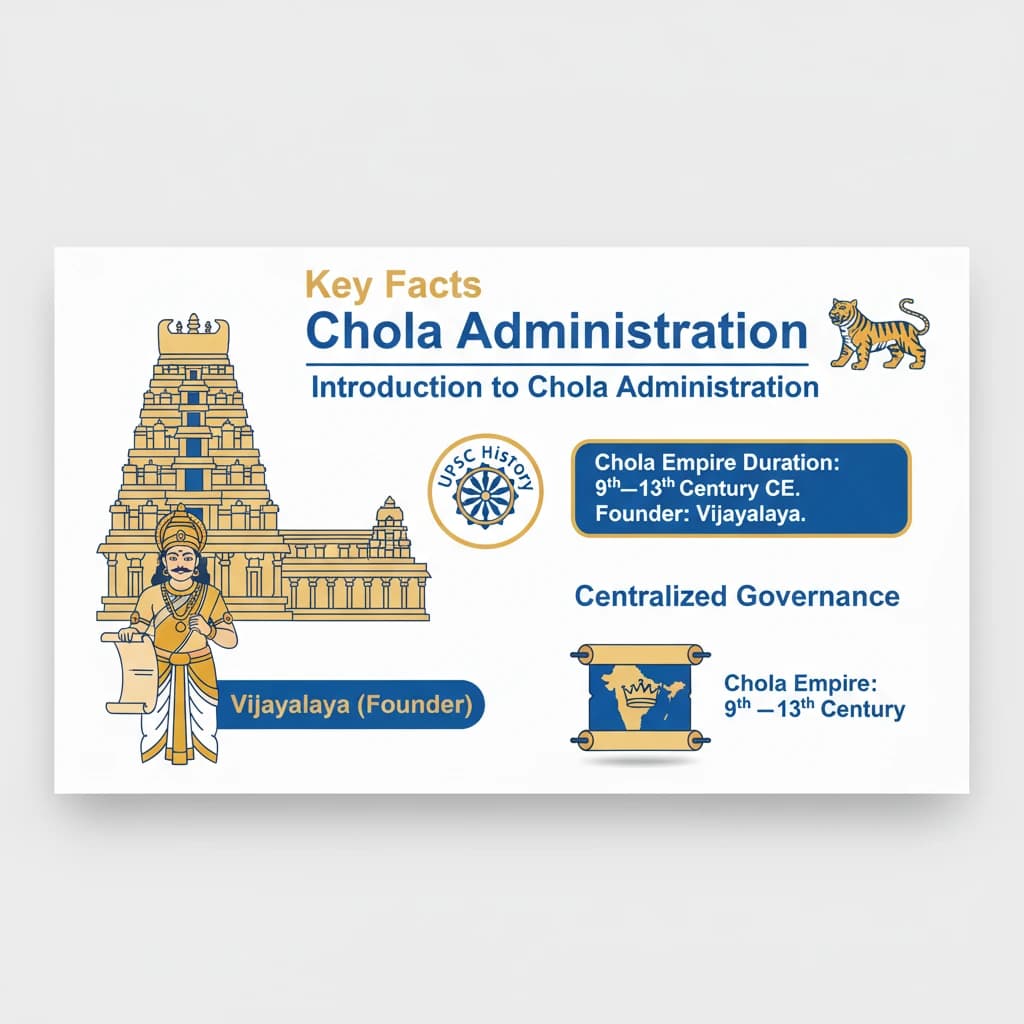
<h4>Introduction to Chola Administration</h4><p>The <strong>Chola Empire</strong>, founded by <strong>Vijayalaya</strong>, rose to prominence by defeating the <strong>Pallavas</strong>. Their reign spanned over five centuries, from the <strong>9th to the 13th Century</strong>, establishing a powerful and enduring administrative system.</p><div class='info-box'><strong>Chola Empire Duration:</strong> 9th–13th Century CE. <strong>Founder:</strong> Vijayalaya.</div><h4>Centralized Governance</h4><p>At the apex of the <strong>Chola administrative structure</strong> was the <strong>King</strong>, whose extensive powers were carefully balanced by a <strong>council of ministers</strong>. The <strong>Central Government</strong> comprised a structured council with two main categories of officials.</p><div class='info-box'><strong>Higher Officials:</strong> Known as <strong>Peruntaram</strong>. <strong>Lower Officials:</strong> Known as <strong>Siruntaram</strong>.</div><h4>Provincial Administration</h4><p>The vast <strong>Chola Empire</strong> was systematically divided into <strong>nine provinces</strong>, each known as a <strong>Mandalam</strong>. These <strong>Mandalams</strong> were further subdivided into smaller units called <strong>Kottams</strong> or <strong>Valanadus</strong>.</p><div class='info-box'>Further Subdivisions: <strong>Nadus</strong> (districts) and then <strong>Urs</strong> (villages). This hierarchical structure ensured efficient governance.</div><h4>Revenue System</h4><p>The primary source of income for the <strong>Chola administration</strong> was <strong>land revenue</strong>. A general rate of <strong>1/6th of the land yield</strong> was collected as tax. This could be paid in <strong>cash, kind, or a combination of both</strong>.</p><div class='info-box'>Other Taxes: <strong>Customs, tolls, mines, ports, forests, salt pans, professional taxes, and house taxes</strong> were also levied.</div><h4>Local Administration: A Distinctive Feature</h4><p>The most remarkable aspect of <strong>Chola administration</strong> was its highly developed <strong>local governance system</strong>. This system granted substantial autonomy to local units, particularly the <strong>Nadus</strong> and <strong>Villages</strong>.</p><div class='key-point-box'>The <strong>Nadu</strong> was a crucial administrative unit, possessing its own assembly and headed by the <strong>Nattar</strong>. The council of <strong>Nattars</strong> was known as the <strong>Nattavai</strong>.</div><p>At the village level, the <strong>Grama Sabha</strong> played a vital role, responsible for maintaining public infrastructure and regulating markets. Village assemblies were supported by various <strong>Variyams</strong> (committees), each tasked with specific administrative duties.</p><h4>Trade under the Chola Dynasty</h4><p><strong>Local Trade:</strong> The <strong>Chola Empire</strong> experienced significant growth in internal trade, facilitated by robust <strong>mercantile corporations</strong> and organized <strong>guilds</strong>. These powerful and autonomous merchant guilds were often referred to as <strong>“nanadesis”</strong>.</p><div class='info-box'>In major trade centers like <strong>Kanchipuram</strong> and <strong>Mamallapuram</strong>, local merchant organizations called <strong>“nagaram”</strong> coordinated trade and market activities.</div><p><strong>Maritime Trade:</strong> The <strong>Chola dynasty</strong> established extensive trade relations with regions including <strong>West Asia, China, and Southeast Asia</strong>. They actively engaged in the lucrative trade of valuable commodities such as <strong>spices, precious stones, and textiles</strong>, which were highly sought after across Asia.</p><h4>The Brihadisvara Temple: A Chola Architectural Marvel</h4><p>The iconic <strong>Brihadisvara Temple</strong> was constructed by <strong>Rajaraja I</strong>. It was inaugurated in his <strong>19th regnal year (1003-1004 CE)</strong> and consecrated in his <strong>25th year (1009-1010 CE)</strong>.</p><div class='key-point-box'>The temple stands as a prime example of the pure form of <strong>Dravidian temple design</strong>.</div><h4>Architectural Features of Brihadisvara Temple</h4><p><strong>Design:</strong> The temple features a massive <strong>colonnaded prakara</strong> (enclosure) adorned with sub-shrines dedicated to the <strong>eight guardian deities (ashtadikpalas)</strong>. <strong>Gopuram:</strong> Its grand gateway is known as <strong>Rajarajan tiruvasal</strong>, serving as an impressive entrance to the complex. <strong>Circumambulatory Path:</strong> A dedicated pathway encircles the sanctum, allowing devotees to perform <strong>pradakshina</strong> (circumambulation) around the sacred <strong>shivlinga</strong>.</p><h4>Artistic Elements of Brihadisvara Temple</h4><p><strong>Mural Paintings:</strong> The temple walls are richly decorated with expansive and exquisite <strong>mural paintings</strong>. These murals include <strong>81 of the 108 Karanas</strong> (dance poses) from <strong>Bharatanatyam</strong>.</p><div class='info-box'>A notable mural depicts <strong>Raja Raja I</strong> and his guru <strong>Karuvurarur</strong>, found within the temple in <strong>Tamil Nadu</strong>.</div><p><strong>Inscriptions:</strong> The temple contains numerous <strong>inscriptions</strong> detailing <strong>Rajaraja Chola I's military achievements, temple grants, and administrative orders</strong>.</p>
Concept Diagram

💡 Key Takeaways

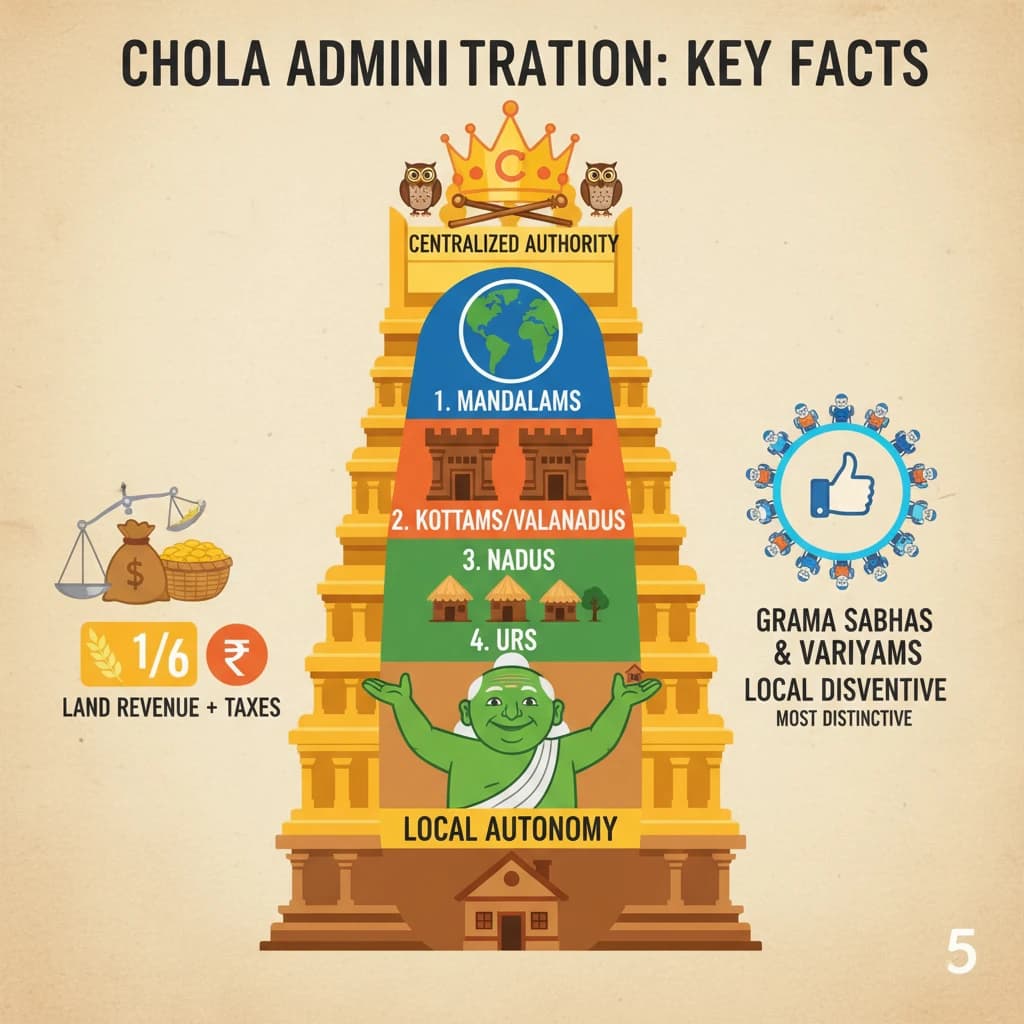
  • •Chola administration was a blend of centralized authority (King & Council) and strong local autonomy.
  • •The empire was divided into Mandalams, Kottams/Valanadus, Nadus, and Urs.
  • •Land revenue (1/6th yield) was the main income, supplemented by various other taxes.
  • •Local self-governance, through Grama Sabhas and Variyams, was the most distinctive feature.
  • •Cholas fostered extensive local (nanadesis, nagaram) and maritime trade (West Asia, China, SE Asia).
  • •The Brihadisvara Temple, built by Rajaraja I, exemplifies pure Dravidian architecture and Chola artistic achievements.

🧠 Memory Techniques
Memory Aid
95% Verified Content

📚 Reference Sources

•NCERT History Textbooks (Class XI/XII)
•Standard reference books on Ancient and Medieval Indian History

Related Topics

Loading related topics...
Explore:History Topics·All Subjects·Daily Current Affairs·Editorial Analysis·Previous Year Questions·UPSC GPT