Loading page, please wait…
Vaidra Logo
Vaidra

Top 4 items + smart groups

UPSC GPT
New
Current Affairs
Daily Solutions
Daily Puzzle
Mains Evaluator

Version 2.0.0 • Built with ❤️ for UPSC aspirants

Loading...
Loading...
Loading...
Loading...
Loading...
Loading...
Loading...
Loading...
Loading...
Loading...
Loading...
Loading...
Loading...

100 Years of Vaikom Satyagraha - UPSC History

What is 100 Years of Vaikom Satyagraha in UPSC History?

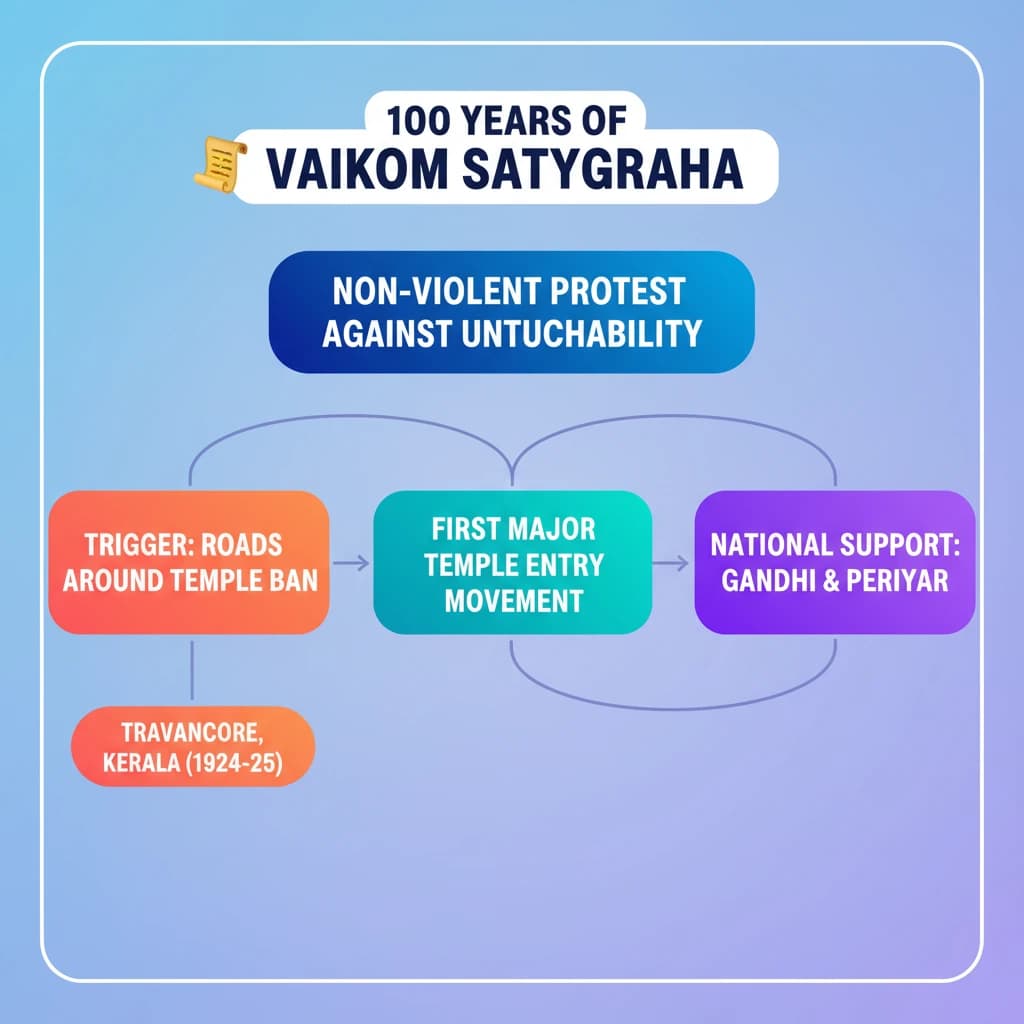
100 Years of Vaikom Satyagraha is a key topic under History for UPSC Civil Services Examination. Key points include: Vaikom Satyagraha (1924-1925) was a non-violent protest against untouchability in Travancore, Kerala.. It was triggered by the prohibition of 'lower castes' from using roads around Vaikom Mahadeva temple.. It holds the distinction of being the first major temple entry movement in India.. Understanding this topic is essential for both UPSC Prelims and Mains preparation.

Why is 100 Years of Vaikom Satyagraha important for UPSC exam?

100 Years of Vaikom Satyagraha is a Medium-level topic in UPSC History. It is tested in both Prelims (factual MCQs) and Mains (analytical answer writing). Previous year UPSC questions have frequently covered aspects of 100 Years of Vaikom Satyagraha, making it essential for comprehensive IAS preparation.

How to prepare 100 Years of Vaikom Satyagraha for UPSC?

To prepare 100 Years of Vaikom Satyagraha for UPSC: (1) Study the comprehensive notes covering all key concepts on Vaidra. (2) Practice previous year questions on this topic. (3) Connect it with current affairs using daily updates. (4) Revise using key takeaways and mind maps available for History. (5) Write practice answers linking 100 Years of Vaikom Satyagraha to related GS Paper topics.

Key takeaways of 100 Years of Vaikom Satyagraha for UPSC

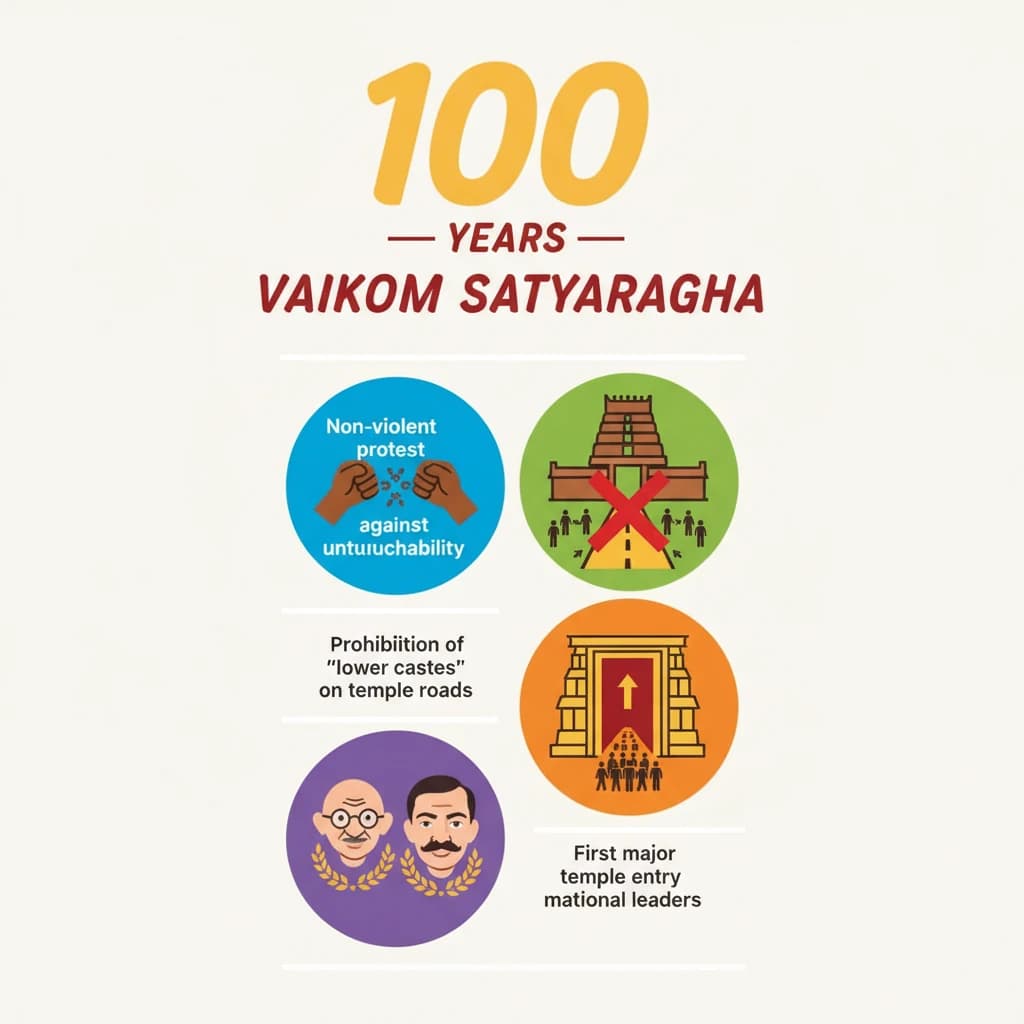
  • Vaikom Satyagraha (1924-1925) was a non-violent protest against untouchability in Travancore, Kerala.
  • It was triggered by the prohibition of 'lower castes' from using roads around Vaikom Mahadeva temple.
  • It holds the distinction of being the first major temple entry movement in India.
  • The movement received support from national leaders like Mahatma Gandhi and Periyar E.V. Ramasamy.
  • It significantly influenced subsequent social reform and temple entry movements across India.
  • Its centenary highlights the ongoing relevance of fighting caste discrimination and upholding social justice.
100 Years of Vaikom Satyagraha

100 Years of Vaikom Satyagraha

Medium⏱️ 8 min read✓ 98% Verified
history

📖 Introduction

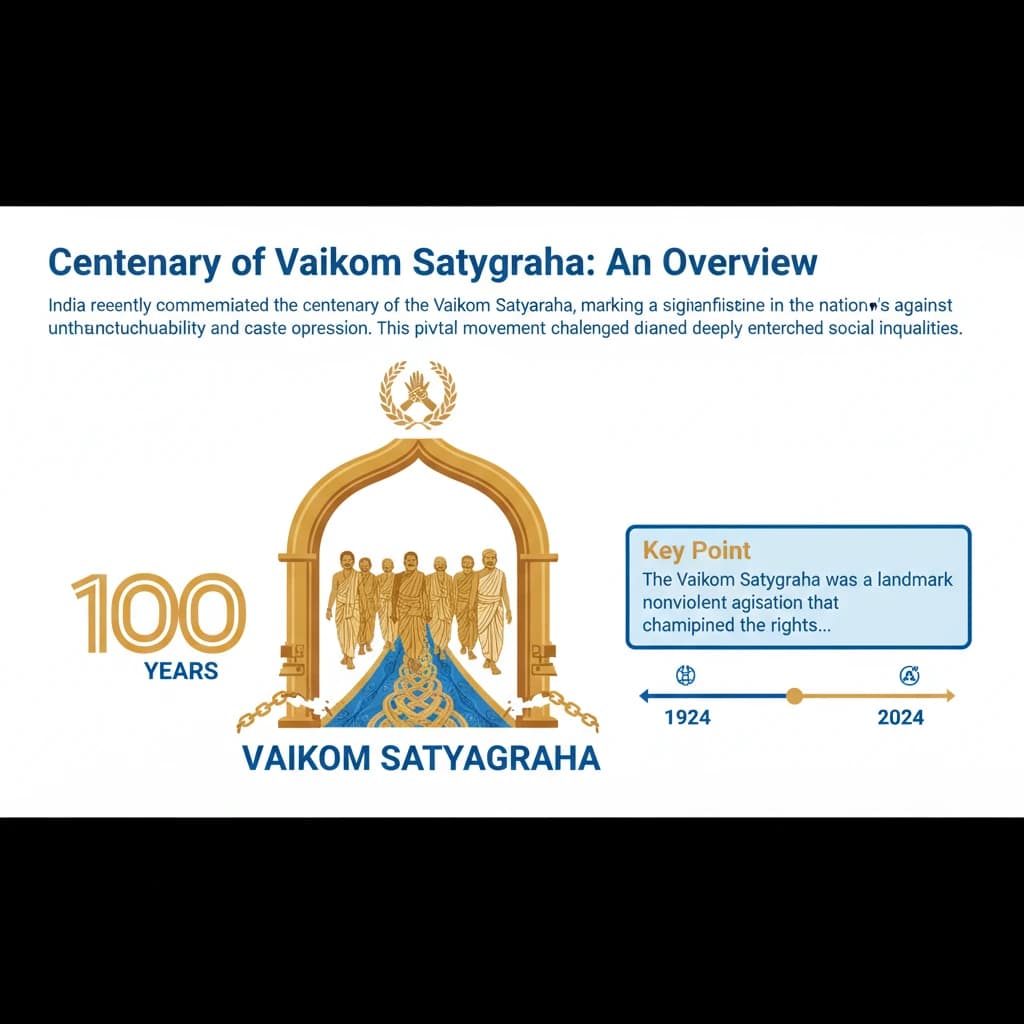
<h4>Centenary of Vaikom Satyagraha: An Overview</h4><p>India recently commemorated the <strong>centenary</strong> of the <strong>Vaikom Satyagraha</strong>, marking a significant milestone in the nation's struggle against <strong>untouchability</strong> and <strong>caste oppression</strong>. This pivotal movement challenged deeply entrenched social inequalities.</p><div class='key-point-box'><p>The <strong>Vaikom Satyagraha</strong> was a landmark nonviolent agitation that championed the rights of oppressed communities to access public spaces, particularly roads around temples.</p></div><h4>Background and Duration of the Movement</h4><p>The <strong>Vaikom Satyagraha</strong> unfolded in <strong>Vaikom</strong>, a town within the erstwhile <strong>princely state of Travancore</strong>, located in present-day <strong>Kerala</strong>. It spanned precisely a century ago, from <strong>30th March 1924</strong> to <strong>23rd November 1925</strong>.</p><div class='info-box'><p><strong>Location:</strong> Vaikom, Travancore (modern-day Kerala)<strong>Dates:</strong> 30th March 1924 – 23rd November 1925</p></div><p>This movement represented a formidable protest against the widespread practices of <strong>untouchability</strong> and severe <strong>caste discrimination</strong> that had long afflicted Indian society.</p><h4>Core Issues and Triggers</h4><p>The primary catalyst for the movement was the strict prohibition of people from <strong>oppressed classes</strong>, notably the <strong>Ezhavas</strong>, from using the public roads surrounding the sacred <strong>Vaikom Mahadeva temple</strong>. These roads were considered 'sacred' and restricted to 'upper castes'.</p><p>Initial attempts were made to negotiate with the authorities, including the <strong>Maharani Regent of Travancore</strong>, to secure the opening of these temple roads for all sections of society.</p><h4>Key Significance and Impact</h4><p>The <strong>Vaikom Satyagraha</strong> holds the distinction of being the <strong>first among the temple entry movements</strong> in India. Its success and methodology subsequently inspired and paved the way for similar social reform movements across various parts of the country.</p><div class='exam-tip-box'><p>The <strong>Vaikom Satyagraha</strong> is crucial for UPSC as it exemplifies early non-violent social reform and the intersection of social and political awakening. It's a key topic for <strong>GS Paper I: History</strong> and <strong>Social Issues</strong>.</p></div><h4>Interplay with Nationalist Movement</h4><p>The movement emerged at a time of a burgeoning <strong>nationalist movement</strong> in India. It effectively aimed to foreground the importance of <strong>social reform</strong> alongside the broader political aspirations for independence.</p><p>This dual focus highlighted that true national liberation required not just political freedom but also the eradication of deep-seated social injustices like untouchability.</p>
Concept Diagram

💡 Key Takeaways

  • •Vaikom Satyagraha (1924-1925) was a non-violent protest against untouchability in Travancore, Kerala.
  • •It was triggered by the prohibition of 'lower castes' from using roads around Vaikom Mahadeva temple.
  • •It holds the distinction of being the first major temple entry movement in India.
  • •The movement received support from national leaders like Mahatma Gandhi and Periyar E.V. Ramasamy.
  • •It significantly influenced subsequent social reform and temple entry movements across India.
  • •Its centenary highlights the ongoing relevance of fighting caste discrimination and upholding social justice.

🧠 Memory Techniques
Memory Aid
98% Verified Content

📚 Reference Sources

•NCERT History Textbooks (relevant chapters on Social Reform Movements)
•Standard reference books on Modern Indian History (e.g., Bipan Chandra, Spectrum)

Related Topics

Loading related topics...
Explore:History Topics·All Subjects·Daily Current Affairs·Editorial Analysis·Previous Year Questions·UPSC GPT
Back
All Subjects

Topics

0 topics • 0 completed

Loading topics...
Loading...
Loading...
Loading...
Loading...
Loading...
Overall Progress0%
100 Years of Vaikom Satyagraha - UPSC History