Loading page, please wait…
Vaidra Logo
Vaidra

Top 4 items + smart groups

UPSC GPT
New
Current Affairs
Daily Solutions
Daily Puzzle
Mains Evaluator

Version 2.0.0 • Built with ❤️ for UPSC aspirants

Loading...
Loading...
Loading...
Loading...
Loading...
Loading...
Loading...
Loading...
Loading...
Loading...
Loading...
Loading...
Loading...

What are the Contributions of Pt. Jawaharlal Nehru? - UPSC History

What is What are the Contributions of Pt. Jawaharlal Nehru? in UPSC History?

What are the Contributions of Pt. Jawaharlal Nehru? is a key topic under History for UPSC Civil Services Examination. Key points include: Nehru was a key figure in both India's independence struggle and its post-1947 nation-building.. His vision established India as a modern, democratic, secular, and scientifically-oriented state.. Major social reforms include the Hindu Code Bill, advancing women's rights.. Understanding this topic is essential for both UPSC Prelims and Mains preparation.

Why is What are the Contributions of Pt. Jawaharlal Nehru? important for UPSC exam?

What are the Contributions of Pt. Jawaharlal Nehru? is a Medium-level topic in UPSC History. It is tested in both Prelims (factual MCQs) and Mains (analytical answer writing). Previous year UPSC questions have frequently covered aspects of What are the Contributions of Pt. Jawaharlal Nehru?, making it essential for comprehensive IAS preparation.

How to prepare What are the Contributions of Pt. Jawaharlal Nehru? for UPSC?

To prepare What are the Contributions of Pt. Jawaharlal Nehru? for UPSC: (1) Study the comprehensive notes covering all key concepts on Vaidra. (2) Practice previous year questions on this topic. (3) Connect it with current affairs using daily updates. (4) Revise using key takeaways and mind maps available for History. (5) Write practice answers linking What are the Contributions of Pt. Jawaharlal Nehru? to related GS Paper topics.

Key takeaways of What are the Contributions of Pt. Jawaharlal Nehru? for UPSC

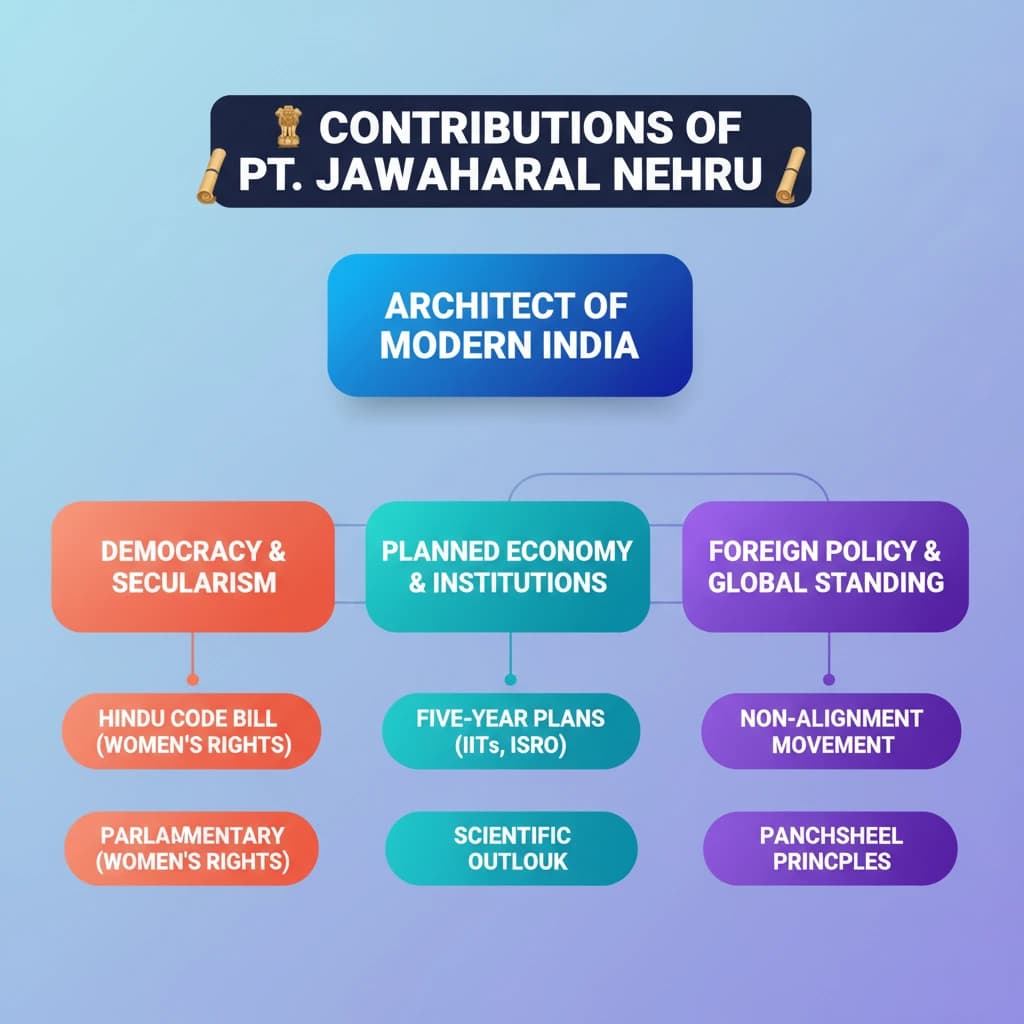
  • Nehru was a key figure in both India's independence struggle and its post-1947 nation-building.
  • His vision established India as a modern, democratic, secular, and scientifically-oriented state.
  • Major social reforms include the Hindu Code Bill, advancing women's rights.
  • He championed planned economic development through Five-Year Plans and established premier institutions like IITs and ISRO.
  • His foreign policy of Non-Alignment and Panchsheel shaped India's global standing during the Cold War.
What are the Contributions of Pt. Jawaharlal Nehru?

What are the Contributions of Pt. Jawaharlal Nehru?

Medium⏱️ 8 min read✓ 95% Verified
history

📖 Introduction

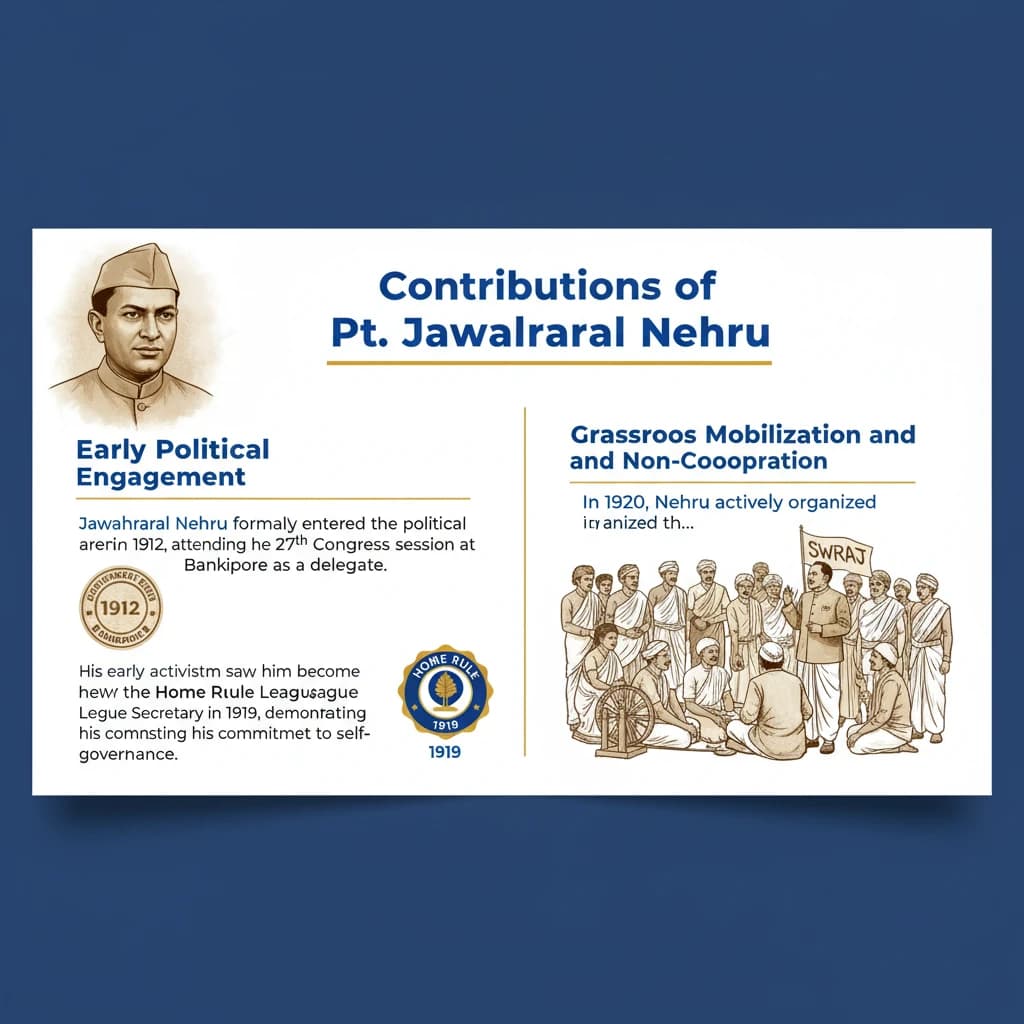
<h4>Early Political Engagement</h4><p><strong>Jawaharlal Nehru</strong> formally entered the political arena in <strong>1912</strong>, attending the <strong>27th Congress session</strong> at <strong>Bankipore</strong> as a delegate.</p><p>His early activism saw him become the <strong>Home Rule League Secretary</strong> in <strong>1919</strong>, demonstrating his commitment to self-governance.</p><h4>Grassroots Mobilization and Non-Cooperation</h4><p>In <strong>1920</strong>, Nehru actively organized the first <strong>Kisan March</strong> in <strong>Pratapgarh, Uttar Pradesh</strong>, highlighting agrarian issues.</p><p>He faced imprisonment twice during the significant <strong>Non-Cooperation Movement (1920-22)</strong>, showcasing his dedication to the national cause.</p><h4>Rising through Congress Ranks</h4><p>His organizational skills led to his appointment as <strong>General Secretary</strong> of the <strong>All India Congress Committee (AICC)</strong> in <strong>1923</strong>.</p><p>In <strong>1928</strong>, Nehru strongly advocated for complete independence at the <strong>Madras Congress</strong>, pushing the party's agenda forward.</p><h4>Protests and Constitutional Efforts</h4><p>He bravely led a procession against the <strong>Simon Commission</strong> in <strong>Lucknow</strong> in <strong>1928</strong>, enduring a lathi-charge.</p><div class='info-box'><p>In <strong>1928</strong>, Nehru played a crucial role in the <strong>Nehru Report</strong>, a proposal for constitutional reforms drafted by his father, <strong>Motilal Nehru</strong>.</p></div><p>To further the cause of full independence, he established the <strong>Independence for India League</strong> in <strong>1928</strong>.</p><h4>Purna Swaraj and Quit India</h4><p>The pivotal <strong>Lahore Congress of 1929</strong> saw <strong>Nehru elected President</strong>, where the Congress officially adopted <strong>complete independence</strong> as its goal, known as the <strong>Purna Swaraj Resolution</strong>.</p><div class='key-point-box'><p>On <strong>August 7, 1942</strong>, <strong>Nehru moved the historic Quit India Resolution</strong> at the <strong>AICC session in Bombay</strong>, marking a decisive phase in the freedom struggle.</p></div><h4>Vision for Modern India as PM</h4><p>As <strong>India’s first Prime Minister (1947–1964)</strong>, <strong>Nehru</strong> was instrumental in establishing a <strong>modern democratic state</strong>.</p><p>He championed <strong>secularism</strong>, promoted <strong>scientific advancement</strong>, and laid the groundwork for India's <strong>industrialization</strong>.</p><h4>Social Reforms: Hindu Code Bill</h4><p>A cornerstone of his social reform agenda was the <strong>Hindu Code Bill</strong>, aiming to replace religious laws with a <strong>secular civil code</strong>.</p><div class='info-box'><p>Key provisions of the <strong>Hindu Code Bill</strong> included outlawing <strong>polygamy</strong>, granting women <strong>property and divorce rights</strong>, amending <strong>inheritance laws</strong>, and introducing provisions for <strong>inter-caste marriage</strong>.</p></div><h4>Tribal Welfare: Panchsheel</h4><p><strong>Jawaharlal Nehru’s Tribal Panchsheel</strong> outlined a policy for tribal development based on respect and self-governance.</p><ul><li><strong>Self-development</strong> and respect for <strong>tribal rights</strong>.</li><li>Minimal external imposition and local participation in administration.</li><li>Focus on <strong>human-centred outcomes</strong> over financial metrics.</li></ul><h4>Economic Development and Institutions</h4><p>Nehru established vital institutions crucial for India's progress, emphasizing a planned economy.</p><div class='info-box'><p>Key institutions founded include the <strong>Indian Institutes of Technology (IITs)</strong>, the <strong>Indian Institutes of Management (IIMs)</strong>, and the <strong>Indian Space Research Organisation (ISRO)</strong>.</p></div><p>He spearheaded <strong>industrialization</strong> through <strong>Five-Year Plans</strong>, aiming for national <strong>self-sufficiency</strong>.</p><p>He also promoted a <strong>scientific temperament</strong> to combat religious obscurantism, continuing the legacy of reformers like <strong>Raja Ram Mohan Roy</strong>.</p><h4>Institutionalization of Democracy</h4><p>Nehru’s <strong>‘Objective Resolution’</strong> played a guiding role for the <strong>Constituent Assembly</strong> in drafting the <strong>Constitution</strong>.</p><p>It significantly shaped the <strong>Preamble</strong> and the fundamental philosophy of the <strong>Constitution of India</strong>.</p><h4>Foreign Policy of Non-Alignment</h4><p>India's <strong>non-alignment policy</strong>, championed by Nehru, aimed to maintain neutrality during the <strong>Cold War</strong>.</p><div class='key-point-box'><p>He was pivotal in forming the <strong>Non-Aligned Movement (NAM)</strong>, advocating for global peace at conferences like <strong>Bandung (1955)</strong> and <strong>Belgrade (1961)</strong>.</p></div><p>The <strong>Panchsheel Principle</strong>, or the <strong>Five Principles of Peaceful Coexistence</strong>, were partly formulated by India and China in the <strong>1950s</strong>.</p><ul><li><strong>Mutual Respect</strong> for Each other’s <strong>Territorial Integrity and Sovereignty</strong>.</li><li><strong>Mutual Non-Aggression</strong>.</li></ul>
Concept Diagram

💡 Key Takeaways

  • •Nehru was a key figure in both India's independence struggle and its post-1947 nation-building.
  • •His vision established India as a modern, democratic, secular, and scientifically-oriented state.
  • •Major social reforms include the Hindu Code Bill, advancing women's rights.
  • •He championed planned economic development through Five-Year Plans and established premier institutions like IITs and ISRO.
  • •His foreign policy of Non-Alignment and Panchsheel shaped India's global standing during the Cold War.

🧠 Memory Techniques
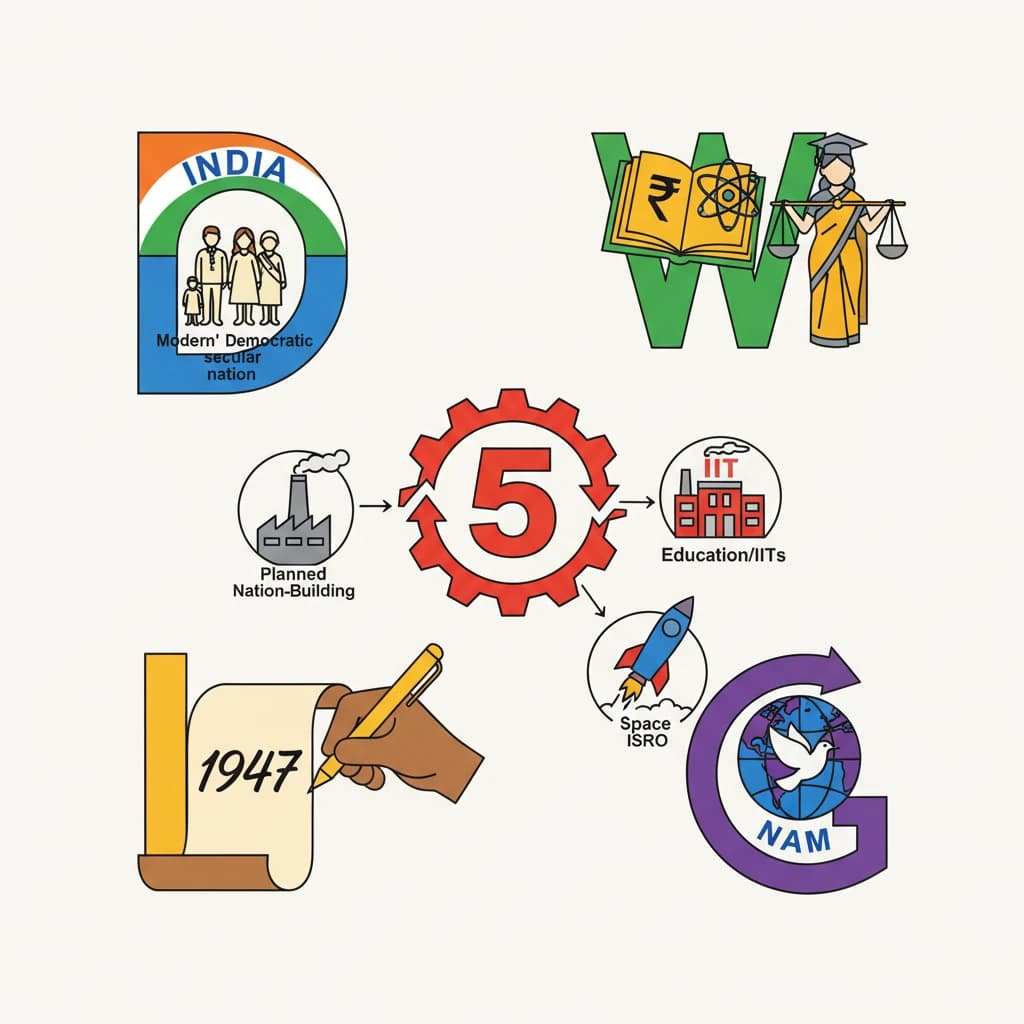
Memory Aid
95% Verified Content

Related Topics

Loading related topics...
Explore:History Topics·All Subjects·Daily Current Affairs·Editorial Analysis·Previous Year Questions·UPSC GPT
Back
All Subjects

Topics

0 topics • 0 completed

Loading topics...
Loading...
Loading...
Loading...
Loading...
Loading...
Overall Progress0%
What are the Contributions of Pt. Jawaharlal Nehru? - UPSC History