Loading page, please wait…
Vaidra Logo
Vaidra

Top 4 items + smart groups

UPSC GPT
New
Current Affairs
Daily Solutions
Daily Puzzle
Mains Evaluator

Version 2.0.0 • Built with ❤️ for UPSC aspirants

Loading...
Loading...
Loading...
Loading...
Loading...
Loading...
Loading...
Loading...
Loading...
Loading...
Loading...
Loading...
Loading...
Back
All Subjects

Topics

0 topics • 0 completed

Loading topics...
Loading...
Loading...
Loading...
Loading...
Loading...
Overall Progress0%

Raja Raja I and Chola Administration - UPSC History

What is Raja Raja I and Chola Administration in UPSC History?

Raja Raja I and Chola Administration is a key topic under History for UPSC Civil Services Examination. Key points include: Raja Raja I (Arulmozhi Varman) ruled the Chola empire from 985-1014 CE, marking its imperial zenith.. His reign was characterized by extensive military conquests, including Cheras, Pandyas, Sri Lanka, and parts of Chalukya territory.. He built a powerful Chola Navy, earning the Bay of Bengal the title 'Chola Lake', facilitating overseas expeditions.. Understanding this topic is essential for both UPSC Prelims and Mains preparation.

Why is Raja Raja I and Chola Administration important for UPSC exam?

Raja Raja I and Chola Administration is a Medium-level topic in UPSC History. It is tested in both Prelims (factual MCQs) and Mains (analytical answer writing). Previous year UPSC questions have frequently covered aspects of Raja Raja I and Chola Administration, making it essential for comprehensive IAS preparation.

How to prepare Raja Raja I and Chola Administration for UPSC?

To prepare Raja Raja I and Chola Administration for UPSC: (1) Study the comprehensive notes covering all key concepts on Vaidra. (2) Practice previous year questions on this topic. (3) Connect it with current affairs using daily updates. (4) Revise using key takeaways and mind maps available for History. (5) Write practice answers linking Raja Raja I and Chola Administration to related GS Paper topics.

Key takeaways of Raja Raja I and Chola Administration for UPSC

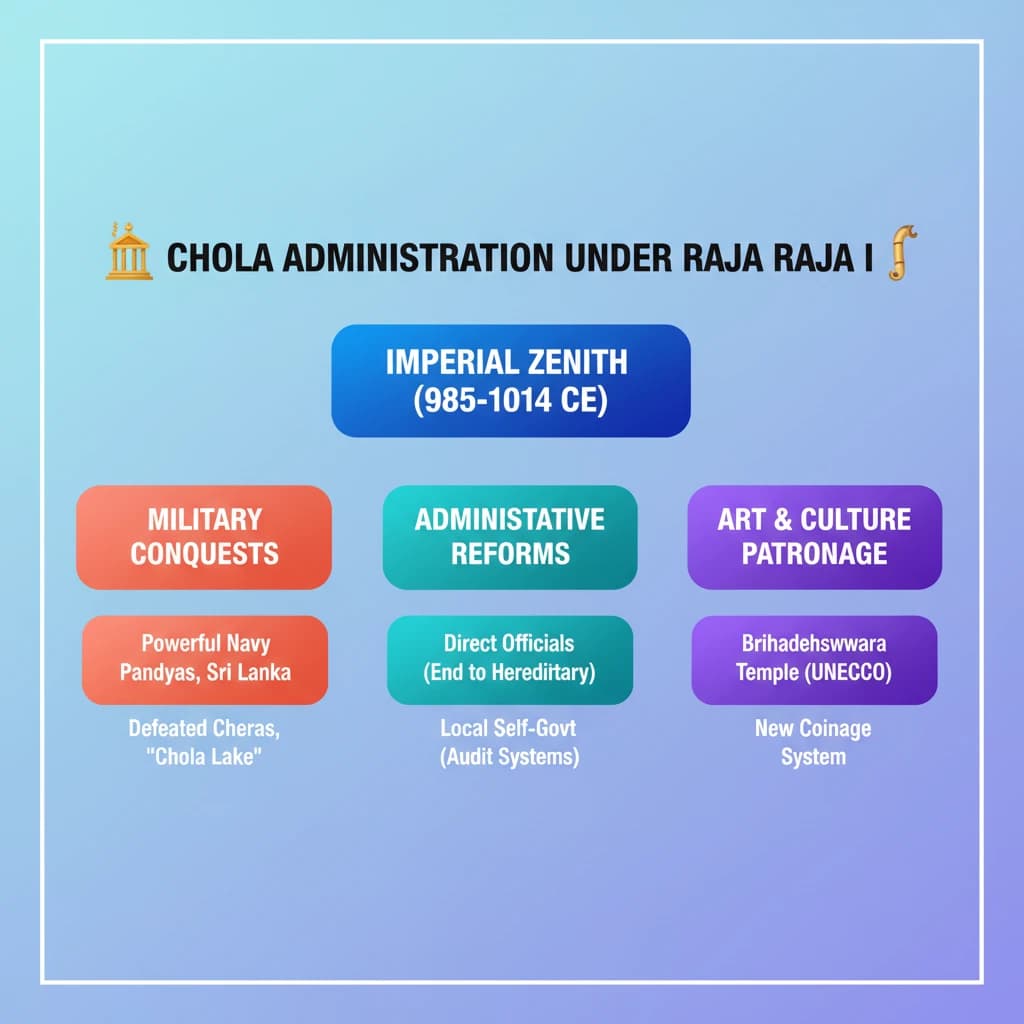
  • Raja Raja I (Arulmozhi Varman) ruled the Chola empire from 985-1014 CE, marking its imperial zenith.
  • His reign was characterized by extensive military conquests, including Cheras, Pandyas, Sri Lanka, and parts of Chalukya territory.
  • He built a powerful Chola Navy, earning the Bay of Bengal the title 'Chola Lake', facilitating overseas expeditions.
  • Key administrative reforms included replacing hereditary lords with direct officials and strengthening local self-government with audit systems.
  • He was a great patron of art and culture, commissioning the iconic Brihadeshwara Temple at Thanjavur (a UNESCO site) and introducing new coinage.
Raja Raja I and Chola Administration

Raja Raja I and Chola Administration

Medium⏱️ 10 min read✓ 95% Verified
history

📖 Introduction

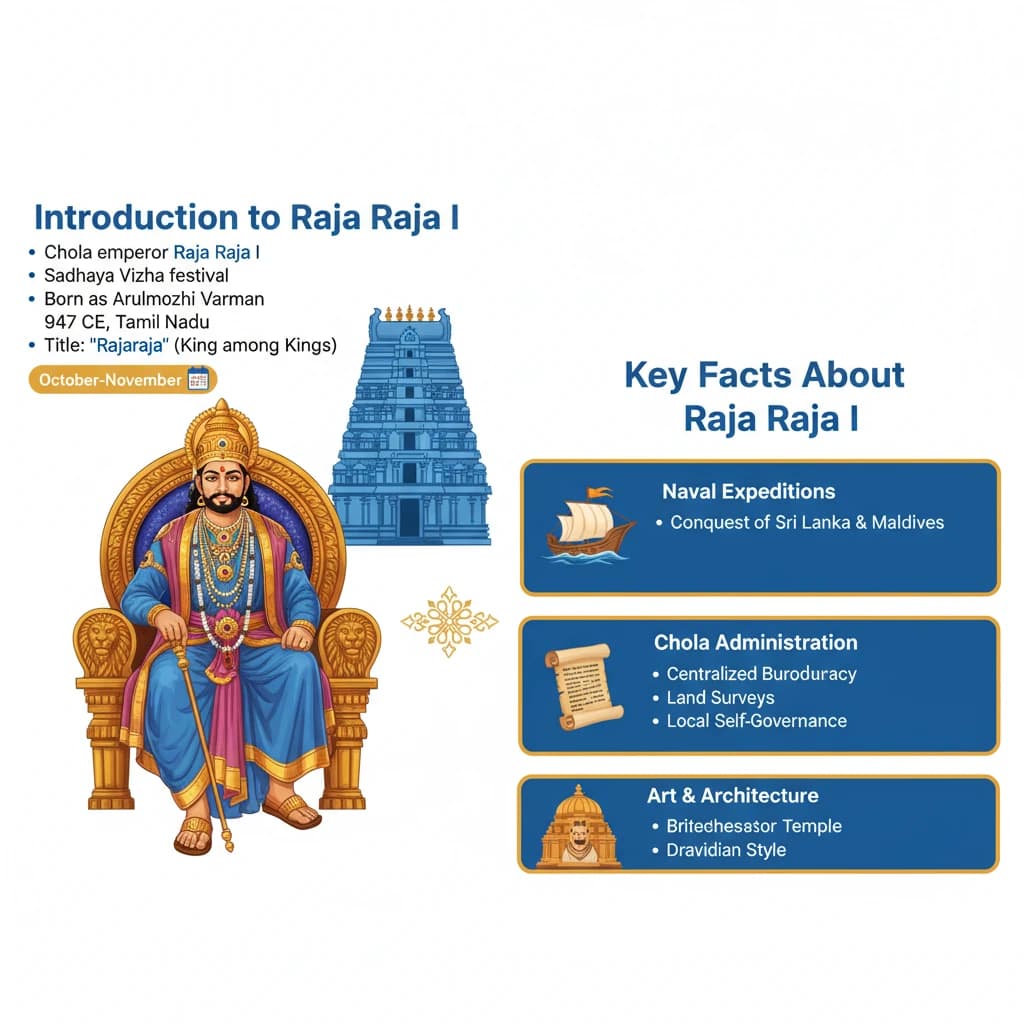
<h4>Introduction to Raja Raja I</h4><p>The birth anniversary of <strong>Chola emperor Raja Raja I</strong> is celebrated during the <strong>Sadhaya Vizha festival</strong>, typically held from mid-October to mid-November, in <strong>Thanjavur, Tamil Nadu</strong>.</p><p>Born as <strong>Arulmozhi Varman</strong> in <strong>947 CE</strong>, he later adopted the significant title <strong>"Rajaraja,"</strong> which translates to "King among Kings."</p><h4>Key Facts About Raja Raja I</h4><div class='info-box'><p><strong>Parentage:</strong> Raja Raja I was the <strong>third child</strong> of <strong>Parantaka Chola II</strong> and <strong>Vanavan Mahadevi</strong>.</p><p><strong>Reign Period:</strong> He ruled the Chola empire from <strong>985 CE to 1014 CE</strong>.</p><p><strong>Succession:</strong> The <strong>Thiruvalangadu inscription</strong> credits his predecessor, <strong>Uttama Chola</strong>, with recognizing his extraordinary potential and appointing him as his successor.</p></div><div class='key-point-box'><p>His reign was characterized by exceptional <strong>military prowess</strong> and a profound <strong>administrative vision</strong>, laying the groundwork for the Chola empire's zenith.</p></div><h4>Notable Military Conquests</h4><ul><li><strong>Battle of Kandalur Salai (988 CE):</strong> This significant <strong>naval battle</strong> against the <strong>Cheras</strong> (located in central and northern Kerala) marked his first major military achievement. It led to the destruction of Chera naval forces and ports.</li><li><strong>Conquest of Kandalur and the Pandyas:</strong> According to the <strong>Senur inscription</strong> (Tamil Nadu), Raja Raja Chola I successfully destroyed the <strong>Pandya capital Madurai</strong> and conquered <strong>Kollam</strong>.</li><li><strong>Titles after Pandya Victory:</strong> After this victory, he adopted the title <strong>"Pandya Kulasani"</strong> (thunderbolt to the Pandyas) and renamed the conquered region as <strong>"Rajaraja Mandalam."</strong> He also took the title <strong>"Mummudi Chola"</strong> (Chola who wears the three crowns) to signify his dominance over the <strong>Cholas, Pandyas, and Cheras</strong>.</li><li><strong>Victory in Sri Lanka (993 CE):</strong> Raja Raja Chola I invaded <strong>Sri Lanka</strong>, capturing its northern half. He established <strong>Jananathamangalam</strong> as the provincial capital there. The full conquest was later completed by his son, <strong>Rajendra Chola I</strong>, in <strong>1017 CE</strong>.</li><li><strong>Conflict with the Chalukyas:</strong> He also defeated the <strong>Chalukyas</strong> in <strong>Karnataka</strong>, annexing crucial regions like <strong>Gangavadi</strong> and <strong>Nolambapadi</strong>.</li><li><strong>Strategic Alliances:</strong> Raja Raja I fostered alliances through strategic marriages, notably his daughter <strong>Kundavai's</strong> union with <strong>Vimaladitya of Vengi</strong>.</li></ul><h4>The Mighty Chola Navy</h4><p><strong>Raja Raja Chola I</strong> significantly strengthened the <strong>Chola navy</strong>, which became so dominant that the <strong>Bay of Bengal</strong> earned the moniker <strong>"Chola Lake."</strong></p><div class='info-box'><p><strong>Main Port:</strong> <strong>Nagapattinam</strong> in Tamil Nadu served as the primary port for the Chola navy.</p><p>This powerful naval force facilitated successful campaigns in <strong>Sri Lanka</strong> and the <strong>Maldives</strong>, extending Chola influence far across the seas.</p></div><h4>Chola Administration under Raja Raja I</h4><div class='key-point-box'><p>Raja Raja I introduced significant administrative reforms, moving towards a more centralized system. He replaced <strong>hereditary lords</strong> with <strong>dependent officials</strong>, exercising direct control over the provinces.</p></div><p>He also greatly strengthened the existing system of <strong>local self-government</strong>, a hallmark of Chola administration.</p><p>A robust system of <strong>audit and control</strong> was installed, ensuring public bodies were constantly monitored and accountable.</p><h4>Art and Culture Patronage</h4><p>Though a dedicated <strong>Shaivite</strong>, Raja Raja Chola I demonstrated religious tolerance by also dedicating several temples to <strong>Lord Vishnu</strong>.</p><div class='info-box'><p><strong>Brihadeshwara Temple:</strong> In <strong>1010 CE</strong>, he commissioned the construction of the magnificent <strong>Brihadeshwara Temple</strong> (also known as <strong>Rajarajeshwaram temple</strong>) at <strong>Thanjavur</strong>. This grand temple is dedicated to <strong>Lord Shiva</strong>.</p><p>It stands as a perfect example of <strong>Dravidian temple architecture</strong> and is part of the <strong>UNESCO World Heritage Site</strong> known as the <strong>"Great Living Chola Temples."</strong></p><p>The other two temples in this UNESCO group are the <strong>Gangaikonda Cholapuram</strong> and <strong>Airavatesvara temple</strong>.</p></div><p>A notable piece of Chola sculpture from this era is the iconic representation of <strong>Nataraja</strong> in the <strong>Tandava dance posture</strong>.</p><div class='exam-tip-box'><p>The <strong>Brihadeshwara Temple</strong> is a crucial topic for <strong>UPSC Prelims and Mains (Art & Culture)</strong>. Understand its architectural features and historical significance.</p></div><h4>Coinage Reforms</h4><p>Raja Raja Chola I introduced new coinage, moving away from the older <strong>tiger-emblem coins</strong>.</p><div class='info-box'><p>His new coins featured a <strong>standing king</strong> on one side and a <strong>seated goddess</strong> on the other.</p><p>These distinctive coins were so influential that they were also copied by the kings of <strong>Sri Lanka</strong>.</p></div>
Concept Diagram

💡 Key Takeaways

  • •Raja Raja I (Arulmozhi Varman) ruled the Chola empire from 985-1014 CE, marking its imperial zenith.
  • •His reign was characterized by extensive military conquests, including Cheras, Pandyas, Sri Lanka, and parts of Chalukya territory.
  • •He built a powerful Chola Navy, earning the Bay of Bengal the title 'Chola Lake', facilitating overseas expeditions.
  • •Key administrative reforms included replacing hereditary lords with direct officials and strengthening local self-government with audit systems.
  • •He was a great patron of art and culture, commissioning the iconic Brihadeshwara Temple at Thanjavur (a UNESCO site) and introducing new coinage.

🧠 Memory Techniques
Memory Aid
95% Verified Content

Related Topics

Loading related topics...
Explore:History Topics·All Subjects·Daily Current Affairs·Editorial Analysis·Previous Year Questions·UPSC GPT
Raja Raja I and Chola Administration - UPSC History