📖 Introduction
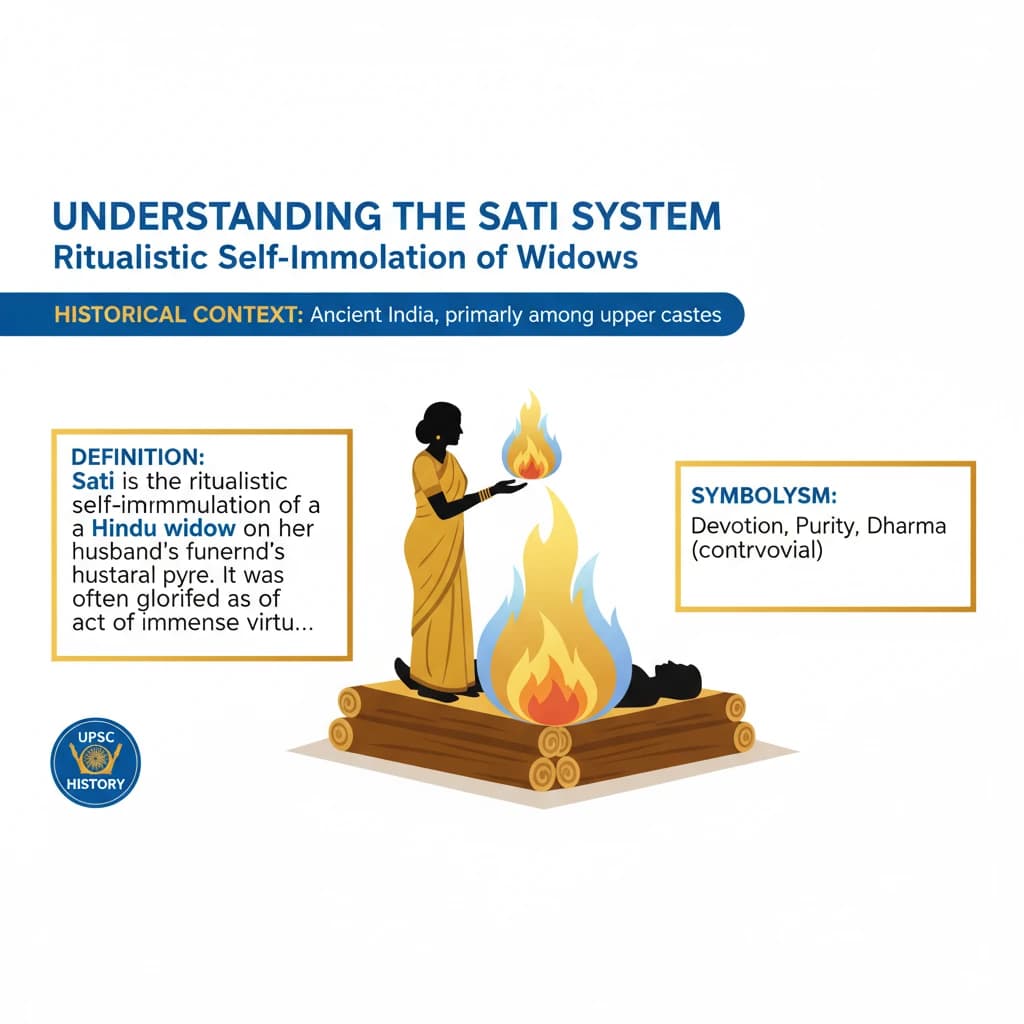
<h4>Understanding the Sati System</h4><p>The term <strong>Sati</strong> refers to an ancient and controversial practice where a <strong>widow immolated herself</strong> on the funeral pyre of her deceased husband. This act was often seen as the ultimate expression of devotion and purity.</p><div class='info-box'><p><strong>Definition:</strong> <strong>Sati</strong> is the ritualistic self-immolation of a Hindu widow on her husband's funeral pyre. It was often glorified as an act of immense virtue.</p></div><p>Following the immolation, a <strong>memorial stone</strong> and sometimes a <strong>shrine</strong> would be erected in her honor. The widow was then worshipped, often revered as a <strong>Goddess</strong>, signifying her sacrifice and perceived spiritual elevation.</p><h4>Early Epigraphical Evidence</h4><p>The earliest known <strong>epigraphical evidence</strong> of the practice of Sati dates back to <strong>510 AD</strong>. This significant historical record provides crucial insight into its ancient prevalence.</p><div class='info-box'><ul><li><strong>Location:</strong> <strong>Eran</strong>, in <strong>Madhya Pradesh</strong>.</li><li><strong>Source:</strong> The <strong>Eran Pillar Inscription</strong> of <strong>Bhanugupta</strong>.</li><li><strong>Date:</strong> <strong>510 AD</strong>.</li></ul></div><p>This inscription serves as a primary source for understanding the historical existence and recognition of Sati in early Indian society.</p><h4>Abolition Efforts: Mughal Empire</h4><p>The <strong>Mughal Empire</strong> initiated significant steps towards curbing the practice of Sati. <strong>Emperor Akbar</strong>, known for his progressive policies, took a strong stance against forced immolation.</p><div class='info-box'><p><strong>Akbar's Decree (1582):</strong> Emperor <strong>Akbar</strong> issued an order to his officials across the empire to actively <strong>stop the immolation of any woman</strong> if they perceived she was being forced into the act.</p></div><p>Beyond intervention, <strong>Akbar</strong> also implemented welfare measures. He offered <strong>pension, gifts, and rehabilitation</strong> to widows to discourage them from performing Sati, promoting alternative paths for their lives.</p><h4>Abolition Efforts: Sikh and Maratha Empires</h4><p>Other Indian empires also condemned and acted against Sati. The <strong>Sikh Empire</strong>, through its religious leaders, voiced strong opposition to the practice.</p><div class='info-box'><p><strong>Sikh Guru Amar Das:</strong> During the <strong>15th-16th centuries</strong>, <strong>Guru Amar Das</strong>, the third Sikh Guru, explicitly condemned the practice of Sati, aligning with Sikhism's principles of equality and compassion.</p></div><p>Similarly, the <strong>Maratha Empire</strong> took direct legislative action within its territories. The <strong>Marathas banned Sati</strong> in the regions under their control, demonstrating a commitment to social reform.</p><h4>Abolition Efforts: Colonial Powers</h4><p>Several <strong>European colonial powers</strong> also played a role in prohibiting Sati within their Indian settlements. This marked a crucial shift in legal and social norms.</p><div class='info-box'><p><strong>Colonial Bans:</strong> The <strong>Dutch</strong>, <strong>Portuguese</strong>, and <strong>French</strong> colonial administrations all banned the practice of Sati in their respective Indian colonies, indicating a broader international disapproval.</p></div><p>The most decisive legal blow came from the <strong>British East India Company</strong>. <strong>Governor-General William Bentinck</strong> spearheaded the legislation that outlawed Sati across British India.</p><div class='key-point-box'><p><strong>Bengal Sati Regulation, 1829:</strong> <strong>William Bentinck</strong> declared the practice of Sati <strong>illegal and punishable</strong> by criminal courts. This landmark regulation effectively abolished Sati in British India.</p></div><h4>Other Legal Initiatives to Ameliorate Women's Position</h4><p>The abolition of Sati was part of a larger movement to improve the position of women in Indian society. Other critical reforms targeted different harmful practices.</p><h5>Combating Female Infanticide</h5><p>The horrific practice of <strong>female infanticide</strong>, the killing of female infants, was also addressed through legislative means by the British administration.</p><div class='info-box'><ul><li><strong>Early Regulations:</strong> The <strong>Bengal Regulations of 1795 and 1804</strong> explicitly made infanticide illegal, categorizing it as an act equivalent to murder.</li></ul></div><p>Further legislation aimed at preventing this clandestine practice. An <strong>1870 act</strong> mandated the registration of all births and required verification of female infants for several years in regions known for secret infanticide.</p><h5>Legalizing Widow Remarriage</h5><p>The plight of widows, beyond Sati, was a major concern. Efforts were made to allow widows to remarry, granting them a second chance at a normal life.</p><div class='key-point-box'><p><strong>Pandit Ishwar Chandra Vidyasagar:</strong> His relentless efforts and advocacy were instrumental in pushing for the legalization of widow remarriage. He championed the cause against significant social opposition.</p></div><div class='info-box'><p><strong>Hindu Widows' Remarriage Act, 1856:</strong> This pivotal act legalized the marriage of widows. Crucially, it also recognized children born from such marriages as legitimate, providing legal and social acceptance.</p></div>