Loading page, please wait…
Vaidra Logo
Vaidra

Top 4 items + smart groups

UPSC GPT
New
Current Affairs
Daily Solutions
Daily Puzzle
Mains Evaluator

Version 2.0.0 • Built with ❤️ for UPSC aspirants

Loading...
Loading...
Loading...
Loading...
Loading...
Loading...
Loading...
Loading...
Loading...
Loading...
Loading...
Loading...
Loading...
Back
All Subjects

Topics

0 topics • 0 completed

Loading topics...
Loading...
Loading...
Loading...
Loading...
Loading...
Overall Progress0%
What are the Key Highlights of the Mauryan Art and Architecture? - UPSC History

What are the Key Highlights of the Mauryan Art and Architecture? - UPSC History

What is What are the Key Highlights of the Mauryan Art and Architecture? in UPSC History?

What are the Key Highlights of the Mauryan Art and Architecture? is a key topic under History for UPSC Civil Services Examination. Key points include: Mauryan art is categorized into Court Art (imperial) and Popular Art (local).. Court Art includes palaces (wood), monolithic polished pillars (sandstone, e.g., Ashoka's pillars), and stupas (brick core).. Mauryan pillars show Achaemenid influence but are monolithic, unlike Achaemenid multi-piece pillars.. Understanding this topic is essential for both UPSC Prelims and Mains preparation.

Why is What are the Key Highlights of the Mauryan Art and Architecture? important for UPSC exam?

What are the Key Highlights of the Mauryan Art and Architecture? is a Medium-level topic in UPSC History. It is tested in both Prelims (factual MCQs) and Mains (analytical answer writing). Previous year UPSC questions have frequently covered aspects of What are the Key Highlights of the Mauryan Art and Architecture?, making it essential for comprehensive IAS preparation.

How to prepare What are the Key Highlights of the Mauryan Art and Architecture? for UPSC?

To prepare What are the Key Highlights of the Mauryan Art and Architecture? for UPSC: (1) Study the comprehensive notes covering all key concepts on Vaidra. (2) Practice previous year questions on this topic. (3) Connect it with current affairs using daily updates. (4) Revise using key takeaways and mind maps available for History. (5) Write practice answers linking What are the Key Highlights of the Mauryan Art and Architecture? to related GS Paper topics.

Key takeaways of What are the Key Highlights of the Mauryan Art and Architecture? for UPSC

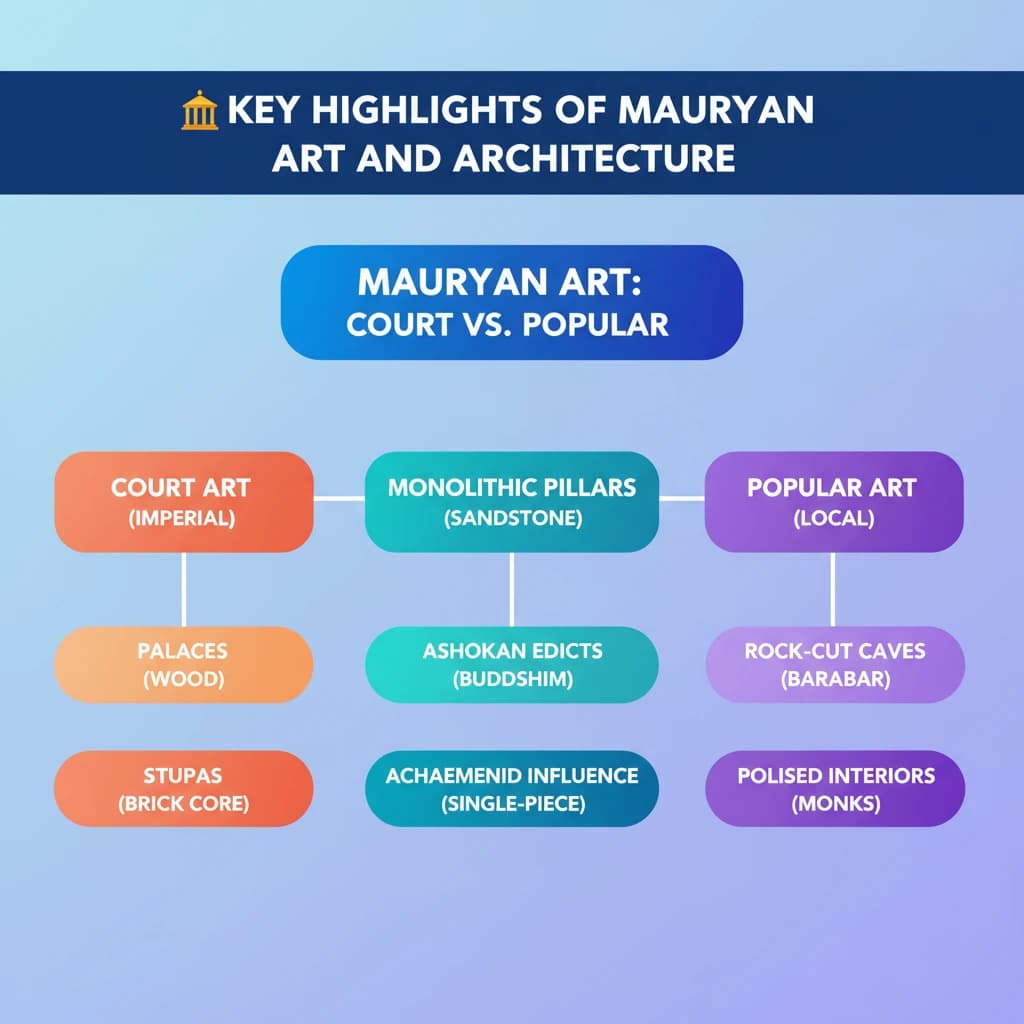
  • Mauryan art is categorized into Court Art (imperial) and Popular Art (local).
  • Court Art includes palaces (wood), monolithic polished pillars (sandstone, e.g., Ashoka's pillars), and stupas (brick core).
  • Mauryan pillars show Achaemenid influence but are monolithic, unlike Achaemenid multi-piece pillars.
  • Ashokan pillars served to disseminate Buddhist teachings and court orders.
  • Popular Art includes rock-cut caves (e.g., Barabar Caves) for monks, known for polished interiors.
  • The Lion Capital of Sarnath and Ashoka Chakra are enduring symbols of India's national identity.
What are the Key Highlights of the Mauryan Art and Architecture?

What are the Key Highlights of the Mauryan Art and Architecture?

Medium⏱️ 8 min read✓ 95% Verified
history

📖 Introduction

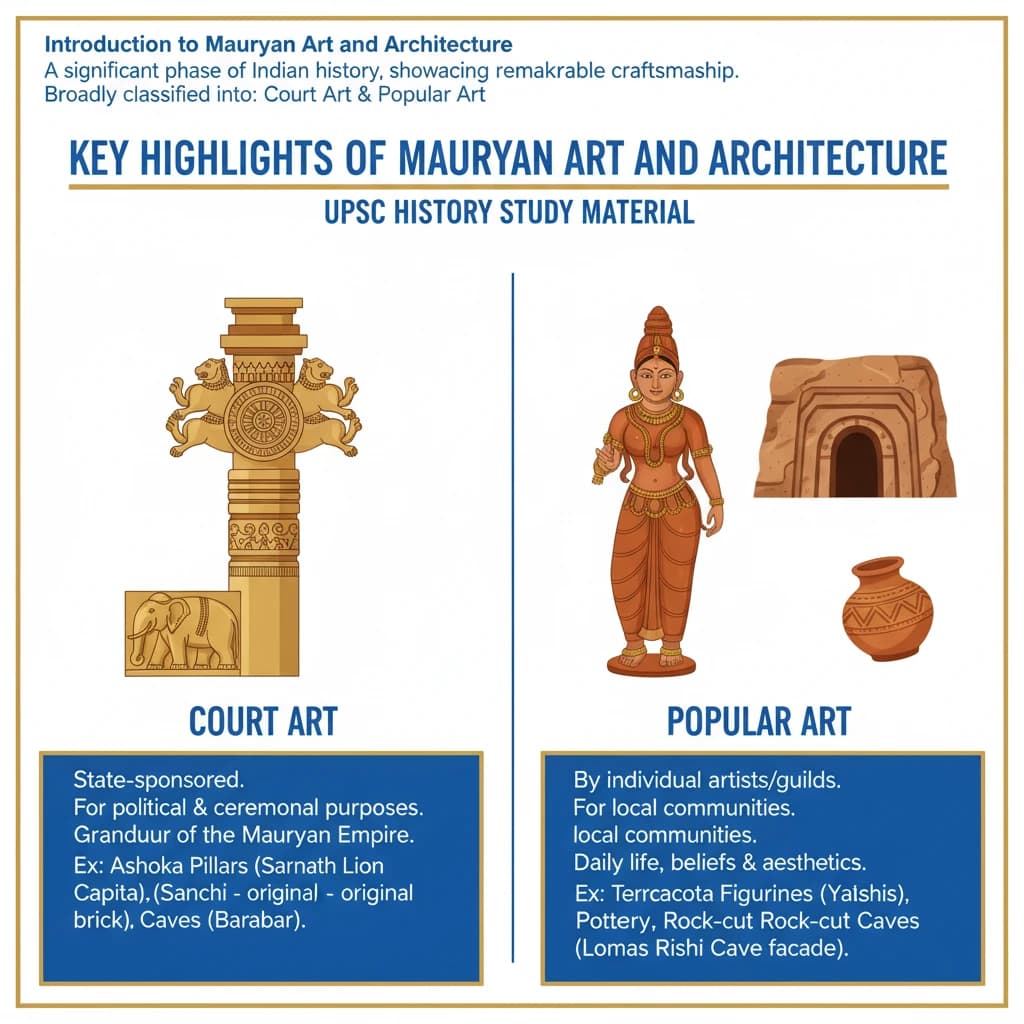
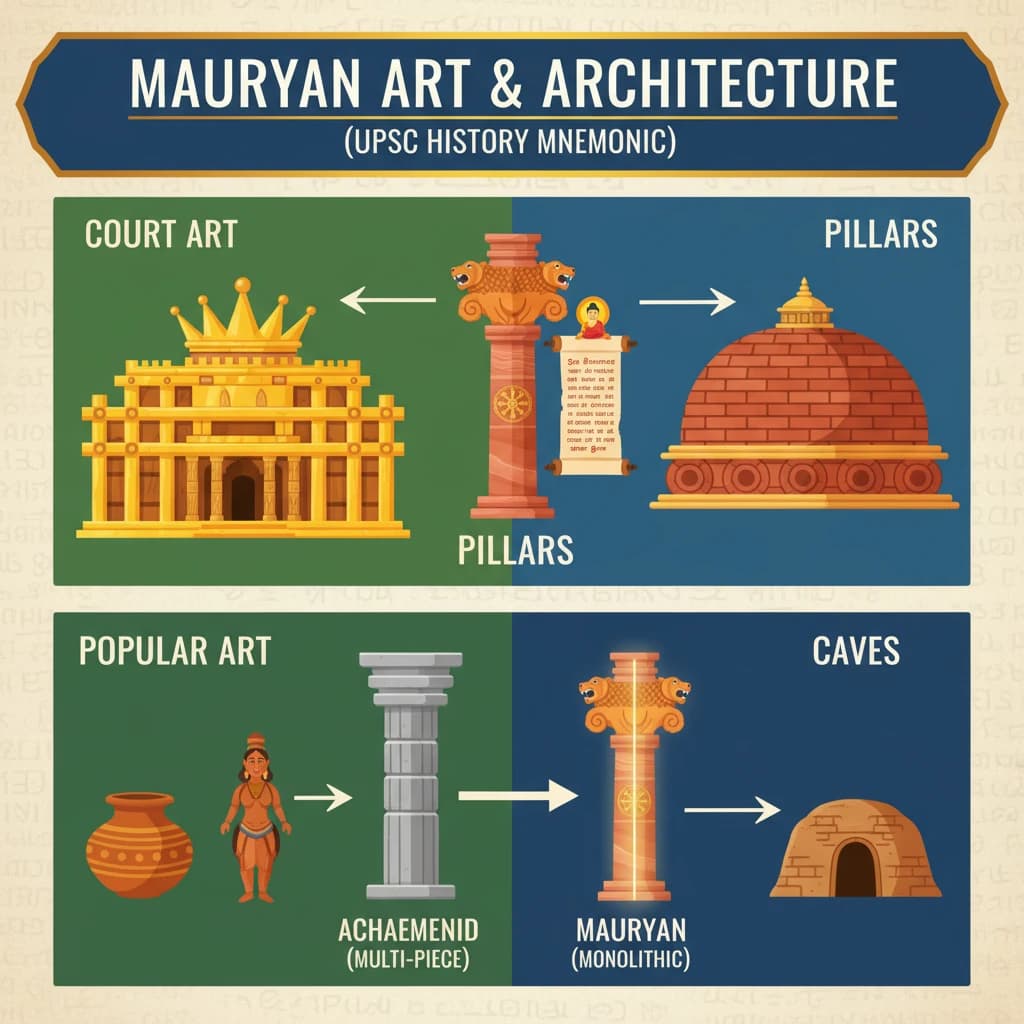
<h4>Introduction to Mauryan Art and Architecture</h4><p><strong>Mauryan art and architecture</strong> represents a significant phase in Indian history, showcasing remarkable craftsmanship and imperial patronage.</p><p>It is broadly classified into two distinct categories: <strong>Court Art</strong> and <strong>Popular Art</strong>.</p><div class='info-box'><p><strong>Court Art</strong> was primarily state-sponsored, designed for political and ceremonial purposes, reflecting the grandeur of the Mauryan Empire.</p><p><strong>Popular Art</strong>, in contrast, was more widely accessible and influenced by local traditions and craftsmanship.</p></div><h4>Mauryan Court Art: Palaces</h4><p>The <strong>Mauryan palaces</strong> were considered architectural marvels, drawing immense praise from foreign travelers and historians.</p><p>The Greek historian <strong>Megasthenes</strong> lauded them as extraordinary creations, while the Chinese traveler <strong>Fa Hien</strong> described them as "god-gifted monuments."</p><p>The design of <strong>Chandragupta Maurya's palace</strong> notably incorporated influences from the grand <strong>Achaemenid palaces</strong> at <strong>Persepolis</strong>, the capital of the <strong>Achaemenid Empire</strong>.</p><p>Interestingly, <strong>wood</strong> served as the primary construction material for these magnificent structures.</p><div class='info-box'><p>Key examples include <strong>Ashoka’s palace at Kumrahar</strong> (near Pataliputra) and the aforementioned <strong>Chandragupta’s palace</strong>.</p></div><h4>Mauryan Court Art: Pillars</h4><p><strong>Mauryan pillars</strong> are iconic examples of imperial art, characterized by their immense height, free-standing nature, and monolithic structure.</p><p>They were typically carved from high-quality <strong>sandstone</strong>, primarily quarried from <strong>Chunar</strong>.</p><p>A distinguishing feature is their highly <strong>lustrous polish</strong>, often referred to as 'Mauryan polish'.</p><p>These pillars also show clear architectural influence from <strong>Achaemenian pillars</strong>.</p><div class='key-point-box'><p>A crucial distinction is that <strong>Mauryan pillars</strong> are <strong>monolithic</strong> and <strong>rock-cut</strong>, demonstrating exceptional carving skills from a single stone block.</p><p>In contrast, <strong>Achaemenian pillars</strong> were constructed by joining multiple pieces.</p></div><p><strong>Ashoka's pillars</strong> are widely distributed across North India and are renowned for their intricate <strong>capitals</strong>.</p><p>These capitals frequently feature majestic <strong>animal figures</strong>, such as <strong>lions</strong> and <strong>bulls</strong>, which often symbolized the power and authority of the Mauryan state.</p><p>The primary purpose of these pillars was to disseminate <strong>Buddhist teachings</strong> (Dhamma) and imperial <strong>court orders</strong>.</p><p>Their inscriptions were written in various languages, including <strong>Pali</strong>, <strong>Prakrit</strong>, <strong>Greek</strong>, and <strong>Aramaic</strong>, to reach a diverse populace.</p><div class='info-box'><p>The typical structure of a <strong>Mauryan pillar</strong> comprises four main parts:</p><ul><li>A tall, <strong>monolithic shaft</strong> forming the main body.</li><li>A <strong>lotus- or bell-shaped capital</strong> (inverted lotus).</li><li>An <strong>abacus</strong>, a square or circular slab above the capital.</li><li>A crowning <strong>capital figure</strong>, usually an animal sculpture.</li></ul></div><p>Similarities with <strong>Achaemenian pillars</strong> from Iran include the use of <strong>polished stones</strong>, decorative motifs like the <strong>lotus</strong>, and the practice of inscribing royal <strong>proclamations</strong>.</p><h4>Mauryan Court Art: Stupas</h4><p><strong>Stupas</strong> are significant Buddhist architectural forms, typically featuring a distinct structural composition.</p><p>They consist of a <strong>cylindrical drum</strong>, a hemispherical mound known as the <strong>anda</strong>, a square railing called the <strong>harmika</strong>, and a central pillar supporting a triple umbrella form, the <strong>chhatra</strong>.</p><p>These elements collectively represent various <strong>Buddhist principles</strong>.</p><p>The construction involved an inner core of <strong>unburnt bricks</strong>, with the outer surface made of <strong>burnt bricks</strong>.</p><p>This exterior was then covered with <strong>plaster</strong> and often adorned with intricate <strong>wooden sculptures</strong>.</p><div class='info-box'><p>The <strong>Sanchi Stupa</strong> in <strong>Madhya Pradesh</strong> is the most renowned example of an <strong>Ashokan stupa</strong>, though its current form is largely post-Mauryan.</p><p>The <strong>Piprahwa Stupa</strong> in <strong>Uttar Pradesh</strong> is considered one of the oldest stupas, potentially pre-dating Ashoka.</p></div><p>Other significant stupas, believed to have been built shortly after <strong>Buddha’s Mahaparinirvana</strong>, include those at:</p><ul><li><strong>Rajagriha</strong></li><li><strong>Vaishali</strong></li><li><strong>Kapilavastu</strong></li><li><strong>Allakappa</strong></li><li><strong>Ramagrama</strong></li><li><strong>Vethadipa</strong></li><li><strong>Pava</strong></li><li><strong>Kushinagar</strong></li><li><strong>Pippalivana</strong></li></ul><h4>Mauryan Popular Art: Cave Architecture</h4><p><strong>Cave architecture</strong> flourished as a form of <strong>Popular Art</strong> during the Mauryan era, primarily serving as dwellings or monasteries (<strong>viharas</strong>) for <strong>Jain</strong> and <strong>Buddhist monks</strong>.</p><p>These caves are distinguished by their remarkably <strong>highly polished interiors</strong> and often feature elaborately <strong>decorative gateways</strong>.</p><div class='info-box'><p>A prime example is the <strong>Barabar Caves</strong> in Bihar, dedicated by <strong>Emperor Ashoka</strong> to the <strong>Ajivika sect</strong>.</p></div>
Concept Diagram

💡 Key Takeaways

  • •Mauryan art is categorized into Court Art (imperial) and Popular Art (local).
  • •Court Art includes palaces (wood), monolithic polished pillars (sandstone, e.g., Ashoka's pillars), and stupas (brick core).
  • •Mauryan pillars show Achaemenid influence but are monolithic, unlike Achaemenid multi-piece pillars.
  • •Ashokan pillars served to disseminate Buddhist teachings and court orders.
  • •Popular Art includes rock-cut caves (e.g., Barabar Caves) for monks, known for polished interiors.
  • •The Lion Capital of Sarnath and Ashoka Chakra are enduring symbols of India's national identity.

🧠 Memory Techniques
Memory Aid
95% Verified Content

📚 Reference Sources

•NCERT Class XI: An Introduction to Indian Art
•Upinder Singh: A History of Ancient and Early Medieval India

Related Topics

Loading related topics...
Explore:History Topics·All Subjects·Daily Current Affairs·Editorial Analysis·Previous Year Questions·UPSC GPT