Loading page, please wait…
Vaidra Logo
Vaidra

Top 4 items + smart groups

UPSC GPT
New
Current Affairs
Daily Solutions
Daily Puzzle
Mains Evaluator

Version 2.0.0 • Built with ❤️ for UPSC aspirants

Loading...
Loading...
Loading...
Loading...
Loading...
Loading...
Loading...
Loading...
Loading...
Loading...
Loading...
Loading...
Loading...
Back
All Subjects

Topics

0 topics • 0 completed

Loading topics...
Loading...
Loading...
Loading...
Loading...
Loading...
Overall Progress0%

Reforms in the Sati System - UPSC History

What is Reforms in the Sati System in UPSC History?

Reforms in the Sati System is a key topic under History for UPSC Civil Services Examination. Key points include: The Roop Kanwar Sati incident in 1987 led to stronger legislation.. The Commission of Sati (Prevention) Act, 1987, criminalizes Sati and its glorification.. Glorification includes building temples or performing ceremonies honoring Sati.. Understanding this topic is essential for both UPSC Prelims and Mains preparation.

Why is Reforms in the Sati System important for UPSC exam?

Reforms in the Sati System is a Medium-level topic in UPSC History. It is tested in both Prelims (factual MCQs) and Mains (analytical answer writing). Previous year UPSC questions have frequently covered aspects of Reforms in the Sati System, making it essential for comprehensive IAS preparation.

How to prepare Reforms in the Sati System for UPSC?

To prepare Reforms in the Sati System for UPSC: (1) Study the comprehensive notes covering all key concepts on Vaidra. (2) Practice previous year questions on this topic. (3) Connect it with current affairs using daily updates. (4) Revise using key takeaways and mind maps available for History. (5) Write practice answers linking Reforms in the Sati System to related GS Paper topics.

Key takeaways of Reforms in the Sati System for UPSC

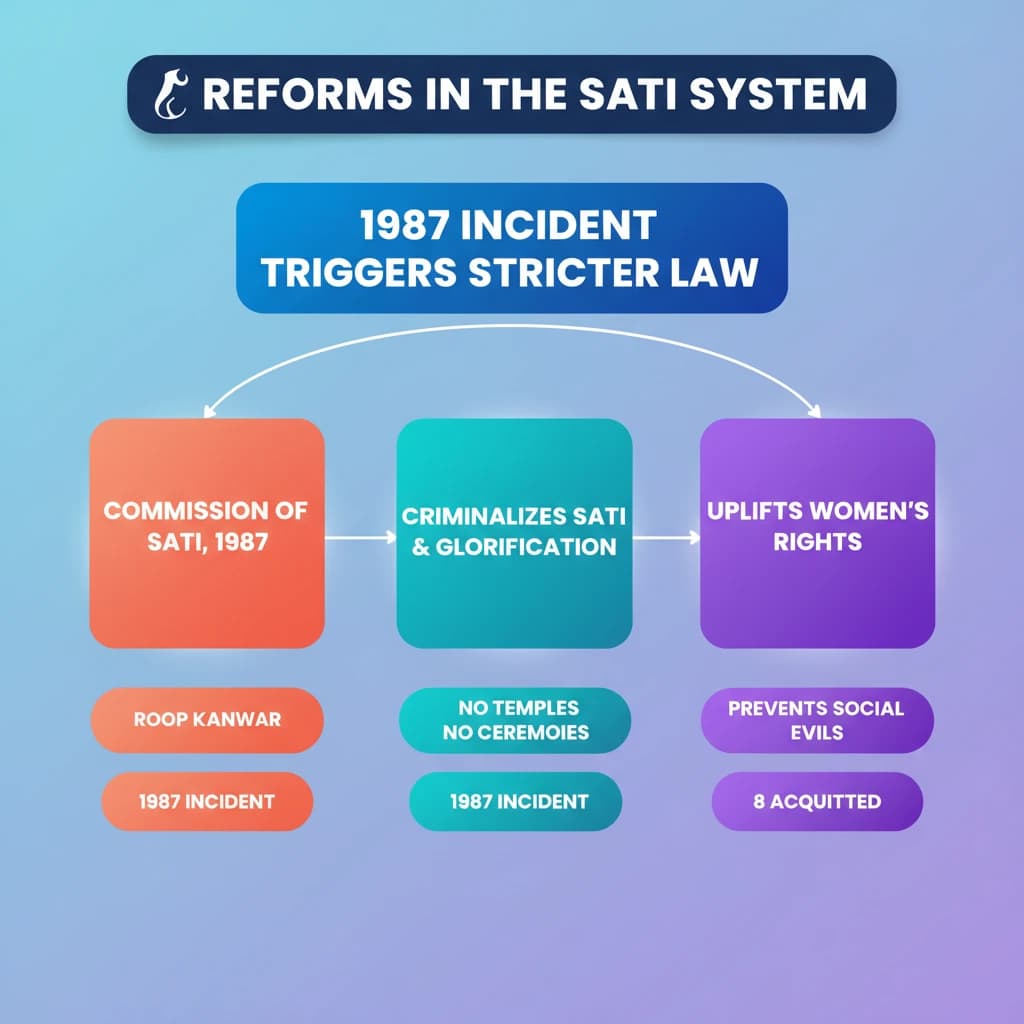
  • The Roop Kanwar Sati incident in 1987 led to stronger legislation.
  • The Commission of Sati (Prevention) Act, 1987, criminalizes Sati and its glorification.
  • Glorification includes building temples or performing ceremonies honoring Sati.
  • Eight persons were acquitted in a case related to glorifying Sati.
  • The Act is crucial for upholding women's rights and preventing social evils.
Reforms in the Sati System

Reforms in the Sati System

Medium⏱️ 6 min read✓ 95% Verified
history

📖 Introduction

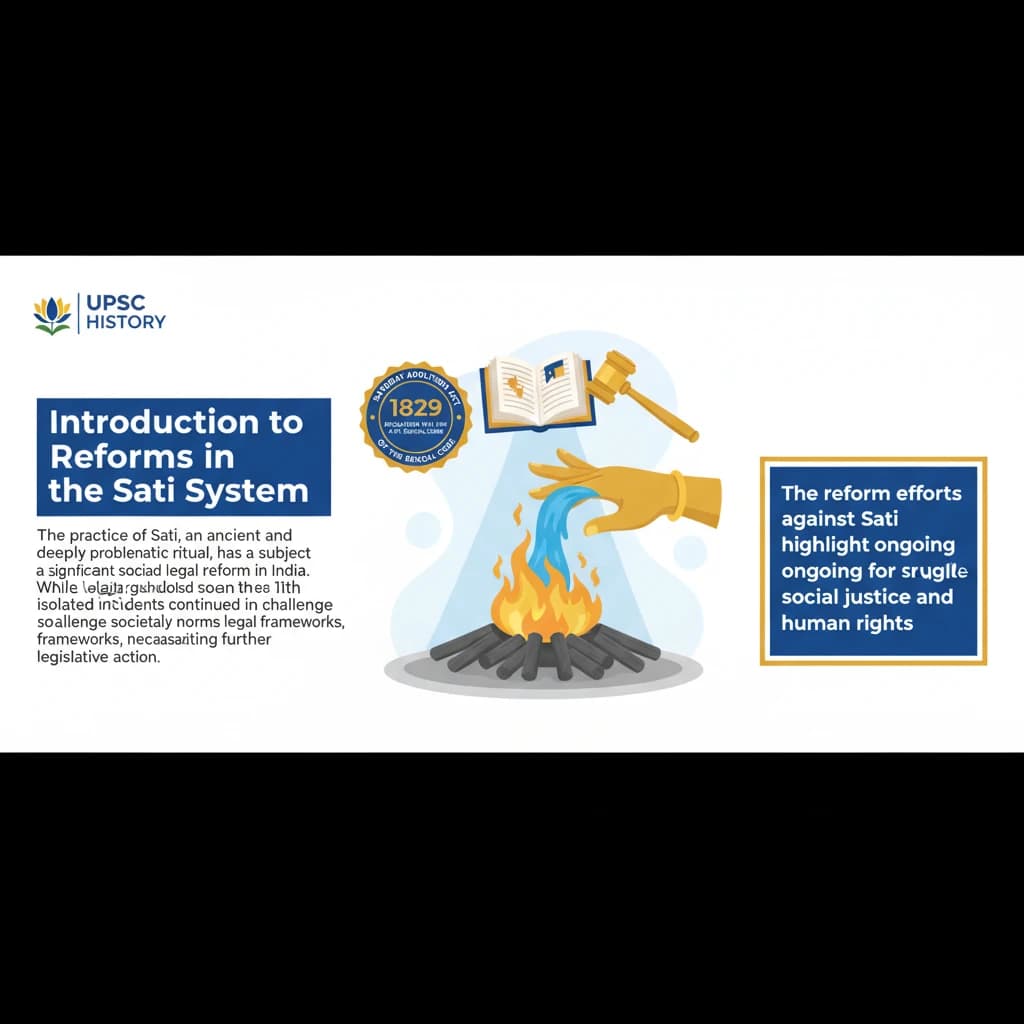
<h4>Introduction to Reforms in the Sati System</h4><p>The practice of <strong>Sati</strong>, an ancient and deeply problematic ritual, has been a subject of significant social and legal reform in India. While largely abolished in the <strong>19th century</strong>, isolated incidents continued to challenge societal norms and legal frameworks, necessitating further legislative action.</p><div class='key-point-box'><p>The reform efforts against <strong>Sati</strong> highlight India's ongoing struggle against harmful traditional practices and its commitment to human rights, particularly for women.</p></div><h4>The Roop Kanwar Incident (1987)</h4><p>A pivotal moment in the modern history of anti-Sati legislation was the tragic incident involving <strong>Roop Kanwar</strong>. This event occurred on <strong>4th September 1987</strong> in <strong>Rajasthan</strong>, drawing widespread national and international condemnation.</p><div class='info-box'><ul><li><strong>Date:</strong> 4th September 1987</li><li><strong>Location:</strong> Rajasthan</li><li><strong>Key Figure:</strong> Roop Kanwar</li></ul><p>The incident ignited a fierce debate on the persistence of such practices and the adequacy of existing laws to prevent them.</p></div><h4>Legislative Response: The Commission of Sati (Prevention) Act, 1987</h4><p>In direct response to the outrage and public demand following the <strong>Roop Kanwar case</strong>, the <strong>Union government</strong> enacted a comprehensive law. This legislation aimed to explicitly prohibit the practice of <strong>Sati</strong> and its glorification.</p><div class='info-box'><p><strong>Act Enacted:</strong> The <strong>Commission of Sati (Prevention) Act, 1987</strong></p><p>This Act provided a stronger legal framework to combat the practice and any attempts to romanticize or promote it.</p></div><div class='exam-tip-box'><p>Remember the specific year <strong>1987</strong> and the full name of the Act: <strong>The Commission of Sati (Prevention) Act</strong>. This is a crucial detail for <strong>UPSC Prelims</strong> and <strong>Mains GS Paper I (Indian Society/History)</strong>.</p></div><h4>Legal Action Against Glorification of Sati</h4><p>Beyond preventing the act itself, the law also targets the glorification of <strong>Sati</strong>. This includes acts such as constructing temples or holding ceremonies that honor individuals who committed <strong>Sati</strong>.</p><p>In a related legal development, <strong>8 persons were acquitted</strong> in connection with glorifying the act of <strong>Sati</strong>. This acquittal was specifically linked to their involvement in constructing temples in the name of those who committed <strong>Sati</strong>.</p><div class='key-point-box'><p>The concept of <strong>'glorification'</strong> is central to the <strong>Commission of Sati (Prevention) Act, 1987</strong>, as it seeks to eradicate the social acceptance and veneration that can perpetuate the practice.</p></div>
Concept Diagram

💡 Key Takeaways

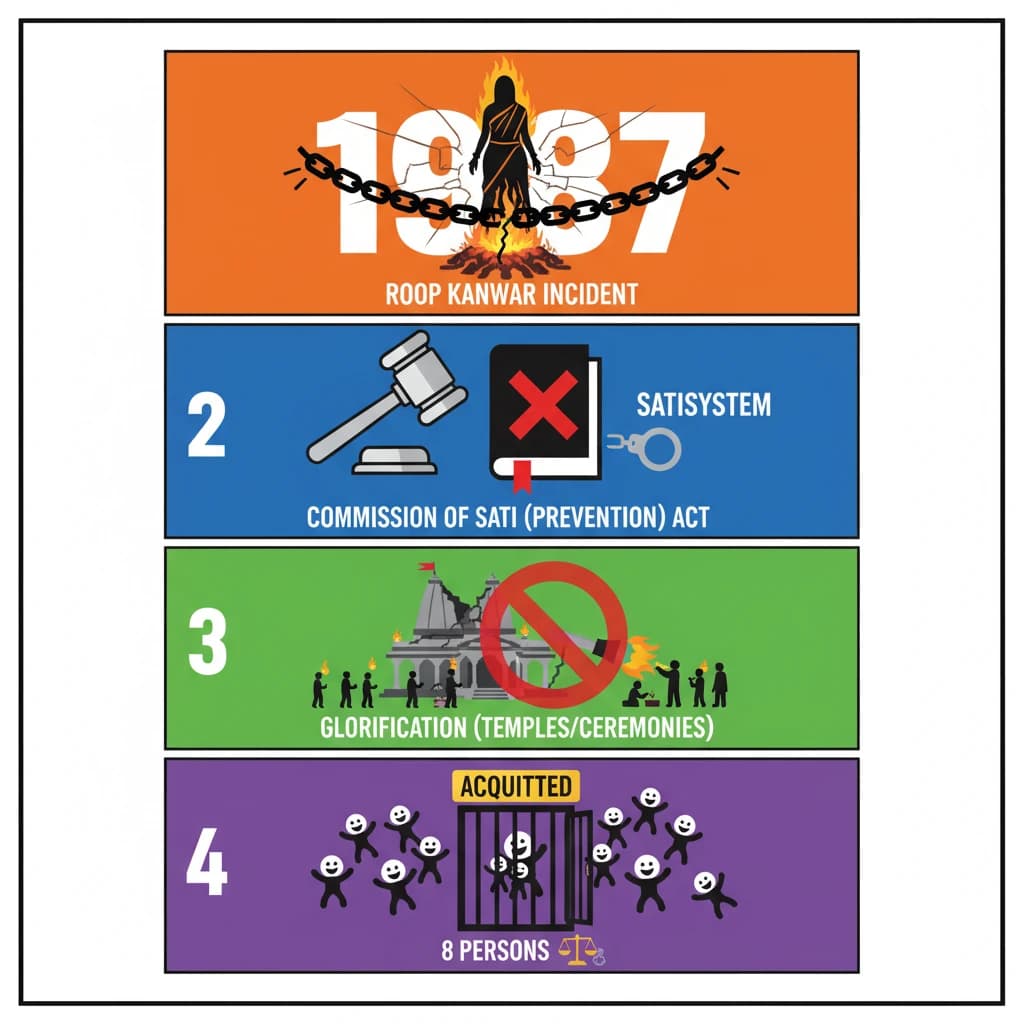
  • •The Roop Kanwar Sati incident in 1987 led to stronger legislation.
  • •The Commission of Sati (Prevention) Act, 1987, criminalizes Sati and its glorification.
  • •Glorification includes building temples or performing ceremonies honoring Sati.
  • •Eight persons were acquitted in a case related to glorifying Sati.
  • •The Act is crucial for upholding women's rights and preventing social evils.

🧠 Memory Techniques
Memory Aid
95% Verified Content

Related Topics

Loading related topics...
Explore:History Topics·All Subjects·Daily Current Affairs·Editorial Analysis·Previous Year Questions·UPSC GPT
Reforms in the Sati System - UPSC History