Loading page, please wait…
Vaidra Logo
Vaidra

Top 4 items + smart groups

UPSC GPT
New
Current Affairs
Daily Solutions
Daily Puzzle
Mains Evaluator

Version 2.0.0 • Built with ❤️ for UPSC aspirants

Loading...
Loading...
Loading...
Loading...
Loading...
Loading...
Loading...
Loading...
Loading...
Loading...
Loading...
Loading...
Loading...
Back
All Subjects

Topics

0 topics • 0 completed

Loading topics...
Loading...
Loading...
Loading...
Loading...
Loading...
Overall Progress0%

Shatadhanvan (195–187 BCE) - UPSC History

What is Shatadhanvan (195–187 BCE) in UPSC History?

Shatadhanvan (195–187 BCE) is a key topic under History for UPSC Civil Services Examination. Key points include: <strong>Shatadhanvan</strong> (195–187 BCE) was a weak Mauryan ruler who lost significant territories due to external invasions.. <strong>Brihadratha</strong> (187–185 BCE) was the last Mauryan emperor.. <strong>Brihadratha</strong> was assassinated by his commander-in-chief, <strong>Pushyamitra Shunga</strong>.. Understanding this topic is essential for both UPSC Prelims and Mains preparation.

Why is Shatadhanvan (195–187 BCE) important for UPSC exam?

Shatadhanvan (195–187 BCE) is a Medium-level topic in UPSC History. It is tested in both Prelims (factual MCQs) and Mains (analytical answer writing). Previous year UPSC questions have frequently covered aspects of Shatadhanvan (195–187 BCE), making it essential for comprehensive IAS preparation.

How to prepare Shatadhanvan (195–187 BCE) for UPSC?

To prepare Shatadhanvan (195–187 BCE) for UPSC: (1) Study the comprehensive notes covering all key concepts on Vaidra. (2) Practice previous year questions on this topic. (3) Connect it with current affairs using daily updates. (4) Revise using key takeaways and mind maps available for History. (5) Write practice answers linking Shatadhanvan (195–187 BCE) to related GS Paper topics.

Key takeaways of Shatadhanvan (195–187 BCE) for UPSC

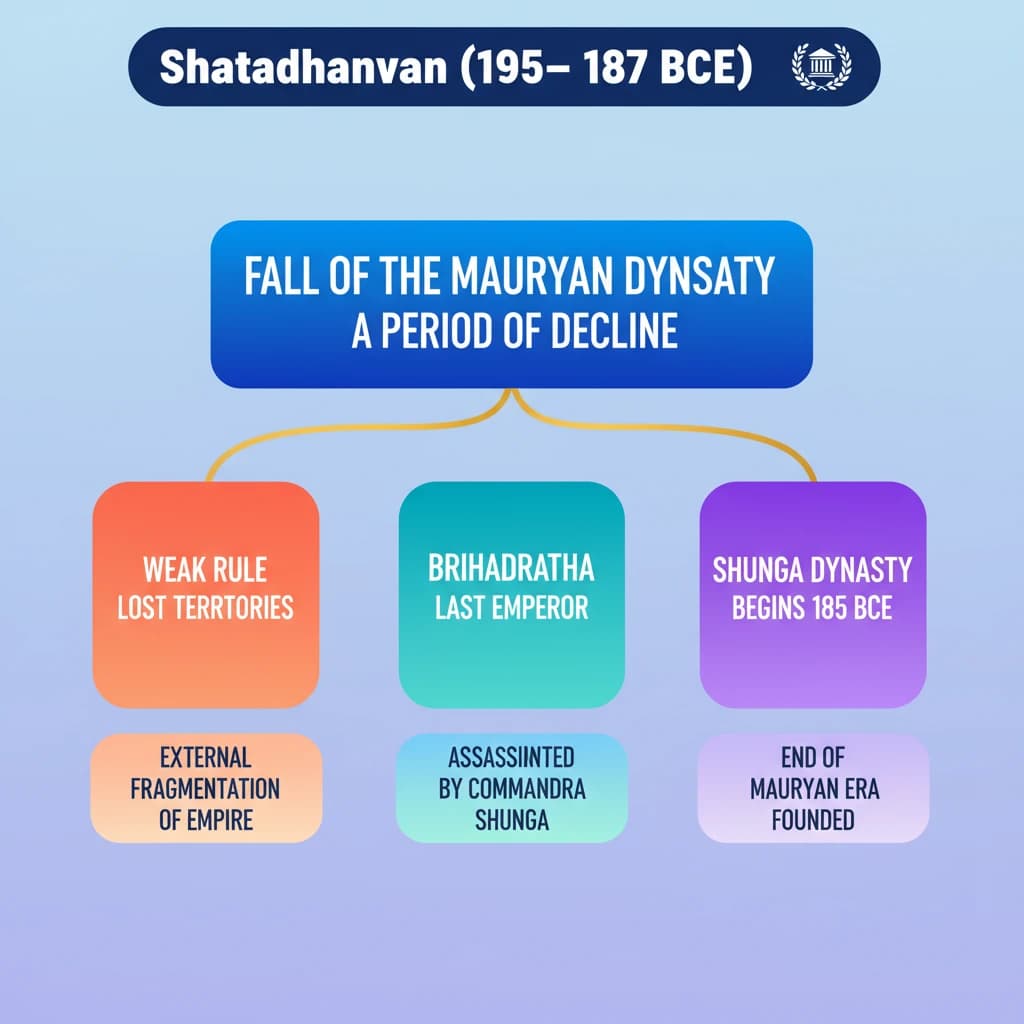
  • <strong>Shatadhanvan</strong> (195–187 BCE) was a weak Mauryan ruler who lost significant territories due to external invasions.
  • <strong>Brihadratha</strong> (187–185 BCE) was the last Mauryan emperor.
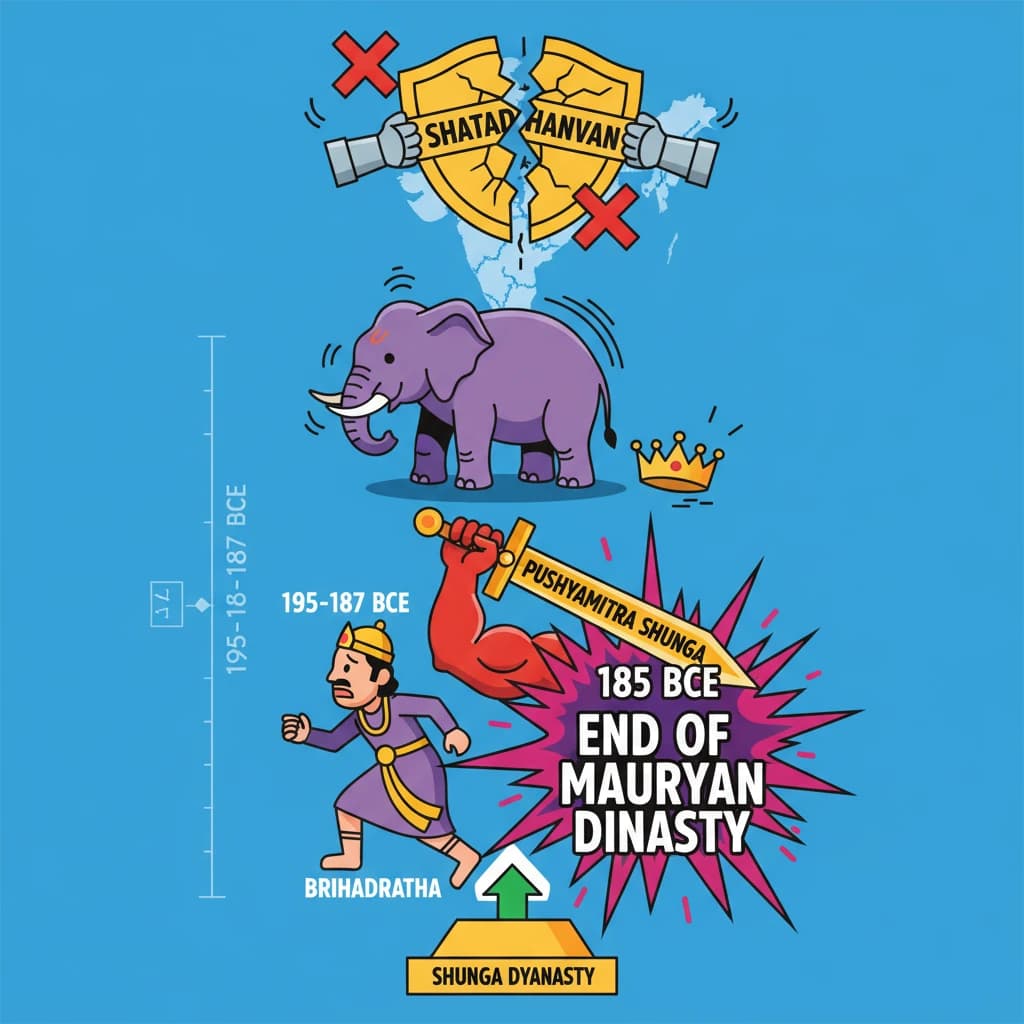
  • <strong>Brihadratha</strong> was assassinated by his commander-in-chief, <strong>Pushyamitra Shunga</strong>.
  • The assassination of <strong>Brihadratha</strong> in <strong>185 BCE</strong> marked the end of the <strong>Mauryan dynasty</strong>.
  • The event led to the establishment of the <strong>Shunga dynasty</strong> by <strong>Pushyamitra Shunga</strong>.
Shatadhanvan (195–187 BCE)

Shatadhanvan (195–187 BCE)

Medium⏱️ 6 min read✓ 98% Verified
history

📖 Introduction

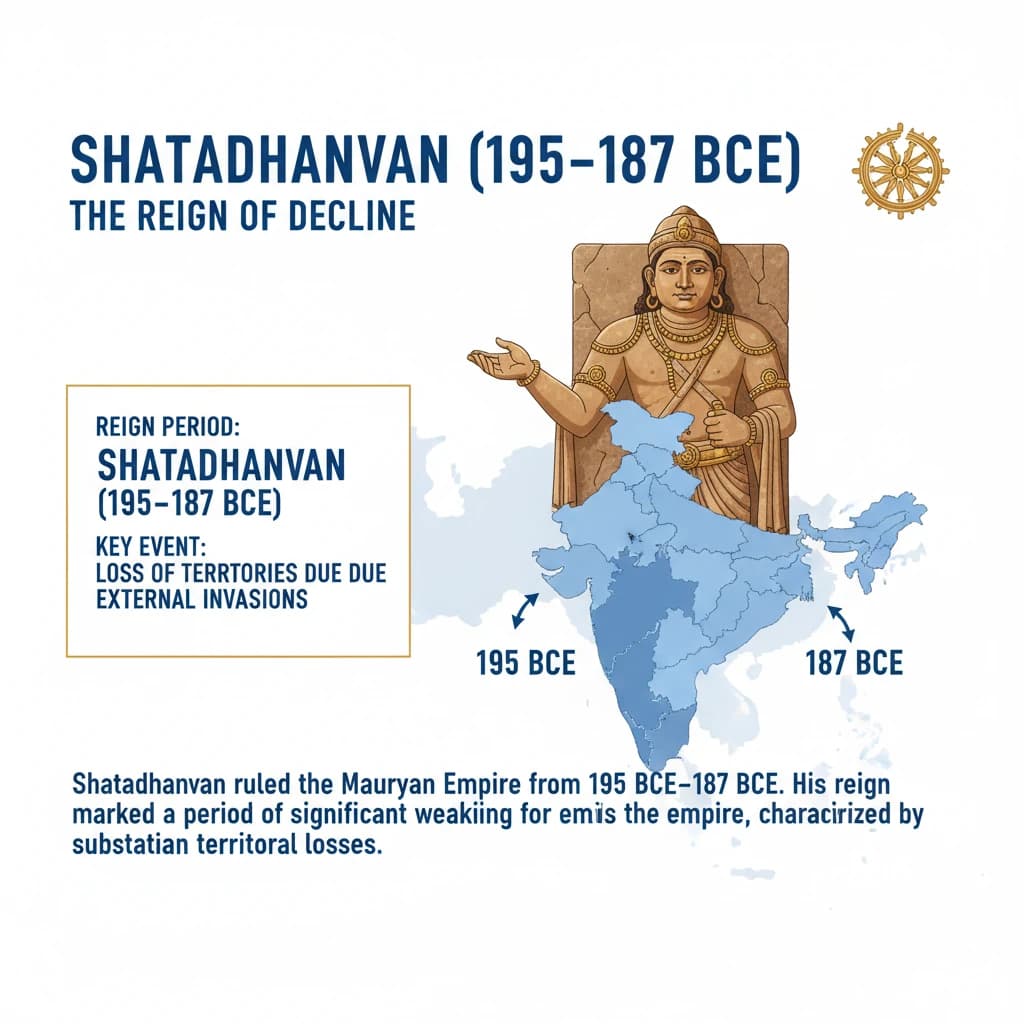
<h4>Shatadhanvan: The Reign of Decline</h4><p><strong>Shatadhanvan</strong> ruled the <strong>Mauryan Empire</strong> from <strong>195 BCE to 187 BCE</strong>. His reign marked a period of significant weakening for the empire, characterized by substantial territorial losses.</p><div class='info-box'><p><strong>Reign Period:</strong> <strong>Shatadhanvan</strong> (<strong>195–187 BCE</strong>)</p><p><strong>Key Event:</strong> Loss of territories due to external invasions.</p></div><p>During his rule, the central authority of the Mauryas diminished considerably. This allowed various peripheral regions to assert independence or fall prey to external pressures.</p><div class='key-point-box'><p>The decline under <strong>Shatadhanvan</strong> highlights the challenges faced by large empires in maintaining control over vast territories, especially when central power wanes and external threats emerge.</p></div><h4>Brihadratha: The Final Mauryan Emperor</h4><p><strong>Brihadratha</strong> succeeded <strong>Shatadhanvan</strong> and was the <strong>last Mauryan emperor</strong>, reigning from <strong>187 BCE to 185 BCE</strong>. His short rule brought the illustrious <strong>Mauryan dynasty</strong> to an abrupt and violent end.</p><div class='info-box'><p><strong>Reign Period:</strong> <strong>Brihadratha</strong> (<strong>187–185 BCE</strong>)</p><p><strong>Key Event:</strong> Assassination by <strong>Pushyamitra Shunga</strong>.</p></div><p><strong>Brihadratha</strong> was assassinated by his own commander-in-chief, <strong>Pushyamitra Shunga</strong>. This act of regicide occurred during a military parade, signaling a clear internal power struggle.</p><div class='exam-tip-box'><p>The assassination of <strong>Brihadratha</strong> by <strong>Pushyamitra Shunga</strong> is a critical turning point in ancient Indian history. It not only ended the <strong>Mauryan dynasty</strong> but also ushered in the <strong>Shunga dynasty</strong>, marking a shift in political power and cultural focus. This event is frequently asked about in <strong>UPSC Prelims</strong> and forms a crucial part of answers in <strong>Mains GS Paper I</strong>.</p></div><p>The rise of <strong>Pushyamitra Shunga</strong>, a Brahmin general, also signifies a change in the religious and social dynamics of the ruling elite following the Buddhist-patronizing Mauryas.</p>
Concept Diagram

💡 Key Takeaways

  • •<strong>Shatadhanvan</strong> (195–187 BCE) was a weak Mauryan ruler who lost significant territories due to external invasions.
  • •<strong>Brihadratha</strong> (187–185 BCE) was the last Mauryan emperor.
  • •<strong>Brihadratha</strong> was assassinated by his commander-in-chief, <strong>Pushyamitra Shunga</strong>.
  • •The assassination of <strong>Brihadratha</strong> in <strong>185 BCE</strong> marked the end of the <strong>Mauryan dynasty</strong>.
  • •The event led to the establishment of the <strong>Shunga dynasty</strong> by <strong>Pushyamitra Shunga</strong>.

🧠 Memory Techniques
Memory Aid
98% Verified Content

📚 Reference Sources

•A History of Ancient and Early Medieval India by Upinder Singh
•India's Ancient Past by R.S. Sharma
•Ancient India by D.N. Jha

Related Topics

Loading related topics...
Explore:History Topics·All Subjects·Daily Current Affairs·Editorial Analysis·Previous Year Questions·UPSC GPT
Shatadhanvan (195–187 BCE) - UPSC History