Loading page, please wait…
Vaidra Logo
Vaidra

Top 4 items + smart groups

UPSC GPT
New
Current Affairs
Daily Solutions
Daily Puzzle
Mains Evaluator

Version 2.0.0 • Built with ❤️ for UPSC aspirants

Loading...
Loading...
Loading...
Loading...
Loading...
Loading...
Loading...
Loading...
Loading...
Loading...
Loading...
Loading...
Loading...
Archaeological Survey of India (ASI) - UPSC History
Back
All Subjects

Topics

0 topics • 0 completed

Loading topics...
Loading...
Loading...
Loading...
Loading...
Loading...
Overall Progress0%

Archaeological Survey of India (ASI) - UPSC History

What is Archaeological Survey of India (ASI) in UPSC History?

Archaeological Survey of India (ASI) is a key topic under History for UPSC Civil Services Examination. Key points include: ASI is India's primary agency for archaeological research and heritage protection, under the Ministry of Culture.. Its core functions include surveys, excavations, and conservation of nationally important monuments and sites.. Governed by the Ancient Monuments Preservation Act, 1904, and the more comprehensive AMASR Act, 1958.. Understanding this topic is essential for both UPSC Prelims and Mains preparation.

Why is Archaeological Survey of India (ASI) important for UPSC exam?

Archaeological Survey of India (ASI) is a Medium-level topic in UPSC History. It is tested in both Prelims (factual MCQs) and Mains (analytical answer writing). Previous year UPSC questions have frequently covered aspects of Archaeological Survey of India (ASI), making it essential for comprehensive IAS preparation.

How to prepare Archaeological Survey of India (ASI) for UPSC?

To prepare Archaeological Survey of India (ASI) for UPSC: (1) Study the comprehensive notes covering all key concepts on Vaidra. (2) Practice previous year questions on this topic. (3) Connect it with current affairs using daily updates. (4) Revise using key takeaways and mind maps available for History. (5) Write practice answers linking Archaeological Survey of India (ASI) to related GS Paper topics.

Key takeaways of Archaeological Survey of India (ASI) for UPSC

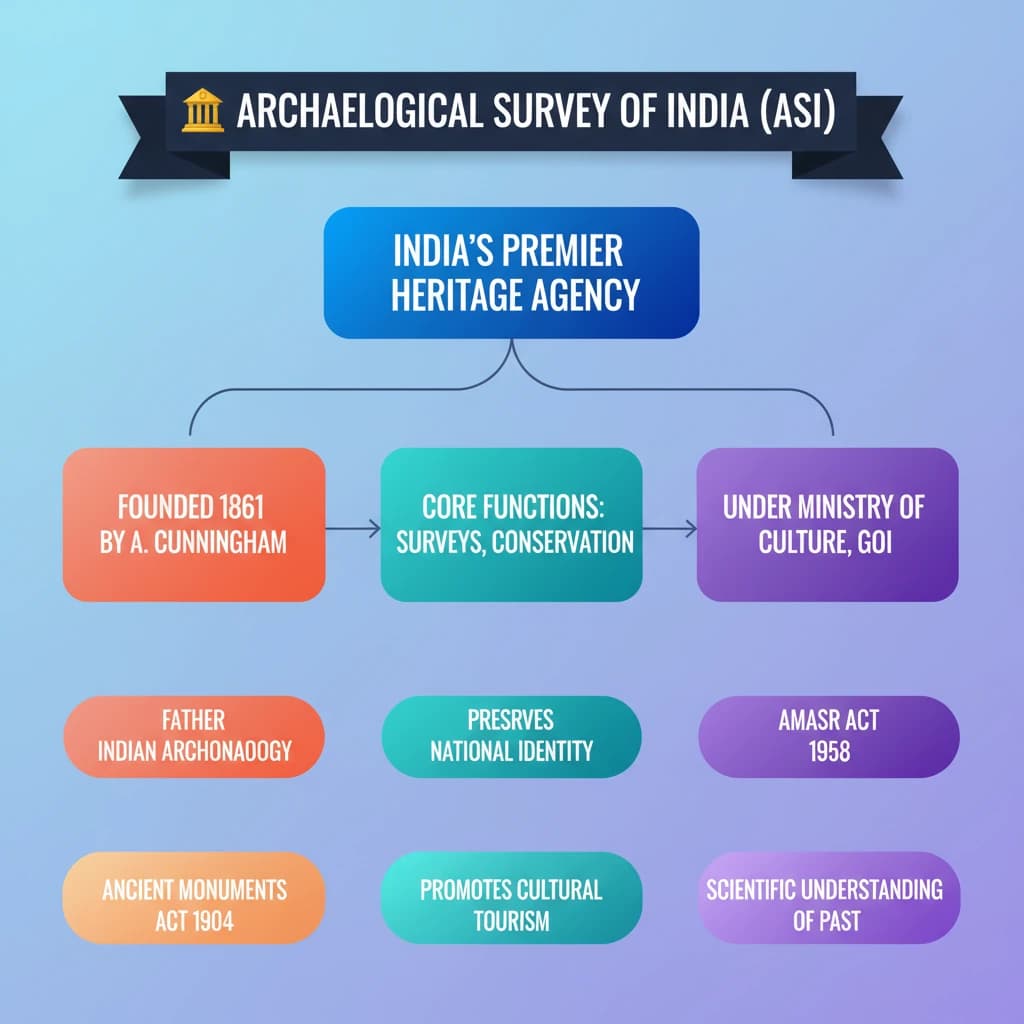
  • ASI is India's primary agency for archaeological research and heritage protection, under the Ministry of Culture.
  • Its core functions include surveys, excavations, and conservation of nationally important monuments and sites.
  • Governed by the Ancient Monuments Preservation Act, 1904, and the more comprehensive AMASR Act, 1958.
  • Founded in 1861 by Alexander Cunningham, known as the 'Father of Indian Archaeology'.
  • Crucial for preserving national identity, promoting cultural tourism, and scientific understanding of India's past.
Archaeological Survey of India (ASI)

Archaeological Survey of India (ASI)

Medium⏱️ 8 min read✓ 98% Verified
history

📖 Introduction

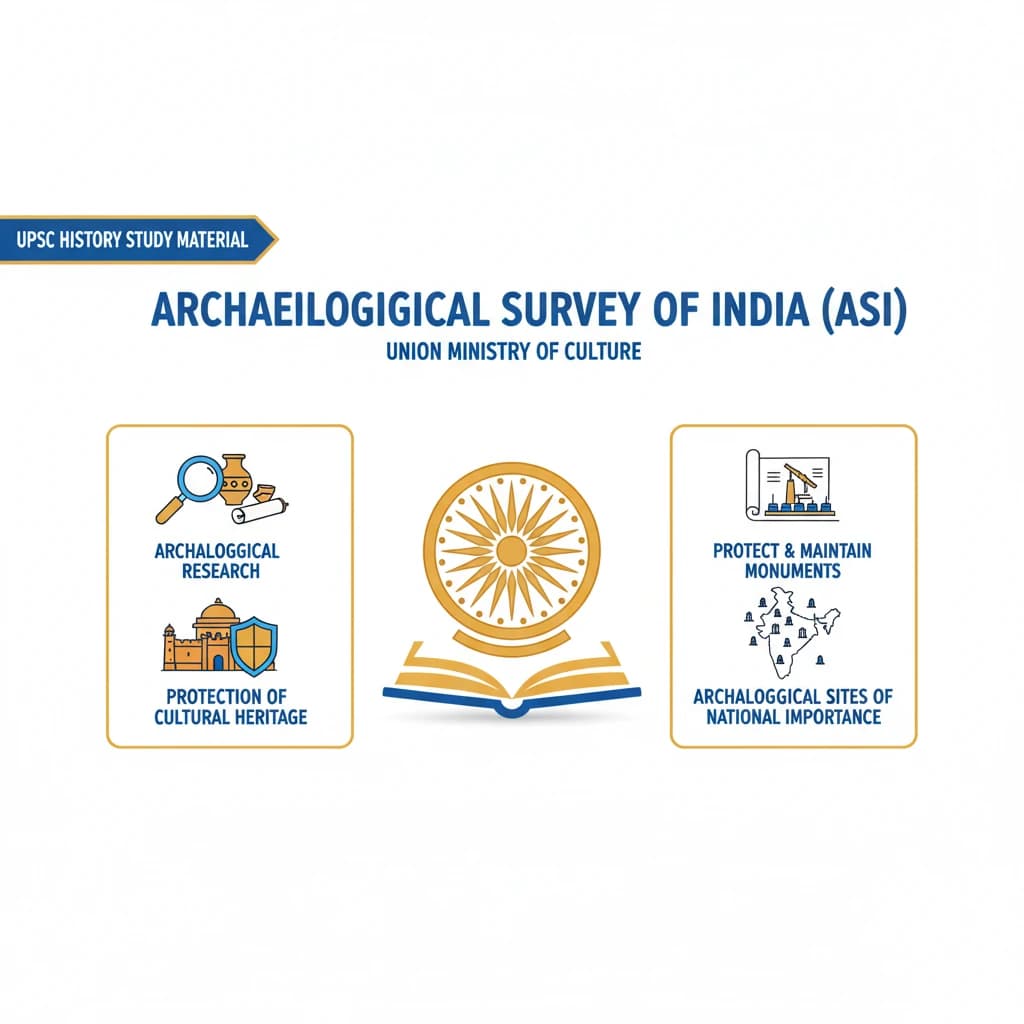
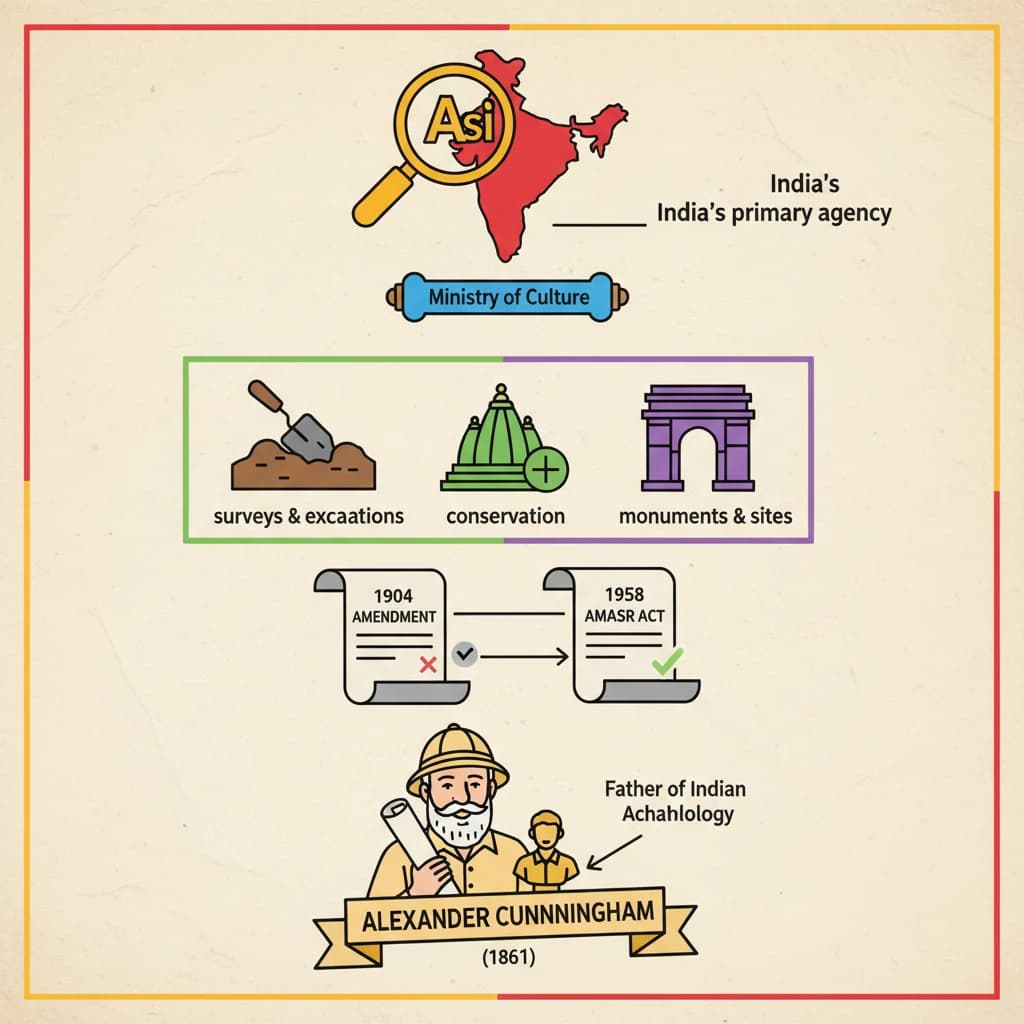
<h4>Introduction to the Archaeological Survey of India</h4><p>The <strong>Archaeological Survey of India (ASI)</strong> is a premier Indian government agency responsible for archaeological research and the protection of cultural heritage. It operates under the <strong>Union Ministry of Culture</strong>.</p><h4>Mandate and Core Functions</h4><p>The primary mandate of <strong>ASI</strong> is to protect and maintain <strong>monuments</strong> and <strong>archaeological sites of national importance</strong> across India.</p><div class='key-point-box'><p>Key functions include:</p><ul><li>Conducting <strong>surveys</strong> to identify new sites.</li><li>Undertaking <strong>excavations</strong> to unearth historical artifacts and structures.</li><li>Ensuring <strong>conservation</strong> and preservation of protected monuments and sites.</li></ul></div><h4>Legislative Framework</h4><p><strong>ASI</strong> derives its authority and responsibilities from specific parliamentary acts. These acts provide the legal framework for its operations.</p><div class='info-box'><ul><li><strong>Ancient Monuments Preservation Act, 1904</strong>: An early legislation focused on the preservation of ancient monuments.</li><li><strong>The Ancient Monuments and Archaeological Sites and Remains Act, 1958 (AMASR Act)</strong>: This is the principal act governing the protection, preservation, and maintenance of ancient monuments and archaeological sites.</li></ul></div><div class='exam-tip-box'><p><strong>UPSC Insight</strong>: Understanding the evolution of these acts (<strong>1904</strong> to <strong>1958 AMASR Act</strong>) is crucial for questions on heritage legislation and governance (<strong>GS-I, GS-II</strong>).</p></div><h4>Founding and Key Figure</h4><p>The <strong>Archaeological Survey of India</strong> was formally established in <strong>1861</strong>, marking a significant step in organized archaeological research in India.</p><div class='info-box'><p><strong>Founder and First Director-General</strong>: <strong>Alexander Cunningham</strong></p><p><strong>Alexander Cunningham</strong> is widely recognized as the <strong>“Father of Indian Archaeology”</strong> for his pioneering work and contributions to the field.</p></div><div class='exam-tip-box'><p><strong>UPSC Insight</strong>: Remember <strong>Alexander Cunningham</strong> and the founding year <strong>1861</strong> as frequently asked factual points in prelims (<strong>GS-I History</strong>).</p></div>
Concept Diagram

💡 Key Takeaways

  • •ASI is India's primary agency for archaeological research and heritage protection, under the Ministry of Culture.
  • •Its core functions include surveys, excavations, and conservation of nationally important monuments and sites.
  • •Governed by the Ancient Monuments Preservation Act, 1904, and the more comprehensive AMASR Act, 1958.
  • •Founded in 1861 by Alexander Cunningham, known as the 'Father of Indian Archaeology'.
  • •Crucial for preserving national identity, promoting cultural tourism, and scientific understanding of India's past.

🧠 Memory Techniques
Memory Aid
98% Verified Content

📚 Reference Sources

•Official ASI Website (general knowledge)
•NCERT History Textbooks (general knowledge)

Related Topics

Loading related topics...
Explore:History Topics·All Subjects·Daily Current Affairs·Editorial Analysis·Previous Year Questions·UPSC GPT