Loading page, please wait…
Vaidra Logo
Vaidra

Top 4 items + smart groups

UPSC GPT
New
Current Affairs
Daily Solutions
Daily Puzzle
Mains Evaluator

Version 2.0.0 • Built with ❤️ for UPSC aspirants

Loading...
Loading...
Loading...
Loading...
Loading...
Loading...
Loading...
Loading...
Loading...
Loading...
Loading...
Loading...
Loading...
Back
All Subjects

Topics

0 topics • 0 completed

Loading topics...
Loading...
Loading...
Loading...
Loading...
Loading...
Overall Progress0%

What are the Other Reforms Undertaken by William Bentinck (1828-1835)? - UPSC History

What is What are the Other Reforms Undertaken by William Bentinck (1828-1835)? in UPSC History?

What are the Other Reforms Undertaken by William Bentinck (1828-1835)? is a key topic under History for UPSC Civil Services Examination. Key points include: Bentinck (1828-1835) was a reformist Governor-General, driven by Utilitarian and Liberal principles.. He initiated Indianisation of administration, appointing Indians as Deputy Magistrates/Collectors.. Judicial reforms included abolishing Provincial Courts, establishing a Supreme Court in Agra, and using vernacular languages in local courts.. Understanding this topic is essential for both UPSC Prelims and Mains preparation.

Why is What are the Other Reforms Undertaken by William Bentinck (1828-1835)? important for UPSC exam?

What are the Other Reforms Undertaken by William Bentinck (1828-1835)? is a Medium-level topic in UPSC History. It is tested in both Prelims (factual MCQs) and Mains (analytical answer writing). Previous year UPSC questions have frequently covered aspects of What are the Other Reforms Undertaken by William Bentinck (1828-1835)?, making it essential for comprehensive IAS preparation.

How to prepare What are the Other Reforms Undertaken by William Bentinck (1828-1835)? for UPSC?

To prepare What are the Other Reforms Undertaken by William Bentinck (1828-1835)? for UPSC: (1) Study the comprehensive notes covering all key concepts on Vaidra. (2) Practice previous year questions on this topic. (3) Connect it with current affairs using daily updates. (4) Revise using key takeaways and mind maps available for History. (5) Write practice answers linking What are the Other Reforms Undertaken by William Bentinck (1828-1835)? to related GS Paper topics.

Key takeaways of What are the Other Reforms Undertaken by William Bentinck (1828-1835)? for UPSC

  • Bentinck (1828-1835) was a reformist Governor-General, driven by Utilitarian and Liberal principles.
  • He initiated Indianisation of administration, appointing Indians as Deputy Magistrates/Collectors.
  • Judicial reforms included abolishing Provincial Courts, establishing a Supreme Court in Agra, and using vernacular languages in local courts.
  • Financial reforms focused on cost-cutting (salaries, allowances) and revenue recovery (forged land deeds).
  • He supported English as the medium of instruction, influenced by Macaulay.
  • His era fostered a climate for social reforms, including later legislative actions against child marriage and the promotion of women's education.
What are the Other Reforms Undertaken by William Bentinck (1828-1835)?

What are the Other Reforms Undertaken by William Bentinck (1828-1835)?

Medium⏱️ 7 min read✓ 90% Verified
history

📖 Introduction

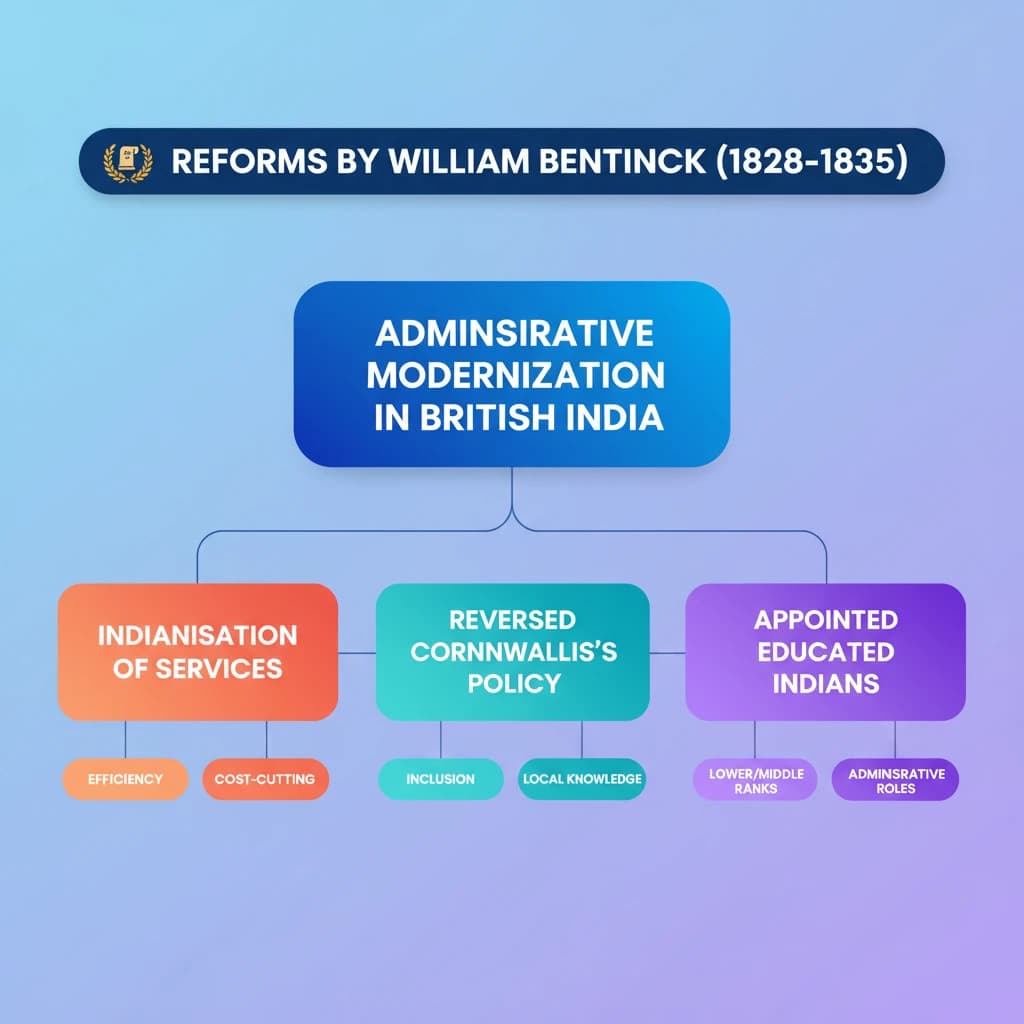
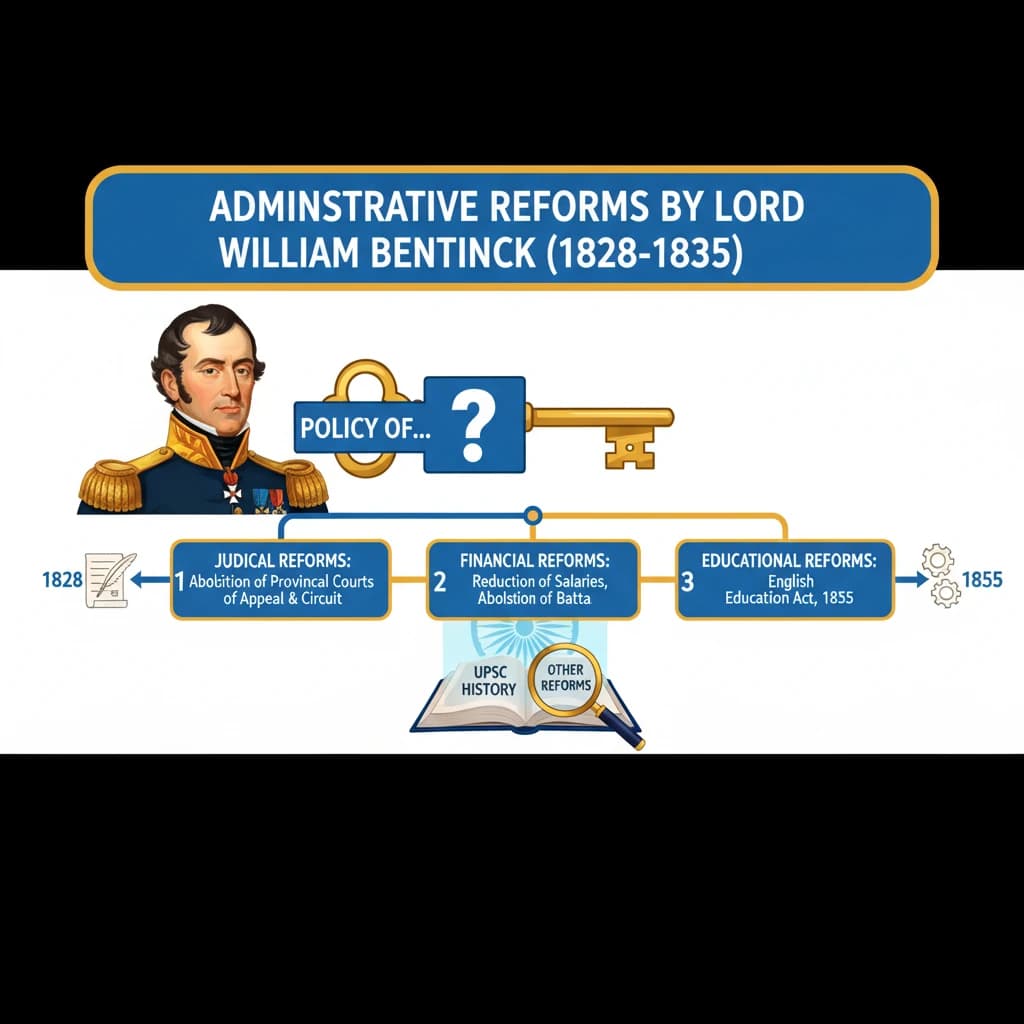
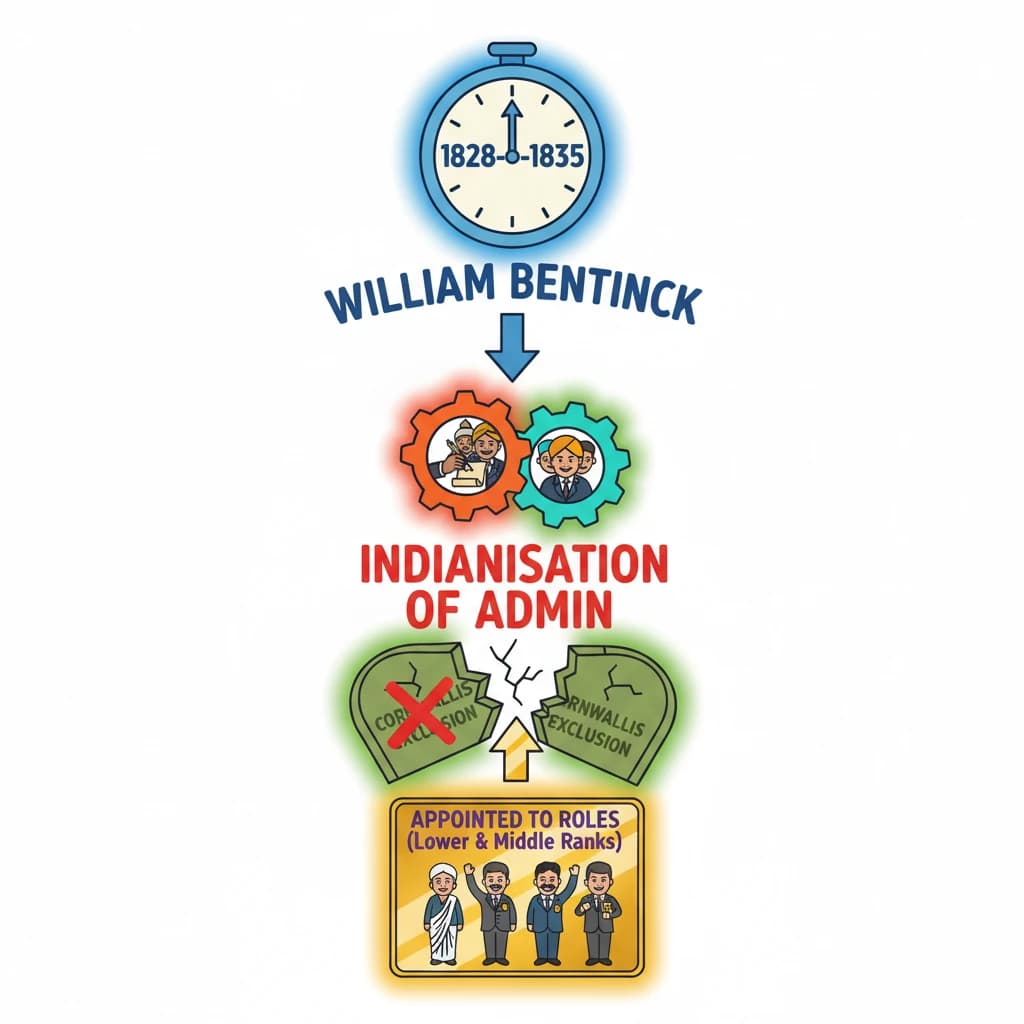
<h4>Lord William Bentinck's Reforms (1828-1835)</h4><p><strong>Lord William Bentinck</strong> served as the <strong>Governor-General of Bengal</strong> from <strong>1828 to 1833</strong> and then as the first <strong>Governor-General of India</strong> from <strong>1833 to 1835</strong>. His tenure is marked by a series of significant administrative, judicial, financial, educational, and social reforms.</p><p>These reforms aimed at improving governance, enhancing efficiency, and addressing prevalent social issues, laying foundational changes in British India.</p><h4>Administrative Reforms</h4><h5>Indianisation of Administration</h5><p><strong>Bentinck</strong> reversed <strong>Lord Cornwallis’s</strong> policy of excluding <strong>Indians</strong> from administrative roles.</p><p>He appointed educated <strong>Indians</strong> as <strong>Deputy Magistrates</strong> and <strong>Deputy Collectors</strong>, marking a significant move towards <strong>Indianising</strong> the government service.</p><div class='key-point-box'><p>This policy aimed to utilize local talent, reduce administrative costs, and improve understanding of local customs and needs.</p></div><h5>Land Revenue Settlement</h5><p><strong>Lord William Bentinck</strong> reviewed and updated the <strong>Mahalwari system</strong> of land revenue in <strong>1833</strong>.</p><p>This involved detailed surveys and negotiations with <strong>landholders</strong> and <strong>village communities</strong>, leading to increased revenue for the state.</p><div class='info-box'><p>The <strong>Mahalwari system</strong> was primarily implemented in parts of the <strong>North-Western Provinces</strong>, <strong>Central Provinces</strong>, and <strong>Punjab</strong>, aiming for a more equitable assessment.</p></div><h5>Administrative Divisions</h5><p>Bentinck reorganised the <strong>Presidency of Bengal</strong> into <strong>twenty divisions</strong>.</p><p>Each division was overseen by a <strong>Commissioner</strong>, which significantly enhanced administrative efficiency and oversight.</p><h4>Judicial Reforms</h4><h5>Abolition of Provincial Courts</h5><p>Bentinck abolished the existing <strong>Provincial Courts of Appeal and Circuit</strong>, which were often slow and inefficient.</p><p>He established a new hierarchy of courts to expedite judicial processes.</p><p>A <strong>Supreme Court</strong> was established in <strong>Agra</strong> for civil and criminal appeals, improving judicial accessibility, especially for the <strong>North-Western Provinces</strong>.</p><h5>Judicial Empowerment</h5><p>He created separate <strong>Sadar Diwani Adalat</strong> (for civil cases) and <strong>Sadar Nizamat Adalat</strong> (for criminal cases) at <strong>Allahabad</strong>.</p><p>This decentralization aimed at improving judicial accessibility for the public in the region.</p><h5>Reduction of Punishments</h5><p>Bentinck reduced the severity of punishments and abolished inhumane practices.</p><p>Practices such as <strong>flogging</strong> were abolished, reflecting a more humane approach to justice.</p><h5>Language of the Courts</h5><p>Bentinck ordered the use of <strong>vernacular languages</strong> in local courts, making justice more accessible and understandable to common people.</p><p>In higher courts, <strong>Persian</strong> was replaced by <strong>English</strong> as the official language.</p><p>Qualified <strong>Indians</strong> were appointed as <strong>Munsiffs</strong> and <strong>Sadar Amins</strong>, integrating them into the judicial system at various levels.</p><h4>Financial Reforms</h4><h5>Cost-Cutting Measures</h5><p>Bentinck formed two committees, one <strong>military</strong> and one <strong>civil</strong>, to examine rising expenditure.</p><p>Following their recommendations, he significantly reduced the salaries and allowances of officials and cut travel expenses.</p><div class='info-box'><p>These stringent measures led to substantial annual savings for the <strong>East India Company</strong>, addressing its financial strain.</p></div><h5>Revenue Recovery</h5><p>He investigated land grants in <strong>Bengal</strong>, where many <strong>rent-free landholders</strong> were found to possess <strong>forged title deeds</strong>.</p><p>By recovering these unlawfully held lands, he enhanced the <strong>Company's revenue</strong>, contributing to financial stability.</p><h4>Educational Reforms</h4><h5>Medium of Instruction</h5><p>Influenced by <strong>Lord Macaulay's Minute on Indian Education (1835)</strong>, Bentinck strongly supported <strong>English</strong> as the medium of instruction.</p><div class='key-point-box'><p>This decision had profound and long-lasting impacts on the Indian education system, promoting Western learning and administrative efficiency.</p></div><h4>Social Reforms</h4><p>While <strong>William Bentinck</strong> is most famously associated with the abolition of <strong>Sati (1829)</strong>, the provided source also highlights other social reform efforts, some of which materialized after his tenure but reflect the progressive spirit of the era.</p><h5>Child Marriage</h5><p>The movement against child marriage gained momentum during and after Bentinck's era, culminating in significant legislative actions:</p><ul><li>The <strong>Age of Consent Act, 1891</strong>, forbade the marriage of girls below the age of <strong>12</strong>.</li><li>The <strong>Child Marriage Restraint Act, 1929 (Sarda Act)</strong>, pushed up the marriage age to <strong>18</strong> for boys and <strong>14</strong> for girls.</li><li>The <strong>Child Marriage Restraint (Amendment) Act 1978</strong> further raised the age of marriage for girls from <strong>15 to 18 years</strong> and for boys from <strong>18 to 21</strong>.</li></ul><div class='exam-tip-box'><p>While these specific acts are post-Bentinck, understanding their chronological progression is crucial for <strong>UPSC Prelims</strong>, illustrating the long-term impact of social reform movements.</p></div><h5>Education of Women</h5><p>The push for female education also saw foundational steps during this period:</p><ul><li>The <strong>Calcutta Female Juvenile Society</strong>, established in <strong>1819</strong>, marked the beginning of a broader movement towards female education.</li><li>The <strong>Bethune School</strong>, founded in <strong>1849</strong> by <strong>J.E.D. Bethune</strong>, became a pivotal institution for women’s education in India.</li></ul><div class='key-point-box'><p>These initiatives, though some after Bentinck's direct influence, reflect the evolving social consciousness that his reformist administration helped foster.</p></div>
Concept Diagram

💡 Key Takeaways

  • •Bentinck (1828-1835) was a reformist Governor-General, driven by Utilitarian and Liberal principles.
  • •He initiated Indianisation of administration, appointing Indians as Deputy Magistrates/Collectors.
  • •Judicial reforms included abolishing Provincial Courts, establishing a Supreme Court in Agra, and using vernacular languages in local courts.
  • •Financial reforms focused on cost-cutting (salaries, allowances) and revenue recovery (forged land deeds).
  • •He supported English as the medium of instruction, influenced by Macaulay.
  • •His era fostered a climate for social reforms, including later legislative actions against child marriage and the promotion of women's education.

🧠 Memory Techniques
Memory Aid
90% Verified Content

Related Topics

Loading related topics...
Explore:History Topics·All Subjects·Daily Current Affairs·Editorial Analysis·Previous Year Questions·UPSC GPT
What are the Other Reforms Undertaken by William Bentinck (1828-1835)? - UPSC History