Loading page, please wait…
Vaidra Logo
Vaidra

Top 4 items + smart groups

UPSC GPT
New
Current Affairs
Daily Solutions
Daily Puzzle
Mains Evaluator

Version 2.0.0 • Built with ❤️ for UPSC aspirants

Loading...
Loading...
Loading...
Loading...
Loading...
Loading...
Loading...
Loading...
Loading...
Loading...
Loading...
Loading...
Loading...
Back
All Subjects

Topics

0 topics • 0 completed

Loading topics...
Loading...
Loading...
Loading...
Loading...
Loading...
Overall Progress0%

Shivaji Maharaj: Death and Key Battles - UPSC History

What is Shivaji Maharaj: Death and Key Battles in UPSC History?

Shivaji Maharaj: Death and Key Battles is a key topic under History for UPSC Civil Services Examination. Key points include: Chhatrapati Shivaji Maharaj founded the Maratha Empire, challenging Adilshahi and Mughal powers.. He died on 3rd April 1680 at Raigad.. Key battles include Pratapgad (1659, vs. Afzal Khan), Surat (1664, vs. Mughals), Purandar (1665, vs. Jai Singh), and Sangamner (1679, his last battle).. Understanding this topic is essential for both UPSC Prelims and Mains preparation.

Why is Shivaji Maharaj: Death and Key Battles important for UPSC exam?

Shivaji Maharaj: Death and Key Battles is a Medium-level topic in UPSC History. It is tested in both Prelims (factual MCQs) and Mains (analytical answer writing). Previous year UPSC questions have frequently covered aspects of Shivaji Maharaj: Death and Key Battles, making it essential for comprehensive IAS preparation.

How to prepare Shivaji Maharaj: Death and Key Battles for UPSC?

To prepare Shivaji Maharaj: Death and Key Battles for UPSC: (1) Study the comprehensive notes covering all key concepts on Vaidra. (2) Practice previous year questions on this topic. (3) Connect it with current affairs using daily updates. (4) Revise using key takeaways and mind maps available for History. (5) Write practice answers linking Shivaji Maharaj: Death and Key Battles to related GS Paper topics.

Key takeaways of Shivaji Maharaj: Death and Key Battles for UPSC

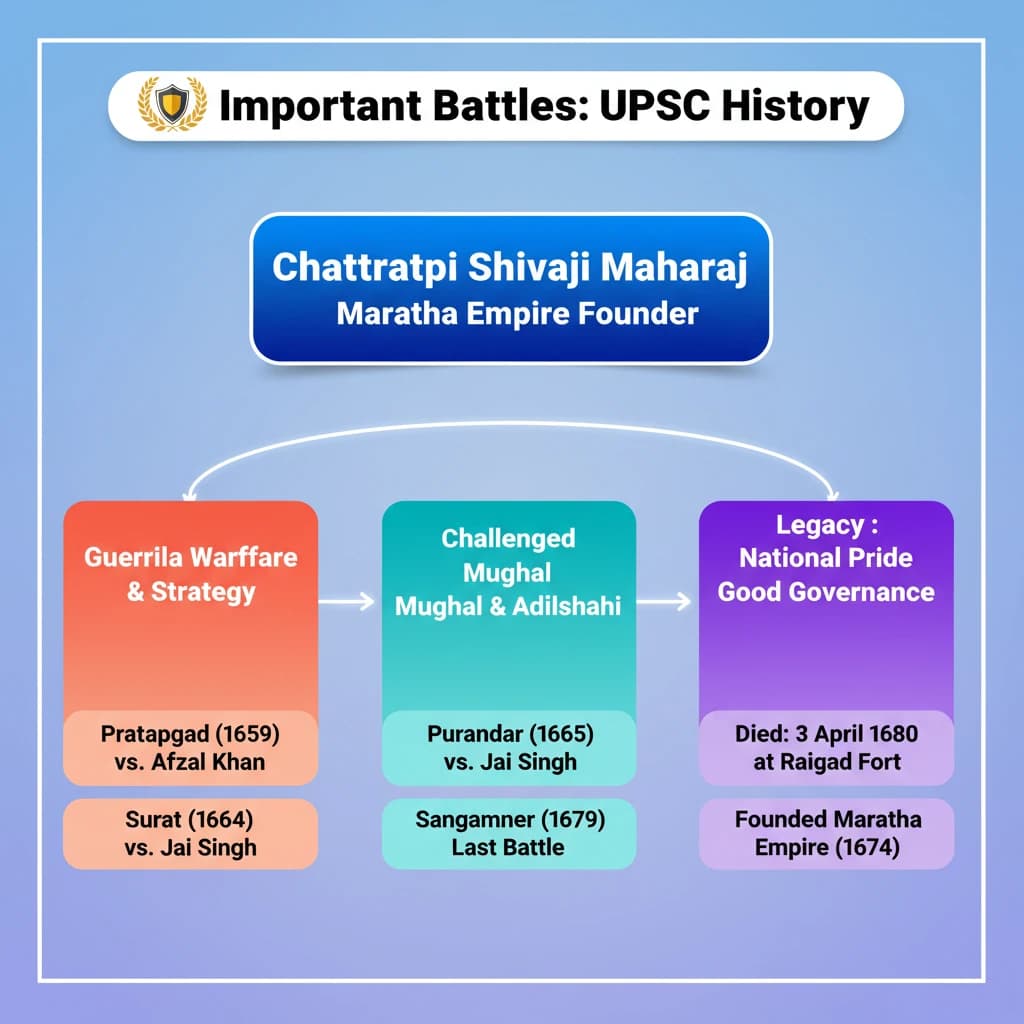
  • Chhatrapati Shivaji Maharaj founded the Maratha Empire, challenging Adilshahi and Mughal powers.
  • He died on 3rd April 1680 at Raigad.
  • Key battles include Pratapgad (1659, vs. Afzal Khan), Surat (1664, vs. Mughals), Purandar (1665, vs. Jai Singh), and Sangamner (1679, his last battle).
  • Shivaji was a master of guerrilla warfare and strategic planning.
  • His legacy continues to inspire national pride and principles of good governance.
Shivaji Maharaj: Death and Key Battles

Shivaji Maharaj: Death and Key Battles

Medium⏱️ 8 min read✓ 95% Verified
history

📖 Introduction

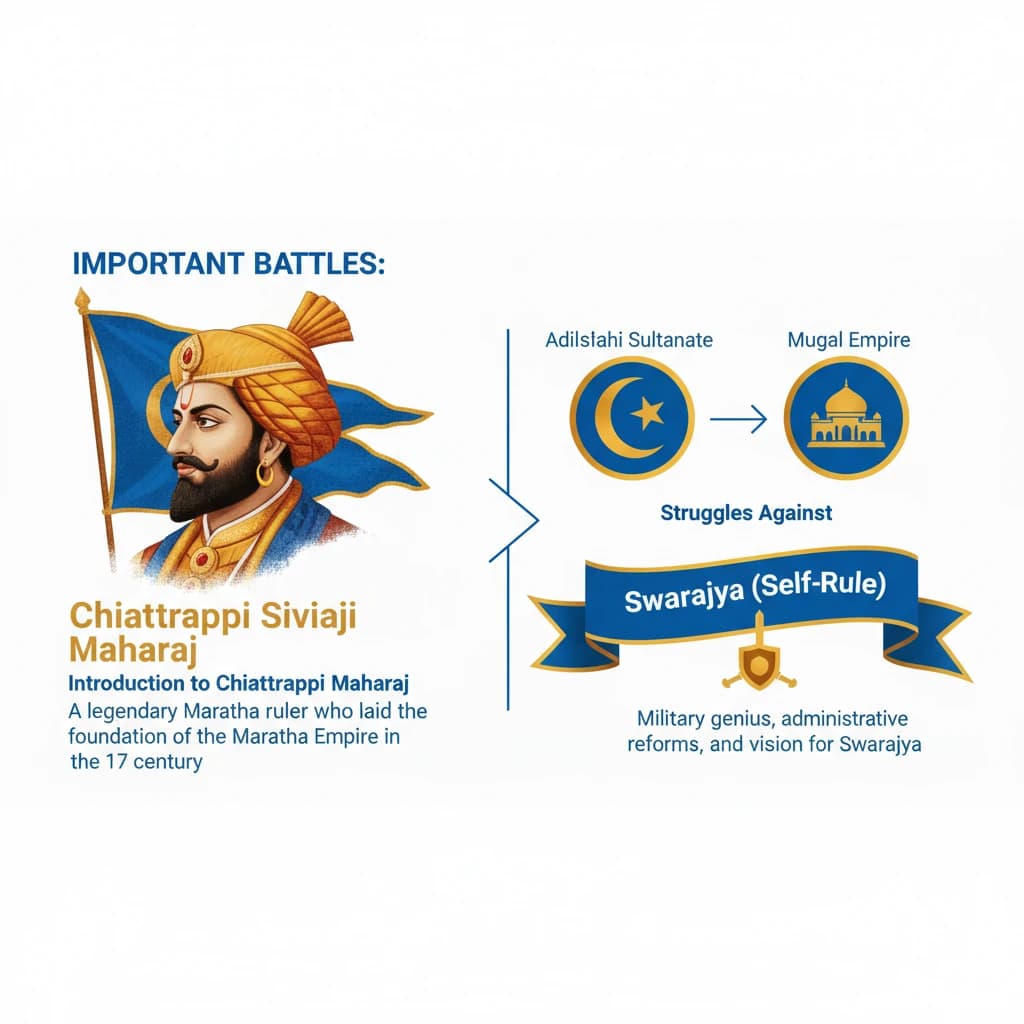
<h4>Introduction to Chhatrapati Shivaji Maharaj</h4><p><strong>Chhatrapati Shivaji Maharaj</strong> was a legendary Maratha ruler who laid the foundation of the <strong>Maratha Empire</strong> in the 17th century. His life was marked by continuous struggles against the <strong>Adilshahi Sultanate</strong> of Bijapur and the formidable <strong>Mughal Empire</strong>.</p><p>His military genius, administrative reforms, and vision for <strong>Swarajya</strong> (self-rule) make him one of the most revered figures in Indian history. The battles he fought were crucial in establishing Maratha dominance.</p><h4>Demise of Chhatrapati Shivaji Maharaj</h4><p>The great Maratha warrior, <strong>Chhatrapati Shivaji Maharaj</strong>, passed away on <strong>3rd April 1680</strong>. His death occurred at <strong>Raigad Fort</strong>, which served as the capital of his burgeoning empire.</p><div class='info-box'><p><strong>Date of Demise:</strong> <strong>3rd April 1680</strong></p><p><strong>Location:</strong> <strong>Raigad Fort</strong></p><p><strong>Cause:</strong> After a three-week fever, leading to his unfortunate demise.</p></div><h4>Key Battles of Chhatrapati Shivaji Maharaj</h4><p><strong>Shivaji Maharaj's</strong> military career was punctuated by several pivotal battles that showcased his strategic brilliance and leadership. These engagements were instrumental in expanding and securing the <strong>Maratha Empire</strong>.</p><p>Understanding these battles is crucial for grasping the dynamics of 17th-century Indian politics and warfare.</p><table class='info-table'><tr><th>Battle Name</th><th>Year</th><th>Parties Involved</th></tr><tr><td><strong>Battle of Pratapgad</strong></td><td><strong>1659</strong></td><td><strong>Maratha forces</strong> (led by <strong>Chhatrapati Shivaji Maharaj</strong>) vs. <strong>Adilshahi general Afzal Khan</strong></td></tr><tr><td><strong>Battle of Surat</strong></td><td><strong>1664</strong></td><td><strong>Chhatrapati Shivaji Maharaj</strong> vs. <strong>Inayat Khan</strong> (Mughal Governor)</td></tr><tr><td><strong>Battle of Purandar</strong></td><td><strong>1665</strong></td><td><strong>Chhatrapati Shivaji Maharaj</strong> vs. <strong>Mughal commander Jai Singh</strong></td></tr><tr><td><strong>Battle of Sangamner</strong></td><td><strong>1679</strong></td><td><strong>Mughal Empire</strong> vs. <strong>Maratha Empire</strong></td></tr></table><div class='key-point-box'><p>The <strong>Battle of Sangamner (1679)</strong> holds particular significance as it was the <strong>last battle</strong> in which <strong>Chhatrapati Shivaji Maharaj</strong> personally participated before his death in 1680.</p></div><div class='exam-tip-box'><p>For UPSC, remember not just the names and dates, but also the <strong>key adversaries</strong> and the <strong>strategic significance</strong> of each battle. Questions often test the chronology and the broader impact on the <strong>Maratha-Mughal relations</strong>.</p></div>
Concept Diagram

💡 Key Takeaways

  • •Chhatrapati Shivaji Maharaj founded the Maratha Empire, challenging Adilshahi and Mughal powers.
  • •He died on 3rd April 1680 at Raigad.
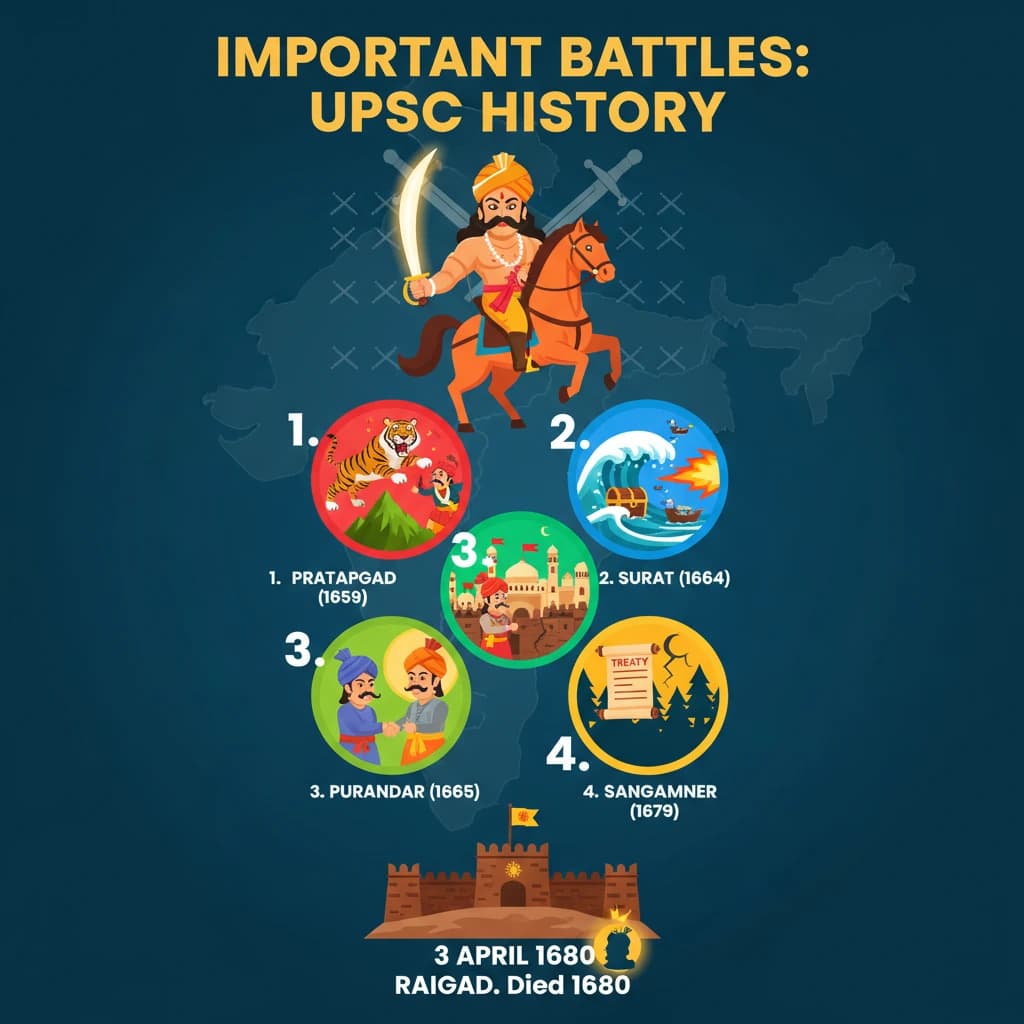
  • •Key battles include Pratapgad (1659, vs. Afzal Khan), Surat (1664, vs. Mughals), Purandar (1665, vs. Jai Singh), and Sangamner (1679, his last battle).
  • •Shivaji was a master of guerrilla warfare and strategic planning.
  • •His legacy continues to inspire national pride and principles of good governance.

🧠 Memory Techniques
Memory Aid
95% Verified Content

📚 Reference Sources

•NCERT History Textbooks (Class XI & XII)
•A History of the Marathas by James Grant Duff (for historical context)
•Shivaji and His Times by Jadunath Sarkar (for detailed accounts)

Related Topics

Loading related topics...
Explore:History Topics·All Subjects·Daily Current Affairs·Editorial Analysis·Previous Year Questions·UPSC GPT
Shivaji Maharaj: Death and Key Battles - UPSC History