Loading page, please wait…
Vaidra Logo
Vaidra

Top 4 items + smart groups

UPSC GPT
New
Current Affairs
Daily Solutions
Daily Puzzle
Mains Evaluator

Version 2.0.0 • Built with ❤️ for UPSC aspirants

Loading...
Loading...
Loading...
Loading...
Loading...
Loading...
Loading...
Loading...
Loading...
Loading...
Loading...
Loading...
Loading...
Back
All Subjects

Topics

0 topics • 0 completed

Loading topics...
Loading...
Loading...
Loading...
Loading...
Loading...
Overall Progress0%

Pulakesin II: The Pinnacle of Chalukya Power - UPSC History

What is Pulakesin II: The Pinnacle of Chalukya Power in UPSC History?

Pulakesin II: The Pinnacle of Chalukya Power is a key topic under History for UPSC Civil Services Examination. Key points include: Pulakesin II was the most powerful ruler of the Badami Chalukya dynasty.. He conquered numerous kingdoms including Kadambas, Gangas, Mauryas, Latas, Malavas, and Gurjars.. Pulakesin II secured submissions from the Chola, Chera, and Pandya kings, demonstrating widespread influence.. Understanding this topic is essential for both UPSC Prelims and Mains preparation.

Why is Pulakesin II: The Pinnacle of Chalukya Power important for UPSC exam?

Pulakesin II: The Pinnacle of Chalukya Power is a Medium-level topic in UPSC History. It is tested in both Prelims (factual MCQs) and Mains (analytical answer writing). Previous year UPSC questions have frequently covered aspects of Pulakesin II: The Pinnacle of Chalukya Power, making it essential for comprehensive IAS preparation.

How to prepare Pulakesin II: The Pinnacle of Chalukya Power for UPSC?

To prepare Pulakesin II: The Pinnacle of Chalukya Power for UPSC: (1) Study the comprehensive notes covering all key concepts on Vaidra. (2) Practice previous year questions on this topic. (3) Connect it with current affairs using daily updates. (4) Revise using key takeaways and mind maps available for History. (5) Write practice answers linking Pulakesin II: The Pinnacle of Chalukya Power to related GS Paper topics.

Key takeaways of Pulakesin II: The Pinnacle of Chalukya Power for UPSC

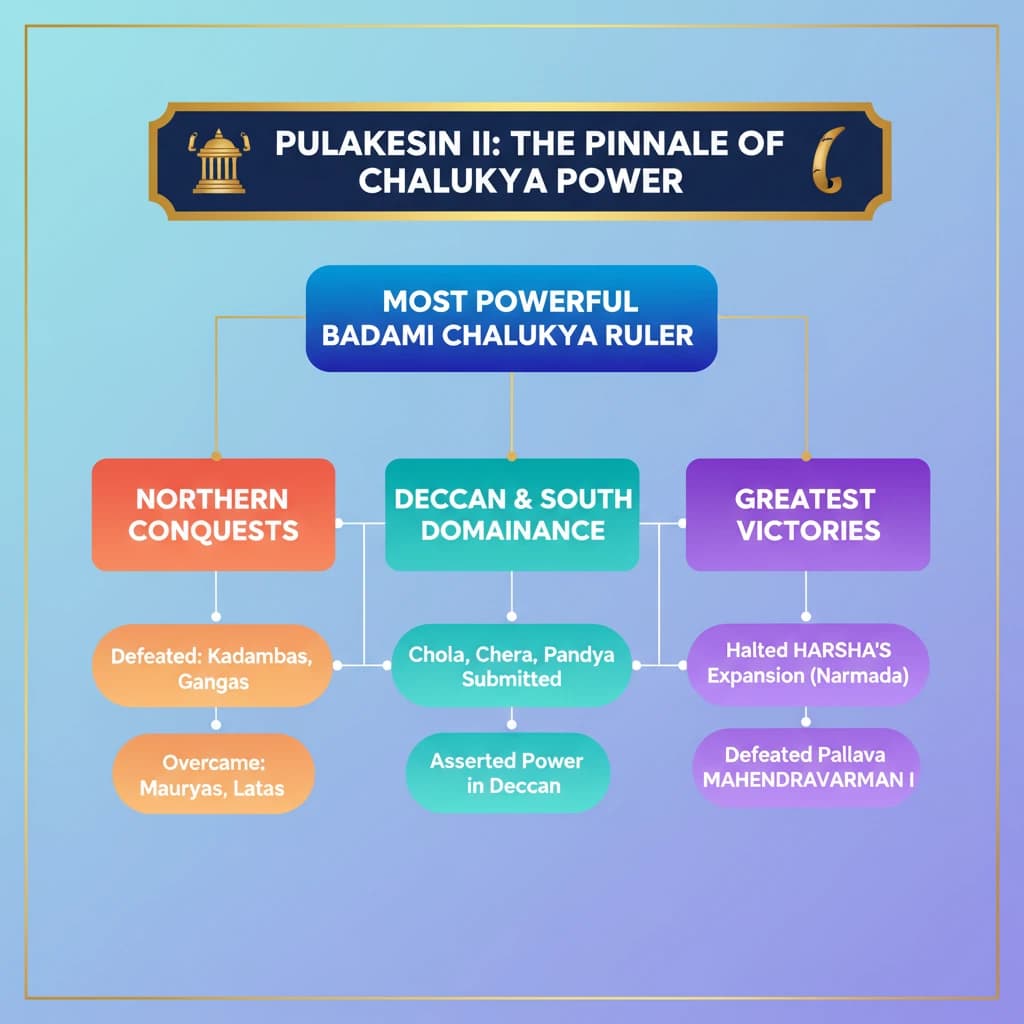
  • Pulakesin II was the most powerful ruler of the Badami Chalukya dynasty.
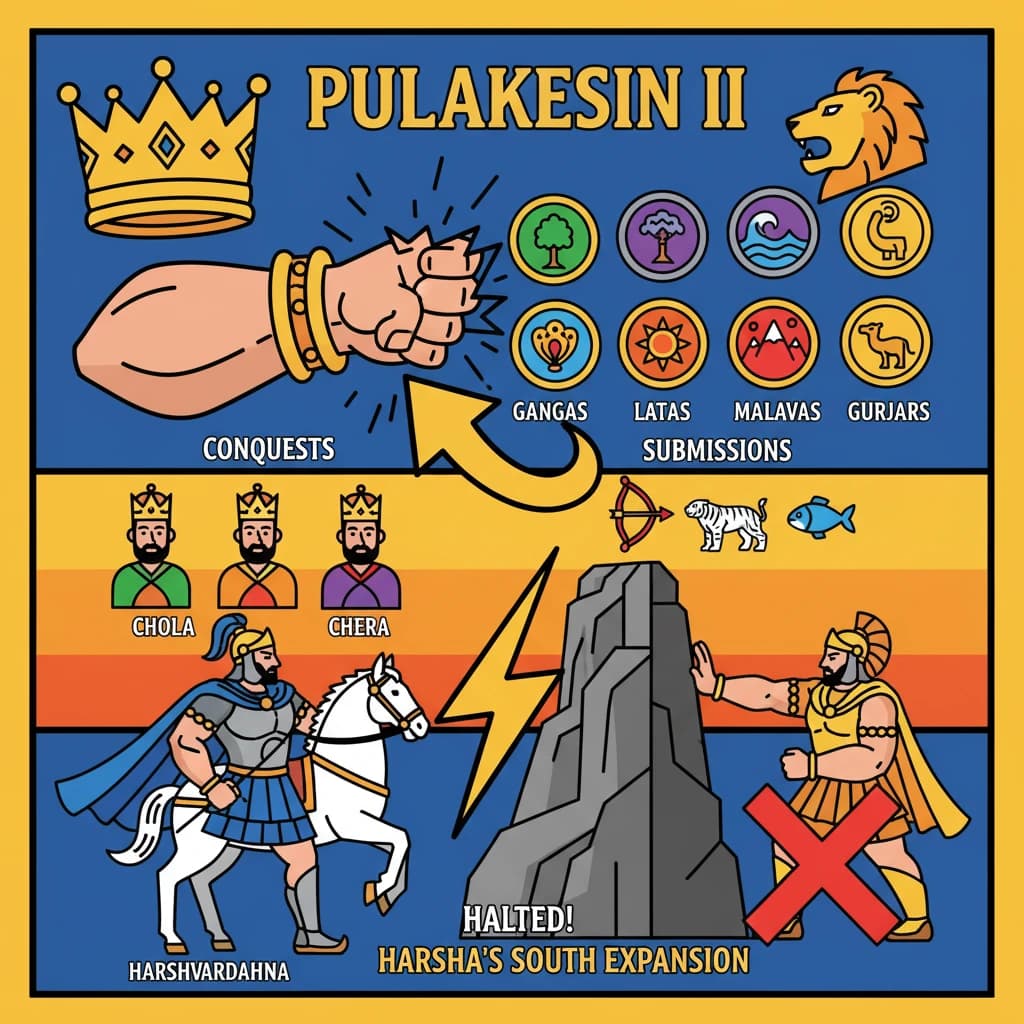
  • He conquered numerous kingdoms including Kadambas, Gangas, Mauryas, Latas, Malavas, and Gurjars.
  • Pulakesin II secured submissions from the Chola, Chera, and Pandya kings, demonstrating widespread influence.
  • His most famous victory was against Harshavardhana of Kannauj, halting Harsha's southern expansion.
  • He also decisively defeated the Pallava king Mahendravarman I, asserting Chalukya dominance in the Deccan.
Pulakesin II: The Pinnacle of Chalukya Power

Pulakesin II: The Pinnacle of Chalukya Power

Medium⏱️ 7 min read✓ 95% Verified
history

📖 Introduction

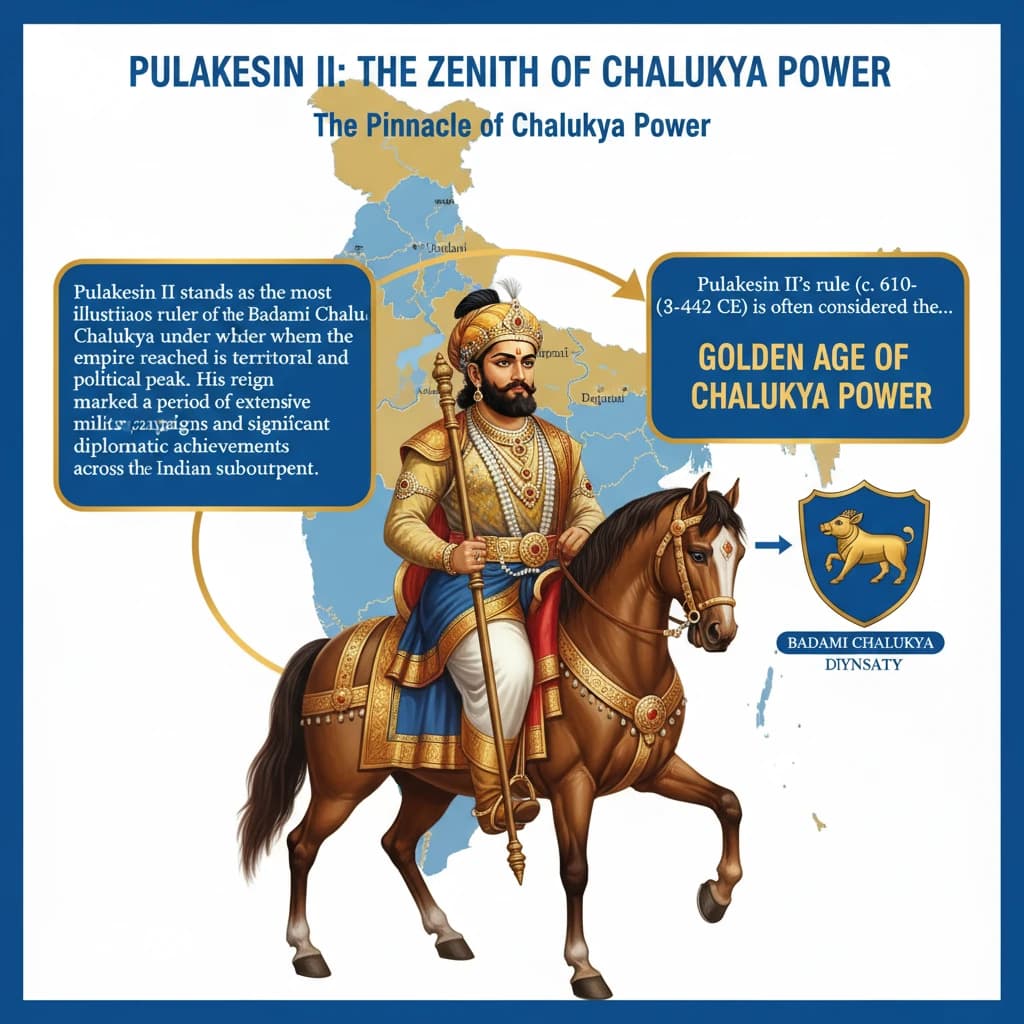
<h4>Pulakesin II: The Zenith of Chalukya Power</h4><p><strong>Pulakesin II</strong> stands as the most illustrious ruler of the <strong>Badami Chalukya dynasty</strong>, under whom the empire reached its territorial and political peak. His reign marked a period of extensive military campaigns and significant diplomatic achievements across the Indian subcontinent.</p><div class='key-point-box'><p><strong>Pulakesin II's</strong> rule (c. <strong>610-642 CE</strong>) is often considered the <strong>'Golden Age'</strong> of the <strong>Chalukyas of Badami</strong>. His military acumen and strategic brilliance were unparalleled, allowing him to establish a vast dominion.</p></div><h4>Conquest of Minor Kingdoms</h4><p><strong>Pulakesin II</strong> embarked on a series of successful campaigns, bringing numerous smaller kingdoms under <strong>Chalukya</strong> suzerainty. These victories consolidated his power base and expanded the empire's influence significantly.</p><div class='info-box'><ul><li><strong>Kadambas:</strong> The ancient kingdom of <strong>Kadambas</strong>, a traditional rival, was decisively defeated.</li><li><strong>Gangas of Mysore:</strong> The <strong>Western Ganga Dynasty</strong>, centered in <strong>Mysore</strong>, also submitted to <strong>Pulakesin II's</strong> might.</li><li><strong>Mauryas of North Konkan:</strong> He extended his control to the coastal regions by conquering the <strong>Mauryas of North Konkan</strong>.</li><li><strong>Latas of Gujarat:</strong> The <strong>Latas</strong>, who ruled parts of modern-day <strong>Gujarat</strong>, were brought into the <strong>Chalukya</strong> fold.</li><li><strong>Malavas and Gurjars:</strong> Further north, the regions governed by the <strong>Malavas</strong> and <strong>Gurjars</strong> also acknowledged <strong>Pulakesin II's</strong> supremacy.</li></ul></div><h4>Securing Submissions from Southern Powers</h4><p>Beyond direct conquest, <strong>Pulakesin II</strong> demonstrated his widespread influence by securing submissions from powerful southern kingdoms. This established the <strong>Chalukyas</strong> as the dominant force in the Deccan and beyond.</p><div class='info-box'><p>The powerful southern dynasties of the <strong>Cholas</strong>, <strong>Cheras</strong>, and <strong>Pandyas</strong> were compelled to acknowledge <strong>Pulakesin II's</strong> authority. This was a testament to his military might and the extensive reach of the <strong>Chalukya</strong> empire.</p></div><h4>Defeat of Major Imperial Rivals</h4><p>The most significant achievements of <strong>Pulakesin II's</strong> reign were his decisive victories against two of the most formidable rulers of his time: <strong>Harshavardhana</strong> of <strong>Kannauj</strong> in the north and <strong>Mahendravarman I</strong> of the <strong>Pallava dynasty</strong> in the south.</p><div class='key-point-box'><p>The victory over <strong>Harsha</strong> is famously recorded in the <strong>Aihole inscription</strong>, composed by his court poet <strong>Ravikirti</strong>. This established <strong>Pulakesin II</strong> as the undisputed master of the south, halting <strong>Harsha's</strong> ambitions of southern expansion.</p></div><div class='exam-tip-box'><p><strong>UPSC Insight:</strong> The clash between <strong>Pulakesin II</strong> and <strong>Harsha</strong> is a frequently asked topic in <strong>Ancient Indian History</strong>, especially regarding their respective spheres of influence and military capabilities. The <strong>Aihole inscription</strong> is a crucial primary source for this period.</p></div><p>His conflict with the <strong>Pallavas</strong> was a protracted struggle for supremacy in the south. <strong>Pulakesin II</strong> successfully defeated the formidable <strong>Pallava king Mahendravarman I</strong>, asserting <strong>Chalukya</strong> dominance over their southern neighbors.</p>
Concept Diagram

💡 Key Takeaways

  • •Pulakesin II was the most powerful ruler of the Badami Chalukya dynasty.
  • •He conquered numerous kingdoms including Kadambas, Gangas, Mauryas, Latas, Malavas, and Gurjars.
  • •Pulakesin II secured submissions from the Chola, Chera, and Pandya kings, demonstrating widespread influence.
  • •His most famous victory was against Harshavardhana of Kannauj, halting Harsha's southern expansion.
  • •He also decisively defeated the Pallava king Mahendravarman I, asserting Chalukya dominance in the Deccan.

🧠 Memory Techniques
Memory Aid
95% Verified Content

📚 Reference Sources

•NCERT Class XI/XII History Textbooks (Ancient India)
•A History of Ancient and Early Medieval India by Upinder Singh
•India's Ancient Past by R.S. Sharma

Related Topics

Loading related topics...
Explore:History Topics·All Subjects·Daily Current Affairs·Editorial Analysis·Previous Year Questions·UPSC GPT
Pulakesin II: The Pinnacle of Chalukya Power - UPSC History