Loading page, please wait…
Vaidra Logo
Vaidra

Top 4 items + smart groups

UPSC GPT
New
Current Affairs
Daily Solutions
Daily Puzzle
Mains Evaluator

Version 2.0.0 • Built with ❤️ for UPSC aspirants

Loading...
Loading...
Loading...
Loading...
Loading...
Loading...
Loading...
Loading...
Loading...
Loading...
Loading...
Loading...
Loading...
Back
All Subjects

Topics

0 topics • 0 completed

Loading topics...
Loading...
Loading...
Loading...
Loading...
Loading...
Overall Progress0%

VD Savarkar: Punya Tithi, Abhinav Bharat Society & Key Facts for UPSC - UPSC History

What is VD Savarkar: Punya Tithi, Abhinav Bharat Society & Key Facts for UPSC in UPSC History?

VD Savarkar: Punya Tithi, Abhinav Bharat Society & Key Facts for UPSC is a key topic under History for UPSC Civil Services Examination. Key points include: V.D. Savarkar was a prominent freedom fighter born on May 28, 1883, in Bhagur, Maharashtra.. His Punya Tithi is observed annually on February 26.. He founded the secret revolutionary society, Abhinav Bharat Society, in 1904.. Understanding this topic is essential for both UPSC Prelims and Mains preparation.

Why is VD Savarkar: Punya Tithi, Abhinav Bharat Society & Key Facts for UPSC important for UPSC exam?

VD Savarkar: Punya Tithi, Abhinav Bharat Society & Key Facts for UPSC is a Easy-level topic in UPSC History. It is tested in both Prelims (factual MCQs) and Mains (analytical answer writing). Previous year UPSC questions have frequently covered aspects of VD Savarkar: Punya Tithi, Abhinav Bharat Society & Key Facts for UPSC, making it essential for comprehensive IAS preparation.

How to prepare VD Savarkar: Punya Tithi, Abhinav Bharat Society & Key Facts for UPSC for UPSC?

To prepare VD Savarkar: Punya Tithi, Abhinav Bharat Society & Key Facts for UPSC for UPSC: (1) Study the comprehensive notes covering all key concepts on Vaidra. (2) Practice previous year questions on this topic. (3) Connect it with current affairs using daily updates. (4) Revise using key takeaways and mind maps available for History. (5) Write practice answers linking VD Savarkar: Punya Tithi, Abhinav Bharat Society & Key Facts for UPSC to related GS Paper topics.

Key takeaways of VD Savarkar: Punya Tithi, Abhinav Bharat Society & Key Facts for UPSC for UPSC

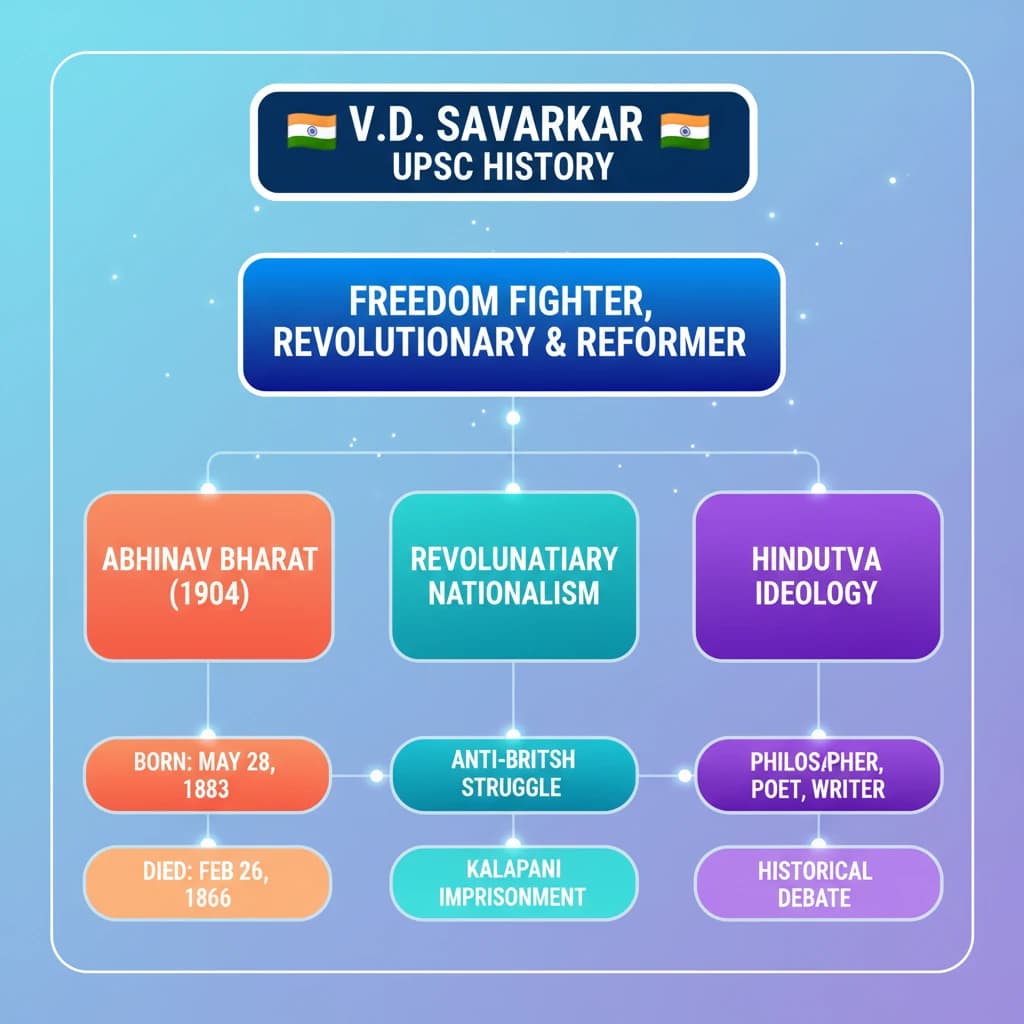
  • V.D. Savarkar was a prominent freedom fighter born on May 28, 1883, in Bhagur, Maharashtra.
  • His Punya Tithi is observed annually on February 26.
  • He founded the secret revolutionary society, Abhinav Bharat Society, in 1904.
  • Savarkar's early life was marked by revolutionary nationalism against British rule.
  • His legacy continues to be a subject of significant historical and political debate in India.
VD Savarkar: Punya Tithi, Abhinav Bharat Society & Key Facts for UPSC

VD Savarkar: Punya Tithi, Abhinav Bharat Society & Key Facts for UPSC

Easy⏱️ 5 min read✓ 98% Verified
history

📖 Introduction

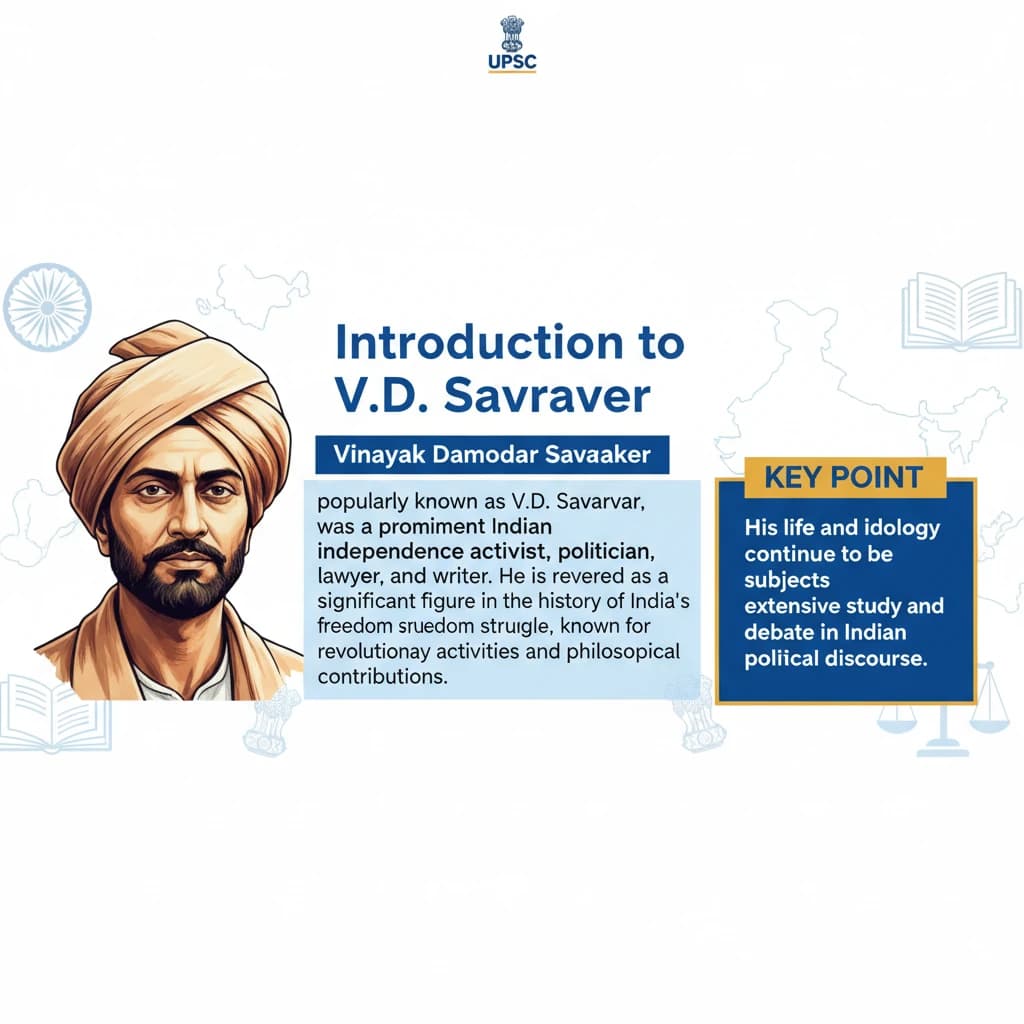
<h4>Introduction to V.D. Savarkar</h4><p><strong>Vinayak Damodar Savarkar</strong>, popularly known as <strong>V.D. Savarkar</strong>, was a prominent Indian independence activist, politician, lawyer, and writer. He is revered as a significant figure in the history of India's freedom struggle, known for his revolutionary activities and philosophical contributions.</p><div class='key-point-box'><p>His life and ideology continue to be subjects of extensive study and debate in Indian political discourse and historical analysis.</p></div><h4>Birth and Early Life</h4><p><strong>V.D. Savarkar</strong> was born on <strong>May 28, 1883</strong>, in the village of <strong>Bhagur</strong>, located near <strong>Nashik</strong> in the state of <strong>Maharashtra</strong>. His early life was marked by a strong sense of nationalism and a commitment to India's independence.</p><div class='info-box'><p><strong>Birth Details:</strong></p><ul><li><strong>Date:</strong> May 28, 1883</li><li><strong>Place:</strong> Bhagur, Nashik, Maharashtra</li></ul></div><h4>Observance of Punya Tithi</h4><p>The <strong>Punya Tithi</strong> (death anniversary) of <strong>V.D. Savarkar</strong> is observed annually on <strong>February 26</strong>. This day commemorates his contributions and legacy.</p><div class='exam-tip-box'><p>Understanding the significance of observing historical figures' anniversaries (<strong>Punya Tithi</strong> or <strong>Jayanti</strong>) is important for <strong>UPSC Mains GS Paper I</strong>, particularly in questions related to modern Indian history and post-independence consolidation, as it reflects ongoing historical narratives and national memory.</p></div><h4>Key Organizations and Contributions</h4><p>Among his significant contributions, <strong>V.D. Savarkar</strong> founded a secret revolutionary society known as the <strong>Abhinav Bharat Society</strong>. This organization played a crucial role in fostering revolutionary ideas and actions against British rule.</p><div class='info-box'><p><strong>Key Organization:</strong></p><ul><li><strong>Name:</strong> Abhinav Bharat Society</li><li><strong>Nature:</strong> Secret revolutionary society</li><li><strong>Purpose:</strong> To overthrow British rule through revolutionary means</li></ul></div><p>His involvement in such organizations highlights his commitment to armed resistance as a means to achieve India's independence.</p>
Concept Diagram

💡 Key Takeaways

  • •V.D. Savarkar was a prominent freedom fighter born on May 28, 1883, in Bhagur, Maharashtra.
  • •His Punya Tithi is observed annually on February 26.
  • •He founded the secret revolutionary society, Abhinav Bharat Society, in 1904.
  • •Savarkar's early life was marked by revolutionary nationalism against British rule.
  • •His legacy continues to be a subject of significant historical and political debate in India.

🧠 Memory Techniques

Memory Aid
98% Verified Content

📚 Reference Sources

•General knowledge of Indian Modern History

Related Topics

Loading related topics...
Explore:History Topics·All Subjects·Daily Current Affairs·Editorial Analysis·Previous Year Questions·UPSC GPT
VD Savarkar: Punya Tithi, Abhinav Bharat Society & Key Facts for UPSC - UPSC History