Loading page, please wait…
Vaidra Logo
Vaidra

Top 4 items + smart groups

UPSC GPT
New
Current Affairs
Daily Solutions
Daily Puzzle
Mains Evaluator

Version 2.0.0 • Built with ❤️ for UPSC aspirants

Loading...
Loading...
Loading...
Loading...
Loading...
Loading...
Loading...
Loading...
Loading...
Loading...
Loading...
Loading...
Loading...
Back
All Subjects

Topics

0 topics • 0 completed

Loading topics...
Loading...
Loading...
Loading...
Loading...
Loading...
Overall Progress0%

What are the Key Facts of the Vijayanagar Empire? - UPSC History

What is What are the Key Facts of the Vijayanagar Empire? in UPSC History?

What are the Key Facts of the Vijayanagar Empire? is a key topic under History for UPSC Civil Services Examination. Key points include: Krishnadevaraya was a scholar and author, writing works like Amuktamalyada.. His court hosted the Ashtadiggajas, including Allasani Peddana (Andhra-kavitapitamaha), author of Manucharitamu.. He patronized Telugu, Kannada, Sanskrit, and Tamil poets.. Understanding this topic is essential for both UPSC Prelims and Mains preparation.

Why is What are the Key Facts of the Vijayanagar Empire? important for UPSC exam?

What are the Key Facts of the Vijayanagar Empire? is a Medium-level topic in UPSC History. It is tested in both Prelims (factual MCQs) and Mains (analytical answer writing). Previous year UPSC questions have frequently covered aspects of What are the Key Facts of the Vijayanagar Empire?, making it essential for comprehensive IAS preparation.

How to prepare What are the Key Facts of the Vijayanagar Empire? for UPSC?

To prepare What are the Key Facts of the Vijayanagar Empire? for UPSC: (1) Study the comprehensive notes covering all key concepts on Vaidra. (2) Practice previous year questions on this topic. (3) Connect it with current affairs using daily updates. (4) Revise using key takeaways and mind maps available for History. (5) Write practice answers linking What are the Key Facts of the Vijayanagar Empire? to related GS Paper topics.

Key takeaways of What are the Key Facts of the Vijayanagar Empire? for UPSC

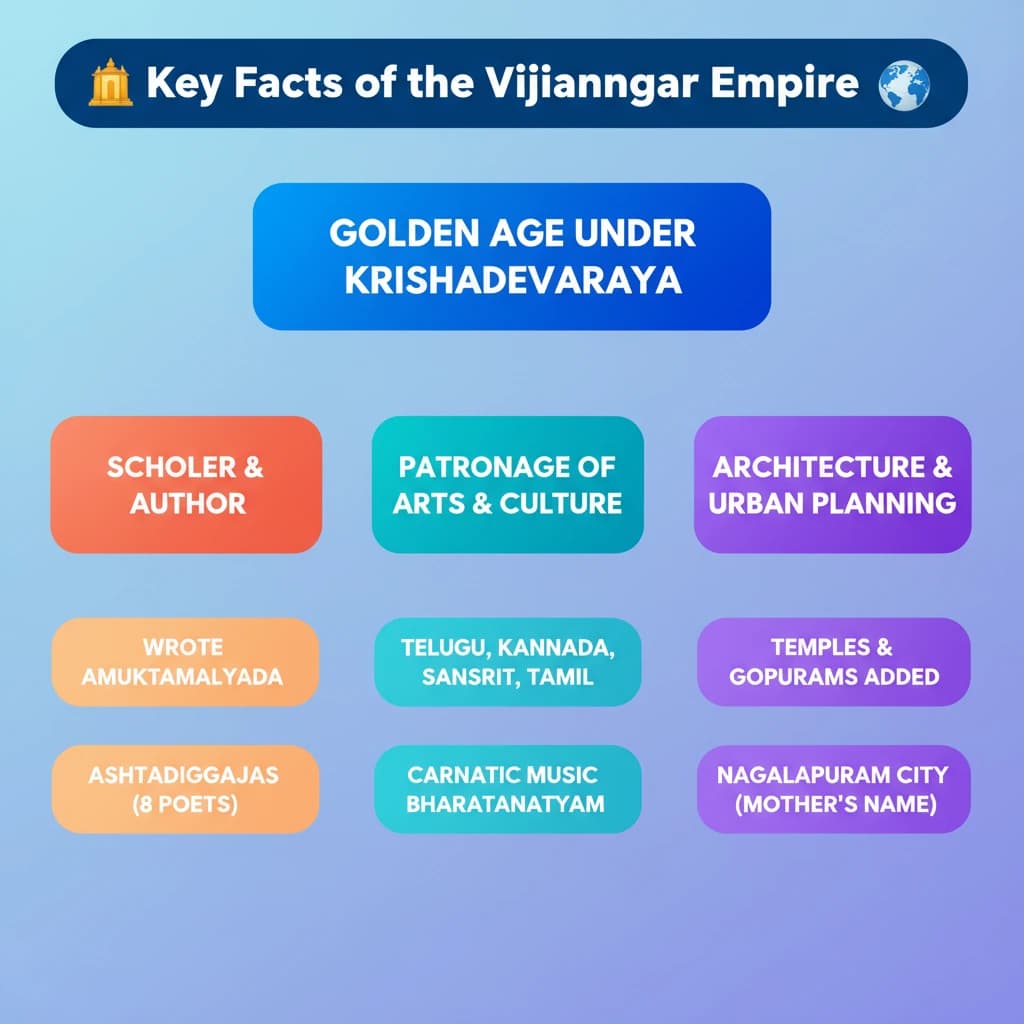
  • Krishnadevaraya was a scholar and author, writing works like Amuktamalyada.
  • His court hosted the Ashtadiggajas, including Allasani Peddana (Andhra-kavitapitamaha), author of Manucharitamu.
  • He patronized Telugu, Kannada, Sanskrit, and Tamil poets.
  • He significantly nurtured Carnatic music and classical dance forms like Bharatanatyam and Kuchipudi.
  • He built temples, added gopurams, and founded Nagalapuram after his mother.
What are the Key Facts of the Vijayanagar Empire?

What are the Key Facts of the Vijayanagar Empire?

Medium⏱️ 7 min read✓ 95% Verified
history

📖 Introduction

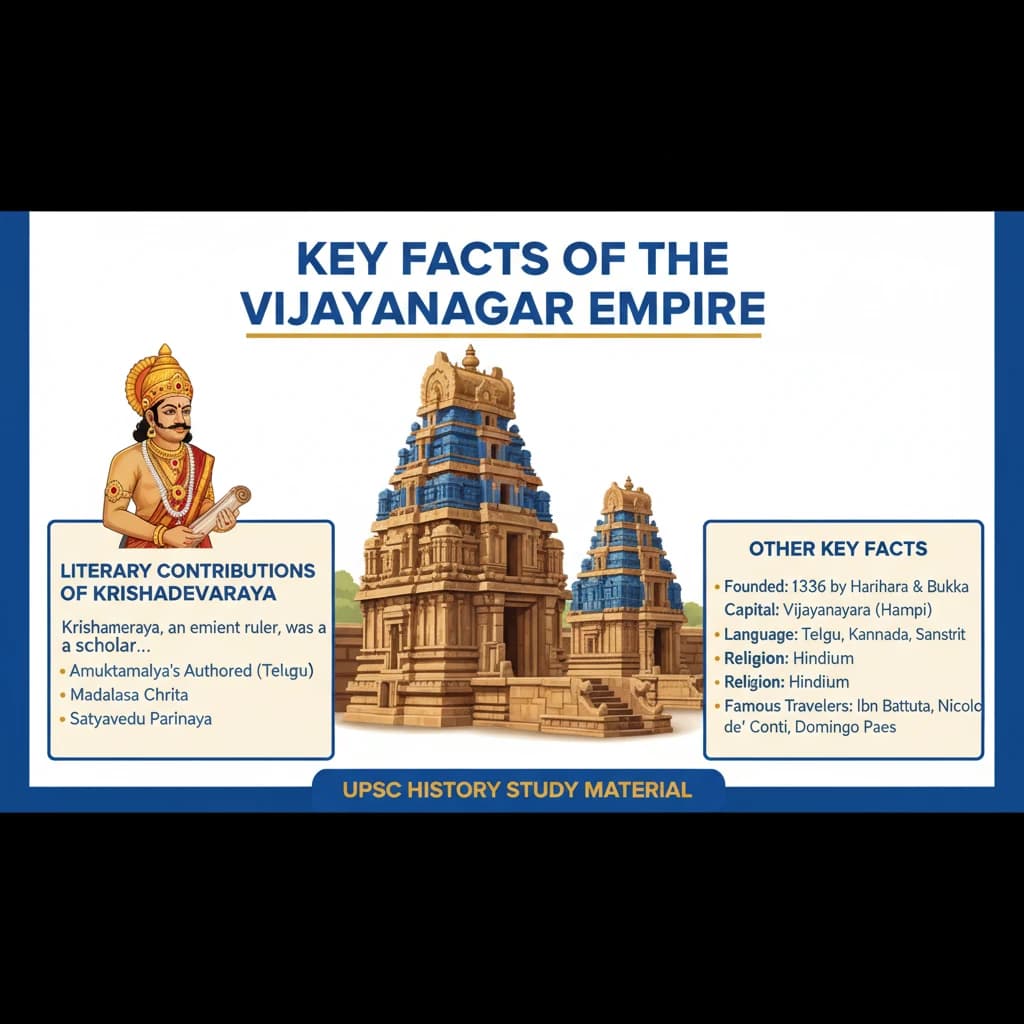
<h4>Literary Contributions of Krishnadevaraya</h4><p><strong>Krishnadevaraya</strong>, the eminent ruler of the <strong>Vijayanagar Empire</strong>, was not only a great warrior but also a profound scholar. He authored several significant literary works himself, showcasing his intellectual prowess.</p><div class='info-box'><p><strong>Krishnadevaraya's Authored Works:</strong></p><ul><li><strong>Amuktamalyada</strong> (Telugu)</li><li><strong>Madalasa Charita</strong></li><li><strong>Satyavedu Parinaya</strong></li><li><strong>Rasamanjari</strong></li><li><strong>Jambavati Kalyana</strong></li></ul></div><p>He was fluent in multiple languages, demonstrating a broad linguistic aptitude. This proficiency enabled him to appreciate and support literary endeavors across various regional languages.</p><h4>Patronage of Learning and Literature</h4><p><strong>Krishnadevaraya's</strong> court was a vibrant hub for scholars and poets, reflecting his deep commitment to fostering learning. His patronage extended to diverse linguistic traditions, including <strong>Sanskrit</strong>, <strong>Telugu</strong>, <strong>Tamil</strong>, and <strong>Kannada</strong>.</p><div class='key-point-box'><p><strong>The Ashtadiggajas:</strong></p><p>His court was famously adorned by the <strong>Ashtadiggajas</strong>, meaning 'eight elephants of literature'. These were eight prominent scholars who significantly enriched Telugu literature during his reign.</p></div><p>Among the <strong>Ashtadiggajas</strong>, <strong>Allasani Peddana</strong> held a pre-eminent position. He was revered as the <strong>Andhra-kavitapitamaha</strong>, or 'Grandfather of Telugu Poetry', and is celebrated for his magnum opus.</p><div class='info-box'><p><strong>Notable Literary Figures and Works:</strong></p><ul><li><strong>Allasani Peddana:</strong> Known for <strong>Manucharitamu</strong>.</li><li><strong>Thimmana (Kannada poet):</strong> Completed the <strong>Kannada Mahabharatha</strong>, originally started by <strong>Kumara Vyasa</strong>, at Krishnadevaraya’s request.</li><li><strong>Mallanarya (Kannada poet):</strong> Author of <strong>Veerasivamartha</strong> and <strong>Bhavachintaratna</strong>.</li><li><strong>Chatu Vittalanatha:</strong> Wrote <strong>Bhagvatha</strong>.</li><li><strong>Thimmanna Kavi:</strong> Famous for his eulogy, <strong>Krishnadeva Bharata</strong>.</li><li><strong>Peddanna (Telugu poet):</strong> Honoured for his exceptional proficiency in both <strong>Telugu</strong> and <strong>Sanskrit</strong>.</li></ul></div><h4>Cultural Development and Arts</h4><p>Beyond literature, <strong>Krishnadevaraya</strong> played a pivotal role in the development and promotion of various art forms. His reign saw a flourishing of music and dance traditions, which continue to influence Indian culture today.</p><div class='key-point-box'><p><strong>Promotion of Performing Arts:</strong></p><ul><li>He significantly nurtured the <strong>Carnatic musical tradition</strong>, providing it with royal patronage and encouragement.</li><li>He actively encouraged classical dance forms, including <strong>Bharatanatyam</strong> and <strong>Kuchipudi</strong>, contributing to their growth and popularity.</li></ul></div><h4>Infrastructural Development and Urban Planning</h4><p><strong>Krishnadevaraya's</strong> contributions were not limited to intellectual and cultural spheres; he also left a lasting legacy in terms of infrastructure and urban development. His reign is marked by significant architectural endeavors.</p><p>He is widely credited with the construction of several magnificent temples. Additionally, he commissioned the addition of impressive <strong>gopurams</strong> (ornate tower gateways) to many important existing temples across South India.</p><div class='info-box'><p><strong>Urban Development:</strong></p><p><strong>Krishnadevaraya</strong> founded a suburban township near the capital city of <strong>Vijayanagar</strong>. This new settlement was named <strong>Nagalapuram</strong>, in honour of his mother.</p></div><div class='exam-tip-box'><p><strong>UPSC Insight:</strong> The cultural and architectural contributions of <strong>Krishnadevaraya</strong> are frequently asked in <strong>UPSC Prelims</strong> (matching pairs, factual questions) and <strong>Mains GS Paper 1</strong> (Art & Culture section) regarding the <strong>Vijayanagar Empire</strong>.</p></div>
Concept Diagram

💡 Key Takeaways

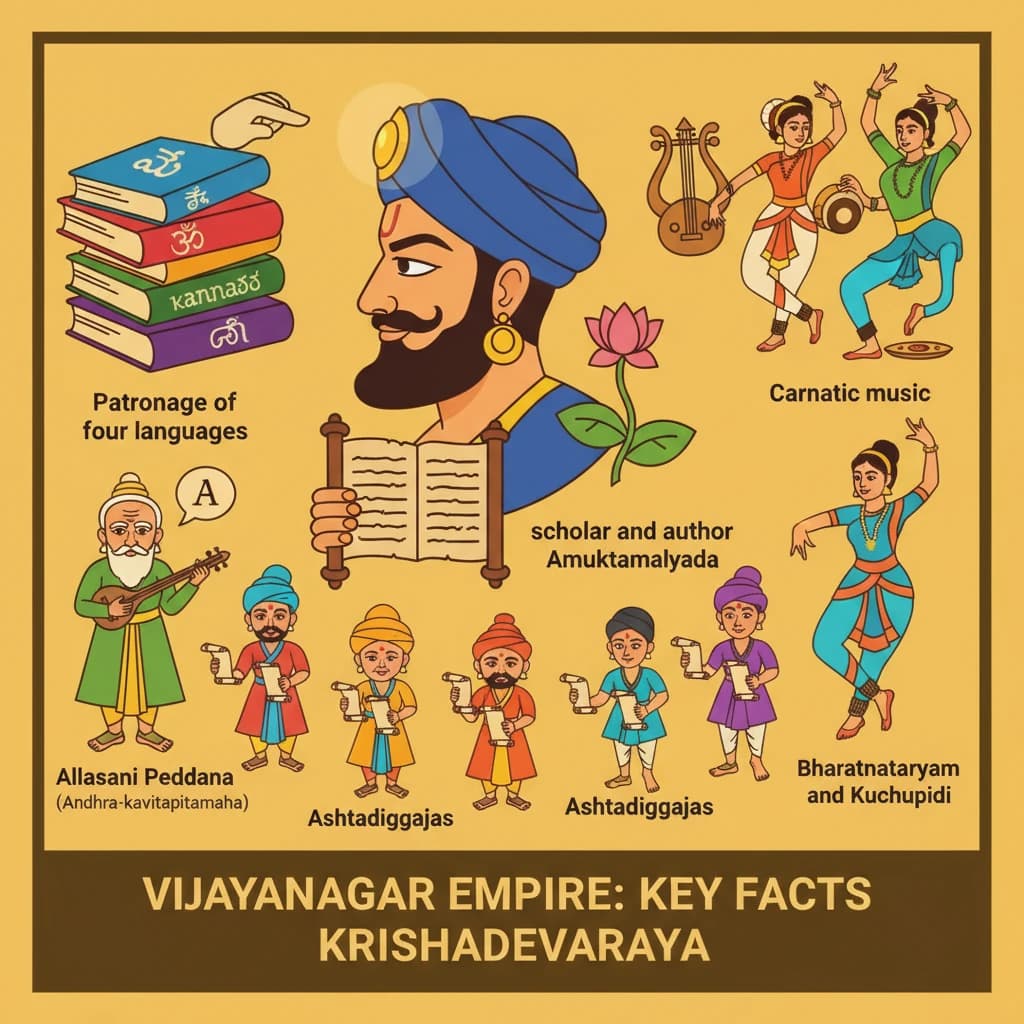
  • •Krishnadevaraya was a scholar and author, writing works like Amuktamalyada.
  • •His court hosted the Ashtadiggajas, including Allasani Peddana (Andhra-kavitapitamaha), author of Manucharitamu.
  • •He patronized Telugu, Kannada, Sanskrit, and Tamil poets.
  • •He significantly nurtured Carnatic music and classical dance forms like Bharatanatyam and Kuchipudi.
  • •He built temples, added gopurams, and founded Nagalapuram after his mother.

🧠 Memory Techniques
Memory Aid
95% Verified Content

Related Topics

Loading related topics...
Explore:History Topics·All Subjects·Daily Current Affairs·Editorial Analysis·Previous Year Questions·UPSC GPT
What are the Key Facts of the Vijayanagar Empire? - UPSC History