Loading page, please wait…
Vaidra Logo
Vaidra

Top 4 items + smart groups

UPSC GPT
New
Current Affairs
Daily Solutions
Daily Puzzle
Mains Evaluator

Version 2.0.0 • Built with ❤️ for UPSC aspirants

Loading...
Loading...
Loading...
Loading...
Loading...
Loading...
Loading...
Loading...
Loading...
Loading...
Loading...
Loading...
Loading...
Back
All Subjects

Topics

0 topics • 0 completed

Loading topics...
Loading...
Loading...
Loading...
Loading...
Loading...
Overall Progress0%

Arunachal Pradesh: From NEFA to Statehood - A Historical Overview - UPSC History

What is Arunachal Pradesh: From NEFA to Statehood - A Historical Overview in UPSC History?

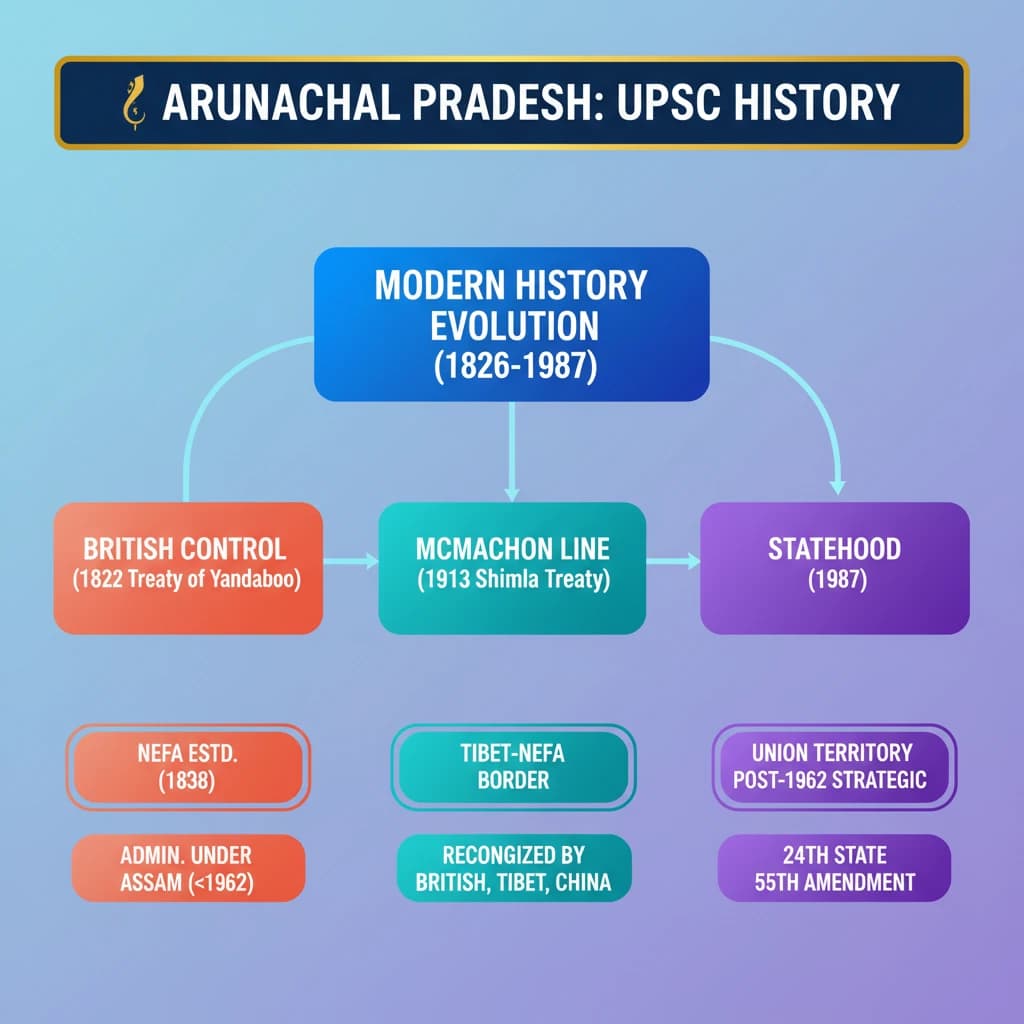
Arunachal Pradesh: From NEFA to Statehood - A Historical Overview is a key topic under History for UPSC Civil Services Examination. Key points include: Arunachal Pradesh's modern history began with British control via the 1826 Treaty of Yandaboo, leading to NEFA's establishment by 1838.. The 1913 Shimla Treaty defined the McMahon Line as the border between Tibet and NEFA, recognized by British, Tibetan, and Chinese authorities.. Before 1962, it was under Assam's jurisdiction; post-1962, it became a Union Territory due to strategic importance.. Understanding this topic is essential for both UPSC Prelims and Mains preparation.

Why is Arunachal Pradesh: From NEFA to Statehood - A Historical Overview important for UPSC exam?

Arunachal Pradesh: From NEFA to Statehood - A Historical Overview is a Medium-level topic in UPSC History. It is tested in both Prelims (factual MCQs) and Mains (analytical answer writing). Previous year UPSC questions have frequently covered aspects of Arunachal Pradesh: From NEFA to Statehood - A Historical Overview, making it essential for comprehensive IAS preparation.

How to prepare Arunachal Pradesh: From NEFA to Statehood - A Historical Overview for UPSC?

To prepare Arunachal Pradesh: From NEFA to Statehood - A Historical Overview for UPSC: (1) Study the comprehensive notes covering all key concepts on Vaidra. (2) Practice previous year questions on this topic. (3) Connect it with current affairs using daily updates. (4) Revise using key takeaways and mind maps available for History. (5) Write practice answers linking Arunachal Pradesh: From NEFA to Statehood - A Historical Overview to related GS Paper topics.

Key takeaways of Arunachal Pradesh: From NEFA to Statehood - A Historical Overview for UPSC

  • Arunachal Pradesh's modern history began with British control via the 1826 Treaty of Yandaboo, leading to NEFA's establishment by 1838.
  • The 1913 Shimla Treaty defined the McMahon Line as the border between Tibet and NEFA, recognized by British, Tibetan, and Chinese authorities.
  • Before 1962, it was under Assam's jurisdiction; post-1962, it became a Union Territory due to strategic importance.
  • Achieved full statehood on February 20, 1987, as the 24th state, via the 55th Constitutional Amendment.
  • Its statehood aligned with national policy to grant distinct identities to tribal regions.
Arunachal Pradesh: From NEFA to Statehood - A Historical Overview

Arunachal Pradesh: From NEFA to Statehood - A Historical Overview

Medium⏱️ 8 min read✓ 98% Verified
history

📖 Introduction

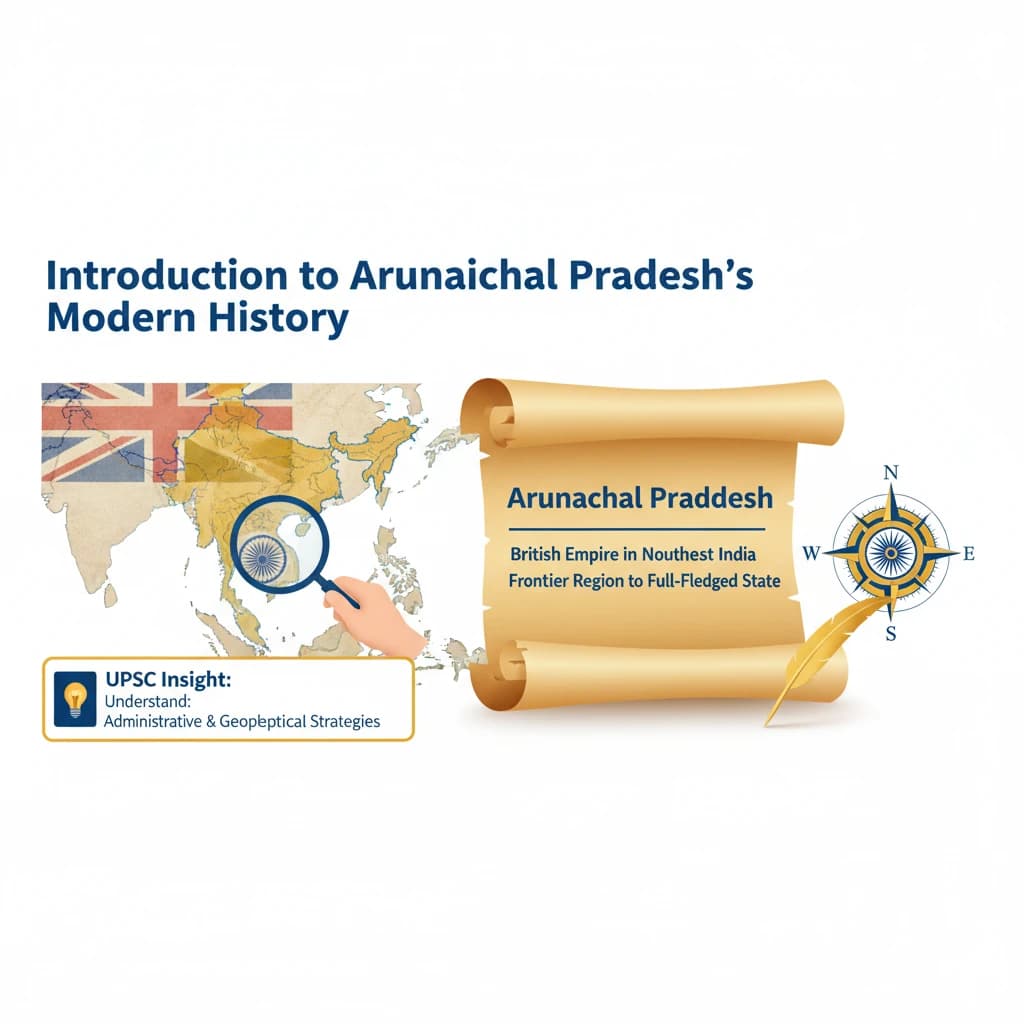
<h4>Introduction to Arunachal Pradesh's Modern History</h4><p>The modern historical narrative of <strong>Arunachal Pradesh</strong> is deeply intertwined with the administrative and geopolitical strategies of the <strong>British Empire</strong> in Northeast India.</p><p>Its journey from a loosely administered frontier region to a full-fledged state reflects significant shifts in regional power dynamics and national policy.</p><div class='exam-tip-box'><p><strong>UPSC Insight:</strong> Understanding the historical evolution of states like Arunachal Pradesh is crucial for <strong>GS Paper I (History)</strong> and <strong>GS Paper II (Polity & Governance)</strong>, especially regarding border issues and federalism.</p></div><h4>British Control and Early Administration</h4><p>The formal commencement of <strong>British control</strong> over the region that would become Arunachal Pradesh began after the <strong>First Anglo-Burmese War</strong>.</p><p>This control was solidified through the signing of the <strong>Treaty of Yandaboo</strong> in <strong>1826</strong>. This treaty marked a pivotal moment, bringing the frontier territories under British influence.</p><div class='info-box'><p><strong>Key Event:</strong> The <strong>Treaty of Yandaboo (1826)</strong> officially ended the <strong>First Anglo-Burmese War</strong>, leading to British annexation of Assam and initiating control over adjacent tribal areas.</p></div><p>Subsequently, by <strong>1838</strong>, the British established the <strong>North East Frontier Agency (NEFA)</strong>. This agency was created to administer the tribal areas along India's northeastern border, including parts of present-day Arunachal Pradesh.</p><h4>The Shimla Treaty and Border Demarcation</h4><p>A significant development in defining the region's boundaries occurred in <strong>1913</strong> with the <strong>Shimla Treaty</strong>. This treaty aimed to establish clear borders in the Himalayan region.</p><p>The <strong>Shimla Treaty</strong> delineated the boundary between <strong>Tibet</strong> and <strong>NEFA</strong>. This boundary, famously known as the <strong>McMahon Line</strong>, was recognized by <strong>China, Tibet</strong>, and the <strong>British rulers</strong> at the time.</p><div class='key-point-box'><p><strong>Important Concept:</strong> The <strong>McMahon Line</strong>, established by the <strong>Shimla Treaty (1913)</strong>, remains a point of contention in India-China relations, highlighting the historical complexities of border demarcation.</p></div><h4>Administrative Evolution: From Assam to Union Territory</h4><p>Prior to <strong>1962</strong>, <strong>Arunachal Pradesh</strong> was constitutionally under the jurisdiction of <strong>Assam</strong>. This meant its administrative affairs were managed by the Assam government.</p><p>However, due to its immense <strong>strategic significance</strong>, especially in the context of border security, the region underwent a crucial administrative transition.</p><p>After <strong>1962</strong>, it was separated from Assam and transitioned into a <strong>Union Territory</strong>, placed under a separate administration directly controlled by the Central Government.</p><h4>Attainment of Full Statehood</h4><p>The final step in its administrative evolution was the attainment of full <strong>statehood</strong>. <strong>Arunachal Pradesh</strong> achieved this milestone on <strong>20th February 1987</strong>.</p><p>It became the <strong>24th state</strong> of the <strong>Indian Union</strong>. This was facilitated through the <strong>55th Constitutional Amendment Act</strong>.</p><div class='info-box'><p><strong>Key Date:</strong> <strong>20th February 1987</strong> – Arunachal Pradesh becomes the <strong>24th state</strong> of India via the <strong>55th Constitutional Amendment</strong>.</p></div><p>This move was consistent with India's national policy of granting <strong>distinct state identities</strong> to significant <strong>tribal regions</strong>, recognizing their unique cultural and administrative needs.</p>
Concept Diagram

💡 Key Takeaways

  • •Arunachal Pradesh's modern history began with British control via the 1826 Treaty of Yandaboo, leading to NEFA's establishment by 1838.
  • •The 1913 Shimla Treaty defined the McMahon Line as the border between Tibet and NEFA, recognized by British, Tibetan, and Chinese authorities.
  • •Before 1962, it was under Assam's jurisdiction; post-1962, it became a Union Territory due to strategic importance.
  • •Achieved full statehood on February 20, 1987, as the 24th state, via the 55th Constitutional Amendment.
  • •Its statehood aligned with national policy to grant distinct identities to tribal regions.

🧠 Memory Techniques

Memory Aid
98% Verified Content

📚 Reference Sources

•NCERT History Textbooks (Class XI & XII)
•Ministry of Home Affairs, Government of India Publications
•The Constitution of India
•Official websites of Arunachal Pradesh Government

Related Topics

Loading related topics...
Explore:History Topics·All Subjects·Daily Current Affairs·Editorial Analysis·Previous Year Questions·UPSC GPT
Arunachal Pradesh: From NEFA to Statehood - A Historical Overview - UPSC History