Loading page, please wait…
Vaidra Logo
Vaidra

Top 4 items + smart groups

UPSC GPT
New
Current Affairs
Daily Solutions
Daily Puzzle
Mains Evaluator

Version 2.0.0 • Built with ❤️ for UPSC aspirants

Loading...
Loading...
Loading...
Loading...
Loading...
Loading...
Loading...
Loading...
Loading...
Loading...
Loading...
Loading...
Loading...
Story of Usha Mehta and Congress Radio - UPSC History
Back
All Subjects

Topics

0 topics • 0 completed

Loading topics...
Loading...
Loading...
Loading...
Loading...
Loading...
Overall Progress0%

Story of Usha Mehta and Congress Radio - UPSC History

What is Story of Usha Mehta and Congress Radio in UPSC History?

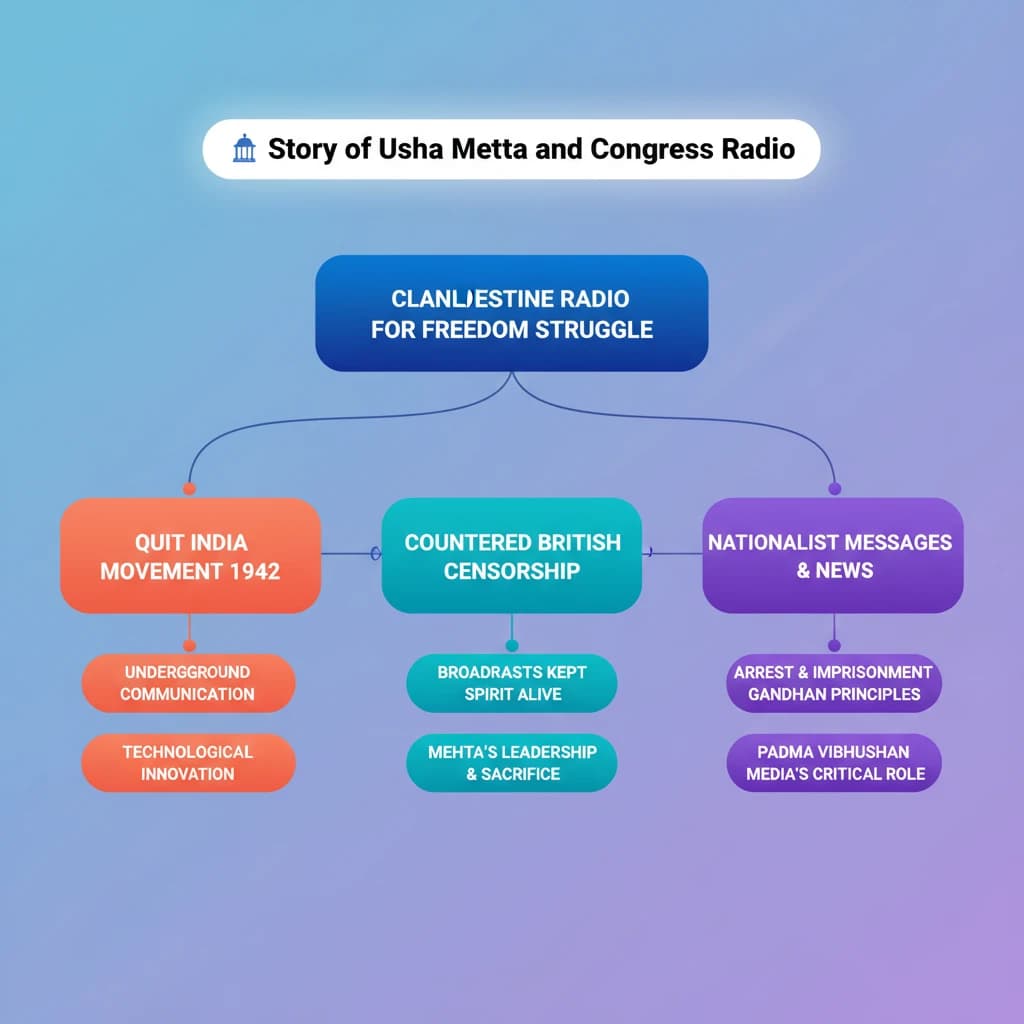
Story of Usha Mehta and Congress Radio is a key topic under History for UPSC Civil Services Examination. Key points include: Usha Mehta was a key figure in the Quit India Movement, establishing the clandestine Congress Radio.. Congress Radio countered British censorship, broadcasting news and nationalist messages to keep the movement alive.. The initiative demonstrated the power of underground communication and technological innovation in resistance.. Understanding this topic is essential for both UPSC Prelims and Mains preparation.

Why is Story of Usha Mehta and Congress Radio important for UPSC exam?

Story of Usha Mehta and Congress Radio is a Medium-level topic in UPSC History. It is tested in both Prelims (factual MCQs) and Mains (analytical answer writing). Previous year UPSC questions have frequently covered aspects of Story of Usha Mehta and Congress Radio, making it essential for comprehensive IAS preparation.

How to prepare Story of Usha Mehta and Congress Radio for UPSC?

To prepare Story of Usha Mehta and Congress Radio for UPSC: (1) Study the comprehensive notes covering all key concepts on Vaidra. (2) Practice previous year questions on this topic. (3) Connect it with current affairs using daily updates. (4) Revise using key takeaways and mind maps available for History. (5) Write practice answers linking Story of Usha Mehta and Congress Radio to related GS Paper topics.

Key takeaways of Story of Usha Mehta and Congress Radio for UPSC

  • Usha Mehta was a key figure in the Quit India Movement, establishing the clandestine Congress Radio.
  • Congress Radio countered British censorship, broadcasting news and nationalist messages to keep the movement alive.
  • The initiative demonstrated the power of underground communication and technological innovation in resistance.
  • Mehta faced arrest and imprisonment but remained committed to Gandhian principles, earning the Padma Vibhushan.
  • Her story highlights the sacrifices of individuals and the critical role of media in India's freedom struggle.
Story of Usha Mehta and Congress Radio

Story of Usha Mehta and Congress Radio

Medium⏱️ 7 min read✓ 98% Verified
history

📖 Introduction

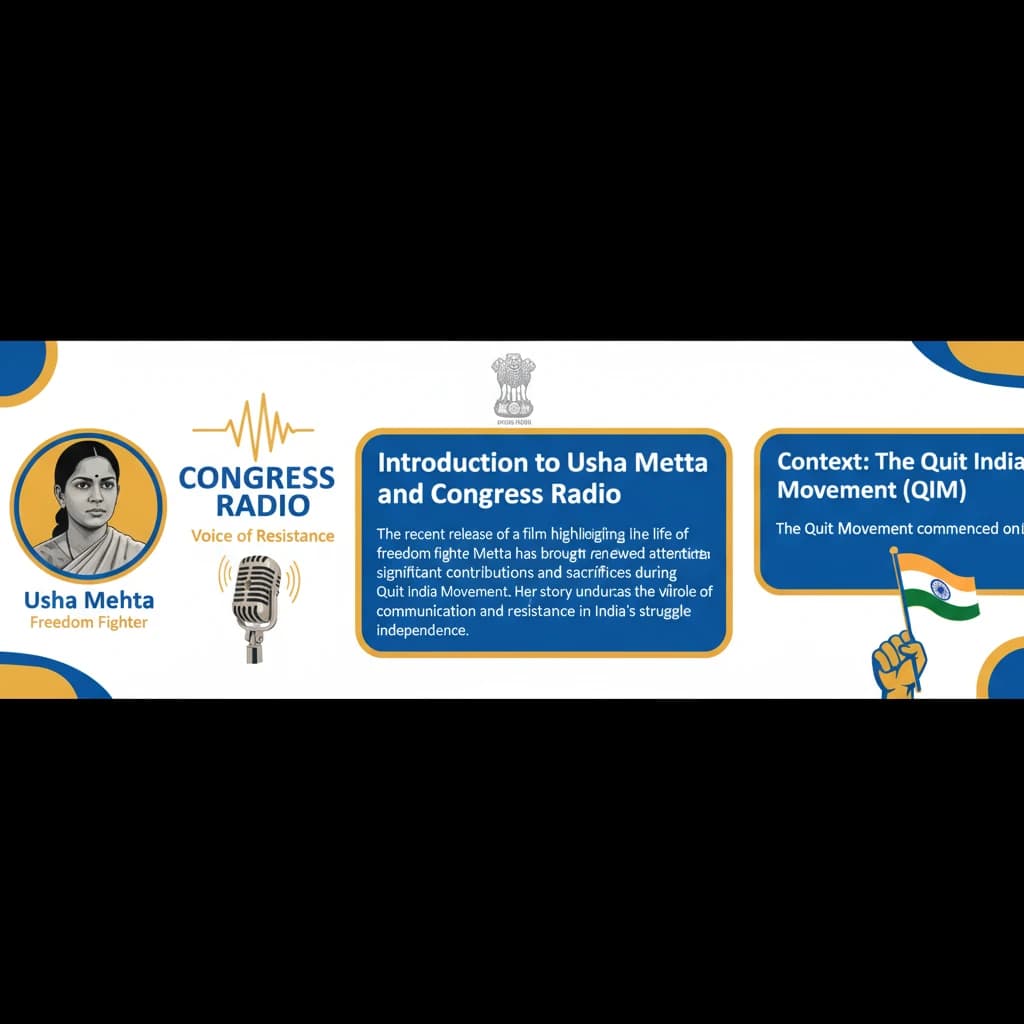
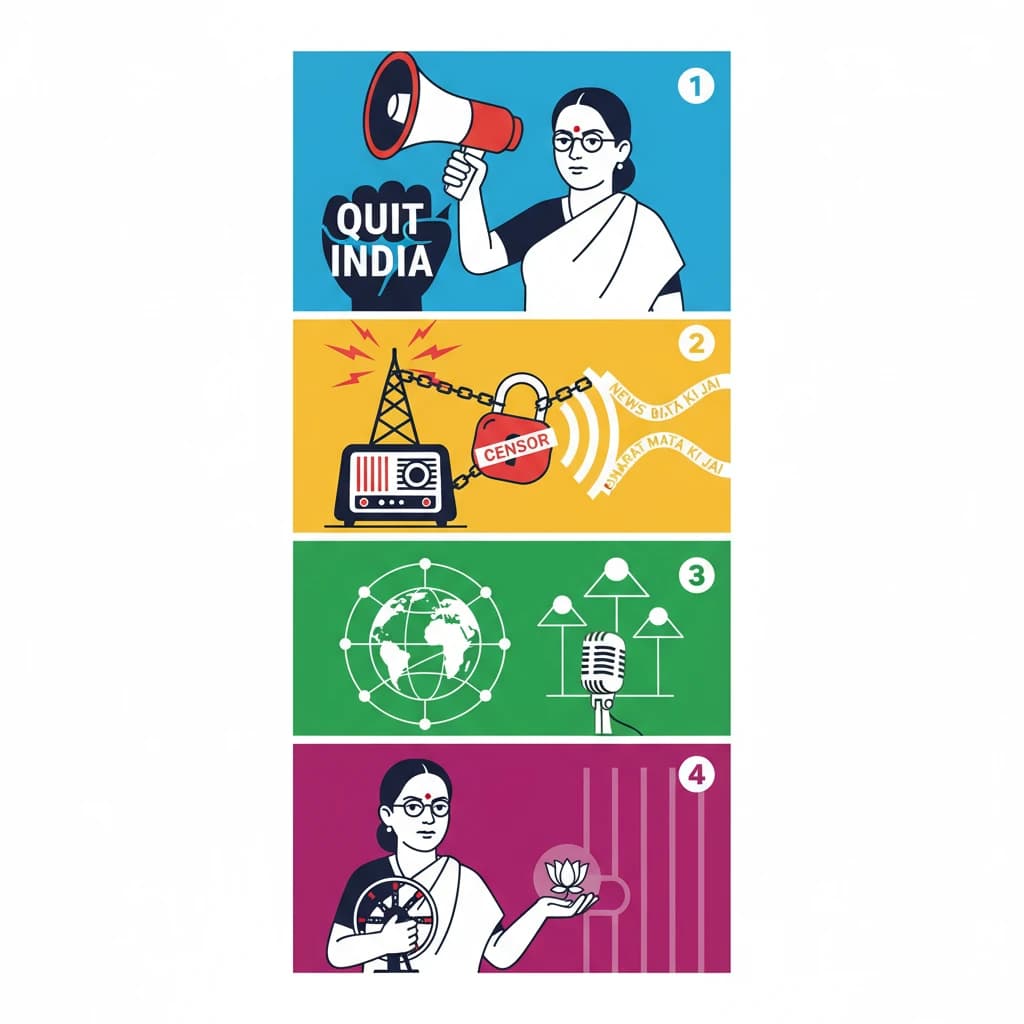
<h4>Introduction to Usha Mehta and Congress Radio</h4><p>The recent release of a film highlighting the life of freedom fighter <strong>Usha Mehta</strong> has brought renewed attention to her significant contributions and sacrifices during the <strong>Quit India Movement</strong>.</p><p>Her story underscores the vital role of communication and resistance in India's struggle for independence.</p><h4>Context: The Quit India Movement (QIM)</h4><p>The <strong>Quit India Movement</strong> commenced on <strong>August 8, 1942</strong>, following <strong>Mahatma Gandhi's</strong> powerful call to action with the iconic slogan <strong>'Do or Die'</strong>. This movement marked a period of widespread <strong>mass civil disobedience</strong> and nationwide protests.</p><p>It also saw the establishment of various <strong>parallel governance structures</strong> across the country, signifying a strong defiance against British rule.</p><div class='info-box'><p><strong>Key Event:</strong> The <strong>Quit India Movement</strong> began on <strong>August 8, 1942</strong>.</p><p><strong>Slogan:</strong> <strong>'Do or Die'</strong>, given by <strong>Mahatma Gandhi</strong>.</p></div><p>In response, <strong>British authorities</strong> initiated a massive crackdown, leading to the mass arrests of prominent leaders including <strong>Gandhi</strong>, <strong>Jawaharlal Nehru</strong>, and <strong>Sardar Patel</strong>. This severely impacted the movement's initial intensity.</p><h4>Usha Mehta's Pivotal Role in QIM</h4><p><strong>Usha Mehta</strong>, then a spirited <strong>22-year-old law student</strong>, was deeply inspired by <strong>Gandhian ideology</strong>. She chose to abandon her studies to actively participate in the independence movement.</p><div class='key-point-box'><p><strong>Usha Mehta's Vision:</strong> Recognizing the critical need to disseminate information and counter colonial censorship, <strong>Mehta</strong> conceived the idea of establishing <strong>Congress Radio</strong> as a clandestine means of communication.</p></div><h4>Establishment of Congress Radio</h4><p>Setting up <strong>Congress Radio</strong> presented numerous challenges, particularly in securing adequate funding and technical expertise. <strong>Mehta</strong>, alongside dedicated associates like <strong>Nanikram Printer</strong>, worked tirelessly to bring this vision to fruition.</p><p>Despite stringent regulatory restrictions imposed by the <strong>British authorities</strong>, <strong>Nanikram Printer's</strong> technical prowess was instrumental in creating a functional transmitter. This allowed <strong>Congress Radio's</strong> inaugural broadcast on <strong>September 3, 1942</strong>.</p><div class='info-box'><p><strong>First Broadcast:</strong> <strong>Congress Radio</strong> went on air on <strong>September 3, 1942</strong>.</p><p><strong>Key Associate:</strong> <strong>Nanikram Printer</strong>, for technical expertise.</p></div><h4>Catalysing Independence Through Broadcasts</h4><p><strong>Congress Radio</strong> quickly became a crucial and reliable source of news for Indians, effectively bypassing <strong>colonial censorship</strong>. It played a significant role in disseminating vital information regarding the progress of the <strong>Quit India Movement</strong>.</p><p>Beyond news, the station also broadcasted powerful <strong>political speeches</strong> and ideological messages. These transmissions were instrumental in strengthening the people's resolve and dedication towards achieving independence.</p><div class='exam-tip-box'><p><strong>UPSC Insight:</strong> The role of <strong>underground media</strong> like <strong>Congress Radio</strong> is crucial for understanding the diverse strategies employed during the <strong>Freedom Struggle</strong>, especially in <strong>GS Paper I (Modern Indian History)</strong>.</p></div><h4>Legal Consequences and Mehta's Enduring Legacy</h4><p>The covert operations of <strong>Congress Radio</strong> eventually drew the attention of the <strong>British authorities</strong>. This led to the arrest and subsequent trial of <strong>Usha Mehta</strong> and her associates.</p><p>Revered as <strong>'Radio-ben'</strong> for her pioneering efforts, <strong>Mehta</strong> continued to embody <strong>Gandhian principles</strong> even after India gained independence. Her unwavering commitment earned her national recognition, including the prestigious <strong>Padma Vibhushan</strong> in <strong>1998</strong>.</p>
Concept Diagram

💡 Key Takeaways

  • •Usha Mehta was a key figure in the Quit India Movement, establishing the clandestine Congress Radio.
  • •Congress Radio countered British censorship, broadcasting news and nationalist messages to keep the movement alive.
  • •The initiative demonstrated the power of underground communication and technological innovation in resistance.
  • •Mehta faced arrest and imprisonment but remained committed to Gandhian principles, earning the Padma Vibhushan.
  • •Her story highlights the sacrifices of individuals and the critical role of media in India's freedom struggle.

🧠 Memory Techniques
Memory Aid
98% Verified Content

📚 Reference Sources

•General historical accounts of the Quit India Movement
•Biographical information on Usha Mehta

Related Topics

Loading related topics...
Explore:History Topics·All Subjects·Daily Current Affairs·Editorial Analysis·Previous Year Questions·UPSC GPT