Loading page, please wait…
Vaidra Logo
Vaidra

Top 4 items + smart groups

UPSC GPT
New
Current Affairs
Daily Solutions
Daily Puzzle
Mains Evaluator

Version 2.0.0 • Built with ❤️ for UPSC aspirants

Loading...
Loading...
Loading...
Loading...
Loading...
Loading...
Loading...
Loading...
Loading...
Loading...
Loading...
Loading...
Loading...
Copper Plates Discovered From Vijaynagara Kingdom - UPSC History
Back
All Subjects

Topics

0 topics • 0 completed

Loading topics...
Loading...
Loading...
Loading...
Loading...
Loading...
Overall Progress0%

Copper Plates Discovered From Vijaynagara Kingdom - UPSC History

What is Copper Plates Discovered From Vijaynagara Kingdom in UPSC History?

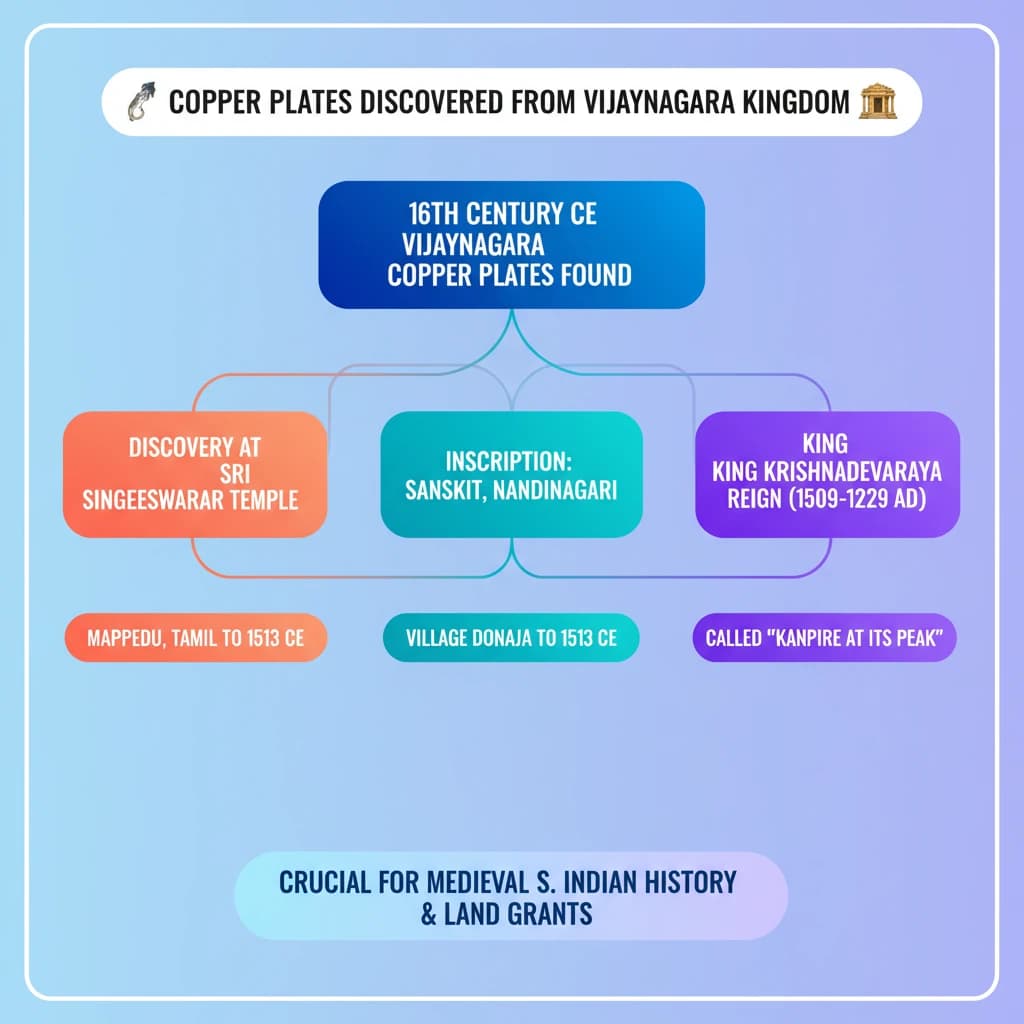
Copper Plates Discovered From Vijaynagara Kingdom is a key topic under History for UPSC Civil Services Examination. Key points include: 16th Century CE copper plates from the Vijayanagara Kingdom were discovered at Sri Singeeswarar temple, Mappedu, Tamil Nadu.. The inscription, in Sanskrit and Nandinagari script, records a village donation to Brahmins by the Raja of Chandragiri.. It was engraved in 1513 CE during the reign of King Krishnadevaraya (1509-1529 AD).. Understanding this topic is essential for both UPSC Prelims and Mains preparation.

Why is Copper Plates Discovered From Vijaynagara Kingdom important for UPSC exam?

Copper Plates Discovered From Vijaynagara Kingdom is a Medium-level topic in UPSC History. It is tested in both Prelims (factual MCQs) and Mains (analytical answer writing). Previous year UPSC questions have frequently covered aspects of Copper Plates Discovered From Vijaynagara Kingdom, making it essential for comprehensive IAS preparation.

How to prepare Copper Plates Discovered From Vijaynagara Kingdom for UPSC?

To prepare Copper Plates Discovered From Vijaynagara Kingdom for UPSC: (1) Study the comprehensive notes covering all key concepts on Vaidra. (2) Practice previous year questions on this topic. (3) Connect it with current affairs using daily updates. (4) Revise using key takeaways and mind maps available for History. (5) Write practice answers linking Copper Plates Discovered From Vijaynagara Kingdom to related GS Paper topics.

Key takeaways of Copper Plates Discovered From Vijaynagara Kingdom for UPSC

  • 16th Century CE copper plates from the Vijayanagara Kingdom were discovered at Sri Singeeswarar temple, Mappedu, Tamil Nadu.
  • The inscription, in Sanskrit and Nandinagari script, records a village donation to Brahmins by the Raja of Chandragiri.
  • It was engraved in 1513 CE during the reign of King Krishnadevaraya (1509-1529 AD).
  • Krishnadevaraya, known as "Kannadaraya," was a pivotal ruler of medieval South India, leading the Vijayanagara Empire to its peak.
  • These discoveries are crucial for understanding medieval South Indian history, administration, and the practice of land grants.
Copper Plates Discovered From Vijaynagara Kingdom

Copper Plates Discovered From Vijaynagara Kingdom

Medium⏱️ 7 min read✓ 98% Verified
history

📖 Introduction

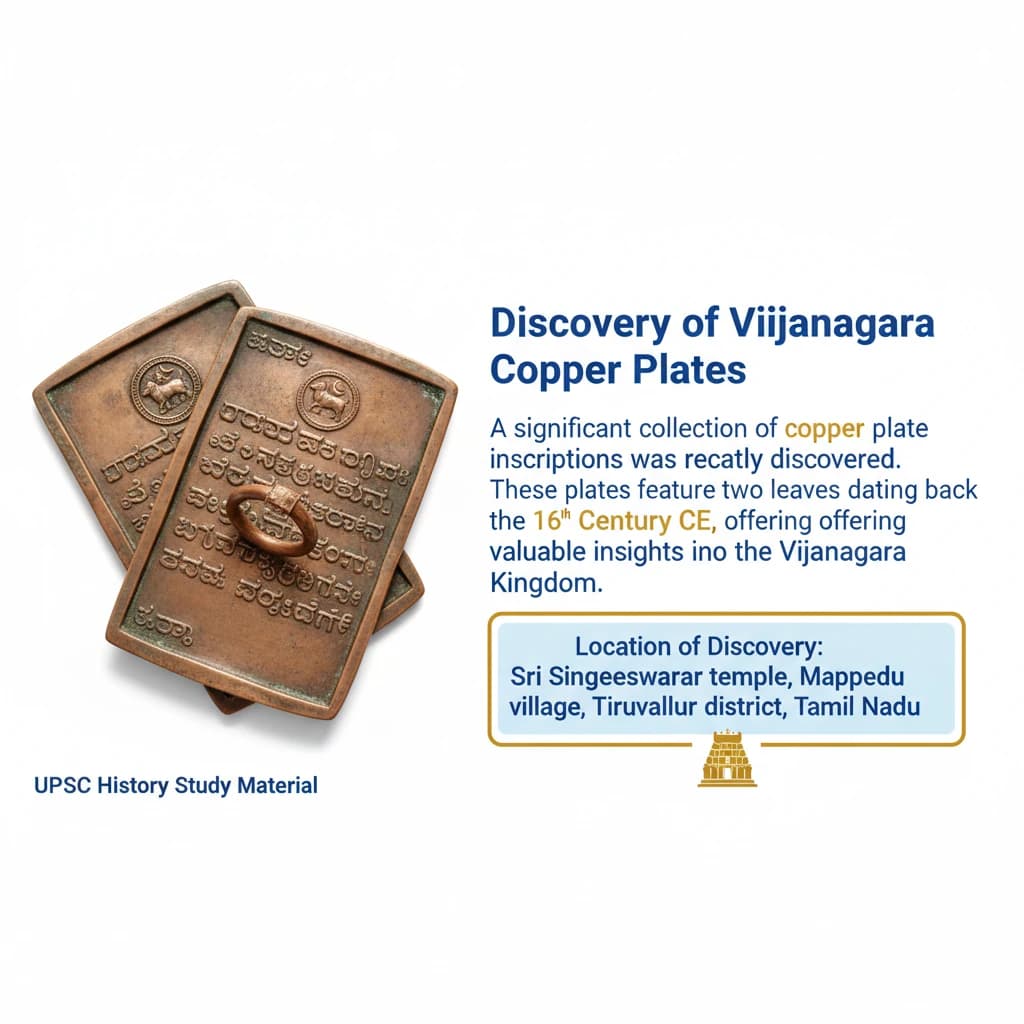
<h4>Discovery of Vijayanagara Copper Plates</h4><p>A significant collection of <strong>copper plate inscriptions</strong> was recently discovered. These plates feature two leaves dating back to the <strong>16th Century CE</strong>, offering valuable insights into the <strong>Vijayanagara Kingdom</strong>.</p><div class='info-box'><p><strong>Location of Discovery:</strong> Sri Singeeswarar temple, <strong>Mappedu village</strong>, <strong>Tiruvallur district</strong>, <strong>Tamil Nadu</strong>.</p></div><p>The two leaves of the copper plates were meticulously strung together using a ring. This ring prominently featured the distinct <strong>seal of the Vijayanagara kingdom</strong>, authenticating their origin.</p><h4>Details of the Inscription</h4><p>The inscription itself details the <strong>donation of a village to Brahmins</strong>. This grant was made by the <strong>Raja of Chandragiri</strong>, a significant figure within the broader Vijayanagara political landscape.</p><div class='info-box'><p><strong>Language:</strong> <strong>Sanskrit</strong><br><strong>Script:</strong> <strong>Nandinagari</strong><br><strong>Engraving Year:</strong> <strong>1513 CE</strong></p></div><p>The engraving date of <strong>1513 CE</strong> places this inscription firmly within the glorious reign of <strong>King Krishnadevaraya</strong>, one of the most celebrated rulers of the Vijayanagara Empire.</p><h4>King Krishnadevaraya: A Pivotal Ruler</h4><p><strong>King Krishnadevaraya</strong> ruled the powerful <strong>Vijayanagara Kingdom</strong> for two decades. His reign is often considered the zenith of the empire's power and cultural flourishing.</p><div class='info-box'><p><strong>Reign Period:</strong> <strong>1509 to 1529 AD</strong></p></div><p>He was adorned with several prestigious titles, reflecting his stature and influence. These titles highlight his dominion and cultural patronage.</p><ul><li><strong>Kannadaraya</strong></li><li><strong>Kannada Rajya Ramaramana</strong></li></ul><div class='key-point-box'><p><strong>Krishnadevaraya</strong> is widely regarded as one of the <strong>greatest emperors in Indian history</strong>. He stands as one of the most significant rulers of <strong>medieval South India</strong>, known for his administrative acumen, military prowess, and literary patronage.</p></div><h4>Successors to Krishnadevaraya</h4><p>Following the illustrious reign of <strong>Krishnadevaraya</strong>, the Vijayanagara throne saw a succession of rulers. These transitions marked different phases in the empire's history.</p><ol><li>In <strong>1530 AD</strong>, <strong>Achyuta Raya</strong> succeeded Krishnadevaraya.</li><li>Subsequently, in <strong>1542 AD</strong>, <strong>Sada Siva Raya</strong> took over the reins of the empire.</li></ol><div class='exam-tip-box'><p>Understanding the chronology of rulers and the significance of their reigns, like that of <strong>Krishnadevaraya</strong>, is crucial for <strong>UPSC Prelims (GS Paper 1)</strong>. Questions often test knowledge of key figures and their contributions to Indian history.</p></div>
Concept Diagram

💡 Key Takeaways

  • •16th Century CE copper plates from the Vijayanagara Kingdom were discovered at Sri Singeeswarar temple, Mappedu, Tamil Nadu.
  • •The inscription, in Sanskrit and Nandinagari script, records a village donation to Brahmins by the Raja of Chandragiri.
  • •It was engraved in 1513 CE during the reign of King Krishnadevaraya (1509-1529 AD).
  • •Krishnadevaraya, known as "Kannadaraya," was a pivotal ruler of medieval South India, leading the Vijayanagara Empire to its peak.
  • •These discoveries are crucial for understanding medieval South Indian history, administration, and the practice of land grants.

🧠 Memory Techniques

Memory Aid
98% Verified Content

📚 Reference Sources

•NCERT Textbooks on Ancient and Medieval Indian History
•Standard academic texts on the Vijayanagara Empire and South Indian Epigraphy

Related Topics

Loading related topics...
Explore:History Topics·All Subjects·Daily Current Affairs·Editorial Analysis·Previous Year Questions·UPSC GPT