Loading page, please wait…
Vaidra Logo
Vaidra

Top 4 items + smart groups

UPSC GPT
New
Current Affairs
Daily Solutions
Daily Puzzle
Mains Evaluator

Version 2.0.0 • Built with ❤️ for UPSC aspirants

Loading...
Loading...
Loading...
Loading...
Loading...
Loading...
Loading...
Loading...
Loading...
Loading...
Loading...
Loading...
Loading...
Back
All Subjects

Topics

0 topics • 0 completed

Loading topics...
Loading...
Loading...
Loading...
Loading...
Loading...
Overall Progress0%

Harappan Crafts: Bronze, Textiles, Pottery, and Jewellery - UPSC History

What is Harappan Crafts: Bronze, Textiles, Pottery, and Jewellery in UPSC History?

Harappan Crafts: Bronze, Textiles, Pottery, and Jewellery is a key topic under History for UPSC Civil Services Examination. Key points include: Harappans were highly skilled in diverse crafts, including bronze manufacturing, textiles, pottery, bead-making, and seal-making.. Bronze production relied on copper from Khetri (Rajasthan) and tin likely from Afghanistan.. Evidence of weaving comes from textile impressions on objects.. Understanding this topic is essential for both UPSC Prelims and Mains preparation.

Why is Harappan Crafts: Bronze, Textiles, Pottery, and Jewellery important for UPSC exam?

Harappan Crafts: Bronze, Textiles, Pottery, and Jewellery is a Easy-level topic in UPSC History. It is tested in both Prelims (factual MCQs) and Mains (analytical answer writing). Previous year UPSC questions have frequently covered aspects of Harappan Crafts: Bronze, Textiles, Pottery, and Jewellery, making it essential for comprehensive IAS preparation.

How to prepare Harappan Crafts: Bronze, Textiles, Pottery, and Jewellery for UPSC?

To prepare Harappan Crafts: Bronze, Textiles, Pottery, and Jewellery for UPSC: (1) Study the comprehensive notes covering all key concepts on Vaidra. (2) Practice previous year questions on this topic. (3) Connect it with current affairs using daily updates. (4) Revise using key takeaways and mind maps available for History. (5) Write practice answers linking Harappan Crafts: Bronze, Textiles, Pottery, and Jewellery to related GS Paper topics.

Key takeaways of Harappan Crafts: Bronze, Textiles, Pottery, and Jewellery for UPSC

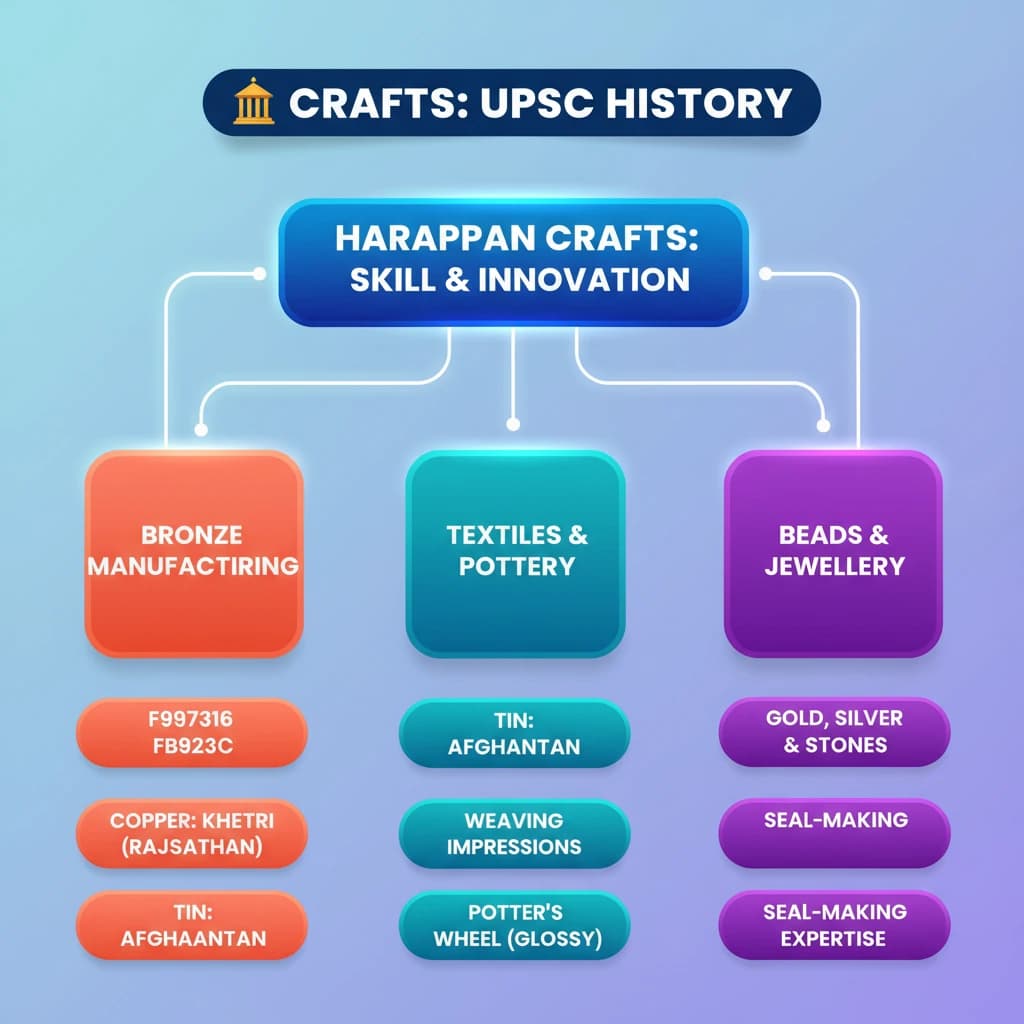
  • Harappans were highly skilled in diverse crafts, including bronze manufacturing, textiles, pottery, bead-making, and seal-making.
  • Bronze production relied on copper from Khetri (Rajasthan) and tin likely from Afghanistan.
  • Evidence of weaving comes from textile impressions on objects.
  • Goldsmiths created jewellery from gold, silver, and precious stones.
  • The potter's wheel was widely used, producing distinctive, glossy pottery.
Harappan Crafts: Bronze, Textiles, Pottery, and Jewellery

Harappan Crafts: Bronze, Textiles, Pottery, and Jewellery

Easy⏱️ 5 min read✓ 98% Verified
history

📖 Introduction

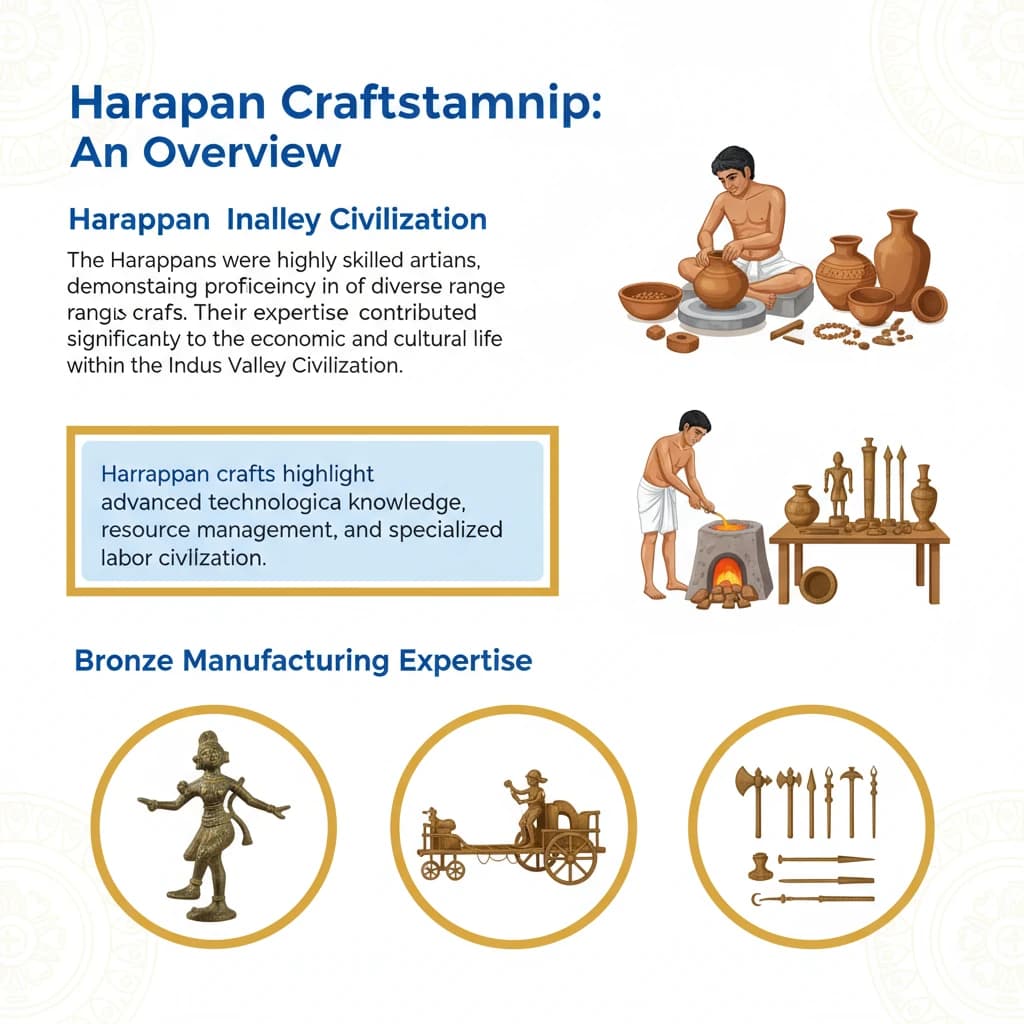
<h4>Harappan Craftsmanship: An Overview</h4><p>The <strong>Harappans</strong> were highly skilled artisans, demonstrating proficiency in a diverse range of crafts. Their expertise contributed significantly to the economic and cultural life of the <strong>Indus Valley Civilization</strong>.</p><div class='key-point-box'><p>Harappan crafts highlight advanced technological knowledge, resource management, and specialized labor within the civilization.</p></div><h4>Bronze Manufacturing Expertise</h4><p>One of the most notable skills of the Harappans was their mastery of <strong>bronze manufacturing</strong>. This involved sophisticated metallurgical techniques to create various tools, weapons, and artistic objects.</p><div class='info-box'><ul><li><strong>Copper Source:</strong> Primarily obtained from the <strong>Khetri mines</strong> in <strong>Rajasthan</strong>.</li><li><strong>Tin Source:</strong> Believed to have been imported, possibly from <strong>Afghanistan</strong>.</li></ul></div><p>The availability and strategic procurement of these raw materials were crucial for their bronze industry.</p><h4>Textile Production and Weaving</h4><p>Evidence suggests that the Harappans possessed knowledge of <strong>textile production</strong> and <strong>weaving</strong>. While direct textile remnants are rare due to preservation challenges, indirect evidence points to this skill.</p><div class='info-box'><p><strong>Textile impressions</strong> found on various objects, such as seals and pottery, provide crucial clues about their weaving capabilities and the types of fabrics produced.</p></div><h4>Diverse Range of Key Crafts</h4><p>Beyond metallurgy and textiles, the Harappan civilization supported a wide array of specialized crafts. These industries catered to both utilitarian needs and aesthetic preferences of the populace.</p><ul><li><strong>Boat-making:</strong> Essential for riverine and coastal trade and transportation.</li><li><strong>Bead-making:</strong> Produced intricate beads from various materials, highly valued for ornamentation.</li><li><strong>Seal-making:</strong> Involved carving unique seals, primarily for administrative and trade purposes.</li><li><strong>Terracotta Production:</strong> Widespread use of baked clay for figurines, toys, and other objects.</li></ul><h4>Goldsmithery and Jewellery</h4><p><strong>Goldsmiths</strong> were prominent craftsmen, creating exquisite ornaments. Their work reflects a high degree of artistic skill and an understanding of precious materials.</p><div class='info-box'><p>Harappan jewellery was fashioned from a variety of valuable materials, including <strong>gold</strong>, <strong>silver</strong>, and various types of <strong>precious stones</strong>.</p></div><h4>Advanced Pottery Techniques</h4><p>Pottery was a ubiquitous craft, with the <strong>potter’s wheel</strong> being widely employed. This technology allowed for efficient and standardized production of ceramic wares.</p><div class='info-box'><p>Harappan pottery is distinctive for its <strong>glossy finish</strong> and diverse forms, indicating advanced firing techniques and aesthetic sensibilities.</p></div><div class='exam-tip-box'><p>Understanding the variety and sophistication of Harappan crafts is vital for questions on the <strong>economic life</strong>, <strong>technological advancements</strong>, and <strong>artistic expressions</strong> of the Indus Valley Civilization in <strong>UPSC Prelims</strong> and <strong>Mains (GS Paper I)</strong>.</p></div>
Concept Diagram

💡 Key Takeaways

  • •Harappans were highly skilled in diverse crafts, including bronze manufacturing, textiles, pottery, bead-making, and seal-making.
  • •Bronze production relied on copper from Khetri (Rajasthan) and tin likely from Afghanistan.
  • •Evidence of weaving comes from textile impressions on objects.
  • •Goldsmiths created jewellery from gold, silver, and precious stones.
  • •The potter's wheel was widely used, producing distinctive, glossy pottery.

🧠 Memory Techniques
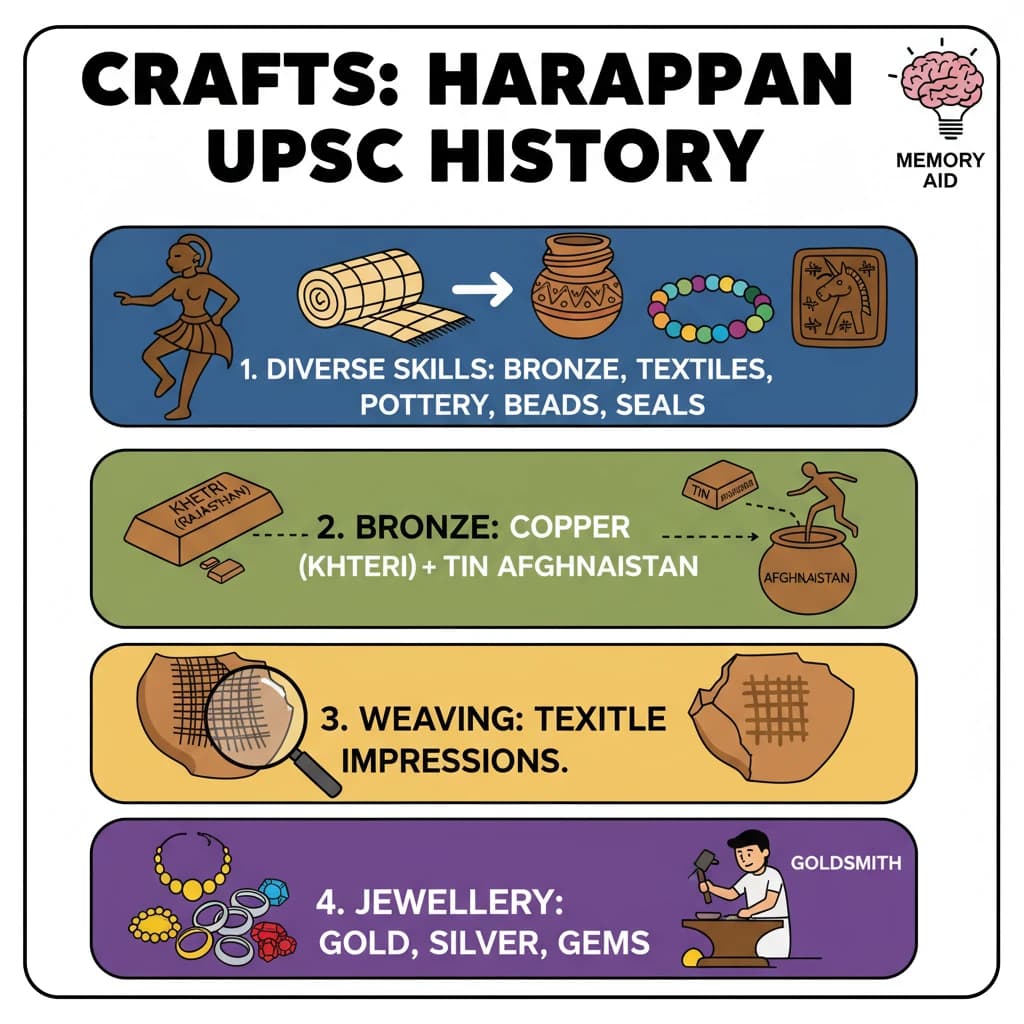
Memory Aid
98% Verified Content

Related Topics

Loading related topics...
Explore:History Topics·All Subjects·Daily Current Affairs·Editorial Analysis·Previous Year Questions·UPSC GPT
Harappan Crafts: Bronze, Textiles, Pottery, and Jewellery - UPSC History